


More news on this day
Delta Air Lines says its automated weight-and-balance system is back online after a Sunday outage triggered widespread delays at Hartsfield-Jackson Atlanta International Airport and across its network on November 22, disrupting Thanksgiving week travel just days after a separate nationwide ground stop by U.S. air regulators.
Get the latest news straight to your inbox!
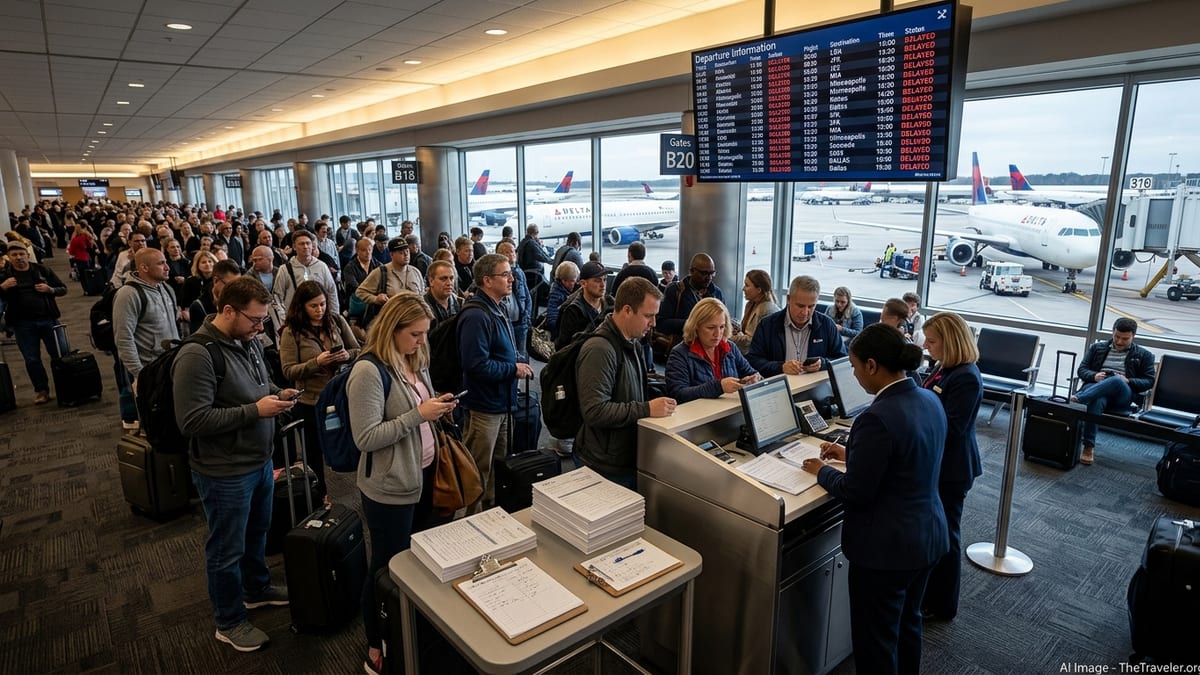
What happened to Delta’s system on November 22
Delta confirmed on Sunday 22 November 2026 that a problem with its automated system for calculating aircraft weight and balance delayed departures across its operation. The system helps determine how passengers, baggage, cargo and fuel are distributed on each aircraft, information that is required before a flight can safely depart. The airline said teams switched to manual workarounds while the automated tools were restored.
The carrier said approximately 70% of delays and cancellations recorded for Delta and its Delta Connection affiliates on Sunday were linked to this automation issue, with the remainder attributed to poor weather and knock-on air traffic control constraints, particularly in the New York City area and the broader Northeast. Delta stressed that the disruption did not involve Federal Aviation Administration air traffic control systems and was confined to its own operations.
Public data from flight-tracking services shows the scale of the impact. By early Sunday evening, FlightAware reported close to 1,250 delayed flights in and out of Hartsfield-Jackson Atlanta International Airport across all airlines, with Delta accounting for a significant share. Separate aggregated figures indicate that around 2,000 Delta flights, representing more than half of the airline’s global schedule that day, were operating late.
Ground stop, ground delay and how operations unraveled
The Federal Aviation Administration placed a ground stop on some Delta flights heading to Atlanta on the morning of 22 November, according to FAA advisories. A ground stop requires flights bound for a specific airport to remain at their departure points until airspace and airport conditions improve. In this case, the measure applied to Delta and its regional carriers flying into Hartsfield-Jackson from within the contiguous United States and was later downgraded to a ground delay program.
Under the ground delay, flights into Atlanta were issued controlled departure times, typically adding close to an hour to planned departure schedules from outstations. As departures from Atlanta also slowed while crews completed weight-and-balance calculations manually, gates turned over more slowly. That meant arriving aircraft in some cases had to wait for available gates, pushing delays later into the day as the effects rippled through the schedule.
Hartsfield-Jackson officials said the disruption was limited to Delta and did not affect the airport’s overall operations or runways. However, Delta’s role as the dominant carrier at the airport meant that the outage effectively translated into visible congestion in concourses and gate areas used by the airline. FAA data show the initial ground stop beginning around 13:00 UTC and lasting about an hour before evolving into a delay program, consistent with the airline’s shift to manual procedures.
Network-wide impact and how long it lasted
Delta operates its largest hub in Atlanta and had about 5,000 mainline and Delta Connection flights scheduled on Sunday, according to the airline. The automation outage primarily affected flights into and out of Atlanta but also had knock-on effects elsewhere as aircraft and crew rotated through the network. Passengers reported delays on Delta flights across major U.S. airports including New York LaGuardia, Newark, Washington Reagan National, Washington Dulles, Boston, Baltimore, Miami, Minneapolis, Nashville, San Antonio and Birmingham.
In some locations, passengers and pilots reported that weight-and-balance data had to be calculated manually and relayed by dispatch before pushback, leading to delays of 30 to 60 minutes even on flights that were not touching Atlanta. Social media posts and passenger accounts described crews explaining that the airline’s weight-and-balance software was offline or that they were “waiting on numbers” from dispatch, consistent with Delta’s description of a technology outage affecting that specific system.
By late Sunday, Delta said its automated system was again functioning and that operations were stabilizing. On Monday 23 November, local media at Hartsfield-Jackson reported that the carrier’s operation was largely returning to normal, although some residual delays remained as aircraft and crews were repositioned. Flight-tracking data also show a substantial reduction in Delta delays and cancellations on Monday compared with the peak levels recorded on Sunday.
Disruption for travelers and what Delta is offering
Delta apologized publicly for the disruption and said it was rebooking affected travelers onto the next available flights. For customers facing long waits or missed connections, the airline said it was providing meal vouchers and hotel accommodation where required under its existing customer service commitments. Delta has reiterated that customers whose flights were canceled and who chose not to travel are entitled to refunds.
For many passengers, the timing compounded the impact. The outage occurred at the start of Thanksgiving week in the United States, traditionally one of the busiest travel periods of the year. Some travelers reported multi-hour delays or missed onward plans, while others were able to depart after more modest delays once manual calculations were completed. As of Monday afternoon, flight trackers showed only a fraction of the previous day’s cancellations and delays on Delta, indicating that most stranded travelers had been accommodated on later services.
Consumer advocates note that, under U.S. Department of Transportation rules, airlines are required to refund the ticket price for canceled flights when passengers choose not to travel, but compensation for delays is not mandated at the federal level. Each airline maintains its own policies for providing meals, hotels or travel credits in cases of extensive disruption. Delta has said in connection with Sunday’s outage that it is following its standard policies for irregular operations.
How this compares with the recent FAA nationwide ground stop
Sunday’s Delta-specific technology problem came less than ten days after a rare nationwide ground stop declared by the Federal Aviation Administration on Friday 13 November. In that earlier incident, a communications failure affecting parts of the FAA’s air traffic network led the agency to temporarily halt departures across the United States while safety systems were checked and restored. U.S. airlines, including Delta, canceled and delayed thousands of flights as a result of the FAA order.
Investigators reviewing the nationwide ground stop have pointed to problems with newly installed network hardware within the FAA’s communications infrastructure as a likely factor, although the agency has said that a final determination of cause is still pending. That disruption ended within hours, but its effects continued into the following weekend as airlines repositioned aircraft and crews and worked through backlogs of displaced passengers.
By contrast, the 22 November issue was confined to Delta’s internal weight-and-balance system and did not trigger any broad restrictions on other carriers. However, because Hartsfield-Jackson is one of the world’s busiest airports and Delta’s primary hub, the practical impact on many domestic travelers was significant. For passengers who had already experienced delays or rebookings after the FAA ground stop, Sunday’s airline-specific outage represented a second disruption in as many weekends.
What travelers should do next and how to prepare
Delta says it is focused on completing its schedule and using cancellations only as a last resort as it continues to work through any remaining effects from Sunday’s outage. Travelers booked on Delta and Delta Connection flights in the days following 22 November are being advised to check their flight status frequently using the airline’s website or mobile app before heading to the airport. Same-day schedule adjustments remain possible if aircraft or crews are out of position as a result of the earlier delays.
Passengers whose travel on or after 22 November was affected by cancellations should verify whether they are eligible for a refund, even if they have already been rebooked and decide not to fly. Those who experienced significant delays may also wish to review Delta’s Customer Commitment and irregular operations policies for potential vouchers, overnight accommodation or meal support that may not be issued automatically in every case, particularly where delays stretched late into the evening.
With peak Thanksgiving travel days still ahead, both the FAA and major U.S. airlines are under pressure to demonstrate that they can manage demand while minimizing further disruptions. While there is no indication from authorities that Sunday’s Delta outage will have continuing technical effects, travelers planning to connect through major hubs such as Atlanta in the coming days may want to build in extra time for connections, monitor weather forecasts and keep flexible arrangements for ground transportation and accommodation where possible.