


More news on this day
Delta Air Lines says it has restored an automated system that calculates aircraft weight and balance after a malfunction on Sunday, November 22, triggered widespread flight delays just days before the busy US Thanksgiving travel period, but schedules at the carrier’s Atlanta hub and across its network have yet to fully return to normal.
Get the latest news straight to your inbox!
What happened to Delta’s automation system
Delta’s latest disruption began on Sunday morning, November 22, when an automated system used to calculate aircraft weight and balance stopped functioning correctly. The tool helps ensure each aircraft’s load, including passengers, baggage, cargo and fuel, stays within safe limits for takeoff. According to multiple statements cited by US media, Delta said the malfunction forced its operations teams to fall back on manual workarounds while technicians worked to restore the system.
The airline has not published a detailed technical explanation of the malfunction, but coverage from the Associated Press and other outlets describes the problem as an internal automation failure, rather than an issue with Federal Aviation Administration equipment or a broader external outage. Delta said around 70% of the delays and cancellations reported on Sunday were directly linked to the weight-and-balance automation problem, with the remainder caused by poor weather, including rain and low clouds affecting parts of the East Coast and Southeast.
By Sunday afternoon, Delta said the automation system had been restored and that flight operations were gradually stabilizing. However, because many aircraft and crews were left out of position after hours of disruption, the airline acknowledged that knock-on effects would persist into Monday and possibly beyond, especially at its largest hub, Hartsfield-Jackson Atlanta International Airport.
Scale of the disruption across Delta’s network
Data from flight-tracking services cited by several news outlets show that about 2,000 Delta flights were delayed on Sunday, November 22, with delays affecting roughly half of the airline’s schedule at the height of the outage. Some regional and mainline departures were held at gates while dispatchers worked through manual calculations, and inbound flights bound for Atlanta were briefly paused at Delta’s request under a ground-delay program administered by the FAA.
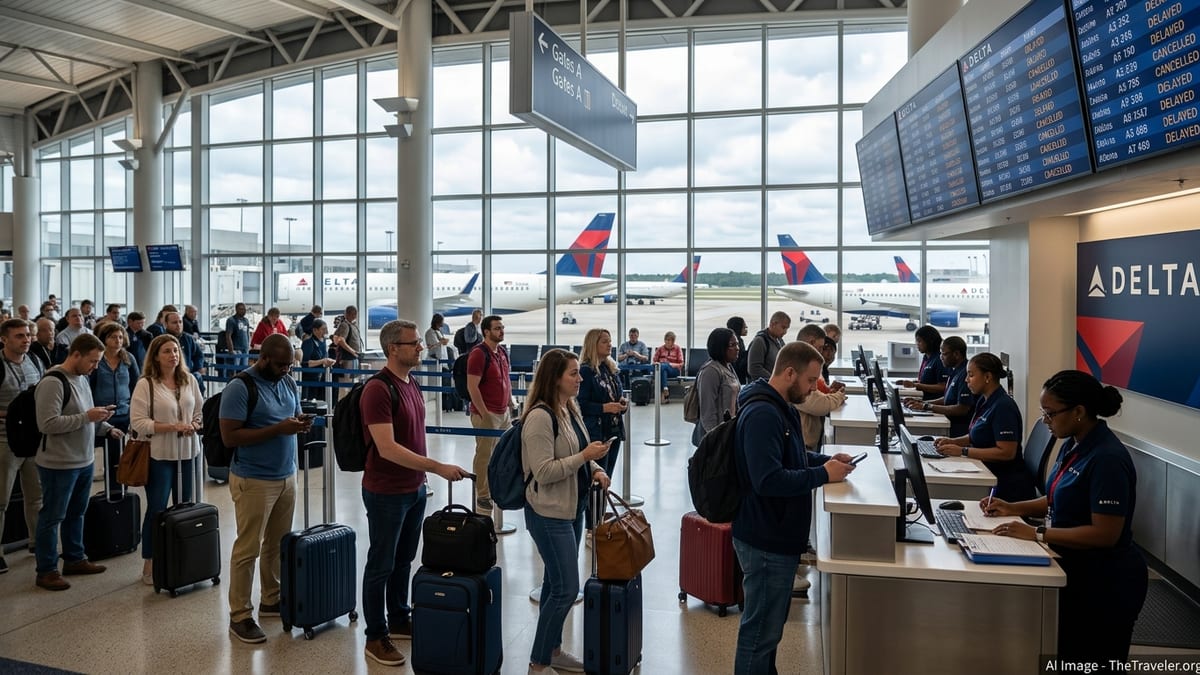
Hartsfield-Jackson, the world’s busiest airport and Delta’s primary hub, experienced the heaviest impact. Local reports from Atlanta on Monday morning described continued lines at customer service counters and a new round of delays and cancellations for Delta passengers, even though the carrier said its system had been restored. Travelers connecting through Atlanta reported missed onward flights and rebookings later in the day, a common pattern when a hub carrier experiences a major operational disruption and aircraft rotations remain out of position.
While exact totals vary by source and time of day, publicly available figures suggest Delta accounted for the majority of US airline delays on Sunday, with well over 1,000 late departures and arrivals. Cancellations were comparatively limited relative to the July 2024 CrowdStrike-related outage that affected multiple airlines, but the timing of this incident, at the start of the Thanksgiving rush, has increased its visibility and impact on travelers’ plans.
Timing with Thanksgiving and other recent aviation system issues
The weight-and-balance automation failure comes at a particularly sensitive point in the US travel calendar. The Transportation Security Administration and major airports have forecast near-record passenger numbers over the Thanksgiving period, with the heaviest days expected between Wednesday, November 25, and Sunday, November 29. Many of the travelers affected by Sunday’s Delta problems were departing early for the holiday week or positioning for connections on later days.
The disruption also follows a separate nationwide technical problem at the FAA a little more than a week earlier, which triggered a rare temporary ground stop of flights across the United States. In that incident, the FAA has said a telecommunications failure and overloaded network equipment disrupted some of its air traffic control systems before they were restored. Detroit Metro Airport and other major hubs reported lingering effects through the following weekend as airlines worked through backlogs.
In public comments and filings, Delta has acknowledged that its operations are heavily dependent on complex technology, noting the impact of past events such as the July 2024 global CrowdStrike-related outage that led to thousands of cancellations and an extended recovery period for the airline compared with some rivals. The carrier has also said in regulatory disclosures that it continues to invest in both customer-facing tools and underlying operational systems to reduce the risk and scale of future disruptions, but Sunday’s malfunction underscores that critical internal applications remain potential single points of failure during peak travel periods.
How this outage compares with previous Delta disruptions
Sunday’s automation problem is the latest in a series of technology-linked disruptions experienced by Delta in recent years. In February 2026, for example, the airline reported a technical issue that coincided with a nor’easter affecting the East Coast, leading to a higher-than-normal proportion of delayed flights even as Delta described the direct system impact as minimal. That event, like the latest outage, highlighted how weather can compound the effects of internal IT glitches by reducing scheduling flexibility.
The most severe recent case remains the July 2024 CrowdStrike incident, when a faulty software update to widely used cybersecurity tools disrupted Windows-based systems around the world. Delta later disclosed that the outage contributed to about 7,000 flight cancellations over five days and affected around 1.4 million customers as crew-management and other critical applications went offline and required manual fixes at individual computers. The US Department of Transportation subsequently opened an investigation into Delta’s handling of that episode, focusing on the carrier’s treatment of passengers during the prolonged recovery.
By contrast, initial data suggest that the November 22, 2026 automation failure resulted mainly in delays rather than wholesale cancellations. The system responsible for weight-and-balance calculations was restored within hours, and there is no public indication that external vendors or cybersecurity issues were involved this time. Still, the incident illustrates that even shorter-lived failures in a single operational system can ripple across a tightly scheduled network, particularly when they occur at a carrier’s primary hub and in the days leading up to a major holiday.
What Delta travelers should expect in the coming days
As of Monday, November 23, Delta and airport officials in Atlanta have said that operations are stabilizing but not yet fully back to normal. Industry reporting indicates that schedules are expected to improve progressively through Tuesday, with the airline working to re-align aircraft and crews and accommodate passengers who were delayed or missed connections. Travelers flying with Delta over the next several days should nonetheless be prepared for residual delays, especially on routes that connect through Atlanta and other major hubs.
Passengers are being advised by airports and travel advisors to monitor their flight status closely via Delta’s website or mobile app on the day of departure, to leave extra time at the airport for check-in and security screening, and to keep an eye on gate information, which may change as operations recover. For those whose plans were significantly affected on Sunday or Monday, Delta has said in similar past events that it may offer rebooking on alternative flights, and, in some cases, hotel or meal vouchers for eligible customers. However, specific accommodations for this latest incident can vary by itinerary, ticket type and local conditions, and travelers should confirm options directly with the airline.
Looking ahead to the core Thanksgiving travel days, forecasts from aviation analysts and government agencies still point to strong demand and generally full flights across the US network. With Delta’s automation system now restored and the broader FAA infrastructure operating normally, there is no indication at this stage of a new nationwide technology issue. Even so, the series of recent glitches at airlines and within federal systems, combined with active late-autumn weather patterns, suggests that travelers will benefit from building flexibility into their plans, checking for updates frequently, and having contingency arrangements in mind if further delays or schedule changes arise.