


More news on this day
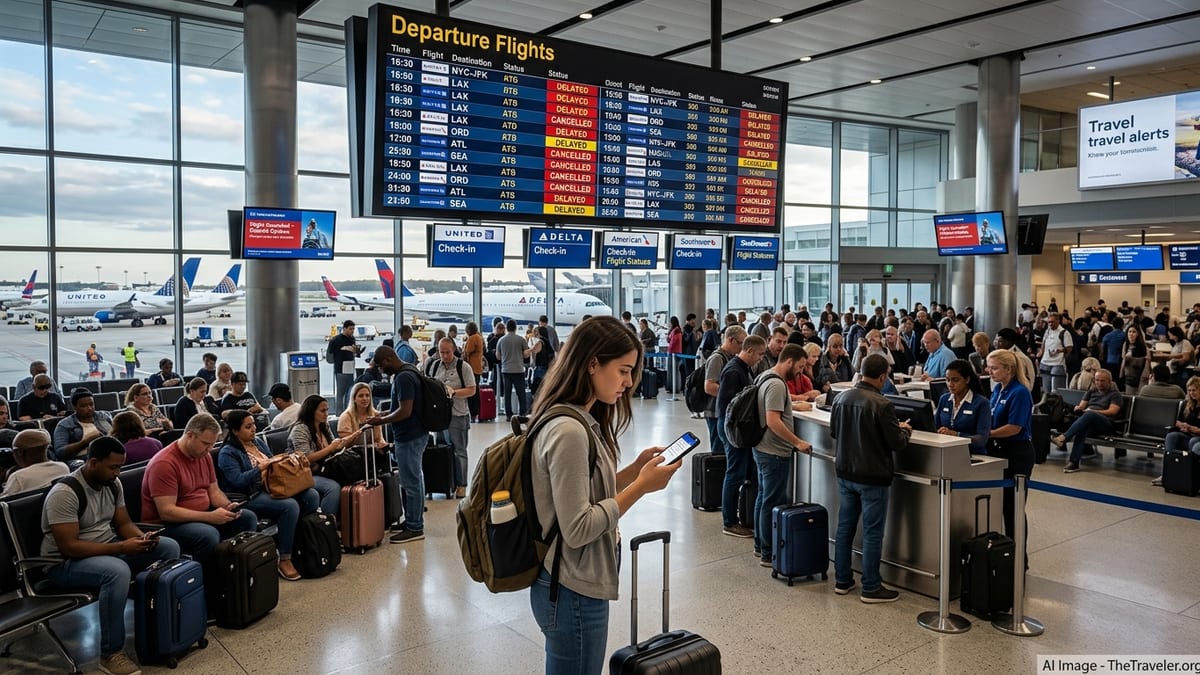
Millions of Americans are flying for Thanksgiving this week just days after a rare nationwide air-traffic ground stop, followed by technology outages at United and Delta that delayed thousands of flights and exposed how fragile the U.S. aviation system can be at peak travel times.
Get the latest news straight to your inbox!
What went wrong before Thanksgiving week
The run-up to the 2026 Thanksgiving holiday has been marked by an unusual concentration of aviation system failures. On Friday, November 13, the Federal Aviation Administration ordered a nationwide ground stop after a telecommunications failure disrupted key parts of its air traffic control network. The halt to departures at U.S. airports lasted about four hours and 45 minutes, one of the longest such nationwide restrictions in a quarter century, and led to thousands of cancellations and missed connections across the system.
According to FAA and Transportation Department briefings, the problem was traced to a router replacement as part of a larger effort to modernize the air traffic control network. When the new equipment malfunctioned, it flooded other components of the system and forced the agency to stop aircraft movements until controllers could be sure they had reliable data. While the outage did not affect onboard collision-avoidance systems, the cascading disruption affected airline schedules into the following day as aircraft and crews were repositioned.
Airlines were still recovering when United Airlines experienced its own technology failure on Monday, November 16. The carrier temporarily halted many departing flights because it could not provide final weight information needed for takeoff calculations. United reported that the issue, which did not affect flights already in the air, was resolved in roughly an hour and said there was no indication of a cybersecurity incident. Even so, the pause contributed to additional delays and knock-on effects for passengers already coping with crowded airports.
On Sunday, November 22, Delta Air Lines reported a separate problem with its automated weight-and-balance system, which supplies critical data to ensure aircraft are loaded within safe limits. Industry tracking site FlightAware recorded roughly 2,000 Delta delays and more than 200 cancellations by the end of the day, affecting nearly half of the airline’s schedule. Delta said the automation was restored later Sunday and that operations were largely back on track on Monday, but many passengers saw disrupted weekend and early-week plans as crews and aircraft were moved back into position.
These events have unfolded just as travel volumes climb. AAA and other forecasters expect nearly 6 million people to fly domestically over the extended Thanksgiving travel period in 2026, making this one of the busiest holiday travel seasons since the pandemic. That combination of peak demand and recent infrastructure and airline outages is driving concern that even routine weather or local staffing issues could again ripple quickly through the system.
How the government and airlines are responding
The federal response has focused primarily on the November 13 ground stop, because that outage originated inside air traffic control infrastructure rather than at individual airlines. The FAA has published an initial explanation of the failure and created a dedicated team drawn from the agency, the Department of Transportation, the Department of Defense and the intelligence community to analyze vulnerabilities in the air traffic network. Officials say they are reviewing hardware, software and contractor procedures to reduce the risk that a single router or configuration error can again trigger nationwide restrictions.
Transportation Secretary Sean Duffy has asked Congress to significantly increase funding for air traffic control modernization, arguing that the system’s mix of legacy analog equipment and newer digital components has left it reliant on complex workarounds. Lawmakers are now examining how quickly upgrades can be delivered without creating new points of failure. While the review and investment process is likely to take years, holiday travelers this week are already flying on a network that has been operating under heightened scrutiny since the outage.
Major airlines, for their part, have emphasized that the recent problems at United and Delta did not originate in shared federal systems and have framed them as isolated technology failures. Both carriers said there is no evidence of malicious activity, and each reported returning to normal operations within a day. However, the concentration of incidents around a single busy travel period has renewed questions about redundancy in airline IT and weight-and-balance tools that have become central to modern operations.
Carriers are unlikely to publish detailed technical post-mortems in the short term, but internal reviews are under way at both airlines, and regulators can request information where safety-critical systems are involved. For now, passengers should assume that most operational decisions will still be made flight by flight, and that recovery from any future glitch will depend heavily on the size of an airline’s network, crew availability and the flexibility built into its holiday schedules.
Practical steps to reduce disruption risk
The recent outages have also highlighted what individual travelers can do to reduce their exposure to delays and cancellations. Aviation consumer advocates and independent travel analysts consistently advise starting with information: downloading the airline’s official app, enabling push notifications and checking flight status repeatedly before leaving for the airport. In practice, airline apps are often the fastest way to learn about a gate change, equipment swap or delay and to request rebooking without waiting in a queue.
Flight-tracking platforms can provide an additional layer of insight. Services that show where your inbound aircraft is coming from can alert you early if your plane is stuck behind weather or congestion in another part of the country. If, for example, your assigned aircraft has not yet departed its previous city two or three hours before your scheduled boarding time, that is a strong signal to start looking at alternatives even if your airline has not officially adjusted the schedule.
Travel planners recommend identifying at least one backup option before you leave home. That could mean noting earlier or later departures on your route, searching for possible connections on different airlines, or in some cases reserving a fully refundable ticket with another carrier on the same day. This strategy can be expensive, since it requires the ability to pay for a second ticket upfront, but it gives some travelers a safety net if a primary flight is canceled or faces a long delay. Anyone considering it should read the fare rules carefully and set reminders for refund deadlines so that unused tickets can be canceled in time.
Departure timing and routing choices can also affect disruption risk. When schedules allow, booking the first flight of the day from an airline’s hub often provides more opportunities to be rebooked later if something goes wrong. Nonstop flights avoid missed connections entirely, which can be particularly valuable in seasons when airlines are operating close to capacity and spare seats are limited. Conversely, tight connections at busy hubs can be risky when the system is still digesting the aftereffects of nationwide or airline-specific glitches.
Understanding your rights and protections in a disruption
Because the recent problems have multiple causes, ranging from federal infrastructure to airline-specific software, passenger rights depend heavily on the exact circumstances of a delay or cancellation. Under current U.S. Department of Transportation rules, travelers are generally entitled to a refund when a flight is canceled or significantly changed and they choose not to travel. The DOT considers a significant delay for refund purposes to include domestic itineraries that arrive at least three hours late and international trips that arrive at least six hours behind the original schedule.
Passengers who accept rebooking and complete their trips usually cannot also demand a refund of the original ticket price, although they may still ask the airline for compensation or vouchers under its customer service policies. The DOT’s public cancellation and delay dashboard allows travelers to compare what major U.S. airlines pledge to provide in situations within the carrier’s control, including meals, hotel accommodation and ground transportation if an overnight stay is necessary. In practice, these commitments typically apply to events such as crew scheduling errors or certain types of mechanical problems and do not extend to weather or air traffic control restrictions.
Technology outages occupy a middle ground. When the failure clearly lies inside an airline’s own systems, carriers can choose to treat affected passengers as they would during other controllable disruptions, even if not strictly required by regulation. During Delta’s November 22 weight-and-balance outage, for example, the airline said it was assisting customers who needed hotel rooms or meals while emphasizing that it expected to move most delayed flights later that day. But when federal infrastructure is at fault, as with the November 13 ground stop, airlines commonly invoke force majeure clauses and may limit their obligations to rebooking assistance without additional accommodation.
Because policies and interpretations differ by carrier, travel lawyers and advocacy groups urge passengers to document everything. Screenshots of delay or cancellation notices, time-stamped photos of departure boards, and copies of rebooking confirmations can be valuable if there is later disagreement about what an airline promised. Receipts for meals, hotels and transportation should be saved in case the carrier or a travel insurer offers reimbursement. Some credit cards include trip delay, interruption or missed connection coverage that may apply even when the airline is not obligated to provide cash compensation, but the terms vary significantly and usually require that the ticket was purchased with the card in question.
Scams, reliability statistics and what travelers should monitor next
Periods of disruption can also attract fraud. Consumer protection agencies and travel advisers warn that scammers sometimes set up fake customer service numbers or social media profiles that appear to represent airlines, then request payment or sensitive personal information during supposed rebooking calls. To reduce this risk, passengers are advised to contact airlines only through official apps, websites or phone numbers listed directly by the carrier, and to be cautious about search engine results or third-party links that may lead elsewhere.
Recent federal data gives travelers a broader sense of how reliably different airlines have been running in 2026, although it does not yet reflect the November outages. The November 2026 Air Travel Consumer Report summarizes performance from January through September and shows variation in both cancellation rates and on-time arrivals among major U.S. carriers. American, Delta, United and Southwest all canceled between roughly 1 percent and 3 percent of their scheduled flights over that period, while smaller network carriers such as JetBlue recorded higher cancellation shares. On-time performance also differed, with some airlines delivering a higher proportion of flights arriving within 15 minutes of schedule.
These figures are useful benchmarks but not guarantees. They describe past behavior over the first nine months of the year and do not include the impact of the November 13 ground stop or the subsequent airline-specific technology glitches. In addition, an individual traveler’s experience can be strongly influenced by route choice, time of day and connection patterns. A generally reliable airline can still suffer localized disruption when storms hit one of its main hubs, while a carrier with weaker overall performance may still deliver an entirely smooth Thanksgiving journey on a particular route.
For the rest of the holiday period, the key variables to watch are weather forecasts along major flight corridors, any updates from the FAA about further work on its communications network and operational notices from large airlines about system maintenance. Travelers with upcoming flights should check their reservations regularly in the days before departure, reconfirm seat assignments and special service requests, and verify that contact details in their airline profiles are up to date so that rebooking offers and alerts are received promptly if something changes at short notice.
Because additional technical issues cannot be ruled out, passengers may want to pack carry-on bags as though an unplanned overnight stay is possible. Keeping prescription medications, essential documents, chargers and a change of clothes in cabin baggage reduces the impact if checked luggage is delayed and allows travelers to move quickly to a hotel or alternate flight if connections are missed. Combined with informed use of airline and government resources, these steps give flyers the best chance of navigating what is shaping up to be a particularly fragile Thanksgiving travel season.