


Caleta de Famara, on Lanzarote’s rugged northwest coast, inspires strong opinions. Some travelers fall in love with its wild beach and low-key surf vibe, while others find it too windy, basic or remote compared with the island’s main resorts. Deciding whether to stay in the village itself, nearby, or visit on day trips will shape your Lanzarote experience more than almost any other choice.
Get the latest updates straight to your inbox!
Understanding Caleta de Famara and Its Atmosphere
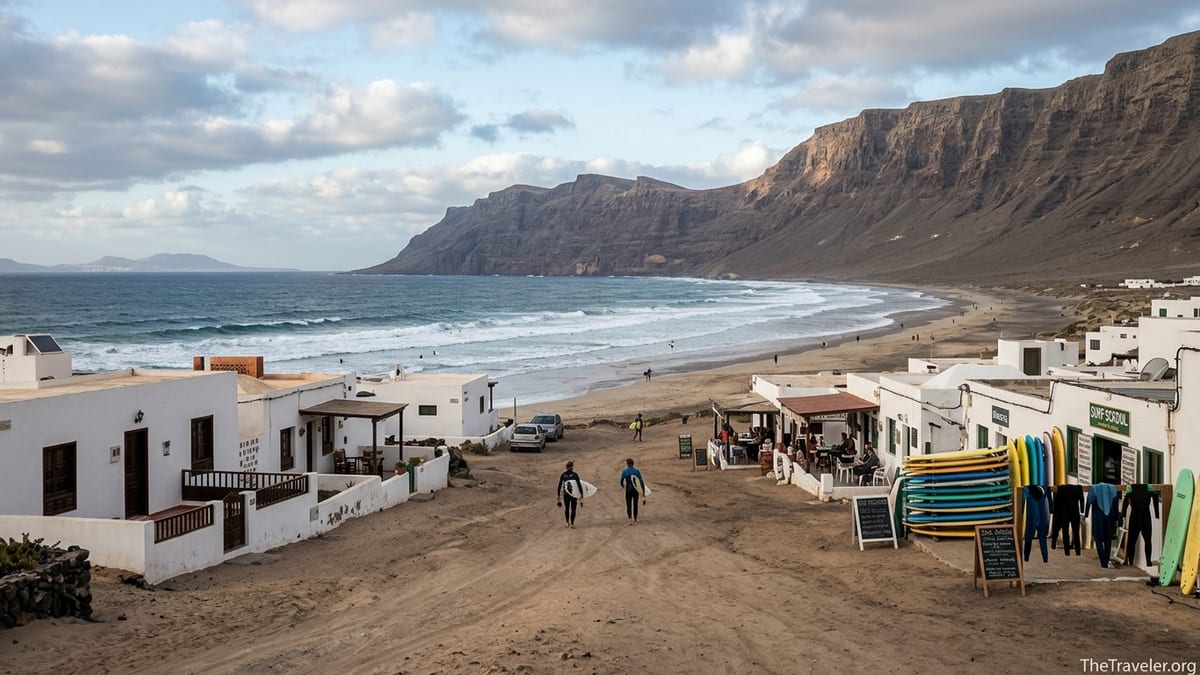
Caleta de Famara is a small coastal village within the municipality of Teguise on Lanzarote’s northwest shore. It sits at the foot of the dramatic Famara cliffs and opens onto a several‑kilometre sandy bay that is exposed to Atlantic swells. Unlike purpose‑built resort areas, it developed as a fishing settlement with modest, low‑rise housing, narrow streets and simple local services that now coexist with surf‑oriented tourism.
The village today is a mix of permanent residents and visitors staying in apartments, surf houses and a handful of small guest accommodations. Most streets are unpretentious and residential in feel, with sand blowing underfoot and the sound of the ocean usually audible in the background. You will not find large hotel complexes, shopping centres or a waterfront promenade lined with souvenir stalls here.
Along the main streets closest to the shore, you can expect surf schools, board rental shops, a few bars and cafes and several casual restaurants focusing on simple Canarian dishes and fish. Nightlife is limited to low‑key bars and occasional live music rather than late‑night clubs. The overall atmosphere is relaxed, youthful and surf‑centric, and the elements are always very present: strong wind, salt spray and sand are part of everyday life in Famara.
This character makes Caleta de Famara a great base for people who prioritise surf, scenery and informality over comfort and convenience. It is less suitable for travellers expecting the polished infrastructure, varied dining and sheltered swimming beaches typical of Lanzarote’s larger resorts.
Surf Camps and Surf Houses in Caleta de Famara
Surf camps are the most distinctive accommodation option in Caleta de Famara. These operations bundle lodging, surf lessons and often equipment hire into multi‑day packages. Verified providers currently based in or directly within the village include Calima Surf, Red Star Surf, Surf Famara and Lanzarote Surf Camp, all of which describe surf houses or surf camp accommodation within a short walk of Famara beach and the village surf schools as of research in November 2026.
Calima Surf advertises a surf house around 100 metres from the beach with private rooms and shared common areas, targeting adults on structured surf courses. Lanzarote Surf Camp lists three surf houses in Caleta de Famara plus a beachfront bungalow and a private apartment within the village. Red Star Surf and Surf Famara operate surf houses and nearby apartments that combine shared bedrooms or dorms with some private-room options, again within the central streets of Caleta de Famara. All of these providers emphasise walking access to the beach, board rental and lesson meeting points.
Surf houses appeal to solo travellers, couples and small groups who want a social environment, built‑in surf coaching and minimal logistical planning. Noise levels can be higher than in standalone apartments, especially in properties with shared dorms, communal kitchens and terraces where guests gather in the evenings. Bathrooms are often shared, and decor tends to be functional rather than stylish. In exchange, guests gain easy access to surf lessons, other surfers to socialise with, and staff who know local conditions.
Facilities vary, but most surf houses promote guest kitchens, Wi‑Fi and basic lounge areas. Wi‑Fi quality is usually sufficient for casual browsing and remote check‑ins, though constant high‑bandwidth video calls may be less reliable during busy times. Parking is typically on the street rather than dedicated; in high season it can be tricky to find a spot close to the house, though distances are short inside the village. Travellers who value quiet nights, guaranteed private bathrooms or dedicated workspace may find a private apartment or alternative base more comfortable.
Self‑Catering Apartments and Village Houses
Self‑catering apartments form the bulk of Famara’s accommodation stock. These range from basic one‑bed units in older low‑rise blocks near the beach to more modern or renovated village houses on quieter back streets. Red Star Surf, for example, markets several apartments and bungalows in Caleta de Famara proper, while other units are listed through large international booking platforms and local agencies based in Teguise and Costa Teguise.
These apartments generally offer private bedrooms, bathrooms and small kitchens or kitchenettes, making them suitable for couples, small families and travellers planning longer stays. Many include simple terraces or roof spaces exposed to the constant wind and occasional sand, which is part of the local experience. Furnishings tend to be modest, but for those who prioritise independence and the ability to cook at home they are a practical option.
Noise levels depend heavily on location. Properties on or just behind the seafront streets are closest to surf schools, beach access and restaurants, making pop‑ins between surf sessions easy but sometimes bringing early‑morning activity, surf school vans and evening social noise. Accommodation a few streets back or towards the edges of the village generally feels quieter and more residential but involves a slightly longer, though still short, walk to the sand.
Wi‑Fi quality varies by specific property and provider. Many landlords advertise fibre or high‑speed connections, particularly in apartments that target longer stays and digital nomads, but coverage across the village is not perfectly uniform. Remote workers who rely on stable video conferencing should confirm connection type and recent guest feedback before booking. Parking is almost always on‑street; spaces are usually available outside peak weeks and August village fiestas, but at busy times you may park a short walk from your door.
Guesthouses, Boutique Options and What Is Not There
Caleta de Famara has very few conventional hotels or boutique guesthouses. As of November 2026, there are no large hotels directly in the village and no widely recognised four‑ or five‑star properties with full service, pools and on‑site restaurants. Most named accommodations are either individual apartments, village houses, or rooms within surf houses managed by surf schools and camps.
A small number of operators present their better‑equipped apartments or bungalows as “boutique” stays, with more considered interior design or sea views, but these are still self‑catering units rather than serviced hotels. Visitors attracted by luxury marketing for “Famara” should check location details carefully: some higher‑end villas and rural houses branded with the Famara name are actually in nearby countryside or villages such as Soo or the bungalow development of Urbanización Playa Famara, rather than inside Caleta de Famara itself.
For travellers who want daily cleaning, staffed reception, lifts and facilities like pools or on‑site restaurants, the more realistic option is to base in a resort such as Costa Teguise or Puerto del Carmen and visit Famara on day trips. Staying in Famara means accepting limited accommodation categories with a do‑it‑yourself feel. For many, that stripped‑back authenticity is part of its allure; for others, it may feel like a compromise compared with better‑serviced parts of Lanzarote.
Because the supply of dedicated guesthouses is small and surf houses host a significant share of visitors, availability can tighten quickly around school holidays, long weekends and major wave forecasts. Booking early for winter swell season and August is advisable if you intend to stay in the village itself and want specific room types.
Prices, Seasons and Rental Regulations
Accommodation prices in Caleta de Famara vary by season, property type and how far in advance you book. Based on a sample of current listings from surf camps, local agencies and major booking platforms reviewed in November 2026, surf camp packages that combine a bed in a shared surf house with daily group lessons typically work out to a per‑person nightly equivalent in the region of budget to lower mid‑range hotel prices on Lanzarote. Private rooms in surf houses and self‑contained apartments typically start higher than simple dorm beds but below full hotel rates in the island’s main resorts.
In broad terms, low‑season nightly rates for simple studios or one‑bed apartments in the village often fall in a lower band than winter and August. Shoulder seasons such as late spring and early autumn usually sit in the middle, while peak weeks around Christmas and New Year, Easter, August fiestas and major surf forecast windows see noticeable price jumps and tighter minimum‑stay requirements. Exact numbers change frequently, and prospective visitors should always check several current listings for their dates rather than relying on older references.
Holiday rentals in the municipality of Teguise, including Caleta de Famara, are subject to Canary Islands and municipal rules covering “viviendas vacacionales” or tourist dwellings. Official data in early 2026 indicated hundreds of such licensed properties in Teguise, and local media have reported both growth in the sector and some subsequent reductions as regulations and enforcement evolve. There is ongoing island‑level debate about how many tourist rentals should be allowed, but details can change and processing times for new licences in Teguise have been described as slow, which may contribute to limited legal supply and periods of constrained availability.
Travellers should prioritise accommodations that specify a tourist licence number or indicate compliance with current rules. This helps support regulated operators and reduces the risk of disruptions if local authorities act against unlicensed rentals. Because rules are periodically updated, it is wise to check recent official or municipal information at the planning stage, particularly if booking far in advance or considering long stays in self‑catering properties.
Day‑to‑Day Life: Wind, Sand and Limited Services
Life in Caleta de Famara is shaped by the elements. The beach faces prevailing trade winds, and sand frequently blows through streets, onto terraces and into open windows. Many properties have simple construction and less insulation than northern European standards, so in winter the village can feel damp and cool indoors even when daytime temperatures are mild. In summer the wind is often welcome relief from the sun but can still be intense, especially on exposed terraces.
Services in the village are limited but generally sufficient for short stays. There are small supermarkets and mini‑markets for basics, a handful of cafes and restaurants, and a bakery or two, but choice is narrower and opening hours can be more variable than in resorts. Spot checks in late 2026 showed several venues closing one day per week or operating reduced hours outside peak season. For larger grocery shops, pharmacy visits or a wider range of restaurants, most residents and visitors drive to Teguise town, Costa Teguise or Arrecife.
Nightlife is notably quieter than in Lanzarote’s resort areas. While surf house gatherings, a couple of bars and occasional live music create some evening atmosphere, there are few late‑night options, and the village usually winds down at a reasonable hour. For some travellers this is a major advantage; for others it can feel too subdued after dark. Earplugs are still useful, as surf groups or village fiestas can mean bursts of noise, especially in August when local celebrations bring extra activity.
Most of Lanzarote’s headline attractions, such as Timanfaya National Park, Cueva de los Verdes, Jameos del Agua and the wine region of La Geria, require a drive from Famara. There is no dense network of direct buses from the village to these sites. Visitors relying on public transport should be prepared for multiple changes or to join organised excursions departing from larger resort bases.
Getting To and From Famara: Driving and Buses
Caleta de Famara does not sit on the main tourist transport axis of Lanzarote, so understanding access is crucial if you are weighing it as a base. Driving times from the island’s key points are moderate but not negligible. From César Manrique–Lanzarote Airport, typical driving time to Caleta de Famara is around 25 to 30 minutes under normal traffic via the inland road network. From Costa Teguise, the journey by car usually takes about 20 to 25 minutes via Tahiche and Teguise. From Puerto del Carmen, the drive is longer, roughly 35 to 45 minutes depending on route and traffic.
Public transport is provided by Intercity Lanzarote buses. Line 20 connects Arrecife with Caleta de Famara, and line 31 links Costa Teguise with Caleta de Famara via Tahiche and Teguise, according to current network information published for 2024 and still referenced in late 2026. These lines offer a limited but useful connection for car‑free travellers, particularly on weekdays. Services stop at a small set of marked bus stops in and around the village.
Service limitations are significant. The number of daily trips is modest, and frequencies are typically lower on weekends and public holidays. Local reporting in 2026 has highlighted that some lines to Caleta de Famara reduce or even suspend certain weekend services, and that travellers may need to make transfers from other routes serving resorts, the airport or Arrecife. Timetables can also change temporarily for village fiestas or road works. Anyone depending on buses should consult the latest official schedules close to travel dates and allow generous margins when connecting onward.
Because late‑evening buses are limited or absent on some days, staying out late in Arrecife, Costa Teguise or Puerto del Carmen usually requires a taxi or rental car. Car‑free visitors intending to explore widely around Lanzarote from a Famara base may find themselves constrained by these schedules, particularly outside peak season or on Sundays.
Who Famara Suits: Families, Nomads, Car‑Free and Older Visitors
Families with young children face a mixed picture in Caleta de Famara. The broad beach offers plenty of space to play, and low‑tide shallows can be fun for supervised paddling. However, strong currents and surf mean that this is not a classic calm swimming bay, and red flag days are common. Shade and facilities on the sand are minimal, and wind‑blown sand can be tiring for very young children. Families who prioritise gentle, sheltered swimming, playgrounds and pushchair‑friendly promenades will generally find Costa Teguise, Playa Blanca or Puerto del Carmen more comfortable bases, with easier beach conditions and more child‑focused infrastructure.
Digital nomads are increasingly drawn to Famara for its laid‑back lifestyle and relatively affordable longer‑stay rentals compared with frontline resort apartments. The village offers a handful of cafes where working for a couple of hours is tolerated, and some apartments and surf houses advertise stronger internet connections targeting remote workers. Even so, connectivity can fluctuate and there is no large dedicated coworking hub in the village. Those whose work requires highly reliable video calls or corporate‑level bandwidth may be better served by basing in Arrecife or Costa Teguise and visiting Famara regularly rather than committing to a full stay there.
Car‑free travellers can stay in Caleta de Famara, but should do so with eyes open. The limited bus services mean that spontaneous island‑wide exploration is difficult, especially in the evenings and on Sundays. For visitors who mainly want to surf, relax locally and perhaps make one or two carefully planned excursions using bus transfers or organised tours, this can be manageable. Those who hope to tour multiple sights independently would likely find a resort with more frequent buses a more practical base.
Older visitors and anyone with mobility constraints need to factor in Famara’s physical environment. Pavements can be uneven or absent in places, with sand collecting along streets and around doorways. Many apartments involve steps, narrow staircases or roof terraces accessed by ladders, and there are few lifts. The walk to the beach may cross soft sand. For travellers who require smooth, level access, handrails or step‑free paths, accommodation in purpose‑built resorts or Arrecife will generally be easier and safer.
Staying in Famara vs Day‑Tripping from Resorts
Choosing between basing yourself in Caleta de Famara or visiting on day trips from a resort hinges on your priorities. Staying in the village delivers early‑morning and sunset walks on a wild beach, instant access to surf conditions and lessons, and immersion in a small, mixed community rather than an entirely tourist‑oriented environment. It also means living with wind, sand, modest infrastructure and limited nightlife.
Costa Teguise, on Lanzarote’s east coast, is a popular alternative base that works well in combination with Famara. It offers a broad choice of hotels and apartments at different price points, several sheltered beaches suitable for swimming and children, a seafront promenade and many restaurants, bars and supermarkets. From Costa Teguise you can reach Famara by car in under half an hour or by the direct bus line 31, then return to a more conventional resort environment each evening.
Puerto del Carmen, further south, provides even greater accommodation variety, including large resort hotels, extensive holiday rentals and nightlife that runs much later than anything in Famara. Its long, relatively sheltered beaches and flat promenade are attractive for families and older travellers. The trade‑off is a longer journey to Famara for surf days and a generally busier, more commercial atmosphere. For visitors who want to combine several surf days at Famara with nightlife and a central position for exploring the rest of the island, Puerto del Carmen can still be a practical base if you are comfortable driving.
In simple terms, travellers who should strongly consider staying in Caleta de Famara for several nights include keen surfers wanting to maximise water time, solo travellers seeking a social surf‑camp environment, and nature‑oriented visitors who value wild scenery and are happy with basic services. Those who may be better off in Costa Teguise, Puerto del Carmen or another larger town are families seeking calm water and playgrounds, digital workers needing robust connectivity and workspace, car‑free visitors reliant on frequent buses, and anyone for whom steps, sand and wind would significantly reduce comfort.