


More news on this day
France has confirmed a long-term renewal plan for its state-supported night trains, combining the lease of 27 new bi-mode locomotives with a full refurbishment of 180 Corail sleeping and couchette cars, a move aimed at improving comfort and reliability on existing Intercités de nuit routes from the early 2030s rather than transforming services immediately.
Get the latest news straight to your inbox!
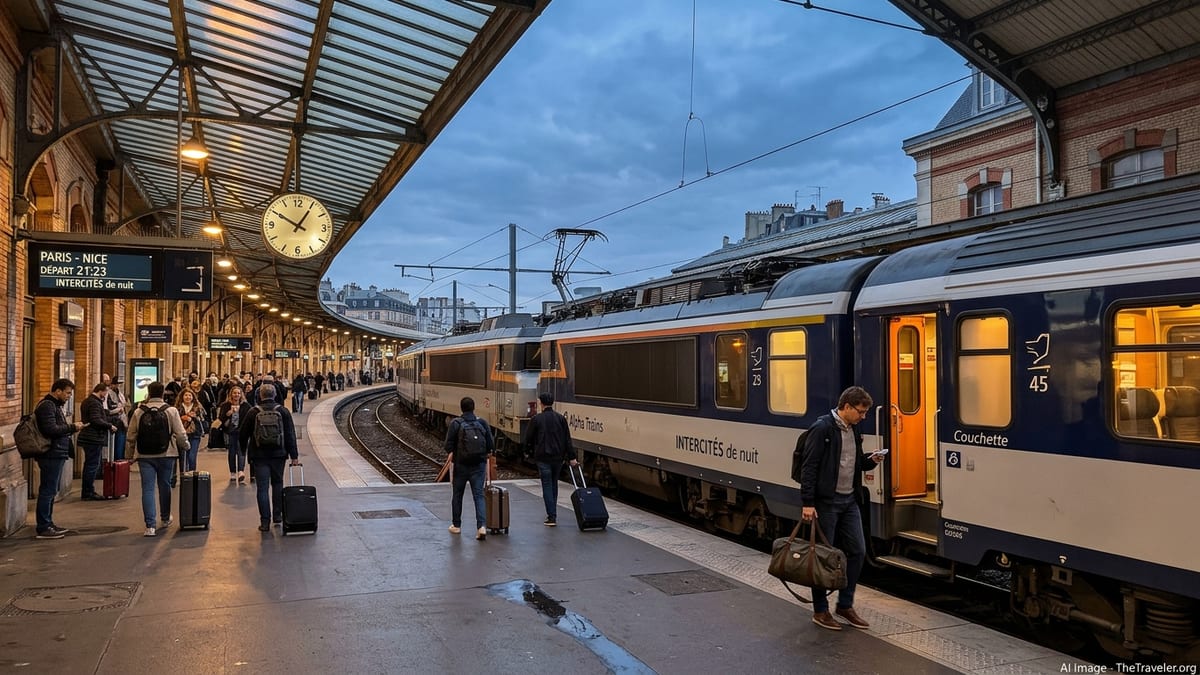
What France has actually decided for its night trains
The Ministry for Ecological Transition and Territorial Cohesion, which oversees the Trains d’équilibre du territoire (TET), has now formalized the rolling-stock strategy for France’s domestic night trains. Following an EU-wide tender launched in February 2025, the State has awarded a contract to rolling-stock lessor Alpha Trains to provide 27 new bi-mode (electric and diesel) locomotives dedicated to Intercités de nuit services. In parallel, SNCF Voyageurs has been instructed to carry out a complete renovation of 180 existing Corail night cars instead of ordering brand-new sleeper coaches.
According to the ministry’s late November 2026 communication and statements by the transport minister to the Senate, the locomotives are scheduled to enter service from 2030, while the refurbished Corail cars will be introduced progressively from the early 2030s, with the government’s latest documents pointing to a horizon around 2032 for full deployment. The State remains the organizing authority for TET, responsible for financing this investment and defining the long-term framework for the night-train network.
The official objective is to extend the usable life of the Corail fleet while significantly improving onboard comfort, operational reliability and energy performance. A full interior refit is planned, including modern sleeping accommodation, updated technical systems and measures to reduce energy consumption relative to the current configuration of these cars, many of which date from the 1970s and 1980s.
How this fits into France’s broader night-train policy
This latest decision builds on a first wave of spending between 2021 and 2023, when roughly €107 million was allocated to renovate 129 night-train cars, alongside about €23 million invested in depots and station facilities closely linked to night services. Those works underpinned the reopening of several domestic routes: Paris–Nice returned in May 2021, Paris–Tarbes/Lourdes in December 2021 and Paris–Aurillac in December 2023, joining Paris–Briançon and the Paris–Rodez/Toulouse/Latour-de-Carol/Cerbère axis as the backbone of the French night-train offer.
Passenger numbers have grown markedly on this combined domestic and international night-train network. Parliamentary and government documents indicate that more than one million passengers used night trains to and from France in 2024, including the now-subsidised services from Paris to Vienna and Berlin. High load factors on some domestic routes, particularly Paris–Nice during the summer peak, are cited in official reports as part of the rationale for committing additional funds to rolling stock.
At the same time, the November 2026 announcements clarify the limits of current ambitions. While earlier policy scenarios envisaged a national night-train network of around ten lines by 2030, the government has now opted to focus this specific package on locomotives and the 180 Corail cars needed to secure today’s five domestic night routes. Any expansion to additional lines in the next decade will require separate political decisions, new funding and further contracts.
What travelers can expect on board in the late 2020s
For travelers planning journeys over the next three to five years, the key point is that the new investment will not transform the onboard experience immediately. Through at least the late 2020s, France’s night trains will continue to rely on existing, mostly refurbished but aging Corail stock. The 129 cars already overhauled in the first renovation phase will remain at the core of the fleet, complemented by incremental maintenance and smaller-scale upgrades as required to keep services running.
Comfort has already improved in some respects compared with the low point of the mid-2010s, with refurbished interiors and better facilities at certain terminals such as Paris Austerlitz and Toulouse Matabiau. However, travelers should not expect a wholesale change in cabin layouts, noise insulation or amenity standards as a direct result of the November 2026 decision before the early 2030s. The upcoming 180-car refurbishment is an industrial program that must pass through design, prototyping, approvals and workshop capacity constraints before new interiors reach regular service.
Capacity will also remain constrained. Official assessments note that with only around 129 operational night cars today, it is difficult to significantly increase frequencies or add new routes without fresh hardware. Until the renovated Corail cars arrive, the existing Paris–Briançon, Paris–Rodez/Toulouse/Latour-de-Carol/Cerbère, Paris–Nice, Paris–Tarbes/Lourdes and Paris–Aurillac services will form the core offer. International night trains such as those to Vienna and Berlin are operated under separate arrangements and are not directly covered by this refurbishment program, even though they contribute to overall demand for night travel from France.
Booking strategy and what to watch for next
In the short term, the practical implication for travelers is that demand is likely to keep outstripping supply on popular night routes, especially in summer and around major events. High load factors recorded on the Paris–Nice line in recent seasons demonstrate how quickly compartments can sell out once tickets are released. For now, the safest strategy remains to book as early as possible once sales open for your intended dates, and to be flexible on travel days if you are targeting a particular route like Paris–Briançon.
Because the November 2026 package does not define new timetables, routes or fares, travelers should treat any discussion of additional domestic or regional night lines as a political objective rather than a confirmed schedule. Government reports continue to mention the idea of a larger night-train network around the start of the 2030s, but they also specify that new lines will depend on updated socio-economic analyses and dedicated financing decisions. No binding route list or launch calendar has been attached to the refurbishment and locomotive contracts themselves.
Looking ahead, the main milestones for travelers to monitor will be the detailed refurbishment designs for the Corail cars, the confirmation of which existing lines receive the new equipment first, and any updated introduction dates beyond the current 2030–2032 horizon. As those elements are clarified in future government and SNCF announcements, they will determine when and where passengers will first experience the next generation of French night-train comfort.