


More news on this day
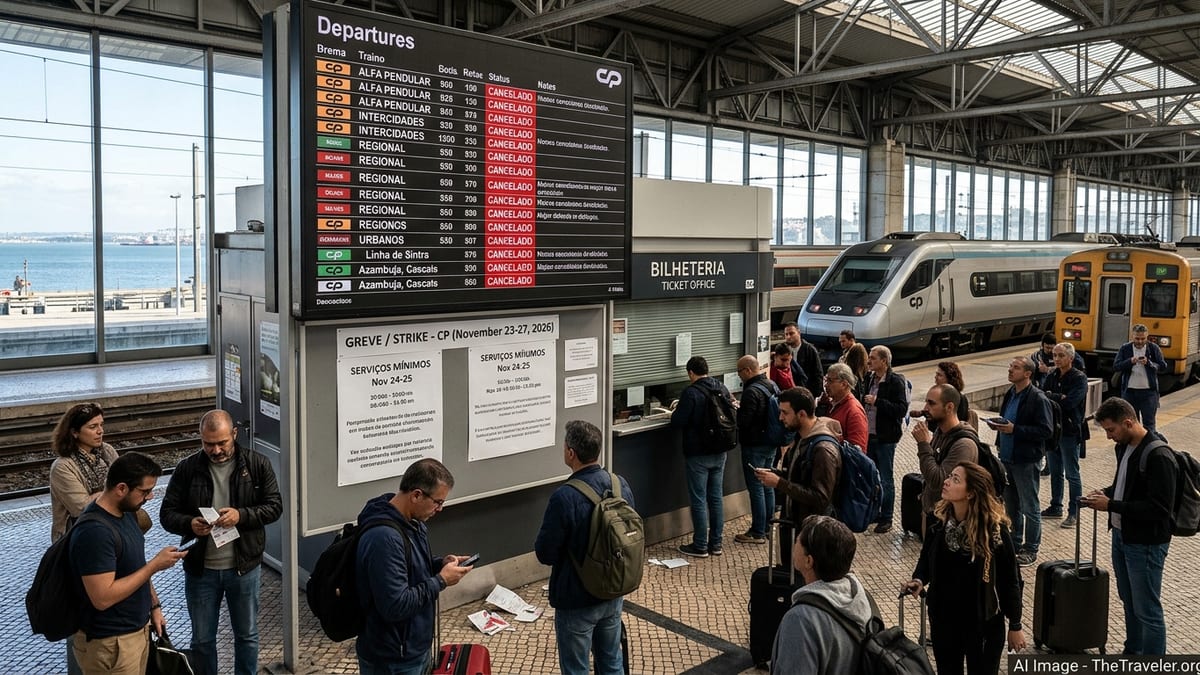
A five-day strike by train drivers at Portugal’s state rail operator CP from 23 to 27 November is moving ahead under exceptional refund rules and a tightly framed minimum-service order for 24–25 November, offering a live test of how the country’s updated rail passenger‑rights regime works in practice.
Get the latest news straight to your inbox!
What the CP strike involves and where disruption is heaviest
The strike was called by the train drivers’ union SMAQ and formally runs from 00:00 on Monday 23 November until 24:00 on Friday 27 November 2026, with CP warning that knock-on disruption is possible on Sunday 22 and Saturday 28 November. CP advises that all service types may be affected, including Alfa Pendular, Intercidades, InterRegional, Regional and urban trains in Lisbon, Porto and Coimbra.
According to early-morning operational reports on 23 November, around one in six scheduled trains had already been cancelled by 10:00, and Portuguese media and union officials are signalling that the most severe impact is expected on Tuesday 24 and Wednesday 25 November, when a full stoppage by drivers is planned. On Monday 23 and Thursday 26 November, the action is more targeted and focuses on overtime and rest-day work, but passengers are still being told to expect short-notice cancellations and delays.
CP is publishing live information on affected trains through its usual digital channels and station notices. However, the company acknowledges that actual circulation may diverge from the theoretical timetable and that even services listed to run can be cancelled at short notice if there are not enough staff.
How Portugal’s new minimum-service order works for 24–25 November
Minimum services for this strike were set by an arbitral tribunal operating under the Economic and Social Council, in a decision dated 17 November 2026 (process ARB/34/2026). The ruling explicitly seeks to balance the constitutional right to strike with the need to protect so‑called “captive” rail users, such as commuters on urban lines and travelers on corridors with no reasonable road alternative.
Crucially for travelers, the minimum-service obligation applies only on Tuesday 24 and Wednesday 25 November and targets around 25 to 30 percent of normal service in specified peak periods. For Lisbon’s urban network, the annexes list guaranteed trains in the early morning and late afternoon on key lines, such as Sintra, Azambuja and Cascais, designed to preserve basic commuting capacity rather than all-day frequency. In Porto, the tables similarly focus on morning and evening trains on the Urbanos do Porto network, while in Coimbra they provide a skeleton service on the urban axis.
On the main intercity corridors, the arbitral decision requires a significant share of Alfa Pendular and Intercidades services to operate on 24 and 25 November, especially along the Lisbon–Porto “Linha do Norte” and on links without practical coach alternatives. However, the decision itself notes that the obligation is to attempt to run these trains, not a guarantee that every listed service will depart. CP advises passengers to treat minimum-service tables as a planning tool rather than a firm confirmation that a specific train will run.
Exceptional refund and rebooking options during the strike
In parallel with the minimum-service order, CP has activated an exceptional commercial policy for passengers booked on longer-distance services. Customer notices covering the period 23–27 November confirm that holders of Alfa Pendular, Intercidades, Internacional, InterRegional and Regional tickets whose trains are cancelled or materially affected by the strike may request either a full refund or a free exchange to another train of the same category and class.
CP specifies that these options are offered in addition to the company’s standard refund and exchange conditions and are directly linked to this strike. The policy applies to advance-purchase and flexible tickets alike, provided the booked service falls within the affected period and is cancelled or disrupted. Urban tickets and passes for Lisbon, Porto and Coimbra are not explicitly covered by the exceptional strike policy and instead remain under CP’s usual conditions, so routine season-ticket refunds or extensions are not automatically granted unless CP issues a separate notice.
In practice, long-distance passengers can normally request a refund or exchange at station ticket offices, through CP’s online “ pós-venda” after-sales area or in the CP app for tickets bought digitally, subject to deadlines that CP sets in its customer notice for this strike. Travelers are advised to screenshot or download the specific November 2026 “Greve” and “Avisos” pages on CP’s site on the day they travel, because CP’s English-language information can lag behind the Portuguese updates and any extension of the refund window or change in eligible services will be posted there first.
How EU and national rules frame your rights
The current strike is also the first widely visible test of Portugal’s updated legal framework for rail passenger rights. On 1 September 2026, Decree-Law 173/2026 entered into force, adapting EU Regulation 2021/782 on rail passenger rights into Portuguese law and revising the national regime for rail and other modes. The decree designates the Autoridade da Mobilidade e dos Transportes (AMT) as the main enforcement body for rail-passenger rights and clarifies the role of the Instituto da Mobilidade e dos Transportes (IMT) in policy and oversight.
Under this framework, passengers whose trains are cancelled or heavily delayed retain the core EU entitlements to information, reimbursement or rerouting, and, in some cases, compensation under the regulation’s standard timetable. The new Portuguese decree does not itself expand or abolish those EU-level rights but specifies how they are applied and supervised in Portugal, including the procedures for complaints and sanctions against operators who fail to comply.
For this strike, CP’s exceptional refund and rebooking policy sits on top of the baseline EU entitlements rather than replacing them. Travelers remain entitled to choose between a refund and rerouting if a scheduled train is cancelled, even though compensation beyond a ticket refund can be limited in cases considered to be extraordinary circumstances. Neither CP nor AMT has announced additional automatic coverage of hotel, taxi or other incidental costs linked to this particular strike, so passengers should not assume those expenses will be reimbursed unless explicitly confirmed case by case.
What travelers should check day by day
For Monday 23 and Thursday 26 November, the absence of a minimum-service order means CP does not have a legal obligation to run a fixed percentage of trains, and service patterns may change throughout the day as staff availability and operational conditions evolve. On Tuesday 24 and Wednesday 25 November, the published minimum-service tables for Lisbon, Porto, Coimbra and key intercity axes offer a baseline of early-morning and late-afternoon trains, but crowding and extended gaps between services are still likely.
Travelers planning to use CP during the strike period should verify their specific trains on the day of travel through CP’s journey planner or customer service lines, paying particular attention to whether the service is listed as a minimum-service train on 24 or 25 November. Those holding advance tickets for Alfa Pendular, Intercidades, Internacional, InterRegional or Regional services that are cancelled or significantly delayed should proactively request refunds or exchanges within the timeframe set by CP’s November strike notice.
Because both operational plans and customer policies can be adjusted while the strike unfolds, passengers arriving in Portugal or booking last-minute journeys are advised to recheck CP’s “Greve/Strike” and “Avisos” pages on the morning of travel. That is where any changes to minimum-service tables, confirmation of additional trains or extensions to the refund and exchange window will appear, and it remains the most reliable guide to how Portugal’s new passenger-rights framework is being applied in real time.