


Planning a first ski or snowboard trip to Japan often comes down to a confusing choice: base yourself in Hakuba Valley or in Nozawa Onsen. Both sit in northern Nagano Prefecture, both get famous Japanese snow, and both attract English-speaking visitors. Yet they feel very different on the ground. Hakuba is a broad valley beneath the Northern Alps, with a cluster of separate ski areas spread along the floor of the valley. Nozawa Onsen is a compact historic hot-spring village with one large, linked resort that rises directly above town. This article compares the two specifically for first-timers and early intermediates, not powder experts, so you can decide which base will make your first Japan ski holiday feel smooth rather than stressful.
Get the latest updates straight to your inbox!
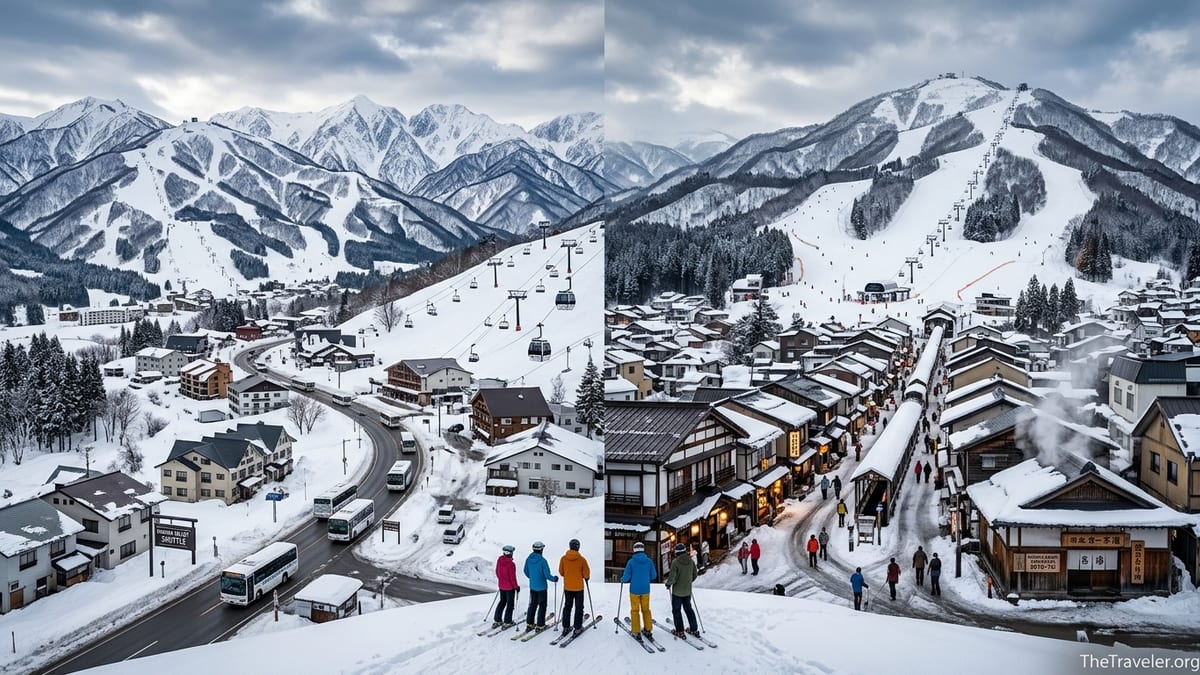
Overall feel: a valley of resorts vs a single ski village
Hakuba Valley is best thought of as a collection of independent ski areas sharing one long valley, rather than one unified ski hill. The official Hakuba Valley area counts ten ski resorts including Tsugaike Kogen, Hakuba Iwatake, Hakuba Happo One, ABLE Hakuba Goryu, Hakuba47 and several smaller hills, each with its own lifts, base area and character. They are linked by a winter shuttle bus network and, with the Hakuba Valley lift pass, you can move between them. This layout suits travelers who like choice and do not mind using buses to sample different mountains.
Nozawa Onsen, by contrast, feels like a single destination. The village sits directly at the foot of Nozawa Onsen Snow Resort, which has multiple base zones but functions as one large, connected ski area above a traditional onsen town. From much of the village you can walk to either the main Nagasaka gondola base, the Hikage learning area via the covered Yu Road moving walkway, or smaller lifts. For first-timers, that simple one-resort structure, combined with a compact town, can make daily logistics more intuitive.
In short, Hakuba offers more terrain variety across scattered resorts and neighborhoods, while Nozawa Onsen offers a tighter, more self-contained ski village experience. Your preference for variety versus simplicity is one of the biggest early filters when choosing between the two.
Terrain for beginners and early intermediates
Hakuba Valley has more overall terrain than Nozawa, but that does not automatically make it easier for beginners. Within the valley, some mountains cater strongly to learners, while others are steeper and more exposed. Tsugaike Kogen is widely regarded as one of the most beginner- and family-friendly areas, with broad, gentle slopes on the lower mountain that give new skiers plenty of space to practice without feeling crowded. Goryu’s Toomi and Iimori zones also have dedicated beginner areas at the base, with Iimori in particular often used by international ski schools for first-timer lessons. Hakuba Iwatake offers a mix of mellow and more challenging runs along with big valley views, which can be good for progressing early intermediates.
Other Hakuba areas skew more advanced. Happo One, the most famous resort in the valley and a 1998 Nagano Olympic venue, has some beginner options at Sakka but its overall pitch is noticeably steeper than Tsugaike or lower Goryu. It quickly turns into demanding terrain higher up. Resorts such as Hakuba47 and Cortina are known more for off-piste and powder, which is not generally what a first-timer needs. For beginners basing in Hakuba, the practical decision is less “Hakuba or not” and more “which Hakuba mountain to focus on,” with Tsugaike, Goryu/Iimori and possibly Iwatake usually the most forgiving choices. Exact beginner and intermediate percentages can change as resorts reclassify runs, so check current trail breakdowns and verticals on each resort’s official site when finalizing a plan.
Nozawa Onsen Snow Resort is a single, sizable mountain with a relatively long vertical drop and a broad spread of beginner and intermediate terrain, mixed with some steeper runs off the top. The main Hikage area above the village is oriented to learners and families, with easy access from town via the Yu Road moving walkway. As you progress, wide pistes on the mid-mountain offer a natural next step without having to navigate buses or new lift systems. Advanced riders can still find steeper sections and tree runs, but the defining experience for first-timers is that you can spend several days exploring new-to-you terrain without leaving one integrated resort.
For a first Japan trip, Hakuba will suit early intermediates and groups that want to sample different mountains, provided someone is comfortable planning which resort to visit each day. Nozawa is often kinder to absolute beginners and those who want to master basics in one familiar area without extra logistics.
Village atmosphere and sense of “Japan-ness”
Hakuba’s villages feel more like a dispersed mountain town than a single traditional settlement. The main accommodation clusters are Happo village near Happo One, Echoland closer to the valley’s bar and restaurant strip, and Wadano, a wooded area with many chalets and hotels near some lifts. Each cluster has its own pockets of restaurants and bars, and there are convenience stores and rental shops spread along the main roads. Because of the size of the valley, you will likely use shuttle buses or taxis to move between resorts and sometimes between nightlife spots, especially at night or in deep snow.
The atmosphere in Hakuba is distinctly international. English is widely spoken in many hotels, shops and restaurants, and there are numerous Western-style bars, cafes and rental outlets. You will still find Japanese izakaya and local eateries, but overall it can feel like a global ski town set in Japan rather than a deeply traditional village. For some first-timers this is reassuring: menus, signage and lesson bookings are straightforward, and it is easy to meet other travelers.
Nozawa Onsen feels much more like a classic Japanese hot-spring village that happens to have a major ski resort above it. Narrow streets lined with wooden ryokan, small guesthouses, family-run eateries and souvenir shops give a strong sense of place. One of the defining features is the network of communal bathhouses, or soto-yu, scattered through the village. These simple, often free local baths are used by residents and visitors alike and create a very Japanese rhythm to afternoons and evenings.
English is present in Nozawa, especially around the main gondola base and in larger lodges and rental shops, but it is less dominant than in Hakuba. Signage is improving each season, yet visitors should expect more Japanese-language menus and interactions. For travelers seeking a village that feels distinctly Japanese, with onsen culture woven into daily life, Nozawa generally delivers more “Japan-ness” than Hakuba, at the cost of slightly less linguistic comfort.
Getting there and getting around
From Tokyo, both Hakuba and Nozawa Onsen are realistically a half-day journey in winter when you include transfers and waiting times. For Hakuba, a common route is the Hokuriku Shinkansen from Tokyo Station to Nagano Station, followed by an Alpico or similar express bus to Hakuba. Recent winter timetables show shinkansen travel times from around 1 hour 20 minutes to Nagano on the fastest services, with the Nagano to Hakuba bus leg typically around 1 hour 10 minutes depending on the specific service and road conditions. For the 2026 to 2027 winter, Alpico has published reserved winter buses between Nagano and Hakuba across the main season dates, and there are direct winter highway buses from Shinjuku’s Busta terminal to Hakuba Happo Bus Terminal with multiple departures per day. Newcomers should check the current season’s train and bus timetables and build in a buffer for connections.
Nozawa Onsen access is broadly similar in length but slightly simpler in terms of winter road exposure. From Tokyo, you take the Hokuriku Shinkansen to Iiyama Station, usually in around 1 hour 40 minutes to 2 hours depending on train type, then transfer to a dedicated Nozawa Onsen bus, often branded as the Nozawa Onsen Liner in winter. These buses typically take around 25 to 30 minutes to reach the village, and operate at set intervals timed to meet key trains in the high season. As with Hakuba, schedules are revised each winter, so travelers should confirm current-season Iiyama to Nozawa services and last departure times on official transport sites.
Once in Hakuba, getting around usually involves a mix of walking and free or paid shuttle buses. If you stay in a central, walkable pocket of Happo, Echoland or Wadano, you can often stroll to local restaurants and some lifts, but reaching more distant resorts like Tsugaike or Cortina will require buses. The Hakuba Valley shuttle system is designed for this, and some passes include free bus use, but the need to interpret route maps and time connections can be mildly stressful for very inexperienced travelers or families with small children.
In Nozawa Onsen, the whole village is compact and hilly, so many visitors walk from lodgings to lifts, onsen and restaurants. From numerous accommodations you can reach the Nagasaka gondola base on foot in around 5 to 15 minutes, though steep streets and snow can slow this. For families and beginners, the covered Yu Road moving walkway that connects the village to the Hikage beginner area reduces the need to negotiate narrow roads in ski boots. Before booking, it is worth checking with your accommodation whether they are realistically walkable to the lifts for most guests or whether you will rely on local shuttles or hotel drop-offs.
Accommodation and approximate costs
Hakuba’s size and popularity mean a wide range of accommodation types and price points. In Happo, Wadano and Echoland you will find everything from simple pensions and lodge-style guesthouses to upscale hotels, luxury chalets and full-service condos. There are also self-catering apartments that appeal to longer stays and families. As a result, nightly rates span a broad spectrum, with high demand and higher prices at New Year and in late January and February. Lift passes include single-mountain tickets and the Hakuba Valley common pass that covers multiple resorts, with pricing adjusted each season. For this article, you should check current 2026 to 2027 winter rates on the official Hakuba Valley and individual resort sites before quoting any figures.
Nozawa Onsen has a denser concentration of small inns, family-run lodges and traditional ryokan. While there are now some stylish boutique stays and self-contained apartments, the overall feel remains more low-rise and intimate. Price levels are not necessarily cheap, especially in peak weeks, but there tend to be fewer ultra-luxury properties than in Hakuba and more midrange Japanese-style rooms with half-board options. Lift passes are offered for Nozawa Onsen Snow Resort as a single area, with separate pricing for different durations and age groups. As in Hakuba, pass and rental prices are recalibrated periodically, so always refer to the current season’s official tables.
For first-time planners, an effective way to compare the two destinations is to build a simple sample budget once you have checked up-to-date prices. For example, draft side-by-side estimates for a three to five night stay in each: midrange lodging in a convenient location, a multiday lift pass, ski or snowboard rental, at least one group lesson day, meals and transport from Tokyo. Do not rely on outdated figures; instead, treat published 2026 to 2027 price lists and quotes from your short-listed accommodations as your reference, and adjust for your own travel dates and group size.
Because Hakuba has more high-end choice, mixed groups that include travelers with larger budgets may find it easier to secure premium rooms and private chalets there, while Nozawa tends to suit visitors happy with simpler lodgings and Japanese inn experiences. That said, both destinations now offer a spread from budget to upscale, so the deciding factor is often village style and convenience rather than pure cost.
Ski schools, lessons and English support
For first-timers, the quality and availability of beginner lessons in English often matter as much as the terrain itself. In Hakuba Valley, several international ski schools operate across key beginner-friendly resorts. In recent seasons, schools have commonly based group and private lessons at Goryu’s Iimori area, at Tsugaike Kogen, and at selected zones in Happo One and Iwatake. Many advertise English-language instruction, children’s programs and sometimes multilingual staff. Exact mountains and meeting points can shift from season to season, especially as resorts refine where they allow third-party schools to operate, so it is important to check each school’s current base resorts and daily meeting locations for the 2026 to 2027 winter before committing.
Nozawa Onsen also has ski and snowboard schools offering instruction in English, including options for children and first-time adults. Lessons are typically centered around the Hikage learning area and near the main gondola base, with rental shops and kids’ facilities close by. Some schools are run directly by the resort, while others are independent but recognized by the lift company. Capacity can be more limited than in Hakuba, simply because the resort and village are smaller, and peak holiday weeks see strong demand from both domestic and international visitors.
Wherever you choose, the key practical step for a first trip is to book lessons early for core high-season dates. For January and February, especially around New Year, school holidays and Chinese New Year, aim to secure group and children’s programs several months in advance where possible. Private lessons may book out even earlier on popular days. When enquiring, confirm not just price and schedule but also language of instruction, exact meeting points, and any requirement to purchase passes or rentals from specific partner shops.
First-timers who feel nervous about navigation may find Nozawa’s single-resort lesson setup easier to understand, since all teaching happens on one mountain above one village. Those staying in Hakuba should be prepared to match their accommodation location with an appropriate school base, ideally at Tsugaike, Goryu/Iimori or another resort known for gentle beginner terrain.
Onsen and off-slope activities
Both Hakuba and Nozawa Onsen offer hot springs and non-ski diversions, but the emphasis differs. In Hakuba, onsen are typically attached to hotels or operated as individual facilities scattered across the valley. You will find modern public baths and hotel spas where day visitors can pay to soak, often with views of the Northern Alps. Après-ski centers on a mix of bars, casual restaurants and live music venues in areas like Echoland and Happo. Off-slope activities can include snowshoe tours, snowmobiling, side trips to nearby towns or even day tours to see the famous snow monkeys in Jigokudani, subject to winter road conditions and tour availability.
Nozawa Onsen’s entire identity is built around hot springs. The village maintains multiple communal bathhouses, many of them free or with small donation boxes, each fed by natural hot-spring sources. These soto-yu add a strong local flavor, as you bathe alongside residents under simple wooden roofs rather than in hotel spa complexes. There are also ryokan baths and a few modern facilities, but the experience is more about participating in long-standing communal culture. Off-slope life tends to revolve around evening soaks, strolling narrow streets, enjoying small izakaya, and seasonal events such as the Dosojin Fire Festival in mid-January, which can be spectacular but also brings heavy crowds and higher prices.
For non-ski days, Nozawa’s options are more village-based and low-key, while Hakuba’s scale and international orientation give more variety in Western-style nightlife and guided excursions. Families with children who need entertainment beyond skiing may find Hakuba’s broader spread of cafes and activity providers comforting, though younger kids often delight in Nozawa’s snow play areas and nightly onsen routine.
In both destinations, onsen etiquette is important. First-time visitors should learn the basics of Japanese bathing customs, such as washing thoroughly before entering communal baths, keeping towels out of the water, and respecting any rules on tattoos or swimwear that individual facilities may enforce.
Seasonality, snow reliability and crowd patterns
Japan’s snowfall can be generous, but it is also variable, and no resort can guarantee specific conditions on particular dates. Hakuba’s resorts generally aim to open in late November or early December and run into late March or April, with higher or north-facing slopes often holding snow longer. The northern end of the valley, including Tsugaike and Cortina, tends to receive heavier natural snowfall on average than some of the more southerly or lower resorts, though exact figures change with each winter. Early in the season, resorts prioritize getting beginner areas open, sometimes supplemented by snowmaking on lower slopes, while steeper upper terrain may follow as natural coverage builds.
Nozawa Onsen Snow Resort usually targets a similar winter window, with operations from early December into spring when conditions allow. Its single large area includes higher-elevation slopes that often maintain snow later into the season, along with lower beginner zones close to the village. As in Hakuba, recent warm spells and shifting weather patterns mean that opening dates and coverage can vary from year to year. Official resort sites and local tourism boards post planned opening dates and current snow depth, and first-timers should treat these as the primary reference in the months before travel.
In terms of crowds, both Hakuba and Nozawa Onsen see peak demand during Japanese school holidays, New Year, and major international holiday windows in January and February. Hakuba’s larger capacity and multiple resorts can spread skiers out across different mountains, but beginner areas in convenient locations still become busy on popular weekends. Nozawa’s compact layout concentrates people into one resort, and during headline events like the Dosojin Fire Festival the village feels very full, which may be overwhelming for some visitors.
Language mix also shifts with timing. Hakuba supports a broad international audience throughout much of the core season, with English widely heard in lift lines and lodges. Nozawa typically has a stronger Japanese presence mixed with Australian and other overseas guests. Travelers seeking a very “local” feel might lean to Nozawa in mid-week, non-holiday periods, while those wanting the reassurance of a well-established international infrastructure may prefer Hakuba at almost any time.
How to choose: matching each base to your first-time profile
For couples or small groups of beginners who like the idea of a classic Japanese village and are happy to walk hilly streets, Nozawa Onsen is often the more atmospheric choice. The ability to wake up, stroll through narrow lanes, ride a gondola from the edge of town and soak in communal baths each afternoon makes for a distinctively Japanese experience. The single large resort keeps logistics simple, and with lessons and rentals clustered near the main beginner areas, you can focus on learning rather than coordinating buses.
Families with young children should think about both terrain and daily movement. In Hakuba, basing yourselves close to beginner-friendly areas like Goryu/Iimori or Tsugaike, ideally within walking distance of lifts, can give you manageable mornings plus the flexibility to move to other mountains later in the week. The trade-off is relying on shuttles for some outings. In Nozawa, the town-to-slope connection is straightforward but often hilly, and carrying kids’ gear up and down snow-covered streets can be tiring. That said, the compactness and the Yu Road connection to the Hikage family zone mean that once routines are established, each day unfolds in a predictable pattern.
Mixed-ability groups, where some people are advanced and others are first-timers, may tilt toward Hakuba. Strong skiers and snowboarders can chase steeper lines and sidecountry at resorts like Happo One, Hakuba47 or Cortina, while beginners stick to Tsugaike or lower Goryu. Meeting back in a shared village area at the end of the day requires some planning, but the variety keeps more experienced riders engaged. In Nozawa, advanced skiers still have challenging terrain, yet there is simply less overall variety across different mountains, which might feel limiting on a longer stay for experts used to roaming.
Finally, consider your comfort level with language and logistics. If you prefer a setting where English is widely used, booking, renting and eating out are straightforward, and you can rely on a structured shuttle network, Hakuba provides that international ski-town feel in a Japanese landscape. If you are drawn to onsen culture, want evenings that feel unmistakably Japanese, and value being able to walk almost everywhere in one compact village, Nozawa Onsen is hard to beat. Neither destination is an absolute winner for every traveler, but by matching their different strengths to your own priorities, you can choose a base that makes your first Japan ski trip feel both manageable and memorable.