


More news on this day
When a flight in the United States is canceled or runs hours late, federal rules now guarantee many passengers an automatic refund of their airfare if they decide not to travel, but coverage for meals, hotels and ground transport still varies widely by airline and sometimes by credit card, leaving travelers to navigate a patchwork of protections every time plans fall apart.
Get the latest news straight to your inbox!
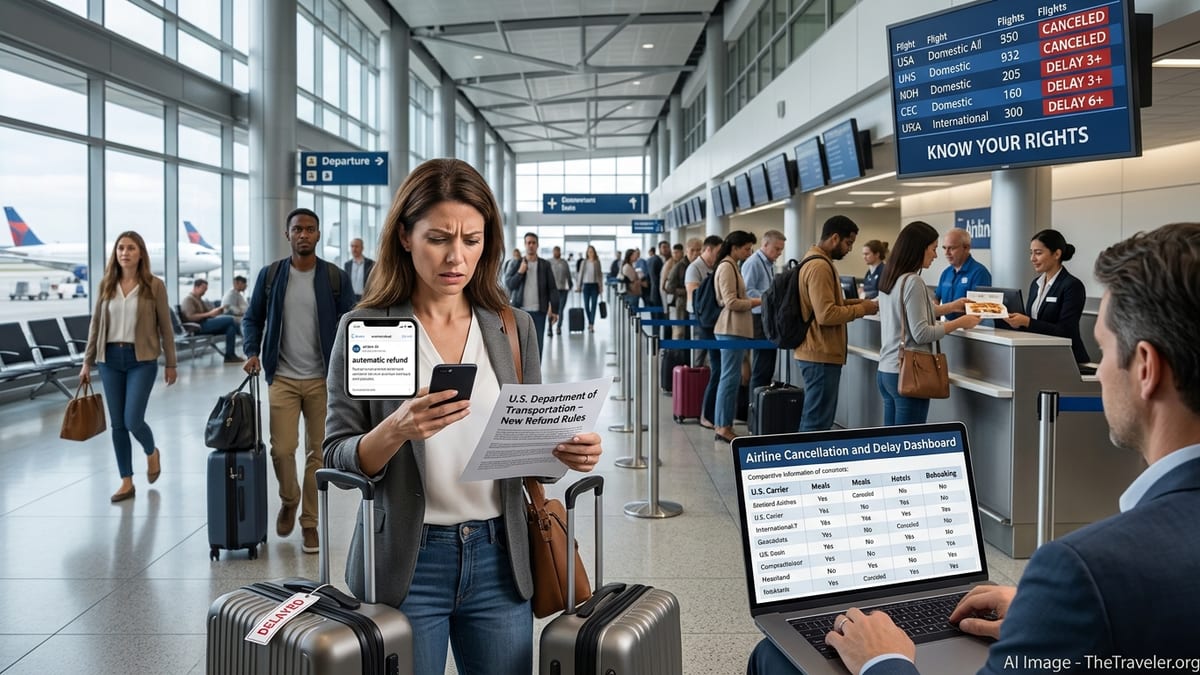
What the new automatic refund rules actually guarantee
The most significant recent change for U.S. air travelers is a federal rule that defines when passengers are entitled to a refund and requires airlines to issue it automatically. For flights to, from or within the United States, if a carrier cancels a flight or makes a significant schedule change and you do not accept the revised itinerary, you are entitled to get your money back rather than a voucher. The U.S. Department of Transportation has now set a clear benchmark for delays: if a domestic flight is scheduled to arrive three hours or more late, or an international flight six hours or more late, and you decline the changed trip, you qualify for a refund of the unused airfare and government taxes.
The automatic-refund requirement applies to disruptions on or after May 16, 2024. Airlines must notify passengers that they are eligible for a refund when a qualifying cancellation or significant delay occurs and process the refund without requiring repeated requests, as long as the traveler does not accept rebooking, a credit or other compensation. The rule covers both nonrefundable and refundable tickets, and applies whether the problem is within the airline’s control, such as a crew scheduling issue, or outside it, such as severe weather or an air traffic control ground stop.
Refunds under this rule are limited to what you paid the airline or ticket seller for the transportation you will not use. They do not automatically cover knock-on expenses such as a prepaid hotel at your destination, a rental car you can no longer pick up, or extra meals purchased during the delay. Those costs fall into a separate category that depends on airline policies, optional insurance, and in some cases credit card coverage.
Meals and hotels: a patchwork of airline promises
Unlike refunds, there is no U.S. federal law requiring airlines to provide hotel rooms or meal vouchers during disruptions. Instead, carriers publish their own commitments, which they also summarize on a public “Airline Cancellation and Delay Dashboard” maintained by the Department of Transportation. That dashboard focuses on problems considered within an airline’s control, such as maintenance issues, crew availability or internal technology failures, and spells out whether each large U.S. carrier will provide complimentary meals, hotel accommodation and ground transport for affected passengers during significant delays or cancellations.
Most major U.S. airlines now commit to offering at least meal vouchers for substantial controllable delays and to covering hotel rooms when an overnight stay is required away from a traveler’s home city for a disruption within the carrier’s control. For example, Delta states in its customer commitments and internal irregular-operations policies that when an event within its control leads to a lengthy delay or cancellation, it will attempt to reroute or rebook travelers and, in some cases, pay for hotel accommodation, ground transportation and meals. If Delta cannot secure a room from its contracted hotels during a controllable overnight disruption, the airline’s policy provides for reimbursing reasonable hotel and transport expenses that passengers arrange themselves, subject to documentation and limits.
These commitments, however, generally do not apply when the disruption is attributed to weather, air traffic control restrictions, airport closures or security events. In those cases, airlines may provide meals or hotel rooms as a courtesy, but they are not obligated to do so and many state explicitly that accommodation will not be covered for weather-related cancellations. Because the boundaries between a weather event and a controllable operational decision can be complex, travelers often need to ask agents how a delay is being coded and check the airline’s written policy or dashboard entry before assuming that a hotel will be paid for.
How airline policies differ and what that means at the airport
Even among the largest U.S. carriers, the exact conditions that trigger a meal voucher or hotel stay can differ. Some airlines specify that a wait of at least three hours after the originally scheduled departure time during a controllable delay is needed before a meal voucher will be issued, while others have shorter or less clearly defined thresholds. For hotels, many commit to covering an overnight stay only when the passenger is away from home and has not yet reached their final ticketed destination, so someone whose return flight is canceled in their home city is less likely to receive a paid room.
The DOT dashboard indicates whether each airline will provide a meal or meal voucher, a complimentary hotel room and ground transport between the airport and hotel when a cancellation or lengthy delay is considered within the carrier’s control. It also highlights policies on rebooking, such as whether the airline will place you on a partner carrier at no additional cost when its own flights are full after a controllable disruption. The government does not dictate the content of these policies, but it does require airlines to submit and display them in a way that allows consumers to compare what they can expect from different carriers before booking.
In practice, when a disruption hits, obtaining what you are entitled to often comes down to communication and documentation. Airline staff may prioritize rebooking first and address hotel and meal needs later, particularly during large-scale events. Travelers who know in advance that their carrier provides a hotel room and meal vouchers for specific types of delays can reference the published commitment when speaking with agents. Keeping receipts for any expenses incurred while waiting for an official voucher or decision is also important, because some airlines will reimburse reasonable costs afterward when they were unable to provide their usual amenities in real time.
When credit cards and insurance step in
Beyond what airlines and federal regulations provide, some travelers have another layer of protection through their credit cards or separate travel insurance. Many premium travel rewards cards issued in the United States include trip delay or trip interruption benefits when cardholders use that card to pay for their airfare. Trip delay coverage typically reimburses reasonable expenses such as meals, hotels and local transportation when a covered delay exceeds a set threshold, often between six and twelve hours or requiring an overnight stay. The specific covered reasons and exclusions vary, but in many policies, airline-caused maintenance delays and even some weather disruptions qualify as long as the delay exceeds the time limit.
Trip interruption coverage is broader and can reimburse nonrefundable prepaid expenses such as hotel stays or tours if a trip is cut short for reasons listed in the policy, which may include illness, injury, severe weather, natural disasters at the destination, or certain strikes and shutdowns. Some credit card protections are secondary to airline compensation, meaning they will cover only what the carrier does not provide, while others pay regardless of what the airline offers. To claim these benefits, travelers must usually file within a specified period, provide detailed receipts and proof of the disruption, such as airline delay messages or boarding passes, and meet any minimum-spend or maximum-benefit limits outlined in the card’s guide to benefits.
Standalone travel insurance policies sold by insurers or booking sites can offer similar protections, but with their own conditions and coverage ceilings. Unlike the DOT refund rule, which applies automatically when criteria are met, these private products are contractual and can exclude certain causes of disruption, such as anticipated storms or known labor disputes that were public before the policy was purchased. For any traveler relying on insurance or card benefits to cover meals or hotels during delays, the key is to confirm the exact trigger times, covered reasons and claim requirements before departure, rather than assuming all delays are treated equally.
Why there is no cash delay compensation and what travelers should check next
Earlier in the decade, the Transportation Department under the previous administration explored a more aggressive approach that would have required airlines to pay cash compensation when major delays or cancellations were within their control, in addition to providing meals and hotels. Draft outlines for that proposal contemplated compensation in the range of a few hundred dollars for domestic flights arriving three to six hours late, with higher payouts for longer delays, loosely echoing compensation regimes in parts of Europe. However, in November 2025 the department formally withdrew that plan, stating that its earlier outline was not the best reading of its statutory authority and that it would instead focus on enforcing existing refund rights and highlighting voluntary airline commitments through tools such as the dashboard.
As a result, there is still no federal requirement for U.S. airlines to pay cash solely because a flight they control is badly delayed, as long as they eventually operate the flight. Passengers are entitled to refunds only when they choose not to travel after a cancellation or significant delay that meets the DOT’s thresholds, or when optional services such as seat selection, baggage or onboard Wi-Fi are not provided. The only cash-like compensation most travelers will see for long waits is what they can obtain through airline goodwill gestures, frequent flyer miles, vouchers, credit card benefits or insurance. That leaves the United States with a system centered on refunds and voluntary commitments rather than mandatory delay payments.
For travelers planning trips around busy periods such as Thanksgiving or year-end holidays, the most practical step is to verify three things before departure: first, whether their airline’s current policies on meals, hotels and rebooking for controllable disruptions match their expectations; second, whether the credit card used to buy the ticket includes trip delay or interruption coverage and under what conditions; and third, how to quickly document any disruption should they need to claim a refund or reimbursement later. Because airline policies and card benefits can change and may differ depending on the type of ticket, taking a few minutes to check the latest terms and to save copies or screenshots can make the difference between absorbing unexpected expenses and having a clear path to getting at least some of that money back.