


More news on this day
Delta Air Lines says it has resolved an automation problem in the system that calculates aircraft weight and balance, after the fault triggered a Sunday ground delay program for flights into Atlanta and caused widespread disruptions to its network just days before the busy U.S. Thanksgiving travel period.
Get the latest news straight to your inbox!
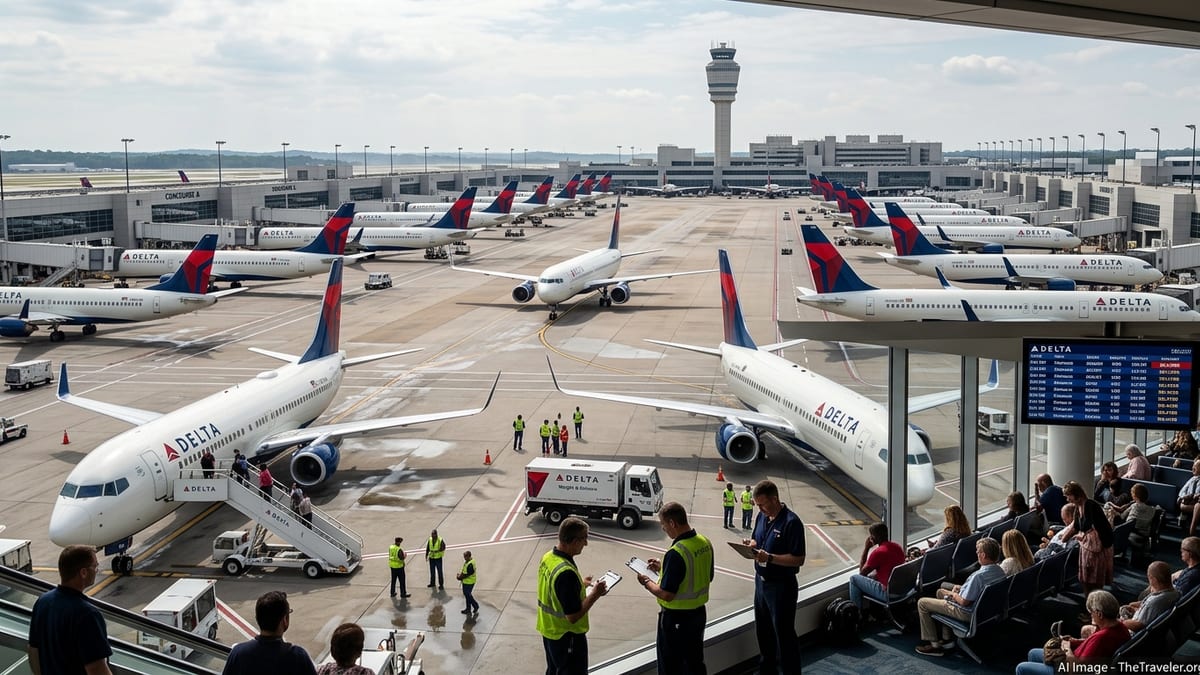
What happened to Delta’s operations in Atlanta
The disruption began on Sunday, November 22, when Delta reported issues with the automated system it uses to calculate weight and balance figures required before departure. The problem primarily affected operations at Hartsfield-Jackson Atlanta International Airport, the carrier’s largest hub, but knock-on delays were recorded across the United States as the airline slowed departures while technicians worked on the fault.
As the issue unfolded on Sunday morning, Delta requested a ground delay program for its flights bound for Atlanta. The Federal Aviation Administration briefly held some Delta-operated arrivals while the airline addressed the problem and prevented congestion at the hub. The FAA lifted the Atlanta ground delay for Delta flights late Sunday morning, around 11:25 a.m. local time, once Delta’s systems were functioning well enough to resume more regular flows.
Although the automation fault was technical and internal to Delta, its impact was felt by passengers at multiple airports. Aircraft already boarded in cities such as Atlanta, New York and Philadelphia sat at gates while flight crews waited for final weight-and-balance performance numbers from the airline’s systems or resorted to manual calculations and paperwork before pushback.
Scale of the delays and how long they lasted
Once the problem was identified, the disruption escalated quickly because weight and balance clearance is required for every departing flight. By Sunday afternoon, flight-tracking services were reporting that a majority of Delta’s schedule was running late. One widely cited data provider noted more than 1,000 delayed Delta flights that day, including a significant share of departures and arrivals at Hartsfield-Jackson Atlanta International Airport, and local media in Atlanta reported that roughly 1,200 flights at the airport were delayed at one point on Sunday.
Delta said on Sunday that it had resolved the issue with its weight and balance system and that the automation was working again. However, the operational consequences did not end immediately. Once the root cause was fixed, the airline still faced aircraft and crews out of position, congested gates at its Atlanta hub and a backlog of passengers whose earlier flights had been delayed or missed. Airport officials and airline representatives described Sunday’s knock-on disruption as continuing into the evening, even though the underlying system had been restored.
On Monday, November 23, local outlets and aviation analytics firms reported that conditions at Atlanta were improving but not yet fully back to normal. Some Delta passengers still encountered delays and scattered cancellations as the airline worked through leftover congestion from the weekend and moved aircraft back into their planned rotations. Airports outside Atlanta that are heavily served by Delta, such as Detroit and Minneapolis, also saw residual delays on Monday tied to aircraft and crew availability.
How this issue differed from wider U.S. aviation outages
The weekend incident at Delta came shortly after a separate nationwide disruption on November 13, when a problem with the Federal Aviation Administration’s telecommunications network forced a temporary ground stop affecting multiple U.S. airlines. That earlier outage, linked to hardware work on the FAA’s systems, halted or delayed thousands of flights across carriers. By contrast, the Atlanta delays tied to Delta on November 22 were caused by an internal airline system and not by air traffic control or airport infrastructure.
Because this latest issue was confined to Delta’s own weight and balance automation, other airlines at Atlanta and across the country were generally able to operate more normally on Sunday, aside from some air-traffic flow restrictions while the FAA managed traffic into the busy Atlanta airspace. For Delta, however, the fact that the problem centered on pre-departure performance calculations meant that almost every part of the day’s schedule was touched in some way, from early-morning departures at smaller outstations to transcontinental and international services relying on Atlanta connections.
Travelers might also recall that technology-related disruptions at large U.S. airlines have become more visible in recent years, but each event has had different technical roots. In this case, available public information points to an automation fault linked specifically to weight and balance procedures, not to customer reservations, crew scheduling or broader airport systems. Regulators and the airline have not indicated that the November 22 issue posed a safety risk; rather, it prevented crews from receiving required data in the normal automated way, which then slowed departures while backup methods were put in place.
Impact on Thanksgiving-week travelers using Atlanta
The timing of the disruption amplified its impact. Atlanta’s airport and Delta had already been preparing for an intense travel period running from November 19 through December 1, with local authorities projecting more than four million passengers to move through the hub over those 13 days. Sunday, November 22, fell at the start of the main Thanksgiving outbound rush, when many travelers head to family gatherings or begin longer holiday trips.
On Sunday, some passengers at Atlanta and other airports reported extended waits on board aircraft, shifting departure estimates and missed connections as they tried to reach their final destinations. In some cases, gate agents and flight crews told customers that performance numbers were being produced manually or were being sent from Delta’s operations center in Atlanta rather than via the usual automated process. A portion of Sunday’s passengers, particularly those with tight layovers through Atlanta, needed to be rebooked on later flights when delays made original connections unrealistic.
By Monday, the picture for travelers had begun to improve, but those booked with Delta through Atlanta still faced a heightened risk of delay compared with a typical day. Aviation data services and local media noted that while delays were becoming less severe, some flights were still departing behind schedule as the airline repositioned aircraft and cleared the remaining backlog. Travelers heading through Atlanta early in Thanksgiving week were advised by airports, airlines and government agencies to monitor their flight status closely, arrive early at the airport and be prepared for lines at security, check-in and concessions that were busier than usual for a Monday in November.
What Delta flyers should know over the coming days
With the automation fault now fixed, Delta’s published schedules remain in place for the rest of the Thanksgiving period, but operational recovery can lag the technical repair of a system. Industry guidance and Delta’s own public statements indicate that the carrier expects operations to progressively normalize through Tuesday, November 24, provided there are no new technology problems or major weather disruptions in key hubs.
Passengers traveling with Delta over the next several days, especially those connecting through Atlanta, should continue to check their flight status on the airline’s app or departure boards before leaving for the airport, even if their itinerary has not yet shown a change. Because some aircraft and crews were displaced during Sunday’s disruption, last-minute gate changes, aircraft swaps or modest schedule adjustments remain possible as the airline fine-tunes its recovery. Travelers with tight connections through Atlanta may want to review whether later onward flights are available as a backup in case inbound services run behind schedule.
For those whose trips were significantly affected on Sunday or Monday, Delta’s standard policies for delays and missed connections apply. Depending on the length and cause of a delay, the airline may offer rebooking options and, in some cases, vouchers or hotel assistance, but eligibility varies by circumstance and jurisdiction. Travelers planning future trips that connect through Atlanta during busy periods such as Thanksgiving week can draw one practical lesson from this episode: when possible, building in slightly longer connection times and keeping the airline’s contact channels handy can make it easier to adapt if an unexpected system issue slows departures again.