


More news on this day
Behind every weather delay in U.S. airspace sits a tightly choreographed system linking FAA traffic managers, meteorologists and airline operations teams who must keep flights safe while limiting disruption for millions of travelers.
Get the latest news straight to your inbox!
Why weather causes so many U.S. flight delays
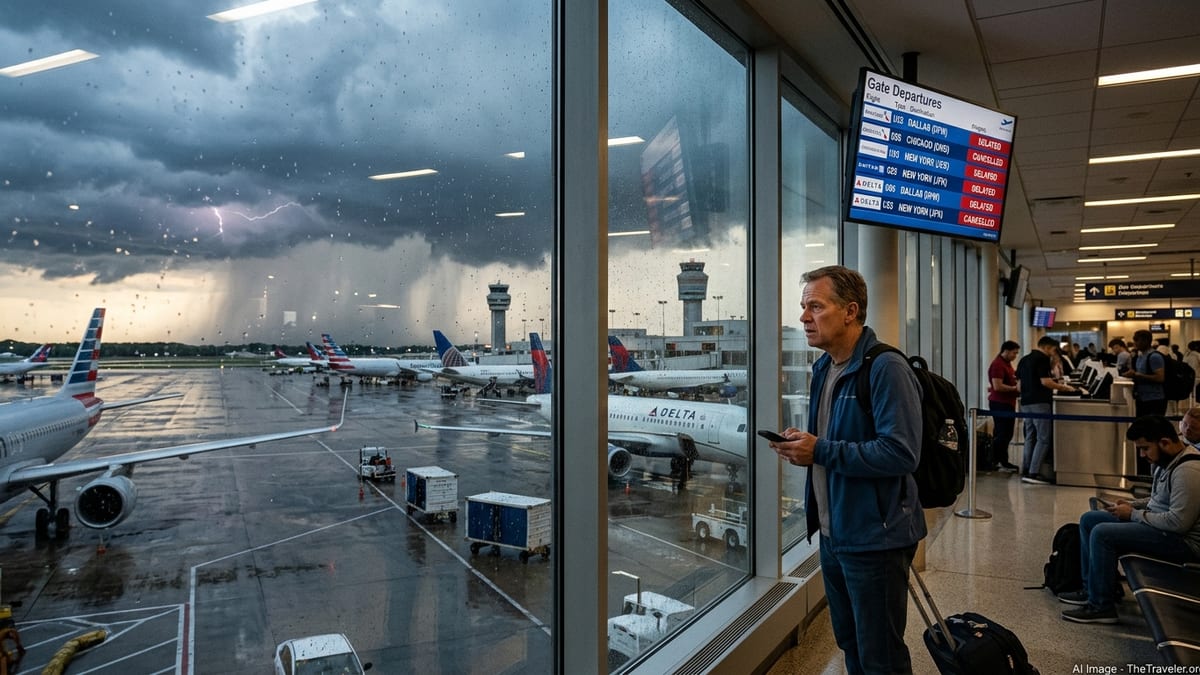
In the United States, weather remains the single biggest cause of air traffic delays in the national airspace system, according to the Federal Aviation Administration. Thunderstorms, low clouds, fog, snow, ice and high winds can all reduce the capacity of a runway, terminal airspace or an entire region by forcing controllers to space aircraft further apart, change runway configurations or temporarily stop operations. This reduced capacity, rather than the presence of bad weather itself, is what generates most reportable air traffic delays.
The FAA’s Operations Network defines an air traffic delay as an instrument flight rules flight held 15 minutes or more because air traffic control detains the aircraft at the gate, on the taxiway, on the runway or in holding en route. Many airline delays that passengers experience never show up in these statistics because they are attributed instead to airline issues such as maintenance, crew availability or late-arriving aircraft. When severe convective weather or low visibility hits a major hub, however, traffic management initiatives that the FAA applies to protect safety quickly ripple through the network and show up as weather-related delays across multiple airports.
Convective storms in particular are a central challenge. A line of thunderstorms can block the main arrival corridors feeding a hub airport or shut down large blocks of en route airspace. Controllers may be technically able to land aircraft during a storm, but if standard arrival routes are blocked or turbulent cloud tops extend above typical cruising altitudes, capacity at the affected airport falls sharply. The result is a need to meter demand into that constrained airspace, which is where the FAA’s formal severe-weather traffic management process begins.
Step one: strategic planning hours before storms form
The first step in managing weather-related delays happens long before thunderstorms appear on a pilot’s radar screen. Each day, traffic managers at the FAA’s Air Traffic Control System Command Center in Warrenton, Virginia, hold planning conferences with regional centers, selected major terminals and airline operations centers. Using National Weather Service and FAA NextGen Weather products, they review forecast convective activity, low ceilings, crosswinds and other hazards that could reduce capacity at key airports or along heavily traveled routes during the next several hours.
This phase is described by the FAA as strategic traffic flow management. Command Center staff compare forecast weather impacts with the expected demand from filed and historical flight plans. If they see that storms are likely to restrict routes into a region such as the New York area or the airspace around a hub like Dallas Fort Worth, they begin drafting operational plans and, when needed, severe weather avoidance plans. These plans specify which airspace is expected to be affected, when capacity constraints are likely to begin and what alternative routes or constraints might be needed.
Strategic planning also relies on time based management tools and the broader NextGen modernization effort. Systems such as the Traffic Flow Management System, Time Based Flow Management and the newer Flow Management Data and Services platform use forecast weather and demand to model how much traffic a runway or airspace sector can handle at specific times. The goal at this stage is not yet to delay individual flights, but to choose the least disruptive combination of future measures so that if the forecast verifies, safety is maintained with the smallest possible impact on travelers.
Step two: implementing traffic management initiatives in real time
Once storms or other adverse conditions begin to develop, planning moves into tactical traffic flow management. During this step, the Command Center and local traffic management units at air route centers and towers activate specific traffic management initiatives, or TMIs, based on the latest radar, satellite and surface observations. These initiatives are essentially tools that change how much traffic can enter a piece of airspace, when those flights depart and which routes they use.
For arrivals into a constrained airport, one of the main tools is a ground delay program. In a ground delay program, the Command Center assigns controlled departure times to flights bound for a specific location so that demand at the arrival airport matches the reduced arrival rate that controllers can safely handle in the weather. Rather than allowing flights to take off and then stack in airborne holding patterns, aircraft are held at their departure airports until their assigned slot time. Similar concepts are used for en route constraints through an airspace flow program when weather reduces the capacity of a busy corridor rather than a single airport.
When conditions deteriorate more sharply than forecast or a runway or airspace sector must be shut down entirely, the FAA can impose a ground stop. Under a ground stop, affected flights are prohibited from departing for a specified airport or region until conditions improve or a new plan is developed. Ground stops are often short and highly localized, but occasionally, as seen in recent nationwide ground stops triggered by technical issues, they can halt departures for hours and strain the entire network. Even when the original constraint is resolved, aircraft and crews are out of position, which extends delays for passengers well beyond the period of the stop itself.
Other tactical measures used around weather include miles in trail spacing, where controllers increase the distance between aircraft along a route; reroutes that steer flows around storm cells; and altitude changes to avoid turbulence or icing. Time based metering adjusts aircraft speeds and sequencing hundreds of miles from their destinations so that they arrive at precisely scheduled times, reducing the need for holding near the airport. These initiatives are updated frequently as weather evolves, which is why passengers can see their estimated departure times change several times during an event even though local conditions may appear similar out the window.
How airlines plug into FAA decision making
While the FAA controls the airspace, airlines play a central role in how weather-related constraints translate into actual passenger delays and cancellations. Through a framework known as Collaborative Decision Making, airline operations centers receive real-time data from FAA traffic flow systems and participate in planning calls about upcoming constraints. When a ground delay program is activated for an airport, the FAA issues a series of controlled departure times for all affected flights, and each airline decides how to assign those slots across its own schedule.
These choices give airlines some flexibility in protecting the most heavily booked or operationally critical flights, but they also mean that two carriers can experience the same weather event very differently. One airline might preemptively cancel a portion of its schedule into a storm affected hub to preserve recovery capacity for the next day, while another may try to operate more of its flights and accept longer delays. Carriers also make their own decisions about whether to pause boarding when a thunderstorm with lightning is overhead, how to staff deicing operations and how aggressively to rebook passengers, all of which affect what travelers experience on the day.
Once a traffic management initiative is in place, airlines and the FAA continue to exchange data to refine it. Surface data from airlines about actual gate-out and takeoff times feed back into traffic flow automation, while updates from NextGen Weather systems on storm movement help traffic managers determine whether they can raise the arrival rate or need to extend a program. In recent holiday periods, federal officials have pointed to these data driven tools and enhanced collaboration as part of broader efforts to limit avoidable delays and cancellations, even as weather and technical outages continue to test the system.
What travelers can expect and how to prepare
For travelers, one of the most confusing aspects of weather-related delays is that the worst problems may occur far away from any obvious storm. A line of thunderstorms over a hub several states away may trigger a ground delay program that gives an aircraft at a sunny origin airport a controlled departure time hours later than scheduled. Similarly, a temporary ground stop at a major hub can lead to rolling delays across the country as aircraft and crews struggle to return to their planned rotations. Understanding that many of these constraints are set nationally, rather than by the local airport, can help explain why gate agents sometimes cannot simply board and depart when the weather at that airport appears acceptable.
What happens next when a storm is forecast depends largely on how confident forecasters are about its timing and severity. If conditions are expected to significantly limit capacity at a busy airport during peak periods, traffic managers may schedule ground delay programs or route restrictions several hours in advance. Airlines typically respond by issuing travel waivers that allow passengers to change flights or dates without the usual fees when a major disruption is expected. When uncertainty is higher, managers may wait to see how storms evolve and then apply more localized holding, reroutes or ground stops, which can lead to shorter notice but more targeted delays.
Travelers facing an active or forecast weather event should monitor their flight status across both airline and airport channels and be aware that estimated times can shift multiple times as the FAA and airlines update their plans. Rebooking options during large disruptions are often constrained by the availability of seats and crews, especially around holiday peaks. Because many weather-related measures are applied systemwide to balance safety and efficiency, individual passengers and frontline staff have limited ability to override them. Verifying connection times, considering earlier departures on the same day when severe storms are forecast, and paying attention to airline advisories about schedule changes remain among the most practical steps travelers can take as the FAA and airlines work through the three-step process of planning, implementing and then unwinding weather-related flight delays.