


Izalco, Cerro Verde and Santa Ana form a tight volcanic complex at the heart of Los Volcanes National Park, protected for its dramatic craters, cloud forest and far‑reaching views. Cerro Verde itself is an extinct, forested cone and the park’s most developed sector, with viewpoints, gardens and short interpretive trails that frame the active silhouettes of Izalco and Santa Ana above Lake Coatepeque. For hikers with extra time beyond Santa Ana, or for travelers who prefer varied paths and miradores to a single summit, Izalco and Cerro Verde offer rewarding alternatives.
Get the latest updates straight to your inbox!
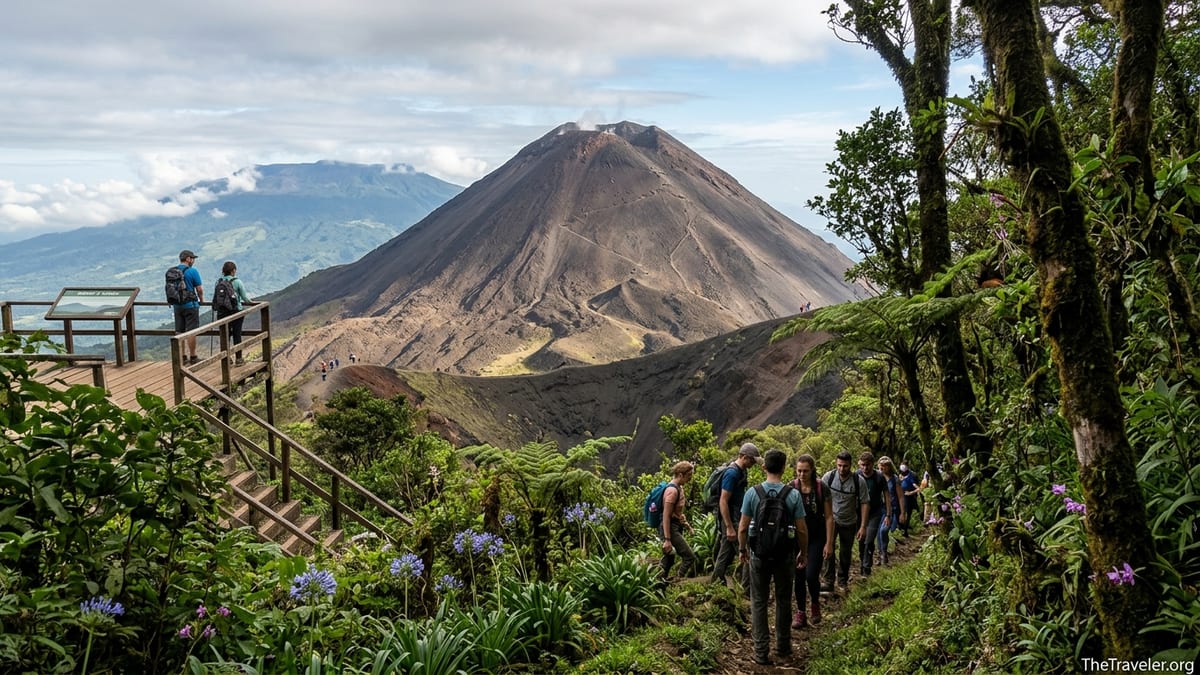
Understanding the Izalco–Cerro Verde Hiking Area
Los Volcanes National Park spans the upper flanks of three main features: the active Santa Ana (Ilamatepec) volcano, the younger cinder cone of Izalco, and the forested Cerro Verde plateau in between. The park is administered by El Salvador’s environment ministry in coordination with tourism authorities, and most visitors experience it through the Cerro Verde sector, reached by a paved access road from the Pan-American Highway. From here, you can look directly across at the dark, conical bulk of Izalco, its lava fields dropping toward the coffee country below.
Cerro Verde functions as both a natural viewpoint and a recreational park. Within a compact area, it concentrates parking, ranger presence, small eateries, gardens, playgrounds and several waymarked trails that loop through cloud forest and past miradores. From the same plateau, longer guided routes leave for the summits of Izalco and Santa Ana. This set-up allows travelers with very different fitness levels to travel together, then split between a demanding ascent and gentler walks without complicated logistics.
For planning purposes it is useful to think of the area in layers. At the core is the Cerro Verde visitor zone and its short interpretive circuits. Radiating out, the Izalco route drops steeply before climbing the volcanic cone, while additional sectors of the park provide more remote access to Santa Ana. Conditions, rules and guiding policies on these routes are periodically adjusted in response to volcanic monitoring, weather and maintenance budgets, so writers and travelers alike should always verify current details shortly before a visit.
Izalco Volcano Hike: Demanding Slopes and Big Views
The Izalco volcano hike is the park’s most physically demanding classic route. Most recent accounts describe it beginning from the Cerro Verde plateau, where hikers descend a long series of concrete and earthen staircases that cut down the forested saddle toward Izalco’s base. This descent can feel deceptively easy at the start of the day, shaded by trees and cooled by Cerro Verde’s misty air, but every step lost in elevation needs to be clawed back at the end of the hike.
Once past the main descent, the trail breaks out of the forest onto open volcanic terrain. Here, the route steepens across loose scree, ash and jagged rocks, sometimes weaving between old lava flows. Recent hikers consistently describe an exposed climb under strong sun, with limited shade and heat radiating off the dark surface. Compared with Santa Ana, Izalco generally feels hotter and more barren, with less variation in scenery but a rawer sense of walking directly on a volcanic cone.
Under typical conditions, reasonably fit hikers may take a couple of sweaty hours to reach the upper slopes, moving at the pace set by the guide and the slowest group members. Footing can be unstable, particularly on the steeper pitches near the top where volcanic gravel tends to slide underfoot. Walking poles can help on both ascent and descent, though some local guides may prefer that visitors keep their hands free. On the way back, the long staircase back up to Cerro Verde usually delivers the final test: many hikers report this forested re-ascent feeling harder than the open cone itself.
Because Izalco is an active volcano in a protected area, access to its upper slopes has never been completely static. In some years, erosion, rockfall, storm damage or heightened monitoring alerts have led to the summit area being partially or fully closed, or to hikes turning around at safer intermediate viewpoints. A responsible writer should therefore avoid promising a specific high point and instead instruct readers to check, close to their visit, whether the current route reaches the true summit area, a shoulder viewpoint, or only a lower ridge.
Guides, Departures and Regulations for the Izalco Route
Guiding and group policies on Izalco have evolved over time, and they can shift again in response to safety reviews. Recent public information from tourism authorities and park partners indicates that, in normal periods, walks to Izalco operate with local guides and sometimes with an accompanying tourism police presence, leaving from the Cerro Verde visitor area after the daily Santa Ana departure. However, the exact requirements are not constant, so any new description should be explicitly time-stamped and based on fresh confirmation.
When updating logistics, writers should verify several operational points directly with official channels or the on-site operator. First, clarify whether guided groups are currently mandatory for Izalco and if independent access is prohibited even for experienced hikers. Second, confirm the exact meeting point and standard departure time for the day’s Izalco hike from Cerro Verde, along with the approximate return time. It is also worth asking about minimum and maximum group sizes, as tours may only run if enough participants sign up or may cap numbers to reduce erosion and keep groups manageable.
Fees for Izalco typically layer onto the general park entry charge. Before publication, confirm the current base entrance fee for Los Volcanes National Park for national visitors, residents and foreigners, plus any parking fee per vehicle. Then verify whether Izalco involves an additional guide fee per person, a flat group fee, or a combination, and whether payment is handled at a park ticket booth or directly with guides. Authors should avoid quoting exact figures unless recently confirmed and instead provide ranges or examples with a clear “at the time of writing” note.
It is also essential to clarify under what conditions the Izalco route can be suspended. Park administrators and civil protection agencies may close or shorten the hike in response to heavy rain, electrical storms, strong winds, landslides along the staircase, or changes in volcanic monitoring data. A good practice is to recommend that readers check the latest advisories from the environment ministry or tourism authorities during the rainy season and that they build flexibility into their itinerary in case the cone is temporarily off limits.
Cerro Verde’s Short Trails and Viewpoints
By contrast, Cerro Verde’s own trails offer a gentler, greener experience that suits families, casual walkers and travelers who prefer frequent viewpoints to one big summit push. The plateau sits in a cool, often misty cloud forest, with temperatures that tend to run significantly lower than the lowlands even at midday. Paths thread through tree ferns, mossy trunks and hummingbird-friendly flowers, occasionally breaking at miradores that frame Izalco’s cone, Santa Ana’s broad massif and the blue sweep of Lake Coatepeque.
The main named routes form a compact network of interpretive trails. Las Flores Misteriosas leads through dense vegetation that highlights the area’s orchids and other characteristic flowers. Una Ventana a la Naturaleza typically combines forest walking with breaks at viewpoints, introducing visitors to both native flora and sweeping panoramas. A third route, often referred to as the Antiguo Hotel de Montaña trail or loop, circles around the historic hotel terraces and miradores on the edge of the plateau, offering some of the most iconic vistas toward Izalco.
Typical walking distances on these circuits are relatively short. Recent visitor-oriented descriptions place individual loop lengths roughly in the one to two kilometer range, with relaxed walking times of 30 minutes to about an hour per trail, depending on pace, photo stops and guide interpretation. Elevation changes are modest compared with the volcano ascents, and much of the surface is compacted earth or simple steps rather than loose rock. Although there are some stairs and roots to negotiate, most reasonably mobile visitors, including older children and adults who do not regularly hike, can complete at least one or two of the loops without difficulty.
As with Izalco, precise details can change over time, especially where trail maintenance, storm damage or small landslides are concerned. Before describing a specific route, writers should confirm which of the interpretive paths are currently open, whether any are operating only in one direction, and if guided accompaniment is now required on sections that were once self-guided. It is also worth checking whether interpretive signage is in good condition and bilingual, or whether visitors will rely mainly on live explanations from guides.
Trailheads, Access and On‑Site Services at Cerro Verde
Practically all these hikes begin from the same general hub: the Cerro Verde visitor area on the main plateau. Travelers usually arrive via the road that climbs from the Pan-American Highway past coffee fincas to the park gate, either by private vehicle, locally organized excursions or a combination of regular intercity buses and a rural route that continues to the park entrance. For hiking-focused readers, it is enough to note that Izalco, Santa Ana and the shorter Cerro Verde walks all branch out from this same starting zone, simplifying logistics for mixed-ability groups.
Within the visitor area, trailheads are typically clustered a short walk from parking. Paths to Las Flores Misteriosas, Una Ventana a la Naturaleza and the Antiguo Hotel de Montaña generally set off from near the main plaza, gardens and lookout terraces, sometimes passing a small playground and picnic lawns before entering denser forest. The Izalco stairs also begin from this plateau, descending away from the same cluster of facilities. Signage may mark the start of each route, but visiting writers should check whether current signs are clear, and whether guides customarily lead all first-time visitors even on the simple loops.
Cerro Verde is one of El Salvador’s more developed natural parks, and recent descriptions list services such as maintained toilets, a cafeteria or small restaurant, snack kiosks on busy days, basic picnic areas, parking lots and a staffed ranger station or information point. The offer, however, is not identical every day of the week or every month of the year. For accurate travel writing, confirm current opening hours for the park gate and main facilities, whether food service operates daily or only on weekends and holidays, and if official guides are always on-site or only at set times.
Some accommodations and private ventures operate within or near the Cerro Verde sector, including lodgings with their own viewpoints and restaurants accessible by foot from the main park area. These businesses can extend options for sunrise or sunset viewing, but they may also have their own access rules independent of the national park schedule. Writers should therefore make a clear distinction between publicly managed park services and private facilities, encourage readers to confirm which are open in the season they plan to visit, and avoid assuming that any specific restaurant or lodge operates year-round.
Safety, Conditions and Preparedness
Conditions on Izalco and Cerro Verde differ sharply, so safety and gear recommendations should be tailored rather than generic. The Izalco route, with its combination of long stair descent, hot, exposed slopes and loose volcanic rock, demands solid fitness, particularly in the legs and knees. Sturdy closed-toe footwear with good grip is essential; lightweight hiking shoes or boots are preferable to casual sneakers, especially for the scree sections. Travelers with a history of knee trouble should think carefully before committing, as the return climb up the staircase can be punishing when already tired.
Heat and sun exposure on Izalco are often underestimated by visitors coming straight from Cerro Verde’s cool mist. Once past the forest, there is little natural shade and the dark surface radiates warmth even on hazy days. Writers should emphasize the importance of carrying sufficient water, wearing sun protection such as a hat and high-SPF sunscreen, and pacing oneself on the steeper stretches. On dry days, fine ash can also become slippery on descent, so guides may recommend a zigzagging technique and careful foot placement to avoid falls.
On Cerro Verde’s forested paths, the main challenges are different. The cooler air, frequent cloud cover and occasional drizzle can lull visitors into underestimating how quickly conditions may change. Trails can become muddy and slick after rain, with roots and wooden steps turning slippery. Light to medium hiking footwear with some tread is usually adequate, but sandals are best avoided. A compact waterproof layer and a light warm layer are wise even on seemingly bright mornings, as temperatures can drop when fog banks roll in or if a shower passes through while you are at a viewpoint.
Across both areas, writers should encourage hikers to follow local guidance closely. Weather patterns, volcanic monitoring reports and trail maintenance status all influence what is safe on a given day. It is particularly important to consult the latest official statements on volcanic activity for Izalco and neighboring Santa Ana when updating any description of risk. National environment and civil protection agencies publish alerts and bulletins; a responsible travel feature should reflect their current assessments, avoid sensationalism and remind readers that rules such as mandatory guides or temporary closures exist to protect both visitors and the fragile volcanic landscape.
Choosing Between Izalco and Cerro Verde’s Trails
With three distinct options in a compact park, the key question for many readers is how to allocate their limited time and energy. Izalco appeals most to hikers with strong legs who relish a demanding outing and the feeling of treading on a raw volcanic cone. Cerro Verde’s short interpretive trails, on the other hand, suit travelers who value variety of viewpoints, birdlife and cool forest ambiance over the bragging rights of a long, steep climb. Given that Santa Ana is often the first choice for a full volcano ascent, Izalco and Cerro Verde can be seen as complementary rather than competing experiences.
For visitors with just one day in the area and moderate fitness, it usually makes sense to prioritize a single major summit, treating the shorter Cerro Verde loops as warm-ups or cool-downs rather than tackling Izalco on the same day. Those with two days and strong endurance can realistically combine one full volcano hike with an additional half-day on the cone of Izalco, sandwiching easier forest walks or restful viewpoint time in between to recover. Travelers arriving with children, multi-generational families or companions who are new to hiking are likely to get more enjoyment by focusing on Cerro Verde’s gentler paths and miradores, while leaving the steeper ascents for a future visit.
Ultimately, the decision comes down to matching terrain and conditions to the people in your group. If you or your readers are drawn to lava rocks, long staircases and a serious workout under the sun, Izalco offers a challenging but memorable outing when conditions and regulations permit. If what you crave is cool air, bird calls and frequent framed views of the greater volcanic complex without committing to hours of steep climbing, the network of trails on Cerro Verde delivers exactly that. Clear, up-to-date information on access, schedules and safety will help travelers calibrate expectations and choose wisely between these compelling corners of Los Volcanes National Park.