

Jordan is famous for its hospitality. Visitors are greeted with steaming glasses of sweet mint tea, invitations into family homes, and a constant chorus of "ahlan wa sahlan" that seems to follow you from the streets of Amman to the sandstone canyons of Petra. For many travelers, this warmth is disarming, especially if you come from places where strangers keep to themselves and unsolicited kindness sets off alarm bells. Learning to trust others while traveling in Jordan is less about letting your guard down completely and more about understanding the culture, reading situations, and building the kind of grounded confidence that lets you say yes when it feels right and no when it does not.
Get the latest updates straight to your inbox!
Understanding Jordan’s Culture of Hospitality
Trust in Jordan begins with recognizing just how central hospitality is to everyday life. In Jordanian culture, welcoming guests is not a small courtesy but a deeply rooted social obligation. The phrase you will hear everywhere, "ahlan wa sahlan," is more than "welcome". Roughly, it invites you to be at ease and treated as one of the family. You might hear it in a downtown Amman café when you ask for directions, or from a shopkeeper in Madaba who has nothing to sell you at all. This context matters, because what might feel like unusually intense friendliness to a visitor is, to many Jordanians, simply the proper way to treat a guest.
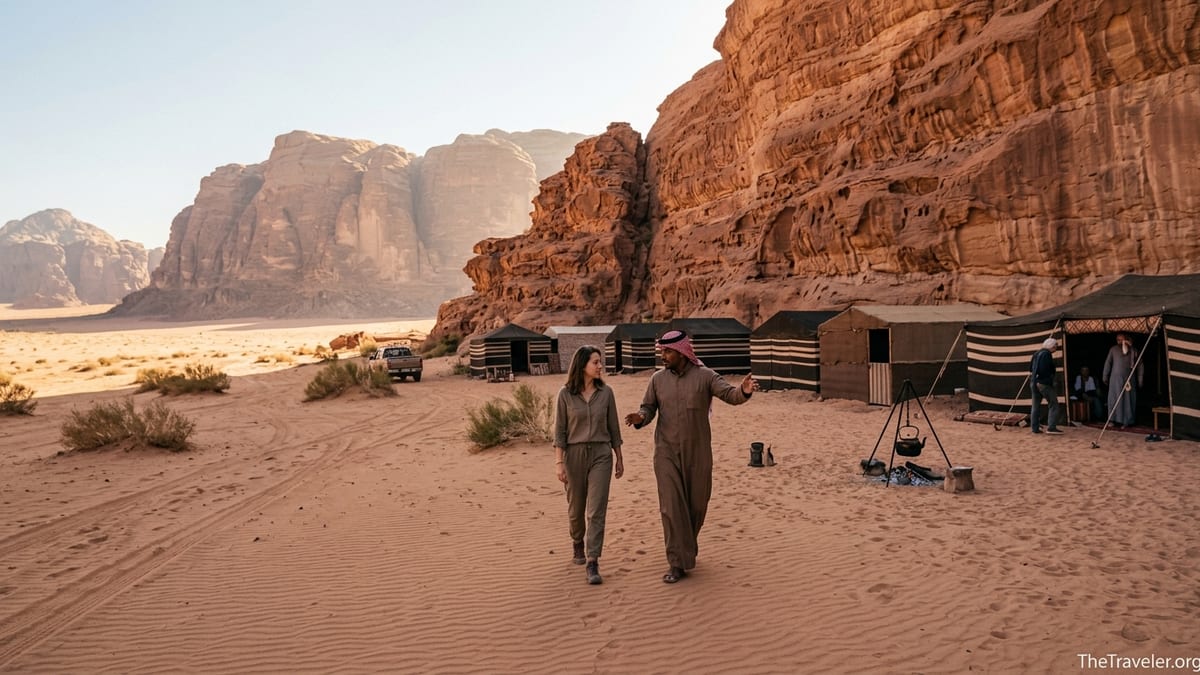
This hospitality is especially visible in areas where Bedouin culture remains strong, such as Wadi Rum and the surroundings of Petra. Many camps in Wadi Rum are still family-run, and hosting travelers is often an extension of the tradition of offering shelter and food to desert passersby. When you sit around a campfire in Wadi Rum, listening to your host talk about growing up between goat-hair tents and the village school, accepting a second cup of tea is not just politeness. It is participation in a social ritual that reassures your hosts that you feel safe and respected.
At the same time, Jordan is a modern country with a lot of contact with visitors. In Amman, for example, you may meet students who speak fluent English and are curious about life abroad, or taxi drivers who have learned how to chat with tourists in several languages. They may ask personal questions that feel forward by Western standards, such as whether you are married or how many siblings you have. In most cases, this is friendly small talk, not an attempt to probe your vulnerabilities. Understanding this helps you respond with calm politeness rather than automatic suspicion.
Recognizing these cultural patterns does not mean you should ignore your instincts. It does, however, help you distinguish between ordinary expressions of warmth and behavior that truly crosses a line. The more you understand what is normal in Jordan, the easier it becomes to build the right kind of trust: open, informed, and still alert.
Balancing Openness and Caution on the Road
Learning to trust others in Jordan, or anywhere, is about balance. Many travelers arrive with one of two extremes: assuming that everyone is their new best friend or assuming that everyone is trying to scam them. In practice, the safest and most rewarding path lies between these poles. For example, imagine you have just landed at Queen Alia International Airport near Amman late at night. You are tired, and a man approaches you in the arrivals hall, offering a taxi into the city for what he calls a "special price". If you accept without checking, you might end up paying two or three times the going rate. If you refuse all help outright, you will remain stressed and isolated. The middle ground is to politely decline informal offers and head to the official airport taxi stand, where prices are posted and trips are logged.
Once you are in the city, the same principle applies in smaller moments. A shopkeeper in Jabal Amman might offer you coffee while you browse handmade ceramics. Accepting a drink in a busy shop where other customers come and go is usually low risk and often leads to memorable conversations. By contrast, accepting a ride alone with a stranger who insists on taking you "somewhere better" than where you planned to go is rarely a good idea. Trusting people does not mean abandoning basic common sense; it means using it to choose where to say yes.
You can also give yourself structural protections that make trusting easier. Booking your first couple of nights through widely reviewed hotels or guesthouses in areas like Amman’s Rainbow Street, Wadi Musa for Petra, or Aqaba’s central district gives you a safe base and staff you can ask for advice. If a friendly local offers to show you around, you can check with your hotel reception: "Is this kind of offer normal? Does this person work with you?" This small step turns blind faith into informed trust.
Travelers who build routines find their anxiety drops quickly. In Amman, you might decide you will only take yellow street taxis that use the meter or rides booked through established ride-hailing apps. In Petra, you may decide that you will only hire registered guides from the visitor center rather than responding to unsolicited offers along the trail. Clear personal rules like these free up mental space. You do not have to debate every interaction from scratch, which makes it easier to relax and enjoy the many genuine connections Jordan offers.
Real Encounters: When Trust Enriches the Journey
Some of the most moving travel moments in Jordan happen when you choose to trust someone and it pays off. Consider a traveler who arrives in Wadi Rum for an overnight stay. She has booked a place at a small Bedouin-run camp and arranged for a pickup from the village. A young man in a dusty pickup truck appears, introduces himself as the cousin of her host, and invites her to climb in. In another context, this might feel risky. Here, she has the camp’s name, has exchanged messages with the owner, and the pickup time matches what they agreed. She confirms the camp name out loud, then rides into the desert. That night, she sits under the Milky Way, shares a communal meal cooked in a zarb pit oven, and listens as her hosts talk about grazing routes and sandstorms. The entire experience hinges on that decision to extend trust, backed by specific checks.
In Petra, many travelers meet local guides from families who lived in the caves around the site before the government relocated them to the village of Wadi Musa. One visitor might start chatting with a guide near the Treasury, impressed by his fluent English and deep knowledge of the Nabataean carvings. Instead of saying yes on the spot to an informal tour at an unclear price, she walks with him to the visitor center, where she can see his registration and agree on a fixed fee. The result is a day spent weaving through narrow trails to viewpoints above the Monastery, drinking tea in his family’s tent, and hearing stories that do not appear in guidebooks. Trust, in this case, becomes a bridge to learning, not just a transaction.
Even seemingly small acts of trust can change a trip. On a local minibus between Madaba and the Dead Sea, for instance, an older woman might notice you struggling with the driver’s Arabic and quietly step in to help, pressing a small piece of bread into your hand while she explains the fare. Or a young student in Amman might walk you an extra ten minutes to make sure you find the right café, refusing any payment but eager to practice English. When you allow these gestures in, while still keeping your valuables secure and your boundaries clear, you start to experience Jordan not just as a collection of sites but as a network of human relationships.
Of course, not every encounter will be perfect. You might agree to a quick "free" cup of tea with a merchant in a touristy part of Amman and then feel pressured to buy something afterward. These gray-zone experiences are normal and do not mean you were foolish to be open. Instead, they help you refine your own comfort levels and communication, making it easier to navigate the next invitation with more clarity and confidence.
Recognizing Red Flags and Common Pitfalls
Trust grows stronger when you know what to watch out for. Jordan is generally considered one of the safer countries in the region for visitors, yet, as in any destination, petty crime and opportunistic scams exist around busy tourist areas. In Amman, this might look like a taxi driver refusing to use the meter and naming a fare that is suspiciously high, or a stranger near a bus station insisting that tickets are sold out and steering you toward an expensive "private" alternative. In Petra or Jerash, it could be an unofficial guide who walks beside you uninvited, points out a few details, then demands payment for a "tour" you did not agree to.
One widely reported pitfall involves unregistered drivers waiting near popular sites such as Petra’s visitor center or the Wadi Rum village parking lot. A traveler, tired after a long hike or tour, might accept a ride without agreeing clearly on the price. At the destination, the driver demands a sum several times higher than what a licensed taxi would charge, sometimes using raised voices to pressure payment. You can often avoid this scenario by asking for a price upfront, comparing it with what your hotel or camp has told you is reasonable, and not entering the vehicle until you are comfortable. If you feel uneasy, it is fine to step back and say you will look for another option.
Another area to treat with caution is any offer that feels too intense, urgent, or emotional very quickly. If someone you have just met insists that you come to their home for dinner that same night, introduces you as their "best friend" after ten minutes, or pushes for personal contact details while ignoring your hesitation, pause. Genuine Jordanian hospitality tends to make room for your comfort. A host might say, "You are welcome any time," and accept a polite refusal. A person who ignores polite signals or attempts to make you feel guilty is not respecting the very values they claim to represent.
Romantic involvement is another space where boundaries matter. Some travelers, particularly solo women, report encounters with men who present themselves as attentive guides or drivers and then quickly shift into flirtation or declarations of strong feelings. While friendships and even relationships can develop naturally, any situation where someone uses their position as your guide, driver, or host to create emotional pressure deserves careful scrutiny. You are never obligated to reciprocate attention, stay in contact, or continue a tour if you feel your boundaries are being crossed. Trust that your discomfort is enough reason to step away.
Practical Strategies for Building Healthy Trust
Trust is easier to extend when you have clear, practical strategies for staying grounded. Before you arrive in Jordan, share your basic itinerary and accommodation details with a trusted person at home. Once on the ground, make it a habit to send a quick message when you change cities or embark on a full-day excursion, whether that is a jeep tour in Wadi Rum or a canyoning trip in Wadi Mujib. This simple routine does not limit your freedom; it increases your sense of security, which in turn makes you more relaxed when meeting new people.
Money management can also support healthy trust. Carry a small "day wallet" with only the cash you expect to need, and keep your main cards and extra cash stored securely in your accommodation or in a money belt under your clothing. When you negotiate taxi rides in cities where meters are not used, like some parts of Aqaba or smaller towns, agree on a price before getting in. If a driver in Amman refuses to turn on the meter, you can simply step out and flag another one. Over time, you will get a feel for typical fares between common points, such as downtown Amman and Abdali Boulevard or Wadi Musa and Petra’s gate, which makes it harder for anyone to overcharge you.
In interactions that involve ongoing contact, such as organizing a multi-day trek in Dana Biosphere Reserve or arranging repeated transfers with a driver, start small. Book a shorter segment first and see how it goes. Does the person arrive on time, listen to your preferences, and respect agreed prices? Do they answer questions directly? If the experience is positive, you will feel more comfortable extending the relationship. If not, you have lost only a small amount of time or money and can change plans. This gradual approach mirrors how trust builds in everyday life and serves you well on the road.
Language also plays a role. Learning a handful of Arabic phrases beyond "shukran" (thank you) can create connection while signaling that you are not entirely naive. Being able to say "khalas" (that is enough) or "la, shukran" (no, thank you) in a clear but friendly tone can end unwanted sales pitches without escalating tension. In Jordan, a firm but courteous refusal is often respected, especially when paired with a smile. The combination of basic language skills, calm body language, and steady eye contact can help you navigate offers gracefully and maintain trust with those who genuinely wish to help.
Solo Travel, Gender, and Trust Dynamics
Solo travelers in Jordan often discover that traveling alone can actually make it easier to build authentic connections. Locals may feel more inclined to start conversation with someone on their own, whether that is an elderly man pouring coffee in a roadside stall outside Karak or a family on a bus to Jerash who invites you to share snacks. At the same time, being solo may mean you attract more attention, and you will need to rely heavily on your own judgment. Many visitors, including solo women, report feeling generally safe in Jordan, especially in major tourist hubs like Petra, Wadi Rum, and the resort areas of the Dead Sea, provided they stay aware of their surroundings.
Gender expectations can influence how interactions unfold. In some conservative areas, you might notice that most visible workers in cafés and shops are men. Solo women may receive more looks or comments than they are used to at home, especially in bus stations or crowded markets. Much of this is curiosity rather than hostility. Simple strategies such as dressing a bit more conservatively than you might elsewhere, keeping shoulders and knees covered, and wearing loose clothing can reduce unwanted attention and signal respect for local norms. Traveling during daylight hours, especially between cities, adds another layer of comfort.
When deciding whom to trust as a solo traveler, public settings and third-party validation are your friends. Meeting a local for coffee in a busy Amman café is very different from accepting an invitation to a private apartment. Booking group day tours to places like Bethany Beyond the Jordan or the Eastern Desert Castles can give you company and structure without sacrificing spontaneity. Hotel staff in areas popular with foreign visitors are accustomed to helping solo travelers vet offers for desert tours, cooking classes, or homestays. Asking, "Have other guests done this?" or "Is this a licensed guide?" turns your decision from a leap of faith into a considered choice.
It is also important to notice your own biases. You might feel safer trusting other tourists who look and sound like you, but in practice, many travelers in Jordan find that local families, older women, and small business owners are some of their strongest allies. Being willing to trust beyond your comfort zone, while still applying the same safety criteria you would anywhere else, allows you to benefit from the care and watchfulness that many Jordanians naturally extend to guests.
Trusting Community-based & Bedouin Experiences
Community-based tourism projects across Jordan offer powerful opportunities to practice healthy trust. In the north, villages near places like Ajloun Forest Reserve host homestays where families open their homes to visitors for cooked meals and overnight stays. In the south, Bedouin-run eco-camps in Wadi Rum and guesthouses in Wadi Musa integrate tourism with local life, giving travelers a chance to learn about traditions around coffee, music, and storytelling. These businesses often grow out of extended families or cooperatives, which means your relationship is not just with one individual but with a broader community.
When choosing such experiences, research and reputation matter. Camps and homestays that have been running for several seasons and appear in multiple recent trip reports usually have a track record of treating guests well. Once you arrive, you may find that family members of different generations work together: an older uncle leading sunset jeep tours, a teenage niece translating in English, an aunt preparing mansaf or zarb. This shared responsibility naturally moderates behavior and supports a culture of accountability. Trusting such a network feels different from relying on an isolated individual who appears suddenly at a bus stop with a deal too good to be true.
A practical example might be organizing a multi-day trek through the mountains between Dana and Petra. Several local initiatives pair licensed guides with village-based accommodation, where you sleep in simple lodges and eat home-cooked meals. Agreeing to such a program involves a level of trust: you are often far from major towns and dependent on your hosts for route-finding, food, and transport. Yet, because these treks are known quantities with repeat visitors, and because money often flows through registered operators or recognized community groups, the risks are more predictable than improvising everything on arrival.
In Wadi Rum specifically, learning about Bedouin customs can deepen both trust and respect. For instance, when you arrive at a camp, you may be offered three small cups of coffee in quick succession. Traditionally, the first cup symbolizes a welcome, the second protection, and the third a sign that you are now considered part of the household for the duration of your stay. You are not obliged to drink all three, but understanding this ritual helps you see how seriously many hosts take their responsibility toward you. Returning that trust through clear communication, punctuality, and fair payment reinforces a mutual relationship rather than a one-sided dependence.
The Takeaway
Traveling in Jordan offers an intensive course in learning to trust others without losing yourself. The country’s culture of hospitality invites you to step out of habits of suspicion that may have developed elsewhere, to accept a second cup of tea, to sit down with strangers who genuinely want to talk, and to see yourself as a guest rather than a customer. At the same time, Jordan is a real place, not a postcard, and retaining basic safety habits around money, transport, and personal boundaries remains essential.
With a few clear personal rules, an understanding of local norms, and a willingness to listen to your instincts, you can say yes to the invitations that matter and no to the ones that do not. The result is not only a safer trip but a richer one: evenings in desert camps where laughter drifts up to the stars, unplanned lunches with families who refuse to let you leave hungry, and conversations in cramped minibuses that stay with you long after you have flown home. In Jordan, learning to trust others is not about naivety. It is about recognizing that, in the right conditions, trust itself can be one of the greatest journeys you take.
FAQ
Q1: Is Jordan generally safe for travelers who want to trust local people?
Yes, Jordan is widely regarded as one of the safer countries in the region for visitors, especially in main tourist areas like Amman, Petra, Wadi Rum, and the Dead Sea. Normal precautions against petty theft and overcharging still apply, but most interactions with locals are genuinely hospitable.
Q2: How can I tell if an offer of help in Jordan is genuine or a potential scam?
Look at context and behavior. Genuine offers usually happen in public places, without pressure or urgency, and respect a polite "no". Red flags include insistence, unclear prices, requests for large sums of money, or attempts to separate you from busy areas.
Q3: Are taxis and rideshares in Jordan safe to trust?
Licensed yellow taxis in cities are common and generally safe, especially when they use the meter. At airports and major bus stations, use official taxi stands. In some areas, ride-hailing apps operate and add another layer of accountability. Always agree on the price in advance if there is no meter.
Q4: Can solo female travelers safely trust local men as guides or drivers?
Many solo women travel safely in Jordan and have positive experiences with male guides and drivers. The key is to book through reputable hotels or tour companies, keep interactions in public settings, and step away if anyone becomes overly familiar, flirty, or ignores your boundaries.
Q5: Is it safe to accept invitations to Jordanian homes for tea or meals?
Invitations are common and often sincere. It is safer to accept when the invitation comes through someone connected to your hotel, guide, or a community project, or when you are with others. Trust your instincts and feel free to decline politely if anything feels rushed or uncomfortable.
Q6: How can I support local communities without being taken advantage of?
Choose community-based tourism projects, family-run camps, and guesthouses with consistent positive feedback. Agree prices in advance, pay fairly for services, and avoid haggling to the point of disrespect. This approach supports livelihoods while keeping expectations clear.
Q7: What should I do if I realize I have overpaid or been mildly scammed?
If the amount is small, it is often best to treat it as a learning experience and adjust your approach. For larger sums or aggressive behavior, involve your hotel, a tour operator, or, if necessary, local police. Keeping receipts and noting vehicle details can help.
Q8: Are Bedouin camps in Wadi Rum trustworthy for overnight stays?
Most established Bedouin camps that have been operating for years are accustomed to hosting international guests and take their responsibilities seriously. Booking in advance with well-regarded camps and confirming details by message or phone increases security and comfort.
Q9: How can I set boundaries politely in Jordan without offending people?
Firm, courteous language works well. Phrases like "No, thank you" with a smile, or "I am tired and need to rest now" are usually understood. Jordanians tend to appreciate clear communication, especially when delivered respectfully.
Q10: What documents or preparations help me feel confident trusting others in Jordan?
Having travel insurance, copies of your passport, confirmed accommodation bookings, and a basic written itinerary you share with someone at home can increase confidence. With these in place, you can approach new people and situations with more ease and discernment.