


Landing at Los Cabos International Airport and driving yourself to Cabo San Lucas or the resorts along the corridor can be a smart way to explore Baja California Sur. It can also be confusing. Car rental desks, mandatory Mexican insurance, surprise deposits and decisions about the toll road versus the free Transpeninsular Highway all hit you within minutes of clearing customs. This guide walks you through the process step by step so you know what to expect, what you will really pay and whether renting a car is the right choice for your Cabo trip.
Get the latest updates straight to your inbox!
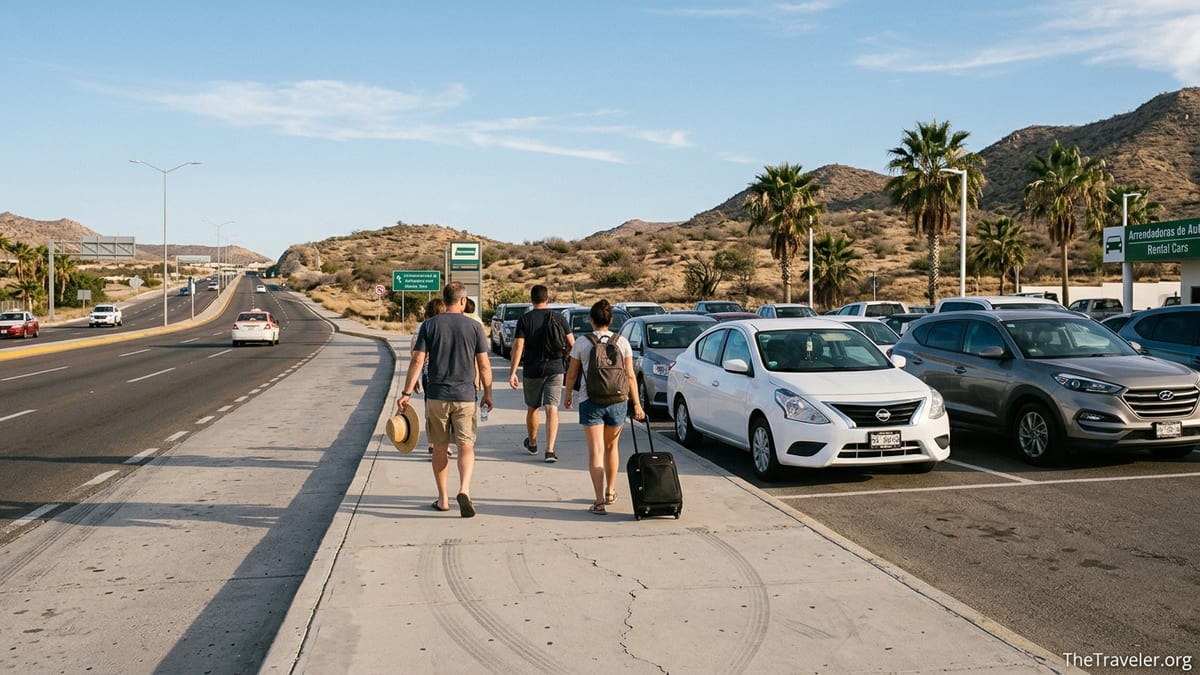
Where to Find Rental Cars at Los Cabos Airport
Los Cabos International Airport (SJD) is the main gateway for visitors headed to San José del Cabo, Cabo San Lucas and the resort corridor. Car rental counters are located in the arrivals areas of both Terminal 1 and Terminal 2, just past customs and baggage claim. Major brands such as Avis, Hertz, Budget, Alamo, National, Enterprise, Europcar, Thrifty, Dollar, Fox and several Mexican companies like Mex Rent a Car and Cactus typically maintain desks here. In practice, this means you collect your bags, walk into the public arrivals hall and immediately see rows of rental company counters on one side.
Most airport rentals operate on a counter plus shuttle model. You complete the paperwork at the counter inside the terminal, then an agent leads you outside to a shuttle van that takes you a few minutes down the road to the car lot. For example, Avis states that for commercial flights arriving into Terminals 1 and 3, you check in at the in-terminal counter and then board an Avis shuttle to its facility just outside the airport. This shuttle ride is included in the rental and usually takes less than ten minutes, even in busy periods.
There are also off-airport companies that do not have a full counter inside the terminal but send a representative or shuttle to meet you at arrivals. With these firms you will often see someone holding a sign with the company name, then ride to an office on the highway near the airport. These operators can sometimes offer lower base rates, but the experience is more variable, and you rely heavily on good communication at pickup.
Whichever company you choose, plan on spending 30 to 60 minutes from the moment you walk out of customs to the moment you actually drive away in your car, especially at peak arrival times on weekends and holidays. Build this timing into any dinner reservations or grocery stops you hope to make after landing.
Understanding Mexican Car Rental Insurance at SJD
Insurance is the single biggest source of confusion and sticker shock for travelers renting at Los Cabos Airport. In Mexico, third-party liability coverage that meets local legal standards is required when you drive. Many rental companies at SJD treat this Mexican liability coverage as a mandatory add-on that is not included in the ultra-low teaser rates you see in search results. It is common for a car that was advertised online for around 10 to 20 US dollars per day to end up closer to 35 to 50 US dollars per day once the basic liability is added at the counter.
You will typically see several types of insurance offered. First is the mandatory civil liability coverage, which protects against damage or injury to other people and property. This is the piece that must comply with Mexican law and that foreign personal auto policies or many credit card protections do not satisfy. Above that, you may be offered collision damage waiver or loss damage waiver to cover damage or theft of the rental vehicle itself, and sometimes personal accident insurance. Travelers who rely on a premium credit card for collision coverage often decline the rental company’s CDW but still must accept or show proof of adequate Mexican liability coverage.
Real-world experiences from recent travelers show wide variation in how strictly companies interpret proof of outside coverage. Some international chains at SJD like Enterprise or National may accept a letter from your credit card issuer stating that you have primary coverage for rental cars in Mexico, while others insist you purchase their liability product regardless. Travelers who prepaid for “full insurance” on foreign booking sites sometimes report that the local desk does not recognize that policy and requires an additional daily payment. To avoid surprises, contact the specific branch or the brand’s Mexican website before you travel and ask how they handle external coverage.
As a planning benchmark, budget at least an extra 20 to 30 US dollars per day for the insurance component alone on top of any base rental rate you see online. If a quote that appears to include everything comes in far below that, treat it with caution and verify in writing that Mexican liability insurance is included and recognized by the local office at SJD.
Deposits, Credit Cards and Payment Surprises
In addition to daily rental charges and insurance, Los Cabos Airport car rental companies routinely place a significant deposit or hold on your credit card. This is standard practice but the amounts can be larger in Mexico than many US travelers expect. A typical range runs from the equivalent of around 800 to 2,000 US dollars, depending on the car category and whether you purchase full coverage or only basic liability. Choosing lower insurance levels often leads to a higher security deposit because the rental company has more risk.
For example, a traveler recently renting a compact car at SJD for about 40 US dollars per day with mid-level insurance reported a temporary hold of roughly 1,000 US dollars on a major US credit card. Another guest booking a small SUV with more limited insurance was asked for a deposit close to 1,500 US dollars. These holds usually fall off a few days after you return the car without damage, but during your trip they reduce your available credit line, which can affect hotel or activity charges if you use the same card.
Most airport rental locations strongly prefer or require a traditional credit card rather than a debit card. Debit card use, when allowed, often comes with stricter conditions such as purchasing the company’s full coverage package and accepting a higher deposit. Because of this, travelers who only travel with debit cards can find themselves unable to rent or paying significantly more than expected. To avoid hassles, bring at least one main credit card in the primary driver’s name with sufficient available limit to absorb both the deposit and your planned travel spending.
Fuel and tolls are two more areas where small miscommunications can cost money. Many companies in Los Cabos operate on a “same to same” or “same as received” fuel policy. If you pick up a car at three-quarters full, you are expected to return it at three-quarters. Since predicting that level at the pump is difficult, travelers sometimes end up returning slightly under and paying a relatively expensive refueling fee by the liter. The simplest strategy is to top up the tank within a few kilometers of the airport and round slightly in the rental company’s favor to avoid disputes at check-in.
Driving from Los Cabos Airport: Toll Road vs Transpeninsular Highway
Once you exit the airport car lot, most visitors face a quick decision: take the modern toll road that loops around San José del Cabo or follow the older Transpeninsular Highway, which serves as the region’s main free thoroughfare. Both ultimately connect the airport to Cabo San Lucas and the resort corridor, but the experience is different and so is the cost.
The toll road, officially part of a limited-access route that links Los Cabos Airport with San José del Cabo and Cabo San Lucas, is paved, relatively straight and designed for faster long-distance travel. In practice, travelers coming directly from SJD to Cabo San Lucas often use the toll road for its predictable travel time and lighter traffic. Recent driver reports suggest that a one-way trip from the airport through all toll booths toward the highway junction costs in the neighborhood of 8 US dollars, paid in Mexican pesos. Many rental cars do not have electronic transponders here, so you pull into the toll booth lanes and pay cash to the attendant.
The alternative is the Transpeninsular Highway, known locally as Highway 1. This is a free federal highway that runs down the Baja Peninsula and passes closer to town centers, gas stations and some local businesses. The stretch between the airport, San José del Cabo and Cabo San Lucas is generally in good condition, but it can be busier, particularly near urban areas and during morning and late-afternoon rush hours. Driving here gives you a bit more exposure to local traffic patterns, frequent lane changes and occasional slower trucks.
For first-time visitors arriving after a long flight, especially those landing after dark, the toll road is often the easiest and most relaxed option. You get wide lanes, clearer signage and fewer intersections. For travelers on a tighter budget, those staying near San José del Cabo, or anyone wanting to stop at big-box stores and local taco spots along the way, the Transpeninsular Highway works perfectly well with normal caution. Many repeat visitors develop a hybrid approach: toll road into town when they are tired or on a schedule, free highway for more leisurely daytime trips.
Practical Cabo Driving Tips: Safety, Gas and Parking
Driving in Los Cabos feels broadly familiar to US and Canadian visitors, but there are local details worth noting. Speed limits are posted in kilometers per hour rather than miles, and enforcement can be sporadic yet strict in certain zones. Police occasionally set up speed checks on the highway corridor or near town entries. Local drivers may be more assertive with lane changes and passing, but overall road manners are moderate compared with some other Mexican destinations. A defensive, patient style works best: keep to the right except to pass, use turn signals clearly and expect the occasional sudden stop.
Night driving on highways outside the main corridor deserves extra care. The region still has stretches with limited lighting and the chance of livestock on or near the road. If you are planning day trips to places like Todos Santos, La Paz or remote beaches, try to schedule driving during daylight hours, particularly on the way back. Within Cabo San Lucas and San José del Cabo, many streets have topes, or speed bumps, that are not always marked clearly. Hitting one at speed can be jarring and potentially damaging, so watch the flow of local cars ahead of you and slow down when they do.
When it comes to fuel, major stations along the corridor and near the airport are generally reliable, but traveler reports repeatedly warn about scams at a few outlets immediately outside SJD. Typical issues involve attendants who start the pump without resetting the meter to zero or who distract customers while cash is counted. To protect yourself, step out of the car, confirm the meter is at zero before fueling begins and pay with a credit card when possible, carefully checking the amount entered. Keeping your own mental tally of liters and pesos helps catch errors quickly.
Parking in Cabo San Lucas is a mix of street spaces, small paid lots and hotel garages. Around the marina and downtown nightlife area, street parking can be tight in the evenings. Paid surface lots near the marina or behind shopping plazas are a practical option, typically charging modest hourly or day rates in pesos. Many large resorts along the corridor between Cabo San Lucas and San José del Cabo offer free self-parking for guests, while some charge a daily fee. Always ask at check-in whether parking is included in your room rate and whether valet is required, as those extras add up over a week-long stay.
Is Renting a Car in Cabo Worth It?
Whether a rental car makes sense at Los Cabos Airport depends on your itinerary, comfort with driving in a foreign country and group size. For visitors staying at an all-inclusive resort and planning only one or two outings, prearranged shuttles and local taxis can be simpler. An airport shuttle from SJD to a Cabo San Lucas resort might run in the ballpark of 25 to 35 US dollars per person one way, while a private transfer for a family or group could cost more but provides door-to-door service without navigating unfamiliar roads.
On the other hand, travelers planning to explore beaches outside the main hotel zones, visit both Cabo San Lucas and San José del Cabo frequently, or take day trips up the coast often find that a rental car quickly pays for itself. As a rough example, imagine a couple visiting for a week, planning three dinners in town, a day exploring San José del Cabo, a grocery run and a trip to Todos Santos. Using taxis or rideshare options for each leg, plus an airport transfer, could easily add up to several hundred dollars. A compact rental car at around 40 to 60 US dollars per day all-in, including insurance, might come out similar in total cost while giving complete flexibility.
Freedom of movement is another intangible benefit. Having your own car allows for spontaneous stops at viewpoints on the corridor, trying different beaches like Chileno Bay or Playa Santa Maria at off-peak times, and shopping for groceries at larger markets without worrying about return transportation. Families with children or groups carrying beach gear often especially appreciate the convenience of being able to load everything into a trunk rather than hauling it into taxis.
There are, however, reasons some travelers still decide against renting. Stress about potential damage claims, uncomfortable encounters at the rental counter over insurance, and concern about interactions with police or road hazards can weigh heavily for nervous drivers. If these worries are likely to overshadow your enjoyment, it might be better to combine a reliable airport shuttle with a few organized excursions that include transportation. The key is to match your choice to your travel style rather than defaulting automatically to either taxis or a rental car.
How to Avoid Common Rental Car Pitfalls in Los Cabos
Several patterns emerge from recent traveler reports about car rentals at SJD. One is the “too good to be true” base rate problem. Online listings advertising cars for just a few dollars per day often lead to frustration at the counter when mandatory insurance and fees are added, doubling or tripling the price. A healthier approach is to run sample bookings directly on the Mexican websites of major brands such as Enterprise, National, Hertz or Avis, making sure that the quote clearly lists liability insurance as included. Prices that end up in the range of 35 to 60 US dollars per day for a compact or small SUV with full coverage are more realistic for this destination.
Another frequent issue is car availability. During busy seasons like winter holidays, spring break and major US long weekends, some travelers with prepaid reservations have arrived to find long waits or, in the worst cases, no cars immediately available. To reduce the odds of this, choose earlier pickup times when possible, favor companies with multiple offices in the region and avoid extremely deep discount deals that rely on tight fleet management. Keeping printed copies of your confirmation and any emails about included insurance can also help if questions arise.
Documentation is essential. Before leaving the lot, walk slowly around the car with the agent and point out every scratch, dent and chip, however small. Take time-stamped photos or a short video on your phone showing all sides of the vehicle and the interior, including the fuel gauge and odometer. Travelers who do this are in a stronger position if a damage claim appears at return for something that was preexisting. On drop-off, repeat the walk-around and ask the agent to confirm in writing or on your paperwork that the car was returned in good condition.
Finally, consider language and communication. While many staff at airport rental desks speak good English, contract documents may still be in Spanish, especially for local companies. Do not hesitate to ask the agent to explain each line item and to clarify which protections you are accepting or declining. If something feels rushed or unclear, slow the process down. You are committing to significant financial responsibility; taking an extra ten minutes at pickup is worth it for peace of mind.
FAQ
Q1. Do I really need Mexican insurance to drive a rental car from Los Cabos Airport?
Yes. Mexican law requires liability coverage recognized locally, and most rental companies at SJD either include it in a higher all-in rate or add it on at the counter. Credit card or home-country auto policies usually do not replace this requirement.
Q2. How much should I budget per day for a rental car in Cabo, including insurance?
For a compact or economy car picked up at Los Cabos Airport, a realistic all-in range is roughly 40 to 60 US dollars per day once mandatory liability and reasonable additional coverage are included.
Q3. What size deposit do rental companies at SJD usually hold on my card?
Security deposits often range from around 800 to 2,000 US dollars, depending on the vehicle type and insurance level you choose. Higher coverage can reduce the deposit, while minimal coverage tends to increase it.
Q4. Is the toll road from the airport to Cabo San Lucas worth paying for?
For most first-time visitors, yes. The toll road offers smoother traffic and easier navigation, and the total toll cost for a one-way trip toward Cabo San Lucas is on the order of a few US dollars in pesos, which many travelers find worth the time and stress savings.
Q5. Can I pay the Los Cabos toll road with a credit card or do I need cash?
Plan to pay in Mexican pesos at the toll booths. Some lanes may accept cards or other methods, but relying on cash avoids delays or confusion, especially if you are driving a rental without a local toll transponder.
Q6. Are gas stations near Los Cabos Airport safe to use?
Most are fine, but travelers report occasional scams at a few stations close to the airport. Protect yourself by confirming the pump is reset to zero, watching the meter and paying attention when cash or cards are handled.
Q7. Is it safe to drive in Cabo at night?
Within town areas the risk is similar to many mid-sized cities, but highway driving after dark is less advisable due to limited lighting, potential livestock on the road and fatigue. Whenever possible, schedule longer drives during daylight.
Q8. Do I need an international driving permit in Los Cabos?
Most visitors from the United States, Canada and many European countries can rent and drive using a valid driver’s license from home. An international driving permit can be useful as a supplement but is not usually mandatory.
Q9. Is parking easy to find in Cabo San Lucas and San José del Cabo?
In busy areas like the marina and downtown Cabo San Lucas, street parking can be tight, especially at night. However, paid lots and garages are available, and many corridor resorts offer on-site parking for guests.
Q10. Should I rent a car or rely on shuttles and taxis in Cabo?
If you mainly plan to stay at one resort and join organized tours, shuttles and taxis may be simpler. If you want to explore multiple towns, beaches and day-trip destinations on your own schedule, a rental car from Los Cabos Airport usually offers better value and flexibility.