


Landing at Manila’s Ninoy Aquino International Airport (NAIA) can feel overwhelming, especially if it is your first time in the Philippines. Crowded arrival halls, aggressive transport offers, confusing terminal layouts and a mix of official and unofficial services create the perfect environment for scams and simple but costly mistakes. With a bit of preparation, you can walk straight past most of the problems that catch new arrivals every day.
Get the latest updates straight to your inbox!
Understanding NAIA Today: What First‑Time Arrivals Should Expect
NAIA currently operates four passenger terminals that serve different airlines and a mix of domestic and international flights. Terminals 1 and 3 handle most international traffic, Terminal 2 is shared by Philippine Airlines and a few other carriers, and Terminal 4 is a small, older domestic terminal used mainly by low-cost airlines. Renovations and operator changes are ongoing, so layouts, transport pickup points and signage can feel inconsistent. For a first-time visitor stepping off a long flight into the humid Manila air, it is easy to be disoriented and follow the first person who offers to “help.”
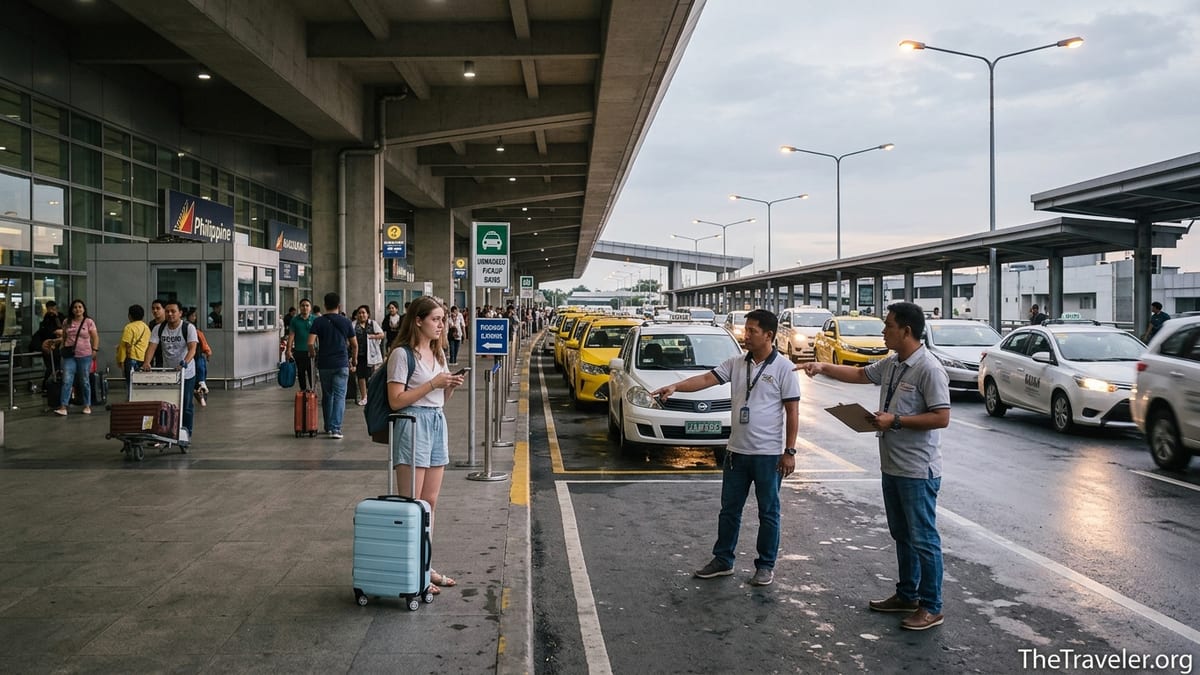
Outside each terminal you will typically find a row of official transport desks, yellow airport taxis, coupon taxi booths, ride-hailing pickup areas and, just beyond the marked zones, clusters of freelance drivers and touts. Some of these freelancers offer legitimate rides, but many rely on confusion and pressure. Stories of passengers being charged the equivalent of a full domestic flight ticket for a 20-minute airport transfer are common, and enforcement, while improving, is still uneven.
At the same time, not everything at NAIA is a scam. There are honest airport staff, licensed taxis that run the meter correctly, and ride-hailing drivers who charge exactly what the app shows. Your goal is to quickly distinguish between accredited services operating inside clear boundaries and anyone who approaches you first or tries to move the transaction away from official counters and apps.
Knowing where to walk, which signs to follow and what standard prices look like from NAIA to major areas such as Makati, Bonifacio Global City (BGC) and Ermita will help you say no with confidence. Think of your arrival like a negotiation: if you know your options and rough costs, it is much harder for anyone to trap you into paying ten times the going rate.
Taxi, Ride-Hailing and “Private Car” Traps Outside Arrivals
The single biggest source of complaints at NAIA remains airport transport. A typical pattern goes like this: a tired foreigner exits customs into the public arrivals area, is immediately approached by a man with a laminated ID or clipboard and hears something like “Taxi sir, fixed price, no traffic problem.” Without checking any posted rates or apps, the traveler accepts, only to be quoted 2,000 to 3,000 pesos for a ride that should cost a fraction of that. Reports of visitors being asked 2,500 pesos for a trip from NAIA to Makati, a distance of roughly 8 to 10 kilometers, are not unusual.
Official yellow airport taxis and white coupon taxis have designated lanes and counters. However, a number of scams piggyback on their reputation. Some drivers stand just outside the proper queues and claim to be “airport taxi” while steering you to an unmarked car or a taxi parked beyond the barriers. Others use a legitimate-looking taxi but refuse to turn on the meter, insisting on a fixed price much higher than the going rate. In one case that triggered official sanctions, a passenger was charged 1,300 pesos for a very short ride between Terminal 2 and Terminal 3, a route that, under normal circumstances, should cost far less than half that even with airport surcharges.
Ride-hailing platforms such as Grab and JoyRide Super Taxi operate at NAIA through official pickup bays. The app will show you a clear fare estimate for a standard car. On a typical day, a GrabCar from NAIA to Makati might display somewhere in the 250 to 450 peso range depending on time and demand, and to BGC perhaps 300 to 500 pesos. These figures can surge during peak hours, but if you are being quoted anything close to 2,000 pesos for the same routes, that is a red flag. Some touts approach new arrivals saying “Grab, sir?” then quote an inflated “cash fixed rate” and walk you to an unmarked vehicle that has nothing to do with the platform.
To protect yourself, treat anyone who approaches you directly in the arrivals hall with caution, regardless of how official their badge looks. Instead, follow the overhead signs to “Airport Taxi” or “Coupon Taxi” and line up inside the marked barriers, or walk to the clearly signed ride-hailing pickup zone and book through the app yourself. If you choose a yellow taxi, insist the driver turns on the meter as you depart. If they refuse or tell you the meter is “broken,” get out before the car leaves the curb and return to the queue. Do not be embarrassed to walk away; locals do this all the time when a driver refuses to use the meter.
Unofficial “Helpers,” Fake Escorts and Baggage Confusion
Another frequent arrival mistake at NAIA involves accepting help with forms, luggage or immigration in exchange for vague “facilitation fees.” You might see individuals in plain clothes or wearing vests that look similar to airport staff offering to “fast track immigration,” “escort you to the front of the line” or “handle your baggage and customs.” While NAIA has legitimate special assistance services for passengers with disabilities or premium airline customers, spontaneous offers from strangers at the baggage carousel or just outside immigration are almost always a bad sign.
There have been documented cases in the Philippines of passengers paying large sums to so-called escorts who promised to smooth their way through formalities. In one case publicized by the Bureau of Immigration, a traveler bound for overseas work paid around 120,000 pesos to a fake “airport escort” who claimed he could arrange easy passage. The passenger was eventually intercepted and the escort exposed as a scam. Although that incident related to departure rather than arrival, the pattern is the same: scammers prey on those who feel unsure or intimidated by airport procedures.
At the baggage belt, watch out for people who grab your suitcase off the carousel before you reach it and then push it on a trolley while saying “Free service, ma’am, just tip later.” Porters are allowed at NAIA, and some are honest, but the cost should be modest and agreed in advance. Keep sight of your luggage at all times. Past scandals at NAIA, including highly publicized theft cases and baggage tampering incidents, have made many travelers extra cautious. While security has been tightened following those episodes, it is still wise to personally check that all zippers are closed and locks intact before you cross customs, and to avoid letting any stranger wheel your bags out of your sight, even for a moment.
Baggage confusion can also be exploited more subtly. It is not unheard of for scammers to pick up a bag that looks similar to yours and act as if they are “helping” by handing it to you, then angling for a tip. In more worrying scenarios, an accomplice may try to distract you while another person manipulates your bags. Simple habits make a big difference: mark your luggage with something distinctive, take a quick photo of each bag before you leave home, and verify the baggage tag against your claim stub if an airline agent questions ownership. If anything feels off, call an airline representative or airport police yourself instead of relying on a self-appointed fixer.
Terminal Mix-ups, “Shuttle” Scams and Missed Connections
NAIA’s fragmented layout makes terminal confusion one of the easiest ways to lose time and money. Many airlines use one terminal for arrivals and another for departures on connecting flights, and the free official shuttle service between terminals can be slow or hard to spot if you do not know where to look. This gap has created an opening for “terminal shuttle” scams. Several travelers have reported being approached inside or just outside the terminal by men offering a “special shuttle” to another NAIA terminal “because the official bus is closed” or “takes too long.” The passenger is then led to a regular taxi or private car and asked to pay several hundred pesos for a very short hop that should be either free or minimal.
Social media posts have described situations where new arrivals needing to transfer from Terminal 3 to Terminal 1 were quoted 800 to 1,000 pesos by these unofficial shuttles for a ride that, at a standard metered rate plus airport surcharge, would normally sit well below that level. In one instance that drew widespread attention, a taxi driver charged 1,300 pesos for a trip between two NAIA terminals, sparking public outrage and disciplinary action. The lesson is clear: moving between terminals inside the same airport should never cost close to what you would pay for a full ride into central Manila.
To avoid terminal mistakes, always double-check your arrival and departure terminals with your airline before you fly. Print or screenshot your itinerary, including terminal numbers, and keep it handy when you land. If you do need to transfer, ask at an official information desk inside the secure area where to find the free inter-terminal bus or the recommended route. Some passengers choose to walk between Terminal 3 and nearby hotels in Newport City using the Runway Manila pedestrian bridge, then book a ride-hail car from the hotel side to avoid airport taxi chaos. This is a legitimate strategy, but only if you feel comfortable handling your luggage over a short walk and booking through the app yourself.
If your connection is tight, factor in both traffic and terminal transfer time. Manila traffic can slow to a crawl at rush hour, and a misdirected cab can easily turn a 15-minute intra-airport transfer into a stressful 45-minute detour. Refuse any unsolicited “urgent” help that involves handing over your passport or boarding pass. Legitimate airline staff and official airport representatives will not ask you to pay cash just to move between terminals.
Overpriced Services, Hidden Extras and Payment Pitfalls
Overcharging at NAIA does not end with the taxi rank. First-timers often overpay for currency exchange, SIM cards and even snacks simply because they convert prices incorrectly or assume “airport prices” justify any amount. While it is normal for airport food and drink to cost more than in the city, there are still limits. If a small bottle of water is priced at 150 pesos in a kiosk outside arrivals when the same brand costs 30 to 40 pesos in a city convenience store, you are effectively paying an informal “tourist tax.”
The more serious problem arises when services involve cash with no clear receipt. Scammers may quote a seemingly reasonable base price, then add layers of extras: airport fee, terminal fee, luggage fee, toll fee and “late night fee.” A 400-peso fare can suddenly become 900 pesos by the time you reach your hotel. Official yellow taxis and properly booked ride-hailing cars may legitimately pass expressway tolls on to you, but these should be relatively small amounts and, in the case of ride-hailing, already reflected in the quoted fare. Any demand for a fee that was not mentioned before the ride started is negotiable at best and suspicious at worst.
When using cash, carry small bills. Many visitors report drivers and porters claiming they have “no change” for a 1,000-peso note and suggesting that the remaining amount be left as a tip. Paying for an airport transfer that should cost around 300 pesos with a large bill almost guarantees you will lose the difference. Break big notes at a bank counter, airport café or a major shop inside the terminal before heading outside. If you must pay a taxi in cash, count the change in your hand before closing the door.
Card payments also have their own risks. Some unofficial drivers and tour operators might offer to swipe a foreign card through a portable terminal or a smartphone. Besides the possibility of inflated charges, there is a risk your card details will be stored for later misuse. Where possible, stick to in-app payments through well-known platforms or pay by card only at recognizable hotel desks and major retailers inside the airport. Keep printed or digital copies of any receipts, especially for high-value transactions like hotel transfers or prebooked vans.
Safer Alternatives and Smart Arrival Strategies
Despite its reputation, NAIA can be navigated safely with a little planning and a firm attitude. One of the most reliable options for many travelers is to arrange an airport pickup directly with a reputable hotel in Makati, BGC, Ortigas or Newport City. While hotel transfers often cost more than a metered taxi or ride-hail, you will know the price in advance, the driver will be clearly identified, and the car will usually be waiting at a designated bay. Some Manila hotels quote around 2,000 to 2,800 pesos for a private sedan transfer, which may feel expensive but can be worth it if you are arriving very late at night or carrying valuable equipment.
For those on a budget, official yellow airport taxis, when used correctly, remain a practical choice. They operate on a metered system with an airport flag-down rate slightly higher than ordinary city taxis. Typical real-world reports suggest that a straightforward ride from NAIA to Makati often lands somewhere in the 300 to 500 peso range, depending on traffic, and NAIA to central Manila or Ermita in a similar band. While abuses occur, many regular travelers say they have used these taxis multiple times without incident by joining the official queue, refusing any fixed price offers and keeping an eye on the meter.
Ride-hailing through apps such as Grab remains, for many locals and expatriates, the default recommendation. Before your trip, download the app, register a payment method and familiarize yourself with how to set a pickup point. Upon arrival, use the airport Wi-Fi or a local SIM to book. The app will tell you exactly where to meet your driver, often near the Airport Coupon Taxi lane or a clearly posted pickup sign. If drivers are scarce, be patient for a few minutes rather than stepping outside the ride-hailing area into the territory of freelance touts. Some experienced travelers, especially at Terminal 3, simply walk over the pedestrian bridge into Newport City and book a car from there to avoid the most aggressive touts at curbside.
Another safe and inexpensive option for some routes is the UBE Express airport bus, which runs between NAIA terminals and key hubs such as Makati, Robinsons Manila and certain hotel districts. Fares are much lower than a taxi and posted clearly at ticket counters or on the side of the bus. While schedules can vary and the service may not run deep into the night, it is worth checking at the official information desks before assuming your only options are taxis and private cars.
Personal Safety, Scams Beyond the Curb and When to Report
Most NAIA scams are financial rather than violent, but they can still sour your first impression of the Philippines. Stay alert to your surroundings, especially if you are arriving after dark or obviously jet-lagged. Keep your phone, wallet and passport in secure pockets or a money belt while you navigate the arrivals area. Avoid counting large stacks of cash in public, and step aside to a quiet corner or a restroom if you need to reorganize valuables.
Be wary of anyone who creates a sense of urgency or fear. This might include people claiming that a certain tax must be paid immediately in cash, that your luggage will be confiscated without an on-the-spot fine, or that your visa is in question unless you follow them. Official Philippine immigration, customs and transport staff wear uniforms, work inside clearly marked counters and issue written receipts for any legitimate payment. If someone approaches you away from a counter and asks for cash, decline and walk back to an official desk.
There have been high-profile stories in recent years of misconduct involving some airport staff, including theft from passengers and tampering with luggage. In response, authorities have introduced additional CCTV coverage and disciplinary action. These incidents are relatively rare, but they underline why you should lock your bags, avoid leaving them unattended and politely refuse offers for unnecessary handling. When passing through security, empty your pockets into a bag inside your carry-on rather than leaving loose cash or jewelry in trays where items can be mislaid or, in worst cases, stolen.
If you are overcharged or harassed, try to record details discreetly: taxi plate number, company name, time and place. Many taxis display a driver’s ID on the dashboard; you can photograph it quickly as you enter. Upon reaching your destination, speak to hotel staff about how to submit a complaint. You can also report serious incidents to airport authorities or local police. While you may not always recover your money, reports help identify repeat offenders and, over time, contribute to stricter enforcement.
The Takeaway
Arriving at Manila’s NAIA for the first time does not have to be stressful or unsafe. The same airport environment that traps unprepared visitors is navigated smoothly every day by informed travelers who know which services to trust, what prices to expect and when to say no. Most issues arise not from outright danger but from confusion, fatigue and pressure in those first 30 to 60 minutes after landing.
Plan your arrival before you board your flight: confirm your terminal, arrange or at least research your transport options, and install any apps you might need. On the ground, move with purpose toward official counters and signed pickup points, ignore unsolicited offers and keep control of your bags. If something feels wrong, it probably is, and in Manila, as in many busy airports worldwide, the simplest rule stays true: when in doubt, walk away and ask an official for help.
With clear expectations and a few practical strategies, NAIA becomes just another busy gateway rather than a minefield. The city beyond the airport offers warm hospitality, vibrant neighborhoods and excellent value once you have cleared this first hurdle. Treat your arrival as part of the adventure, stay alert without becoming anxious, and you can step into Manila with your budget and your peace of mind intact.
FAQ
Q1. Are taxis at NAIA always a scam?
Not always. Many yellow airport taxis and coupon taxis operate correctly, but scams do occur. Use official queues, insist on the meter and avoid fixed prices from touts.
Q2. How much should a ride from NAIA to Makati or BGC cost?
Prices vary with traffic and time, but a metered yellow taxi or ride-hail trip to Makati or BGC typically falls in the low hundreds of pesos, not in the thousands.
Q3. Is Grab available at all NAIA terminals?
Yes, ride-hailing services such as Grab usually have designated pickup points at NAIA terminals. Follow airport signs and book only through the official app, not through touts.
Q4. What is the safest option if I arrive late at night?
A prearranged hotel transfer is often the safest and least stressful at very late hours, even if it costs more. Otherwise, use the ride-hailing app pickup areas or official yellow taxis.
Q5. How can I avoid baggage tampering or theft at NAIA?
Keep your bags locked, stay near the carousel, refuse unsolicited “help” with luggage and verify that all zippers and tags are intact before leaving customs.
Q6. Are there free shuttles between NAIA terminals?
There is usually an official inter-terminal shuttle or bus service, though schedules can change. Ask at an information desk and avoid paying large sums to unofficial “shuttle” operators.
Q7. Should I change money at the airport?
Changing a small amount at the airport for immediate expenses is fine, but rates in the city are often better. Compare a couple of counters and avoid anyone changing money outside official booths.
Q8. Is it safe to use airport porters?
Licensed porters can be useful, but agree a rough price beforehand and keep your luggage within sight. Decline any aggressive or pushy offers of help.
Q9. What should I do if I am overcharged by a driver?
Note the taxi plate number and company, keep your receipt if available and report the incident to airport authorities or your hotel so they can guide you through filing a complaint.
Q10. Do I need to tip drivers and helpers at NAIA?
Tipping is appreciated but not mandatory. For honest service, a small tip is enough. Never feel obligated to give large tips to anyone who pressured you into using their service.