


More news on this day
Hundreds of air travelers across the Middle East have faced extended waits, missed connections and rebookings after a new wave of operational disruption produced more than 1,100 delayed flights and 49 cancellations in a single day at major regional hubs, according to aggregated tracking data and published reports.
Get the latest news straight to your inbox!
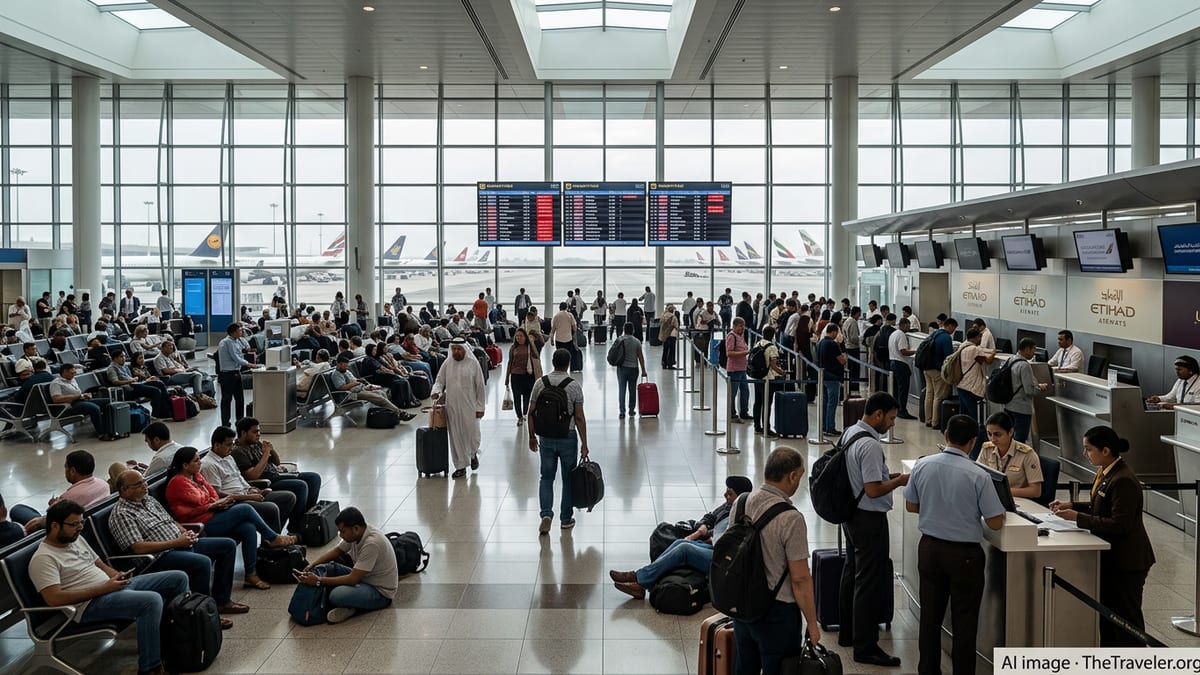
Data Shows Regionwide Spike in Delays and Cancellations
Recent aggregated operational data compiled from global disruption dashboards indicates that Middle East airports collectively recorded about 1,261 delays and 59 cancellations within a 24 hour period, with more than 1,100 of those movements classified as delayed and 49 as outright cancellations at a subset of heavily used hubs including Abu Dhabi and Bahrain. According to published coverage, Bahrain International Airport led the region in the volume of affected services, while other Gulf gateways reported knock on impacts as schedule buffers were eroded.
The figures highlight how quickly performance can deteriorate across a tightly interconnected network of hubs. Bahrain International Airport handles dense banks of short haul flights to Gulf cities such as Dubai, Doha, Riyadh and Abu Dhabi alongside longer haul services to Europe and Asia, so a relatively small number of flight cancellations can cascade into missed onward connections for hundreds of passengers. Publicly available disruption trackers show that many of the affected services were regional sectors, but long haul itineraries were also impacted when aircraft and crew could not be positioned as planned.
While day to day averages at some Gulf airports still show relatively strong on time performance, the recent spike underscores the vulnerability of regional operations to sudden shocks. Even at airports where average departure delays typically hover in the low single digit minutes, a single day of widespread disruption can leave airlines catching up for several subsequent rotations.
Abu Dhabi and Bahrain at the Center of Operational Strain
Zayed International Airport in Abu Dhabi and Bahrain International Airport have emerged as two of the focal points of the latest round of irregular operations. Bahrain has registered repeated instances of disrupted services in recent weeks, including flights that were forced to turn back or be cancelled after departures from Abu Dhabi. One high profile Etihad Airways service from Abu Dhabi to Bahrain returned to its origin in mid July, prompting the airline to cancel additional services on the route that day, according to media reporting based on flight tracking data.
Operational statistics for Abu Dhabi compiled over the past month still reflect generally modest average delays, but they also show a measurable number of cancelled departures when viewed across a 30 day window. Aviation data platforms tracking Zayed International Airport point to a handful of cancellations spread across recent weeks, indicating that the airport has not been immune to the knock on effects seen elsewhere in the region.
At Bahrain International Airport, live arrivals and departure boards continue to show dense scheduling throughout the day, particularly for Gulf Air and other regional carriers that operate shuttle style services around the Gulf. When a disruption event occurs during one of these peak banks, the knock on impact can be significant, as aircraft arriving late from nearby hubs often depart behind schedule on their next leg, compounding delays throughout the network.
Geopolitical Tensions and Weather Among Contributing Factors
According to recent regional coverage, the disruptions have unfolded against a backdrop of elevated geopolitical tension in parts of the Middle East, with renewed hostilities linked to the US Iran conflict affecting airspace usage and airline scheduling. Several carriers, including Emirates, Etihad and other Gulf based airlines, have temporarily suspended or reduced services to destinations such as Kuwait and Bahrain at different points over the past two months, citing operational reasons in public updates as they adjusted flight plans and routings.
These suspensions and frequency cuts can contribute indirectly to concentrated periods of delay and cancellation when services resume or when airlines attempt to rebuild full schedules. In addition, some international carriers from Europe and Asia have altered routings or trimmed frequencies to certain Gulf destinations in response to risk assessments, which can add pressure to remaining services when demand remains robust.
Weather has also played a role in some locations across the broader region during the summer period, with heavy thunderstorms and high winds occasionally slowing ground handling and departure flows. Although many of the most recent cancellations in the Gulf appear linked to airspace and operational constraints rather than local weather alone, the combination of factors has created unstable operating conditions for airlines and airports.
Impact on Passengers and Airline Recovery Efforts
For passengers, the practical effect of more than 1,100 delays and dozens of cancellations in a single day has been a familiar mix of missed connections, overnight stays and rebooked itineraries. Disruption tracking platforms referenced in recent reporting describe extended waits at departure gates, with some travelers held onboard aircraft during ground stops while airspace or routing decisions were being reviewed.
Airlines operating through Abu Dhabi, Bahrain and neighboring hubs have responded by consolidating lightly booked services, reassigning larger aircraft to absorb displaced travelers and opening additional rebooking options via alternative hubs where traffic flows allow. Publicly available flight information boards show that, following severe disruption windows, many carriers attempt to restore as close to normal a schedule as possible within 24 to 48 hours, although residual knock on delays can persist.
Industry data suggests that certain routes in and out of Abu Dhabi and Bahrain have already been experiencing below average punctuality. For example, performance statistics for some Abu Dhabi based low cost services indicate on time arrival rates close to two thirds of flights, with average delays approaching 50 minutes and a small but notable proportion of cancellations recorded over a two month period. In a region where many travelers depend on closely timed connections, such margins can be the difference between a smooth journey and a missed onward flight.
What Travelers Can Do as Disruptions Continue
Travel advisories and expert commentary collected in recent coverage consistently recommend that passengers flying through Middle East hubs build additional buffer time into itineraries and monitor flight status frequently in the days leading up to departure. Real time flight tracking services and official airport information pages provide more reliable indications of current operating conditions than informal social media posts, particularly during fast moving disruption events.
Travelers are also encouraged to pay close attention to notifications from airlines, which may offer voluntary rebooking options or route changes when forecasts indicate a high risk of delays on specific corridors. For those with nonrefundable tickets or complex multi segment itineraries, checking the fare rules and any built in disruption policies before travel can help avoid unexpected costs if a schedule change becomes necessary.
With summer travel demand remaining strong and regional dynamics still fluid, observers note that the pattern of concentrated bursts of delay and cancellation is likely to persist intermittently in the coming weeks. For passengers connecting through Abu Dhabi, Bahrain and neighboring hubs, proactive planning and close monitoring of flight information remain the best tools for navigating an increasingly unpredictable operating environment.
Middle East air travel hit by 1,261 delays and 59 cancellations
UAE flight updates: Bahrain and Kuwait route disruptions
Etihad services disrupted on Abu Dhabi Bahrain route
Operational overview for Abu Dhabi Zayed International Airport