


By the time the first hint of light touched the Rockies above Banff, I had already been awake for hours. It had taken two flights, a late-night drive from Calgary and more than 7,000 kilometers of travel to get here, but as the sky shifted from inky blue to soft pink over the mountains, every kilometer felt worth it. Banff National Park has a way of rewarding early risers, and there is no better introduction to the park than your first full morning, when the town is quiet, the lakes are still and the silhouettes of elk wander along the edge of the forest.
Get the latest updates straight to your inbox!
Waking Up With the Mountains
My first morning in Banff started at a roadside motel on the edge of town, the kind of place where you fall asleep to the sound of passing trains and wake up to the cool mountain air slipping through a cracked window. In June, sunrise in Banff is just after 5:30 a.m., which means the sky is already brightening by 5. The faint glow pushed its way around the curtains as I silenced my alarm, pulled on a fleece and stepped outside into the thin, crisp air that instantly reminded me I was at 1,383 meters above sea level.
Across the parking lot, the mountains that had been shadows the night before were now fully formed walls of stone. Cascade Mountain loomed over the town, its layered limestone cliffs catching the very first light. A few cars were already rolling down Banff Avenue, mostly locals heading to early shifts or photographers chasing sunrise at Vermilion Lakes. For a park that welcomes millions of visitors each year, Banff at dawn still feels like a small mountain town.
That sense of scale hits quickly. The night before, the journey from Calgary along the Trans-Canada Highway had taken just under two hours, but the reality of the Rockies only truly arrived that morning. The signage for Banff National Park, the park gates and the park pass receipt on the dashboard were one thing; stepping outside and seeing jagged peaks in every direction was another. It felt less like arriving in a resort town and more like moving into a valley guarded on all sides by mountains.
For anyone planning a similar start, the key is to expect an early wake-up. In peak summer, you can have usable light by 5:00 a.m., long before most cafes open. Pack a light breakfast the night before, fill your water bottles and have your daypack ready so that when the alarm goes off, you are stepping outside within minutes. Banff rewards those first quiet hours in a way the middle of the day never can.
Chasing First Light at Vermilion Lakes
Like many first-time visitors, I pointed my rental car toward Vermilion Lakes, one of the closest and most accessible sunrise spots from town. From central Banff, it is less than a 10-minute drive along a side road that peels away from the Trans-Canada and follows the edge of the Bow River. You can also ride a bike from Banff Avenue in around 15 minutes or use Roam Transit when the seasonal services are running, but at that pre-dawn hour the parking lot was still mostly empty.
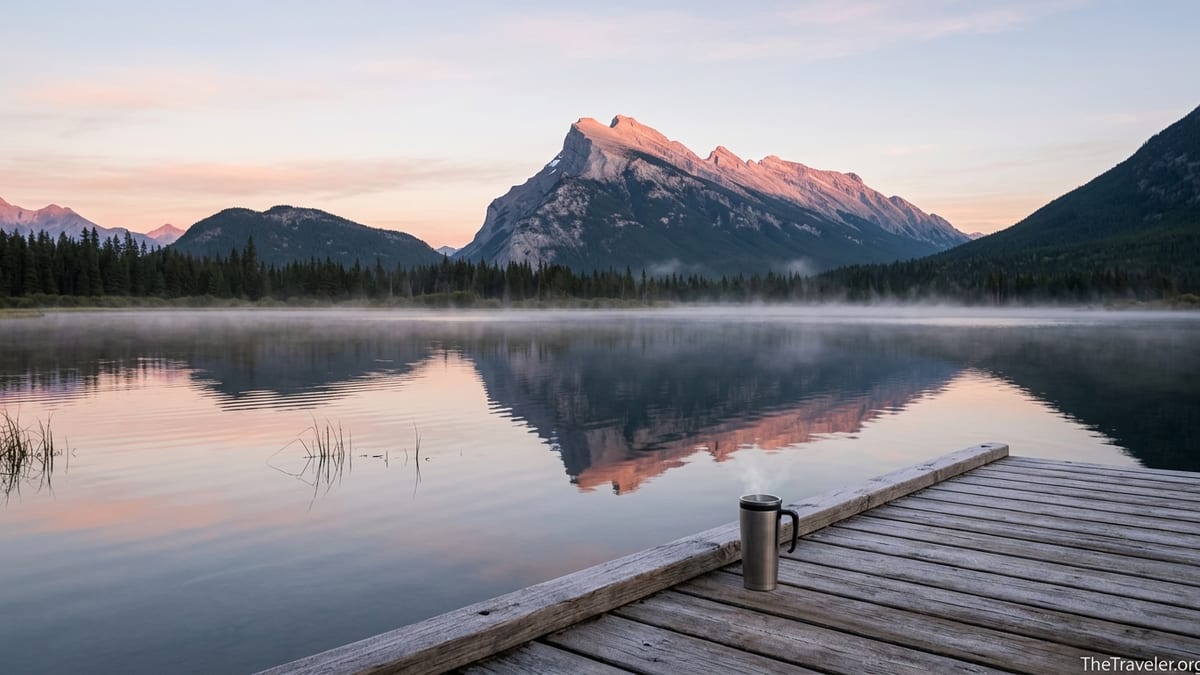
The lakes themselves are shallow and calm, a string of reflective pools at the base of Mount Rundle. On a still morning, Rundle’s long ridge and the forested shorelines appear almost perfectly mirrored in the water. When I stepped out, low mist hovered over the surface and a thin crust of ice clung to the shaded edges, a reminder that even in late spring or early autumn the temperatures here can sit only a few degrees above freezing at sunrise.
Photographers had already claimed a few of the wooden docks that jut out into the lake, tripods planted and cameras aimed west. The air smelled of damp earth and spruce. Somewhere behind me, the muffled call of a train drifted across the valley. Then the color arrived. The eastern sky, which had been a soft gradient of blue, flushed pink and orange, washing over the clouds that hung above the peaks. As the light reached Rundle, the ridge turned the color of a glowing ember, and the entire scene doubled itself in the water below.
This is where the distance you have traveled begins to make sense. People had driven overnight from Vancouver, flown in from Toronto and Europe, or come up from the United States to stand on these docks and watch a mountain wake up. There is a shared quiet as the first rays clear the horizon. It is not a dramatic, noisy moment; it is a slow, unfolding realization that you are standing in one of the most photographed landscapes in Canada and, for a few minutes, it feels like it belongs only to you and the handful of others scattered along the shoreline.
Practical Realities of an Early Banff Morning
Romantic as it feels, the first morning in Banff is also a crash course in the park’s practical realities. Temperatures can be near freezing even in June and September before the sun climbs, so the people who look comfortable on the lakeshore are the ones who packed layers: a base layer, a fleece or light down jacket and a windproof shell. I watched more than one traveler step out of a car in just a hoodie, shiver for a few minutes, and then retreat back inside while everyone else stayed on the dock.
Wildlife is another part of the equation. Dawn is one of the most active times for elk and deer in the Bow Valley, and it is not unusual to see them along the Vermilion Lakes road or in the meadows near the townsite. On my first morning, a small group of elk grazed not far from the parking area, heads lifting and ears twitching whenever a car door closed a little too loudly. It was a clear reminder to keep distance, stay inside designated areas and never step closer just for a better photo.
Even in those early hours, parking can fill at the most popular locations on peak summer weekends. Visitors who do not have a rental car often rely on Roam Transit, the local bus system that connects Banff with sites like Lake Minnewanka, the Banff Gondola and, via regional routes and connections, Lake Louise and Johnston Canyon. Single rides within Banff town typically cost a few dollars, with day passes available for travelers planning several hops in a single day. Buying tickets through the transit apps or at the Banff Visitor Centre is common, especially once the town wakes up and lines grow at bus stops.
That first morning also teaches you about timing. If you plan to use shuttles to reach places like Lake Louise or Moraine Lake later in your trip, you quickly learn that reservations open well in advance and that last-minute spaces can be limited. The same goes for popular breakfast spots. By 9 a.m., there can be a wait for a table on Banff Avenue, so the travelers who enjoyed sunrise and then headed straight to breakfast tend to be sipping coffee while everyone else is still forming a queue.
Breakfast on Banff Avenue
After the glow faded from Vermilion Lakes, the town of Banff felt completely different from the night before. The mountains were now clearly defined, the streets were beginning to hum with delivery trucks and early risers, and the aroma of freshly ground coffee drifted from open doors along Banff Avenue. The walk from a lakeside parking lot back into town is less than 10 minutes by car, but the transition from quiet shoreline to lively main street is striking.
For my first breakfast in Banff, I ducked into a small cafe just off Banff Avenue, a place with local artwork on the walls and a steady flow of hikers in trail pants and climbing helmets clipped to their backpacks. Spots like Whitebark Cafe, Good Earth Coffeehouse and Coyotes Southwestern Grill are often mentioned by regulars for their strong espresso and hearty breakfasts. A typical order might be a latte and a breakfast sandwich for around the price you would expect in a North American resort town, with slightly higher prices than in Calgary but portions designed to fuel a day on the trails.
What struck me was how international the room felt at that hour. At one table, a group from Germany studied a paper map of the Icefields Parkway. At another, a couple from Ontario debated whether to spend the day cycling the Legacy Trail to Canmore or hiking Sulphur Mountain. Guides in branded jackets stopped in for takeaway coffee before meeting clients at the Fairmont Banff Springs or at various trailheads. The conversations swirling around were full of unfamiliar place names that would become familiar over the next few days: Sunshine Meadows, Peyto Lake, Johnston Canyon, Two Jack Lake.
Breakfast in Banff on that first morning was not just about food; it was an orientation. While waiting for a table, I chatted with a local who suggested avoiding the mid-morning rush at Lake Louise by either going very early or later in the afternoon. Another traveler mentioned that they had secured their Parks Canada shuttle reservation to Moraine Lake weeks earlier, while a third was planning to rely on guided tour shuttles that bundle transport and a driver-guide into a single fee. By the time I finished my coffee, I had a clearer mental map of how the next few days in the park could unfold.
From Town to Trails: Planning the Rest of the Day
That first morning in Banff naturally transitions into your first full day on the trails or by the lakes. After breakfast, the options are overwhelming. Some visitors head straight to Lake Louise, around 45 minutes away by car in light traffic, or by reservable public transit. Others opt for closer excursions like Tunnel Mountain, a half-day hike that begins right from town and rewards with panoramic views over Banff, the Bow River and the surrounding peaks.
On my own first day, I chose a middle ground: an easy drive to Lake Minnewanka, only about 15 minutes from Banff, where a lakeside trail and scenic viewpoints provide a gentle introduction to hiking at altitude. The road to the lake winds past Two Jack Lake and several campgrounds, which in summer are full of RVs and tents belonging to travelers who have swapped hotel rooms for lakefront sites. Educational signage along the way explains seasonal road closures designed to protect wildlife and reduce congestion, another reminder that the park’s beauty depends on careful management.
For many first-time visitors, the first morning is also when they learn the rhythm of crowds in Banff National Park. Parking lots at the most famous lakes often fill by early morning in high season, and road access to certain areas is now restricted to shuttles, guided tours and transit. That realization can be sobering, but it also nudges travelers to explore beyond the postcard spots. Rangers and visitor centre staff readily suggest quieter alternatives for a first afternoon, from the Sundance Canyon trail near Cave and Basin to less busy viewpoints along the Bow Valley Parkway when it is open to vehicle traffic.
Logistically, this is the moment to check your park pass, confirm any shuttle reservations and top up supplies. Gas stations in Banff and Lake Louise can be busier and slightly more expensive than in Calgary, but they are important resupply points. Grocery stores and bakeries around Banff Avenue stock trail snacks, while outdoor shops like Atmosphere or Monod Sports help visitors fill in any missing gear, whether that is a better rain jacket or a more comfortable daypack.
Why the Journey Feels Worth It
Looking back, what made that first morning in Banff feel worth every kilometer of travel was not just the beauty of the landscapes but the sense of momentum. The journey from a distant city, the late-night check-in, the early alarm and the chilly lakeside wait all built toward that quiet moment when the first light touched Mount Rundle and everything clicked into place. It was as if the park were offering a calm, deliberate welcome before the busier hours began.
There is also a psychological shift that happens when you see a place you have imagined for years suddenly appear in front of you. Photos of Banff are everywhere, from social media to airline magazines, but standing on the shoreline of Vermilion Lakes or under the peaks around Banff town strips away the filters and edits. The colors are more muted, the air is colder than you expect and the sounds are real: the low murmur of the river, the crunch of gravel underfoot, the distant rumble of trucks on the highway.
In that context, the cost and effort of reaching Banff feel less like a burden and more like a kind of initiation. Long-haul flights, airport layovers, rental car counters and the final drive from Calgary become part of the story. You recognize yourself in the faces of other travelers who arrive at breakfast bleary-eyed but smiling, clutching takeaway cups while swapping tips about where to find the best hot springs or the quietest hikes near Lake Louise.
Perhaps most importantly, a powerful sense of gratitude settles in. Banff National Park is a protected landscape, and spending even a single morning there underscores how fragile and valuable such places are. Seeing elk grazing near the road or watching mist drift across a lake as the mountains catch fire with sunrise light makes the small inconveniences of travel feel trivial by comparison.
The Takeaway
If you are wondering whether Banff National Park is worth the journey, let your first morning answer the question. Wake up before dawn, even if your body still thinks it is the middle of the night, and step out into the cool air. Go to Vermilion Lakes, Tunnel Mountain viewpoint or simply walk down a quiet Banff Avenue as the mountains emerge from the dark. Carry a thermos of coffee if the cafes are not yet open, and give yourself time to stand still and simply watch the light change.
By the time you sit down for breakfast and start plotting the day’s adventures to Lake Louise, Moraine Lake or the local trails, you will likely feel what so many visitors do: that every kilometer, every connection, every bit of planning was justified by those first few hours. Banff rewards effort, and it rewards those willing to meet the park on its own early-morning terms.
Your first morning in Banff will not be identical to mine. The clouds may hide the peaks, or a passing storm may drape the valley in mist. Yet even on less-than-perfect days, the combination of mountain air, wildlife, quiet streets and the promise of a full day ahead is enough to make most travelers start thinking about when they might return. That is the quiet power of Banff’s mornings, and it starts long before the tour buses arrive.
FAQ
Q1. What time should I wake up for sunrise in Banff?
In peak summer, aim to be awake by around 4:45 to 5:00 a.m. so you can reach sunrise viewpoints like Vermilion Lakes or Tunnel Mountain before the best light.
Q2. Do I need a car to enjoy my first morning in Banff?
No. While a car is convenient for reaching lakes quickly, you can walk or cycle to nearby viewpoints and use Roam Transit once morning services begin.
Q3. How cold is it at sunrise in Banff in summer?
Even in July and August, early-morning temperatures can feel close to freezing, especially by the lakes, so plan to wear layered clothing and bring gloves or a hat.
Q4. Where is the easiest sunrise spot for a first-time visitor?
Vermilion Lakes is one of the easiest. It is close to town, has simple parking and offers iconic reflections of Mount Rundle with minimal walking.
Q5. Are there breakfast places open early in Banff?
Several cafes on or near Banff Avenue open around 7:00 a.m., serving coffee, pastries and hot breakfasts. Check current hours when you arrive, as they can vary by season.
Q6. Is it safe to walk around Banff at dawn because of wildlife?
Generally yes, if you stay on sidewalks and paths within town, keep your distance from any animals, never feed wildlife and follow local safety guidance.
Q7. How do I fit Lake Louise or Moraine Lake into my first day?
Reserve a shuttle or transit option in advance for late morning or early afternoon, allowing time for sunrise, breakfast and a relaxed drive or bus ride from Banff.
Q8. What should I pack in my daypack for that first morning?
Bring warm layers, water, a snack or light breakfast, a headlamp if starting in the dark, a camera or phone and your park pass or transit tickets.
Q9. Can I see wildlife on my first morning without going far?
Yes. Elk and deer are often seen near the townsite and along roads like the one to Vermilion Lakes, especially at dawn and dusk, so keep an eye out while driving or walking.
Q10. How crowded is Banff at sunrise compared with midday?
Sunrise is usually far quieter. Popular spots may have a few photographers and early risers, but crowds and parking pressure typically build later in the morning.