


More news on this day
Cruise travel to the Netherlands is entering a new phase of environmental scrutiny as Amsterdam prepares to bar sea going vessels without certified shore power connections from its passenger terminal from 2027, exposing a wider regional gap between infrastructure on paper and what ships can reliably plug into in port.
Get the latest news straight to your inbox!
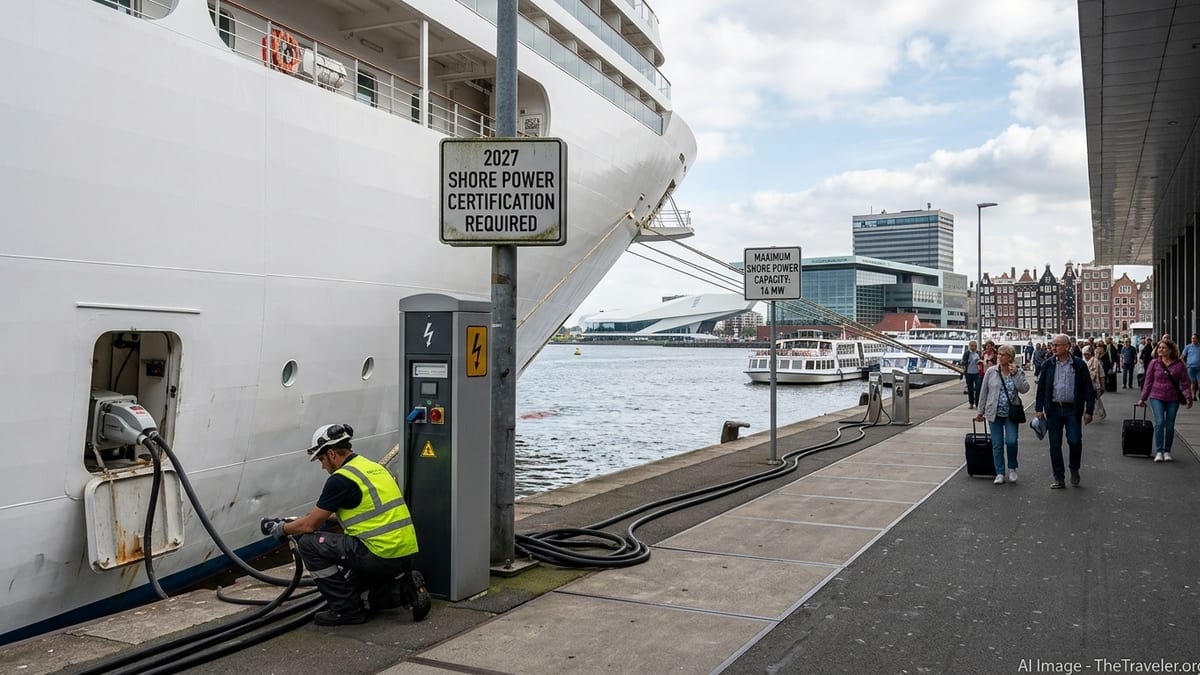
Amsterdam’s 2027 Rule Puts Certification Ahead of Capacity
Amsterdam’s Passenger Terminal has become a focal point for cruise emissions policy in Northern Europe. Publicly available port information shows that the facility has been equipped with shore power for one sea going cruise ship since 2025, with a reported capacity of up to 16 MW and separate connections for multiple river vessels.
From 1 January 2027, sea going cruise ships without certified shore power capability will no longer be accepted at the terminal. Local policy documents indicate that this terminal level rule is intended to run several years ahead of wider European requirements, effectively using access conditions to accelerate fleet upgrades rather than wait for EU shipboard obligations to take hold later in the decade.
The move places technical certification at the centre of itinerary planning. Cruise lines selling Amsterdam calls after the 2026 season will need to demonstrate that vessels meet the port’s electrical standards, including appropriate voltage and frequency ranges and compliance with international shore connection norms. Ships that cannot connect risk losing a marquee city call even if berth space would otherwise be available.
At the same time, Amsterdam’s example illustrates that a single high capacity connection does not automatically resolve operational bottlenecks. Any interruption in the local grid, cable handling constraints on the quay or maintenance on the shore side installation could still limit access on busy days, especially if several river vessels are also drawing power.
Rotterdam Highlights the Engineering Behind Cruise Shore Power
Rotterdam, the Netherlands’ other major cruise gateway, offers a contrasting perspective focused on heavy engineering. The city’s port authority reports that a shore power installation for sea going cruise ships entered service at Holland Amerikakade in March 2025 after a construction phase that required a lengthy high voltage cable route through dense urban infrastructure.
Technical descriptions published by energy network operators and the port describe a combination of long underground cable ducts, a dedicated grid connection and a movable connection tower designed to reach different plug in points on cruise ship hulls. This flexibility is important, as cruise vessels do not share a single standardised position for their electrical inlets even when they comply with common power and frequency ranges.
The Rotterdam project underlines one of the key practical challenges behind European targets. Building shore power systems for large cruise ships is not only a matter of installing transformers and switchgear on the quay. It also depends on securing transmission level capacity in crowded city networks and designing equipment that can safely handle heavy cables in all weather conditions while passenger operations continue nearby.
For travelers, this means that two Dutch ports might both advertise shore power availability, yet offer different levels of day to day reliability depending on local grid resilience, maintenance schedules and how many large vessels are scheduled at peak times.
Copenhagen and Stockholm Reveal Gaps Between Connections and Usage
Across the Skagerrak, Copenhagen has positioned itself as an early adopter of large scale shore power for cruise ships. Environmental and financial reports from Copenhagen Malmö Port describe a facility with five cruise connection points at Langelinie and Oceankaj, initially sharing 20 MVA of capacity, with an expansion toward roughly 48 MVA scheduled around 2028.
Forecasts for recent seasons indicate that only a share of total cruise calls is expected to plug in, even as a higher proportion of passengers is likely to arrive on compatible vessels. The requirement for separate shore power reservations, alongside quay bookings, creates a new layer of planning. If multiple large ships seek connections on the same day, available electrical capacity can be exhausted before every technically ready vessel is able to plug in.
Stockholm presents a similar pattern at a different scale. Port communications for 2026 point to around 154 cruise calls and hundreds of thousands of passengers, with 59 shore power connected calls reported by early November and two international cruise berths at Stadsgården equipped for onshore power. The port estimates that at least 45 percent of cruise calls could connect with current infrastructure, but the final share depends on which ships are assigned to the equipped berths.
Because Stockholm operates as a public port, available information indicates that it cannot impose an unconditional connection mandate on every visiting cruise vessel. Instead, it uses berth allocation as a form of soft pressure, steering shore power ready ships toward attractive central quays where infrastructure is installed. The outcome is that brochures may highlight green credentials, while a significant minority of calls still rely on onboard generators at anchor or at unequipped berths.
Norwegian Ports Balance Local Rules and a Different EU Timetable
Norwegian cruise ports sit outside the European Union but are deeply linked to its regulatory direction. Bergen has become an early test case, with publicly available port guidance stating that cruise ships calling from 2026 are expected to use shore power when technically able. The port reports the ability to connect three cruise ships at once while limiting daily calls to four vessels and around 8,000 passengers, creating a clear need for careful scheduling when arrival times overlap.
In Oslo, port information highlights a shore power installation for cruise ships at Revierkaia, with installed potential around 16 MVA and an initially available capacity closer to 10 MVA. The system is described as capable of serving both 6.6 kV and 11 kV at either 50 or 60 Hz, reflecting the wide range of shipboard systems. A separate facility has been under consideration for Filipstadkaia, though published material does not yet confirm a commissioning date.
At the national level, Norwegian maritime authorities have reported that the country’s implementation of the FuelEU Maritime framework will not begin before 2028. This places Norwegian ports on a different legal timetable from many EU terminals, even as cruise ships that call at both EU and Norwegian destinations still face European connection rules once they enter EU ports later in the decade.
Norway’s recent climate planning documents also point to a mixed picture, with some ports constrained by limited electrical supply while others have underused shore power assets. That contrast highlights a broader question for the whole region: whether investment decisions and cruise deployment choices are fully aligned, or whether infrastructure will at times run ahead of demand.
EU Rules Expose a Regional Readiness Gap
For the wider European cruise market, two Brussels led frameworks set the backdrop for national and port level initiatives. The EU Alternative Fuels Infrastructure Regulation requires qualifying trans European transport network maritime ports to provide onshore power capable of serving at least 90 percent of visits by certain large passenger and container ships by the end of 2029, based on average call numbers between 2027 and 2029.
Separately, the FuelEU Maritime regulation introduces mandatory connection obligations for covered passenger and container ships from 2030 at those equipped ports, with broader requirements phased in after 2035. Regulatory guidance already lists exemptions for short stays, technical failures, lack of available capacity and the use of qualifying zero emission alternatives, meaning that not every European cruise call will automatically fall under a strict plug in rule on day one.
This timetable highlights how far ahead individual ports such as Amsterdam and Bergen are attempting to move. Their rules will become binding several years before most EU shipboard obligations, effectively creating early adopter hubs where non compliant cruise ships may need to rearrange itineraries or accept different homeports.
For the Netherlands, the risk is that if ship retrofits do not keep pace with local rules, Amsterdam could lose some direct calls to alternative ports with more flexible connection policies. At the same time, if Dutch and Scandinavian ports can prove that high connection rates are achievable in practice, they may strengthen their position as preferred homeports for cruise lines marketing lower emission itineraries in Northern Europe.
What Cruise Travelers Should Watch Ahead of 2027 Sailings
For travelers booking Northern Europe cruises that call in the Netherlands and neighboring countries from 2027 onward, the most immediate consequence of these policy shifts will be the composition of itineraries. Lines deploying modern, shore power capable ships are likely to maintain or expand Amsterdam, Rotterdam, Copenhagen, Stockholm, Bergen and Oslo calls, promoting quieter overnight stays and lower local emissions as key selling points.
Passengers on older vessels may see subtle changes instead, such as shorter stays at certain piers, increased use of alternative terminals where shore power is not yet mandatory or a preference for ports whose rules allow more flexibility during the transition years. Any concrete change to a booked itinerary will still depend on commercial decisions by cruise lines rather than regulation alone.
For now, travelers concerned about local environmental impact can check whether their chosen ship is described in public materials as shore power capable and whether the itinerary spends long hours in ports that advertise operational onshore power. While this does not guarantee that every call will involve a successful plug in, it improves the likelihood that auxiliary engines will be shut down at the pier, especially in the Netherlands where rules are tightening fastest.
The emerging picture across Amsterdam, Rotterdam and their Scandinavian counterparts is that Northern Europe’s cruise ports are no longer judged simply by the length of their quays or the size of ships they can host. Their competitiveness increasingly depends on how effectively they connect those ships to the grid and how consistently those connections perform when peak cruise season returns in 2027.