


Few things derail a great travel day like hauling suitcases around a city after checkout. App-based luggage storage services have stepped in to solve that problem, connecting travelers with hotels, shops, and cafes willing to store bags for a fee. Two of the biggest names in this space are Radical Storage and Bounce. They look similar at first glance, but the details matter. This comparison breaks down how each service works, what it costs in real cities, and which types of travelers are likely to be happiest with Radical Storage versus Bounce.
Get the latest updates straight to your inbox!
How Radical Storage and Bounce Actually Work
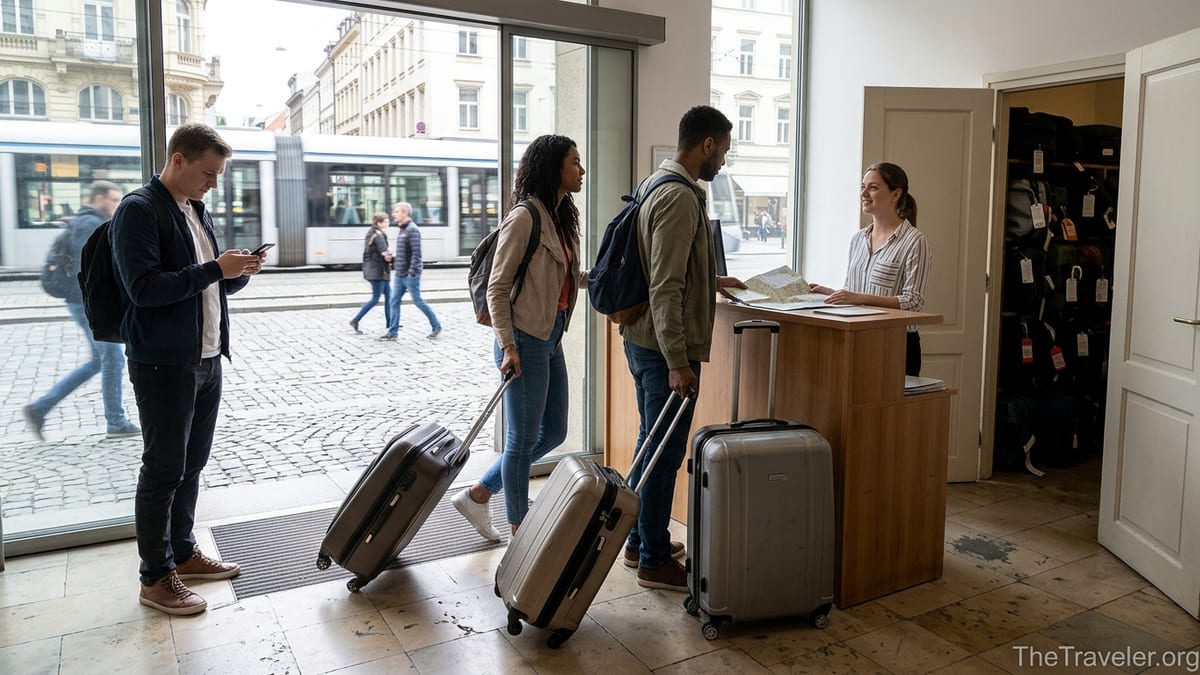
Both Radical Storage and Bounce are marketplaces rather than traditional left-luggage companies. Instead of running their own depots, they partner with existing businesses such as hotels, convenience stores, coworking spaces, bike rental shops, and cafes. Travelers search a map in the app or on the website, pick a location near a station or sight, pay online, then drop bags with staff at the partner venue. Bags are typically tagged, stored out of public view, and collected later the same day or within 24 hours.
Radical Storage emphasizes a very simple model: a flat daily rate per bag with no weight or size limits for standard items. You might store a large checked suitcase, a backpack, and a duffel as three separate items, each charged at the local flat rate. The company highlights that locations are vetted partner businesses, and that travelers book a timeslot online then show a confirmation code on arrival.
Bounce operates similarly but leans hard on its app experience and broad use cases. It markets itself as a place to store not only suitcases but also strollers, ski gear, shopping bags, and even small boxes, provided the partner is willing. Pricing is still per bag per day, but the structure can vary slightly by city, and there may be additional service fees. Bounce also invests heavily in integrations with short-term rental hosts and hotels, positioning itself as an upsell tool for property managers who want to offer luggage storage after checkout.
In practice, this means that in a city like New York or London you will often see both apps listing similar types of locations close to major train stations and attractions. The difference is less about the basic concept and more about price, coverage, guarantees, and traveler experience once you show up at the door.
Global Coverage and Where Each Service Shines
Coverage can be the deciding factor if you are traveling to smaller destinations. Radical Storage has built a very wide geographic network, promoting thousands of partner locations across more than a thousand cities worldwide, from major hubs like Paris, Rome, and New York to secondary destinations such as Split, Porto, and smaller Italian and Spanish resort towns. Travelers report using Radical Storage successfully in places like Dubrovnik, Edinburgh, and Bogota, where luggage storage alternatives can be limited.
Bounce is particularly strong in North America and Western Europe’s major cities. The service is widely used in New York, San Francisco, Los Angeles, London, Paris, and Lisbon, and is expanding in Asia and Latin America. For example, a traveler arriving at New York’s Penn Station will see multiple Bounce points within a few blocks, often at 24-hour delis or hotels. In Las Vegas, Bounce markets 24-hour storage options on or near the Strip, filling a gap for visitors with late-night flights.
If you are planning a Euro trip that includes both big capitals and smaller stops, Radical Storage’s footprint can be an advantage. A traveler might use it in Rome near Termini Station, then again in Amalfi or Split where there is no station-run left-luggage office. On the other hand, a traveler spending a week city-hopping between major hubs like Barcelona, Paris, and Amsterdam will usually find both apps available in central districts with similar density of options.
For US-based travelers sticking to major cities, Bounce’s network is often ample. In mid-sized or less touristy American cities, coverage varies more, so it is worth searching both apps in advance. In some places you may find Bounce only, in others Radical Storage only, and occasionally both, within walking distance of the bus or train station.
Pricing in Real Cities: What You Can Expect to Pay
Both services price per bag, per 24-hour period, but the local rates, fees, and policies differ slightly. Radical Storage is built around a simple all-inclusive daily price that varies by city but is fixed across locations within that city. In practice, travelers commonly encounter rates in the range of the equivalent of 5 to 7 US dollars per bag per day in lower-cost destinations, rising to around the low teens in expensive cities. You pay once per bag for up to 24 hours, with no extra service charges shown at checkout, which makes it easier to estimate costs for a family dropping several suitcases between an Airbnb and an evening flight.
Bounce also sets prices per bag per day but often layers in a service or booking fee, which can make the final amount a few dollars higher than the headline rate. In a practical example, a traveler in New York might see a base price per bag around the mid-teens, with a modest service fee on top. A couple leaving two checked suitcases near Times Square for a full day might pay something roughly in the 30 to 40 dollar range in total, depending on season and exact location.
The difference becomes more noticeable for groups. A family of four with four checked bags and two carry-ons spending a layover in Barcelona might pay a slightly lower, more predictable total with Radical Storage if the city’s flat rate is on the lower side, because there are no extra per-booking fees. With Bounce, the same group could see a marginally higher grand total if a service fee applies to the entire booking, though the per-bag price itself might be competitive.
On short holds of just a few hours, neither service currently offers hourly pricing. In cities where station lockers exist, such as Vienna or Tokyo, two or three hours of locker storage can be cheaper than a full-day per-bag fee with either app, especially for solo travelers. Where lockers are scarce or already full, Radical Storage and Bounce both become cost-effective alternatives, even for brief stays, simply because they allow you to reclaim your last day in town.
Security, Insurance, and What Happens When Things Go Wrong
Security is a top concern when you are trusting strangers with your belongings. Radical Storage stresses that all partner locations are verified businesses and that it offers a guarantee on stored luggage. While the exact coverage amount can vary by region and should be confirmed at booking time, the model is designed to cover theft or serious damage, not minor scuffs. Travelers often report that bags are kept in back rooms, staff-only areas, or locked storage spaces, not left on the shop floor.
Bounce similarly promotes insurance on every booking, with coverage designed to protect against theft or loss up to a advertised upper limit per booking. The company positions this as a major selling point, pitching that you can store valuable items like laptops and cameras in your luggage with greater peace of mind. Partner venues are instructed to store bags in non-public areas and to check QR codes or confirmations before releasing luggage.
In real life, experiences vary by location more than by platform. There are many positive accounts of both services being straightforward and safe: a traveler in Lisbon dropping backpacks at a small hotel desk via Bounce and returning to find them untouched, or a solo traveler in Prague using Radical Storage at a café near the station and praising the clear tagging process and quick pickup. There are also scattered negative online reviews for each, usually involving a partner venue that misplaced a bag or confusion around opening hours and access to locked rooms.
The difference often lies in how each company handles problems. Some travelers recount smooth resolution, with a quick refund and assistance from customer support when a partner location closed early. Others describe slower responses or disputes about compensation. Because both services involve three parties (you, the platform, and the local shop), it is wise to store valuables like passports and electronics on your person when possible and treat insurance as a backstop rather than a license to relax completely.
Booking Experience, Flexibility, and Traveler-Friendly Features
From a usability standpoint, both Radical Storage and Bounce provide map-based search, date and time selection, and digital confirmation. Radical Storage’s interface is deliberately minimal: you enter a city, choose a location, select the number of bags, and pay. The booking is linked to a QR code or code number you present at drop-off. Cancellations and changes are typically managed through your account, with cut-off times that vary by city and policy, but in general same-day cancellations close to the check-in time may not be fully refundable.
Bounce’s app takes a slightly more feature-heavy approach. It often displays detailed opening hours, bag size guidance, and user ratings for each partner. In some major cities, you may see photos of the exact shopfront so you can recognize it on a busy street. Bounce also markets additional services such as late checkout coordination with hotels or luggage storage as an upsell for short-term rentals, which can mean that your “Bounce” location is actually your existing hotel or an affiliated property nearby.
For travelers, the practical question is how flexible each platform feels. In a real-world scenario, a couple arriving early in Rome might book Radical Storage near Termini Station in the morning and then realize their train is delayed by several hours. Being able to return any time within the stated opening hours to retrieve bags makes that delay manageable. Similarly, a digital nomad in New York using Bounce might appreciate the ability to see on the map which storage points are open late into the evening so they can work from a café and collect bags at 10 p.m. rather than rushing across town by 7 p.m.
Both apps benefit from planning ahead. You can usually book on the same day, even within minutes of arrival, but checking opening hours and reviews of the specific partner location saves surprises. If you know you have a 9 p.m. flight from Barcelona and want to explore until 6 p.m., prioritize venues with clearly stated evening hours and good reliability feedback. Features like in-app navigation and the ability to modify bag counts without creating a new booking can be small but meaningful advantages, especially on multi-stop journeys.
Real-World Scenarios: Which Travelers Each Service Fits Best
To understand which service fits better, it helps to walk through common travel situations. Imagine a budget-conscious solo traveler backpacking through central Europe, visiting cities like Krakow, Budapest, and smaller stops such as Split or Bratislava. This traveler cares about low, predictable prices and needs storage in cities where traditional left-luggage options may be scarce. Radical Storage’s flat daily rates and broad geographic reach make it a strong fit here, as they are more likely to find a partner near the old town or station even in smaller destinations.
Now consider a family of four finishing an apartment stay in New York with an evening flight from JFK. They have multiple large suitcases and want to spend their last day in Midtown without returning to Brooklyn first. Bounce’s dense network around Times Square, Bryant Park, and Penn Station may offer numerous options within a few blocks of their planned activities. Even if the per-bag price plus fees is slightly higher, the convenience of close, late-closing locations might justify it for one important day of the trip.
Another example is a couple on a Mediterranean cruise who disembark early in Barcelona and fly home late at night. Port terminals often have limited storage options. Both Radical Storage and Bounce list partner locations near major transport hubs like Sants Station or Plaça de Catalunya. In practice, this couple might open both apps, compare walking distance, user ratings, and closing times, then choose whichever offers a reputable hotel or café on the direct route between the port shuttle and their afternoon sightseeing.
For digital nomads or business travelers who often arrive hours before hotel check-in, either service can become part of a regular routine. Someone who frequently travels between London, Amsterdam, and Berlin might save both apps on their phone, defaulting to Radical Storage in cities where its pricing is more attractive and switching to Bounce in neighborhoods where it has better late-night coverage. In most major hubs, you are not locked into one ecosystem, so the most practical approach is to stay flexible and compare in the moment.
The Takeaway
Radical Storage and Bounce solve the same modern travel problem, but they are not carbon copies. Radical Storage tends to appeal to travelers who value simple, flat pricing and broad coverage that extends beyond capital cities. It can be a particularly strong option for backpackers, long-term travelers, and anyone exploring secondary destinations where storage alternatives are limited or where station lockers are not available or already full.
Bounce, by contrast, often shines in major urban centers where it has built dense networks of partner locations and polished app features. For families and city-break travelers in places like New York, London, or Paris, the ability to choose from numerous late-closing venues within a few blocks of key attractions can outweigh slightly higher all-in pricing. Its integrations with hotels and short-term rentals also make it attractive if you frequently stay in apartments rather than traditional hotels.
Ultimately, the better fit depends less on brand loyalty and more on your specific itinerary. Before each trip, search both Radical Storage and Bounce for your main cities and travel days, taking note of location density, opening hours, user ratings, and estimated total cost for all your bags. In many cases you will find that one platform clearly outperforms the other for a particular stop. Savvy travelers treat these apps as complementary tools rather than rivals and are happy to switch between them whenever it makes a busy travel day lighter.
FAQ
Q1. Are Radical Storage and Bounce cheaper than traditional station lockers?
In some cities yes, in others no. Station lockers can be cheaper for short two to three hour stays, especially for solo travelers, but in places where lockers are limited or very expensive, the flat per-bag pricing of Radical Storage or Bounce can be similar or even better value, particularly for groups or full-day storage.
Q2. Which service has more locations worldwide, Radical Storage or Bounce?
Radical Storage currently promotes coverage in well over a thousand cities worldwide, including many smaller destinations, while Bounce focuses more heavily on dense networks in large urban centers. For major capitals you will often find both, but Radical Storage tends to appear more frequently in secondary cities and resort towns.
Q3. How far in advance should I book luggage storage with these apps?
You can often book on the same day or even minutes before arrival, but it is wise to check the map and opening hours the day before, especially during peak seasons. Popular central locations in cities like Rome or New York can show limited time slots at busy times, so reserving a morning drop-off for an afternoon arrival can provide extra peace of mind.
Q4. Can I access my luggage multiple times during the day?
Policies vary by partner. Some shops and hotels are happy to let you access your bags more than once during opening hours, while others prefer a single drop-off and pickup to minimize disruption. If you know you will need mid-day access, such as to grab a laptop for a meeting, it is worth messaging the location through the app or choosing a venue that explicitly mentions flexible access in its description.
Q5. Are valuables like laptops and cameras covered by insurance?
Both services advertise coverage against theft or loss up to a certain limit, which can include valuables stored inside your luggage. However, the terms and evidence required for a claim can be strict, and claims processes may take time. For that reason, many experienced travelers still keep passports, electronics, and high-value items with them and rely on luggage storage insurance mainly as protection against serious incidents, not as a primary safeguard for expensive gear.
Q6. What happens if the partner location closes early or refuses my booking?
If you arrive to find the partner business closed, moved, or unwilling to accept your bag despite a confirmed booking, you should immediately contact the platform’s customer support through the app. In typical cases, you can expect a refund and assistance in finding an alternative nearby, but response times vary. Taking a photo of any posted closure notice and keeping receipts for emergency alternatives, such as station lockers, can help if you later request reimbursement.
Q7. Is there a size or weight limit for bags?
Radical Storage markets no strict size or weight limits for standard luggage items, though extremely oversized or unusual items may require confirmation with the location. Bounce provides guidelines and expects bags to be manageable for staff and able to fit in the storage area. For items like surfboards, skis, or bicycles, it is prudent to ask the venue in advance or look for locations that explicitly allow larger gear.
Q8. Can I store items other than luggage, like shopping bags or strollers?
Yes, both services commonly accept non-traditional items such as shopping bags, baby strollers, and small boxes, provided they can be safely stored and are not prohibited goods. Some partner locations specifically mention storing stroller or sports equipment. Always avoid storing restricted items such as cash, important documents, dangerous goods, or anything that violates local laws or the platform’s terms.
Q9. How do tips and reviews from other travelers help me choose a location?
User reviews and ratings can be very helpful in spotting consistently reliable venues and filtering out locations with repeated complaints about lost tags, cramped storage spaces, or confusing entry instructions. When comparing several options within the same neighborhood, favor those with detailed positive feedback mentioning clear communication, secure back-room storage, and easy pickup, even if the price is a little higher.
Q10. Should I install both apps or commit to one service?
For frequent travelers, having both Radical Storage and Bounce installed is a practical strategy. Coverage, price, and opening hours can differ significantly by city and even by neighborhood. Checking both apps before each travel day lets you pick the specific location that best fits your schedule and budget, rather than relying on a single provider that might not always have the most convenient or cost-effective option.