


More news on this day
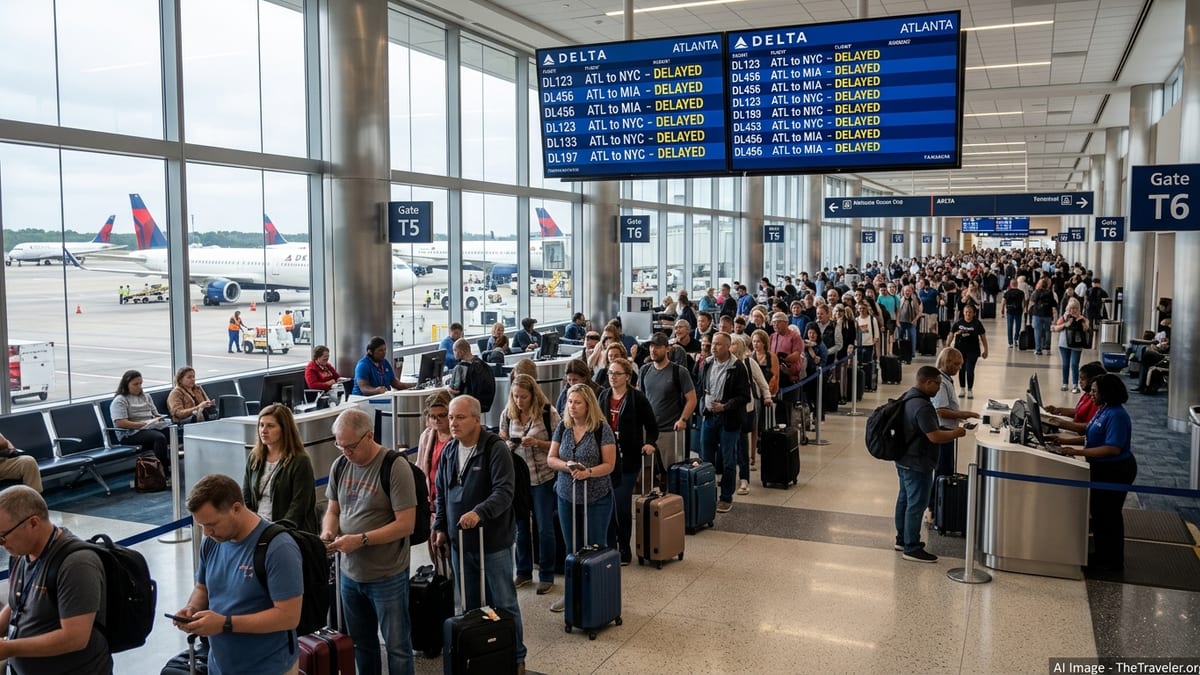
Delta Air Lines says a key automation system is back online after a technical failure at its Atlanta hub on Sunday, November 22, 2026, triggered more than 1,000 flight delays nationwide just as the U.S. Thanksgiving travel period began, leaving passengers facing rolling disruptions that are expected to linger into Tuesday.
Get the latest news straight to your inbox!
What happened to Delta’s systems in Atlanta
Delta has confirmed that the disruption on Sunday stemmed from a problem with its weight-and-balance automation system, a tool used to calculate how passengers, baggage and fuel are distributed on each aircraft before departure. The carrier requested a temporary ground stop for its flights into Hartsfield-Jackson Atlanta International Airport while the issue was addressed, and the Federal Aviation Administration limited some Delta arrivals into the airport for roughly an hour on Sunday morning.
The outage primarily affected flights into and out of Atlanta, but the network impact extended across Delta’s system in the United States. Flight-tracking data showed that by Sunday afternoon, more than 1,000 Delta-operated flights were delayed nationwide, including over 1,000 delays linked directly to operations at Hartsfield-Jackson. At one point, roughly a third of departures and arrivals at the airport were running late, according to multiple data snapshots from aviation tracking services.
Delta has said that the immediate technical problem with the automation system was resolved later on Sunday. The airline and airport have both stated that the issue was not related to a cyberattack, and that the ground delay program applied to Delta flights was put in place to manage congestion as planes and crews fell out of their planned positions. The underlying calculations could still be completed manually, but doing so added extra time to pre-departure procedures at many gates.
Impact on travelers in Atlanta and nationwide
Hartsfield-Jackson Atlanta International Airport is Delta’s largest hub and the world’s busiest airport by passenger volume, which meant the system failure quickly rippled far beyond Georgia. As the problem developed on Sunday morning, flights bound for Atlanta from airports across the United States were held at their origin or placed into delay programs. Several major airports reported clusters of Delta delays on flights whose routings touched Atlanta, even when local weather conditions were favorable.
By early Sunday afternoon, flight tracking services showed that more than 1,300 Delta flights nationwide had been delayed at some point during the day. Delays at Atlanta alone climbed into the four-figure range when both inbound and outbound flights were counted. While most of the affected flights eventually departed, some passengers reported missed connections and overnight disruptions as crews and aircraft reached duty-time limits or ended up out of position relative to the schedule.
The disruption unfolded during one of the heaviest travel periods of the year. Airport officials in Atlanta forecast more than 4 million passengers moving through Hartsfield-Jackson between November 19 and December 1. Many of Sunday’s delayed or canceled flights were carrying travelers headed to early Thanksgiving gatherings or returning from weekend trips. Although the technical fault was resolved within hours, the size of Delta’s operation in Atlanta meant the knock-on effects were still being felt on Monday, with a smaller but noticeable number of residual delays as the carrier worked to realign its schedule.
How this outage fits into a wider run of aviation tech problems
The Atlanta incident adds to a string of recent technology problems affecting U.S. air travel in the run-up to Thanksgiving. Within the past two weeks, a separate telecommunications issue in the Federal Aviation Administration’s systems prompted a nationwide ground stop for all U.S. flights, and United Airlines experienced an outage that temporarily halted its own departures. Other major service providers in sectors such as banking and hospitality have also reported technical disruptions, contributing to wider public attention on digital resilience.
In this case, both Delta and federal officials have said there is no evidence that the weight-and-balance system failure was linked to a cyberattack or to the earlier FAA communications problem. Investigations into the precise cause of Sunday’s Delta outage have not yet been detailed publicly, and the airline has not released technical specifics beyond identifying the affected system as an automation tool used in calculating aircraft performance and loading information.
For travelers, the distinction between different outages is largely academic; what matters is the cumulative effect on reliability. Because Hartsfield-Jackson acts as a central hub in Delta’s network, a failure in a single back-end system there can quickly create delays throughout the United States. Industry data from last year’s holiday period already showed roughly one in four U.S. flights arriving at least 15 minutes late in November and December, and the current series of glitches has raised concerns about whether similar or worse patterns could emerge this season. At the same time, regulators and airlines are emphasizing that critical safety systems remain protected, and that delays in cases like Sunday’s reflect conservative decisions not to depart until performance calculations are verified.
Current status and what passengers can expect this week
As of Monday, November 23, Delta and Hartsfield-Jackson officials have said that operations are stabilizing. The carrier has reported that its schedule returned to largely normal levels by Monday morning, with far fewer new delays being attributed directly to the resolved automation issue. However, residual disruptions have persisted in some parts of the network as aircraft and crews continue to move back into their intended rotations, and some travelers are still seeing longer-than-usual waits at gates where manual checks remain in use for certain flights or where earlier disruptions pushed crews near their regulated duty limits.
Independent travel and aviation outlets say that passengers flying on Delta around Atlanta should still plan for possible knock-on delays through at least Tuesday, November 24. Because the Sunday outage struck close to the Thanksgiving peak, flights are heavily booked, leaving limited spare capacity to absorb rebookings when a single leg runs significantly late. Some passengers whose Sunday flights were canceled or heavily delayed were re-accommodated on later services that are now approaching or at capacity.
Airport officials in Atlanta continue to advise travelers to arrive early and to be prepared for higher-than-usual volumes at check-in, bag drop and security. While security screening has not been directly affected by the Delta system issue, the combination of strong holiday demand and irregular operations can create longer lines across the airport. Travelers connecting through Atlanta should pay particular attention to minimum connection times on their itineraries and be ready for gate changes if Delta continues to adjust its schedule and aircraft assignments to restore normal operations.
Practical advice for travelers booked on Delta
For those traveling in the next few days, the most important step is to monitor flight status frequently through Delta’s official channels. The airline is updating departure and arrival times as aircraft and crews are reassigned, and same-day changes are common in the wake of a large-scale disruption. Passengers should also keep an eye on gate information at the airport, as aircraft substitutions and late-arriving inbound flights can trigger last-minute gate changes, especially at large hubs such as Atlanta.
Delta has encouraged customers affected by Sunday’s disruption to use its website and mobile app to rebook where possible, a process that can be faster than seeking assistance at airport desks during peak times. Some fare rules and change fees may be relaxed for travelers whose flights were directly impacted by the automation issue, but the specifics of any waiver depend on the route and travel date and should be confirmed directly with the airline. When flights are significantly delayed or canceled, passengers may also have certain rights under federal rules or company policies regarding meal vouchers or overnight accommodation; those entitlements vary by circumstance and are not automatic.
Looking ahead to the rest of the Thanksgiving travel window, passengers booked on Delta should assume that the underlying technical problem from Sunday has been corrected, but that operational knock-on effects can still affect individual journeys, particularly on routes that involve Atlanta connections. Anyone with tight onward plans, such as cruises, long-distance train connections or time-sensitive events, may want to allow additional buffer time or consider earlier departures where space is available. Travelers should also be prepared for the possibility that weather-related delays, which are common in late November, may combine with residual schedule imbalances to create further congestion even after the immediate system failure has been resolved.