


More news on this day
A nationwide Federal Aviation Administration ground stop on November 13 followed by technology outages at United Airlines and Delta Air Lines in mid-November have created one of the most disruption-prone weeks for U.S. air travel in more than a decade, spotlighting how dependent holiday flying has become on fragile digital systems and how unevenly airlines and regulators are prepared to protect passengers when those systems fail.
Get the latest news straight to your inbox!
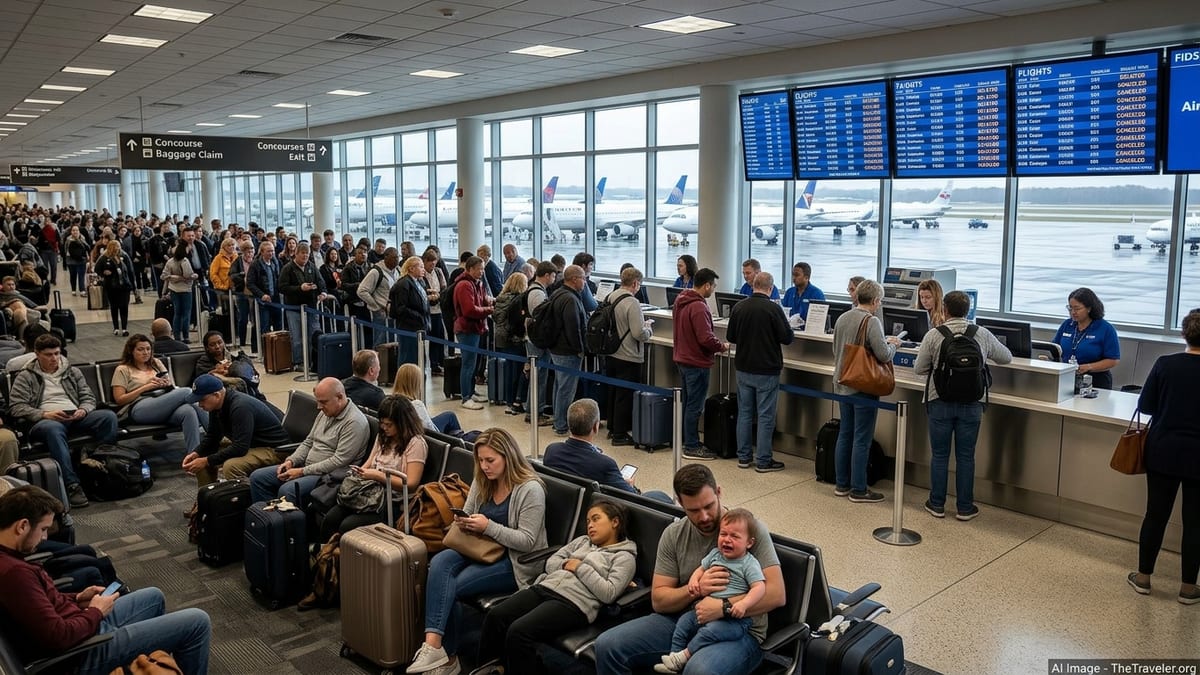
Three failures in ten days snarl pre-Thanksgiving travel
The most far-reaching breakdown came on Friday 13 November 2026, when a telecommunications failure inside the U.S. air traffic system led the FAA to order a nationwide ground stop on most departures. The agency later said the issue did not fully shut down air traffic control but affected key systems to such an extent that it halted takeoffs out of “an abundance of caution” while the fault was isolated and traffic flows were gradually restored. According to FAA and Department of Transportation figures, airlines canceled more than 12,000 flights between November 13 and 16, including just over 9,000 cancellations by major U.S. carriers, with knock-on delays persisting through the weekend.
As operations were still normalizing from the FAA incident, United Airlines experienced its own outage on Monday 16 November. The carrier reported a roughly 90-minute “widespread system outage” that interrupted the flow of operational data to some aircraft, including weight and balance information required before takeoff. United briefly held many departing flights across its network while its technology teams worked to restore internal systems, then lifted the self-imposed ground hold once technicians confirmed that the data feeds were again stable. Early reports from pilots and unions pointed to problems with United’s internal applications that calculate aircraft loading and manage certain crew functions, although the airline has not published a detailed technical breakdown.
Six days later, on Sunday 22 November, Delta Air Lines experienced a similar but separate failure in its automated weight and balance system just as Thanksgiving travel was ramping up. The malfunction disrupted the software that calculates how much each aircraft weighs and how that weight is distributed, a calculation that airlines must complete and transmit to crews before pushback. Delta and federal data show that well over 1,000 of the carrier’s flights were delayed on November 22, with some cancellations and residual disruption extending into November 23 while the airline worked through congested schedules and crew displacements. At the height of the outage, the FAA temporarily halted some Atlanta-bound departures while Delta and the airport coordinated a staggered restart of normal flows.
Digital chokepoints and thin operational buffers
The clustering of incidents has underlined how specific systems have become critical chokepoints in modern aviation. In all three cases, the initial problem involved technical infrastructure rather than weather or airfield conditions. For the FAA, a failure in underlying telecommunications equipment affected the broader air traffic network and triggered a rare nationwide stop on departures. For United and Delta, the problem sat inside the airlines’ own weight and balance and operational data tools, which interface with cockpit systems and operations centers.
Because regulators and airlines treat weight and balance calculations as non-negotiable safety steps, even a short-lived outage can force large numbers of aircraft to remain on the ground until reliable figures are available. While dispatchers and crews can in theory fall back on manual procedures, the scale and time pressure of a banked hub operation mean that extensive manual workarounds are difficult to sustain beyond a limited number of flights. The result is often a wave of departure pushes followed by congested taxiways, missed connections and crew timing problems that take many hours to unwind.
These failures have also highlighted how tight scheduling and high aircraft utilization limit the slack available when systems go down. In its public briefings about the November 13 ground stop, the FAA noted that there was sufficient en route capacity to keep aircraft already in the air moving safely, but far less flexibility to absorb several hours in which most departures were held at the gate. Airlines typically plan narrow turnaround windows and sequence connecting “banks” of flights to maximize use of aircraft and crews. When a ground stop or airline-wide tech failure interrupts one or two of those banks, airports quickly run short of gates, spare aircraft and rested crews, even after the original fault is addressed.
Delay statistics and passenger confidence gaps
The latest disruptions follow an already strained 2025 holiday season. An analysis of federal on-time performance data for November and December 2025 found that nearly one in four domestic U.S. flights arrived at least 15 minutes late, the threshold commonly used to classify a flight as delayed. That share was higher than in many pre-pandemic years, even though airlines had trimmed some schedules in an effort to improve reliability, indicating that delays grew faster than overall seat capacity as demand rebounded.
Oversight bodies including the U.S. Government Accountability Office have previously estimated that chronic delays and cancellations cost passengers and airlines billions of dollars in lost time, productivity and associated expenses over multi-year periods. Those valuations typically exclude harder-to-measure impacts such as missed family events or work commitments, but they help explain why regulators have stepped up pressure on carriers to publish clearer customer commitments and invest in more resilient operations. For travelers, the November 2026 outages reinforce those statistics with visible queues at airport counters, long lines at customer service desks and crowded gate areas when multiple departure banks are disrupted at once.
Survey work on both sides of the Atlantic suggests that many passengers still have limited understanding of what assistance they are entitled to during such events. A 2024 Eurobarometer survey commissioned by the European Commission found that about 30 percent of EU air travelers had faced at least one significant disruption, such as a long delay or cancellation, in the previous year. Yet only around one third of respondents said they were aware of their air passenger rights framework. In Canada, research for the Canadian Transportation Agency in 2024 found that fewer than half of surveyed passengers were confident their airline would provide a satisfactory resolution to a major problem, and only about one third realized that the regulator could help with complaints. Private surveys by compensation intermediaries show similar gaps between perceived and actual knowledge of rights, although those findings often reflect samples tilted toward travelers who have recently experienced problems.
Regulators focus on transparency rather than new cash payouts
Regulatory responses to repeated disruption have largely prioritized transparency and enforcement of existing commitments over new compensation entitlements, particularly in the United States. The U.S. Department of Transportation’s Airline Cancellation and Delay Dashboard, first launched in 2022 and updated since, compiles what each major carrier publicly promises to provide during controllable delays and cancellations, including meal vouchers, overnight hotel accommodation and rebooking on its own or partner airlines. The dashboard does not itself create legal obligations, but it allows passengers and policymakers to compare carriers’ customer service plans side by side.
Congress has since written a related transparency requirement into federal law. Under provisions now included in Title 49 of the U.S. Code, airports with scheduled passenger service that qualify as large, medium or small hubs must display prominent signage outlining key federal air travel rights. These posters are required to summarize protections around cancellations, lengthy tarmac delays and disability assistance and to direct travelers to official DOT resources for more detailed information. Implementation has been gradual, but by late 2026 travelers at many larger U.S. airports can see standardized passenger rights notices at check-in areas and concourses.
The core U.S. legal position on compensation has not changed alongside these transparency measures. Federal rules still do not require airlines to pay automatic cash compensation for domestic delays and cancellations that fall within a carrier’s control. Instead, passengers are entitled to refunds when a flight is canceled or significantly changed and they choose not to travel, a right that the DOT reinforced in refund regulations finalized in 2024. Those rules define when airlines must issue refunds automatically rather than waiting for passengers to request them, but they do not create a European-style scheme that pays fixed amounts per passenger based solely on delay length and distance.
Within the European Union, Regulation (EC) No 261/2004 continues to provide such fixed-sum compensation for many cancellations, long delays and denied boardings, provided the disruption is not caused by “extraordinary circumstances” outside the airline’s control. On July 22, 2024, the European Commission published revised interpretative guidelines designed to clarify recurring problem areas under the regulation, such as how rights apply to missed connections, journeys that involve multiple carriers and itineraries that combine different modes of transport. The guidance does not change the law, but it seeks to harmonize enforcement among national agencies and give passengers and airlines clearer expectations.
The Commission has also reiterated proposals to update the legislative framework, including measures aimed at strengthening enforcement and adapting rules to multimodal trips where one ticket covers, for example, a rail and a flight segment. Those proposals remained under negotiation among EU institutions as of late 2026, so they are not yet reflected in day-to-day traveler entitlements. Elsewhere, Canada’s Air Passenger Protection Regulations and the United Kingdom’s post-Brexit regimes have both been subject to review and legal challenges regarding what counts as within an airline’s control and how much compensation is due, but each jurisdiction continues to operate its own distinct set of rules and complaint processes.
Airline tech upgrades and the limits of resilience
The November outages have landed in the middle of an industry push to upgrade operational and customer-facing technology. A 2024 airline technology investment survey published by Amadeus reported that around one third of participating carriers believed they already had “end-to-end” disruption-management tools capable of rebuilding schedules, rebooking passengers and managing crew in near real time when irregular operations occur. Nearly two thirds of respondents said they aimed to achieve that level of capability by 2030, citing the potential to reduce misconnected passengers, speed up recovery after storms and automate routine notifications.
These platforms are designed to bring together data that often sits in separate systems, including weather forecasts, airspace restrictions, aircraft routing, airport congestion indicators and crew availability. In theory, an integrated system can predict which flights are most likely to be disrupted, propose alternate routings and issue rebooking offers or vouchers before passengers reach the airport. Some providers and airlines are experimenting with tools that can coordinate with alliance partners, interline carriers and even rail operators to suggest cross-modal alternatives when an entire region is affected by storms or infrastructure failures.
The recent events, however, illustrate that investment in such tools does not eliminate single points of failure inside airline and air traffic infrastructure. For both United and Delta, the immediate trigger was a breakdown in specific applications responsible for feeding accurate weight and balance information to cockpit and dispatch systems. Those functions sit upstream from the more visible customer experience tools. When they fail, higher-level automation that might otherwise help rebook passengers has little to work with until the underlying calculation engines are restored or manual alternatives are put in place. The FAA’s November 13 ground stop, meanwhile, stemmed from a telecommunications issue inside air traffic networks, a reminder that critical government-run systems face similar modernization challenges.
Beyond aviation, November 2026 has seen significant outages across email services, banking applications and government networks, prompting media and public speculation about whether a common cyber threat or broader systemic weakness was at work. Current statements from U.S. transportation officials, the FAA and affected companies indicate that investigators have not identified evidence of a linked cyberattack behind the aviation incidents. Instead, early explanations emphasize interactions between aging infrastructure and increasingly complex, highly automated software environments. While detailed post-mortems are still under way, officials have warned that further technical issues are possible as both regulators and airlines replace legacy systems while keeping them connected to newer platforms.
What travelers should check before their next holiday trip
For passengers flying during the remainder of 2026 and into 2027, the recent disruptions underscore the importance of understanding both airline policies and formal legal protections before departure. In the United States, travelers can review the DOT’s Airline Cancellation and Delay Dashboard when choosing carriers or preparing for a busy travel period. The dashboard shows, airline by airline, what each company pledges to provide during controllable delays and cancellations, from meal vouchers to overnight accommodation or confirmed seats on the next available flight, including on partners in some cases. Those commitments sit alongside each carrier’s contract of carriage and customer service plan and can influence how quickly a disrupted passenger is rebooked or housed.
At airports, passengers should increasingly encounter federally mandated passenger rights posters at large, medium and small hubs with scheduled commercial service. While the exact placement varies by airport, the notices are intended to be visible in check-in halls and concourses and to summarize core federal protections, including the right to refunds for canceled flights and certain rules on lengthy tarmac delays and accessibility. The posters do not guarantee compensation for delays that do not involve cancellations or significant schedule changes, but they can help travelers quickly determine whether their situation may qualify for a refund or other specific remedies.
In Europe, travelers departing from an EU airport or flying to the bloc on an EU carrier can consult official summaries of Regulation 261 and national enforcement body guidance to gauge their eligibility for compensation and care. Because entitlements depend heavily on the cause of the disruption, the length of the delay and the itinerary structure, passengers on multi-leg or multi-ticket journeys should pay close attention to whether flights are booked on a single reservation and which carrier is operating each segment. National enforcement bodies typically advise passengers to first submit complaints directly to the airline and then escalate if they receive no response or consider the response inadequate.
Across jurisdictions, regulators consistently recommend that travelers keep thorough records when disruptions occur. That includes saving boarding passes, booking confirmations, delay or cancellation notifications from airline apps or text messages, receipts for meals or hotels paid out of pocket and any written communication with carrier representatives. In the wake of events such as the November 13 FAA ground stop or the subsequent Delta and United outages, those records can help passengers demonstrate what happened, which party caused the disruption and whether they are owed refunds or, where applicable, additional compensation or care. With further regulatory changes under discussion and airlines continuing to roll out new automation, travelers planning peak-season trips may also want to build extra time into connections and review airline-specific policies before departure so they know what to ask for if digital systems stumble again.