


More news on this day
Delta Air Lines says its flight operations have largely returned to normal after a malfunction in its automated weight-and-balance system triggered a wave of delays affecting close to 2,000 flights nationwide on Sunday, just as the U.S. Thanksgiving travel period got underway.
Get the latest news straight to your inbox!
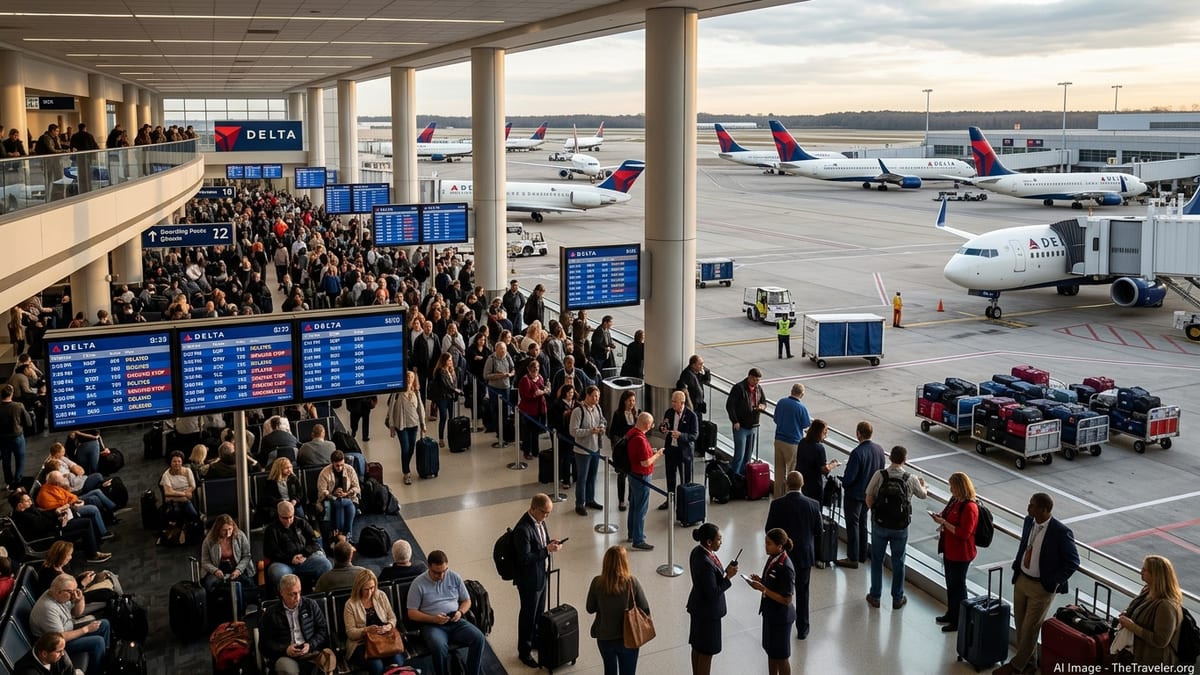
What went wrong with Delta’s system
The disruption began on Sunday 22 November 2026, when Delta reported problems with the automated system it uses to calculate aircraft weight and balance before departure. The airline confirmed that the outage affected its ability to dispatch flights normally, prompting a request for a temporary ground stop for Delta-operated services bound for Atlanta, the carrier’s busiest hub.
According to flight-tracking data cited by multiple outlets, by early Sunday afternoon roughly half of all Delta departures were running late, with estimates ranging from about 1,300 to nearly 2,000 delayed flights worldwide over the course of the day. Some reports put the share of delayed services at close to 60 percent of Delta’s scheduled Sunday operation. In several cases, crews reverted to manual procedures for weight-and-balance calculations so flights could depart safely while the automated tool was restored.
The Federal Aviation Administration described the problem as an airline-specific issue and emphasized that it was not related to air traffic control systems. The agency initially issued a ground stop for Delta flights headed to Atlanta before shifting to a ground delay program once the situation was better understood and workarounds were in place. Other U.S. airlines were not directly affected by Delta’s internal system failure, although knock-on congestion occurred at some airports where Delta has a large presence.
How the outage affected Thanksgiving-week travelers
The timing of the malfunction compounded its impact. The glitch hit just as many Americans were beginning their Thanksgiving trips, in a year when overall holiday air travel volumes are expected to be high at major U.S. hubs. Airports including Atlanta, Minneapolis–St. Paul, Detroit and New York–area gateways all reported lines and delays for passengers booked on Delta on Sunday.
At Hartsfield–Jackson Atlanta International Airport, Delta’s primary hub and a key connecting point for domestic and international itineraries, the combination of the ground stop, subsequent ground delay program and manual procedures led to longer-than-usual waits at gates. Local and national media reported passengers sitting on aircraft awaiting clearance to push back, as well as travelers facing missed connections and the need to rebook onward flights. By late afternoon on Sunday, some airports reported that delays were easing and terminal conditions were improving, but the earlier disruption continued to ripple through the network into the evening.
Delta stated that it was providing hotel, meal and transportation vouchers to eligible customers whose trips were significantly disrupted. However, availability varied by location and by how long passengers were delayed, and some travelers still needed to arrange their own accommodations or alternative flights, particularly at peak times when spare seats were limited across the industry. With many Thanksgiving departures already heavily booked on competing carriers, options to switch airlines at short notice were constrained on some routes.
Recovery on Monday and the wider context of recent outages
By Monday 23 November 2026, Delta said its operations were stable and that flights were running on or close to schedule. While scattered delays remained as aircraft and crews were repositioned, the airline and several major airports described Monday’s operation as normal or near-normal compared with the significant disruption seen on Sunday. Travelers flying later in the week are being told to check flight status regularly but are not currently facing a continuation of Sunday’s widespread, system-driven delays.
The Delta outage did not occur in isolation. It followed a rare nationwide ground stop on Friday 13 November, when a malfunction in the Federal Aviation Administration’s communications network forced regulators to halt most U.S. departures for several hours. That earlier incident disrupted thousands of flights across multiple airlines and continued to affect schedules into the subsequent weekend. In between, United Airlines experienced its own system issue, temporarily pausing some departures while it resolved problems with internal technology.
The cluster of events has renewed attention on the resilience of aviation technology in the United States, from federal air traffic infrastructure to airline-specific operational tools such as crew assignment, baggage tracking and weight-and-balance software. Federal officials and carriers have generally stressed that safety systems remained intact during these incidents and that outages primarily affected the ability to dispatch flights efficiently, not to operate them safely once airborne. However, the disruptions have highlighted how quickly technical problems can cascade into large-scale travel delays during busy periods.
What travelers experienced on the ground
For passengers booked on Delta on Sunday, the most immediate effects were extended waits, missed connections and schedule uncertainty. Many travelers reported that aircraft boarded on time but sat at gates for extended periods while ground and flight crews waited for updated weight-and-balance data or manual clearance to depart. Others found that departure times were repeatedly pushed back on airport displays and mobile apps, with new departure estimates sometimes changing again before boarding began.
At intermediate hubs such as Minneapolis–St. Paul and Detroit, the disruption meant that some inbound flights arrived significantly behind schedule, which in turn caused passengers to miss tightly timed connections. Where possible, Delta rebooked customers on later same-day flights or on services the following day. In some cases, travelers opted to reroute through alternative hubs or to drive part of their journey rather than wait for available seats on busy routes.
Although the weight-and-balance outage mainly affected Sunday operations, its effects could still be felt in pockets on Monday, particularly on morning flights operated by aircraft that had ended Sunday far from their planned overnight locations. Some travelers departing early Monday reported residual delays as Delta continued to clear the backlog and normalize aircraft rotations. However, by Monday afternoon, flight-tracking data and airport reports indicated that Delta’s on-time performance was much closer to typical levels for the carrier.
What Thanksgiving travelers should do now
For travelers yet to depart for Thanksgiving, the main implication of Sunday’s outage is the possibility of lingering schedule adjustments as Delta fine-tunes aircraft and crew positions. Most sources indicate that the airline is operating its published schedule this week, but flight times may shift slightly as the carrier works through any remaining imbalances from the disruption. Passengers should monitor their booking through Delta’s app or website and sign up for flight-status alerts, since gate assignments and departure times can change even after check-in.
Given the combination of recently resolved technology issues and the usual congestion of the holiday period, airports, airlines and travel advisors are consistently recommending that domestic passengers plan to arrive at least two hours before departure, and international passengers at least three hours before. Those connecting through large hubs such as Atlanta, Minneapolis–St. Paul, Detroit, Salt Lake City and New York–JFK may want to allow extra time between flights where itineraries can still be adjusted, particularly if traveling with checked baggage or young children.
Looking ahead to the rest of the week, no further Delta-specific system problems have been reported as of Tuesday 24 November 2026, and federal regulators have not announced any new nationwide air traffic restrictions beyond routine flow-control measures. However, weather systems across different parts of the United States are expected to influence travel conditions, and any new disruption could compound delays at already busy airports. Travelers should continue to verify flight status close to departure, watch for messages from their airline about schedule changes, and be prepared with contingency plans such as alternative routings or flexible ground transport where feasible.