


More news on this day
Delta Air Lines says operations are stabilizing after a malfunction in its weight and balance automation system triggered a wave of delays centered on Hartsfield-Jackson Atlanta International Airport on Sunday, affecting more than 1,000 flights nationwide and disrupting travel at the start of the busy Thanksgiving period.
Get the latest news straight to your inbox!
What happened to Delta’s system in Atlanta
Delta’s problems began on the morning of Sunday, November 22, 2026, when the airline reported issues with the automated system it uses to calculate weight and balance for flights. The technology is a core safety and performance tool used to ensure aircraft are loaded properly before departure. As the system malfunction spread, Delta slowed and then halted some departures while crews reverted to backup processes, causing delays to build quickly at its main hub in Atlanta and across the network.
The Federal Aviation Administration responded by issuing a ground stop for Delta flights bound for Hartsfield-Jackson Atlanta International Airport, the world’s busiest hub and Delta’s largest base of operations. The order, applied to Delta traffic headed to Atlanta, was later eased to a ground delay program as the airline worked through the issue and began restoring departures. By early afternoon, Delta said the weight and balance automation system had been restored and flights were once again being dispatched using normal procedures.
Even after the technical fault was fixed, the scale of disruption remained significant. Flight tracking data from multiple sources showed that by Sunday afternoon more than 1,200 flights in and out of Atlanta were delayed, while totals for Delta’s systemwide operation topped 1,300 delayed flights and more than 100 cancellations. The majority of those irregular operations were linked directly to the automation problem, according to the airline, with the remainder attributed to poor weather in parts of the network.
Scale of the disruption for travelers
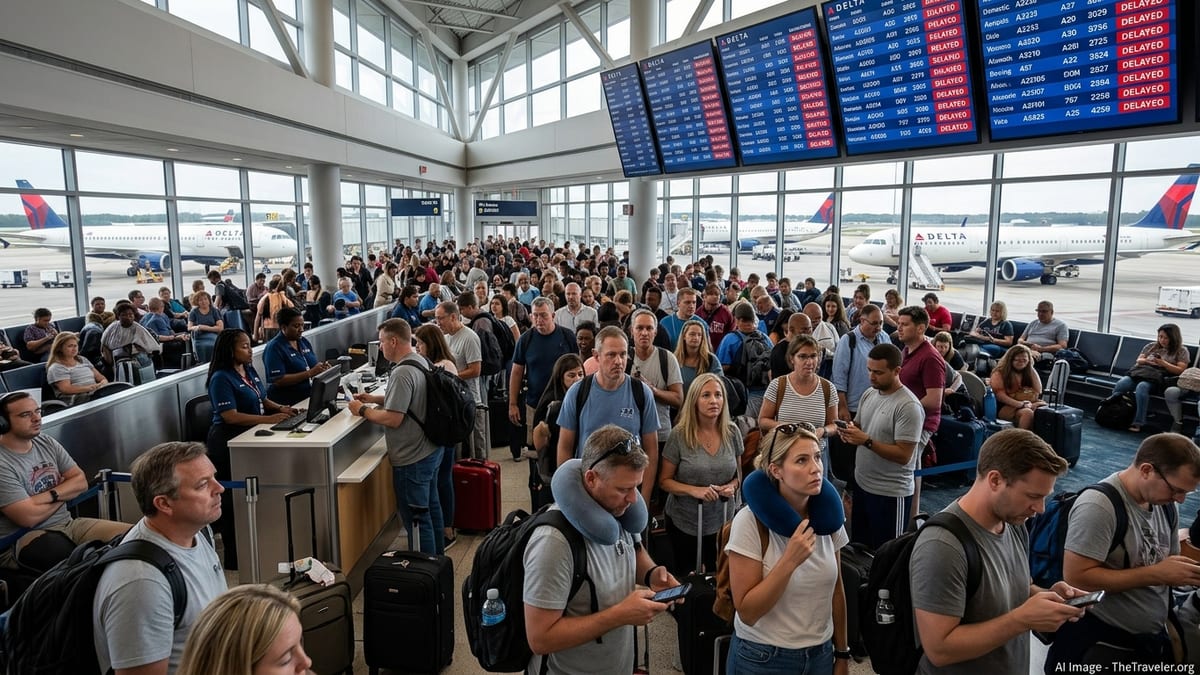
The outage struck at one of the busiest times of the year for U.S. air travel, with the Sunday before Thanksgiving already expected to be a heavy departure and connection day. At Hartsfield-Jackson Atlanta, roughly 38 percent of departing flights and more than one third of arriving services were delayed on Sunday, according to flight status data compiled that day. Because Delta operates the dominant share of flights at the airport, those figures translated into long queues at check-in and customer service desks, crowded gate areas and missed onward connections for passengers traveling through the hub.
Nationwide, the problem rippled well beyond Georgia. By Sunday evening, estimates from flight tracking providers indicated that close to 2,000 Delta-operated flights had arrived late, representing well over half of the carrier’s daily schedule. Disruptions were reported at other major Delta stations including New York, Detroit, Minneapolis–St. Paul, Los Angeles and Salt Lake City as aircraft and crews scheduled to pass through Atlanta were held or reassigned. Many customers traveling on multi-leg itineraries saw onward flights depart without them or found themselves rebooked on later services as the airline tried to recover its schedule.
Although the ground stop applied specifically to routes into Atlanta, the hub-and-spoke structure of Delta’s network meant that delays quickly cascaded. Aircraft arriving late into smaller and midsize cities often turned around late for their next flights, while crews bumped up against duty-time limits after extended waits on the ground. In some cases, that forced additional cancellations even after the computer system was back online, as aircraft were left without legal flight crews to operate them until schedules could be reset.
How Delta and the FAA responded
Delta said on Sunday afternoon that its automation system had been restored and that it was moving to normalize operations. The airline indicated that around 70 percent of the delays and cancellations recorded by flight trackers were directly linked to the system fault, with the rest driven by weather. By Monday morning, November 23, the carrier described its operation as “stable,” although residual delays and some cancellations continued as equipment and crews were repositioned across the network.
The Federal Aviation Administration confirmed that it had initially issued a ground stop on Sunday for Delta flights headed to Atlanta, then shifted to a less restrictive ground delay program as safety-critical systems returned to normal and traffic could be metered into the hub. The agency did not report any broader impact on flights operated by other airlines beyond knock-on congestion at shared airports. The FAA’s actions were separate from a nationwide ground stop that had affected all U.S. carriers a few days earlier following a telecommunications failure in air traffic control systems, which had already strained airline operations ahead of the Thanksgiving rush.
Delta has not publicly detailed the precise cause of the malfunction beyond identifying it as an issue with its weight and balance automation. There is no indication so far that the outage was related to cybersecurity concerns, and early statements have framed it as an internal equipment or software problem affecting one of several systems the airline uses to compute load data. Regulators and the airline are expected to review how the backup procedures were implemented and whether system redundancy and contingency planning were sufficient, particularly given recent scrutiny of aviation technology reliability in the United States.
Context: a tough week for aviation technology
The Delta outage came at the end of a challenging period for the U.S. aviation system. In the days before Delta’s problems, the FAA had ordered a rare nationwide ground stop after a router failure disrupted communications between air traffic control facilities, temporarily halting departures at airports across the country. United Airlines also experienced its own system outage within the same week, delaying many of its departures. Together, the incidents highlighted how dependent airlines and regulators have become on complex, tightly coupled digital systems for everything from crew scheduling to aircraft dispatch.
Weight and balance automation is one example of that technological reliance. Before departure, airlines must calculate how fuel, passengers, baggage and cargo are distributed on board to ensure safe takeoff and landing performance. Although these calculations can be performed manually using established procedures, large airlines typically use automated tools to speed up the process and reduce the risk of human error when handling thousands of flights a day. When automation fails unexpectedly, staff must either pause departures or switch to slower manual workflows, with each delay compounding as the day progresses.
Travelers have little visibility into these internal systems, experiencing only the downstream effects in the form of late departures and missed connections. However, the clustering of outages in the run-up to Thanksgiving has already prompted questions about the resilience of airline IT architecture and the adequacy of safeguards designed to prevent localized failures from spreading across entire networks. Investigations by federal officials and internal reviews at airlines are likely to focus on whether recent incidents share any common vulnerabilities or whether they simply reflect the growing age and complexity of critical software and infrastructure.
What Delta passengers should do next
By Tuesday, November 24, Delta’s schedules were expected to look more like a normal holiday operation, but the knock-on effects of Sunday’s disruption have not fully disappeared. Aircraft and crews are still being repositioned, and some busy routes may continue to experience delays or last-minute aircraft swaps as the airline works to rebalance its network. Passengers connecting through Atlanta and other major Delta hubs should be prepared for longer-than-usual lines and should allow additional time between connections where possible.
Travelers with upcoming Delta flights this Thanksgiving week are being encouraged to monitor their flight status frequently through the airline’s app or website and to sign up for text or email alerts, since these systems will carry the most current information on schedule changes and gate assignments. In previous disruptions, Delta has typically allowed affected customers to rebook without change fees within a specified timeframe; passengers whose trips were disrupted on or after November 22 should check whether any flexible travel waivers apply to their itinerary before making changes. Same-day standby or rerouting over alternative hubs may be available on a case-by-case basis, especially if connections through Atlanta remain congested.
For travelers yet to depart, arriving early at the airport, completing check-in and baggage drop as soon as they open, and having a backup plan for tight connections remains prudent while the operation fully recovers. Those with essential time-sensitive travel, such as international departures or last flights of the day from smaller cities, should pay particular attention to schedule updates and consider speaking with airline staff about earlier options if their original flight begins to show significant delay. While Delta’s automation issue has been resolved, the residual disruptions serve as a reminder that the U.S. air travel system can take days, rather than hours, to fully recover once a major hub has been disrupted.