


More news on this day
Delta Air Lines says its operation has largely returned to normal after a problem with an automated weight-and-balance system delayed more than 1,000 flights on Sunday, disrupting the busy run-up to the U.S. Thanksgiving holiday and raising fresh questions for travelers already wary after this summer’s IT outage at the carrier.
Get the latest news straight to your inbox!
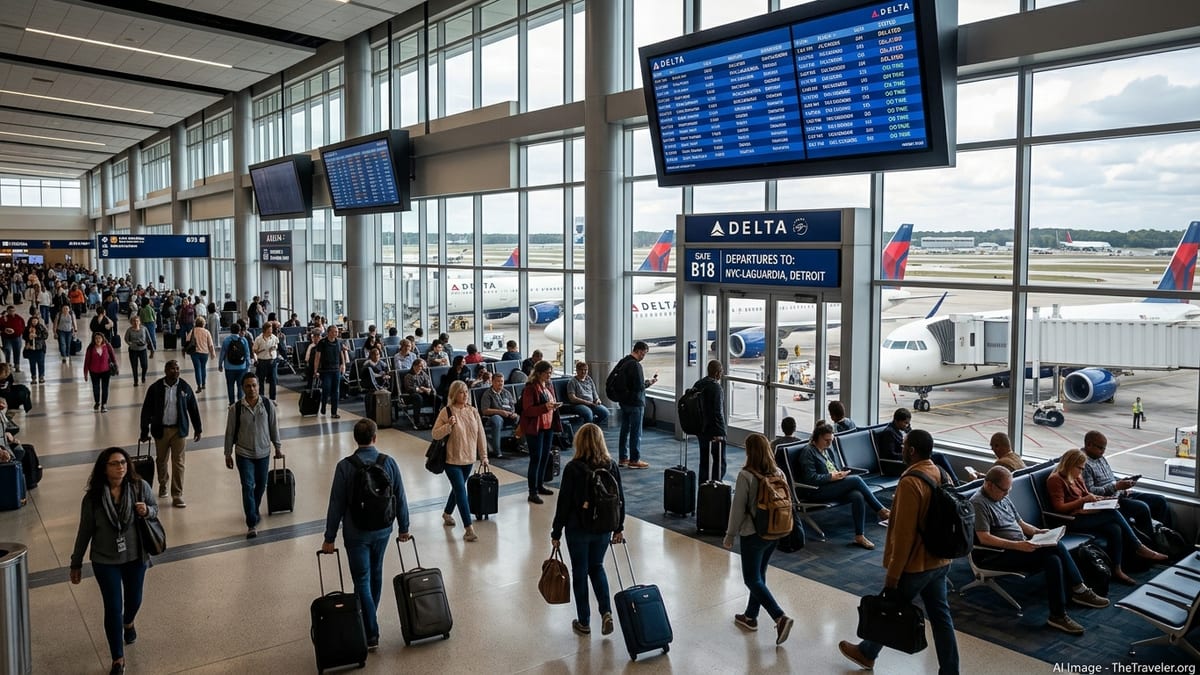
What happened to Delta’s flights ahead of Thanksgiving
The latest disruption unfolded on Sunday, November 22, 2026, when an automated system used to calculate aircraft weight and balance for Delta flights malfunctioned. The issue triggered widespread delays as the airline slowed or paused departures while crews reverted to manual procedures and checked data needed for safe takeoff performance.
Data from flight-tracking services and multiple news reports show that more than 1,000 Delta departures were delayed on Sunday, concentrated around the airline’s main hub at Hartsfield–Jackson Atlanta International Airport but affecting its network across the United States during one of the busiest travel periods of the year. The Federal Aviation Administration said the problem did not involve its air traffic systems, indicating the disruption was limited to Delta’s own operations.
By Monday, November 23, Delta said its operation was “stable” and that flights were moving normally, even as some passengers continued to experience knock-on delays from equipment and crew being out of position. The carrier stated that it had aimed to have all of Sunday’s affected flights in the air by the end of that day and emphasized that safety procedures had worked as designed by preventing departures without accurate weight data.
Is Delta still facing delays and cancellations now?
As of Tuesday, November 24, the broad wave of delays directly linked to Sunday’s weight-and-balance system issue has largely passed, and Delta’s network is operating close to its normal schedule. Major hubs such as Atlanta, Detroit, Minneapolis–St. Paul, Salt Lake City and New York–LaGuardia were showing typical levels of congestion for the Thanksgiving week, rather than an ongoing systemwide disruption tied to the glitch.
Operational data for U.S. carriers in the days since the problem indicate that Delta’s share of delayed and canceled flights has reverted to levels in line with other large airlines during peak holiday travel, when weather, air traffic control constraints and local airport congestion can all cause day-to-day fluctuations. In practical terms, travelers booking or flying on Delta today are no longer facing a distinct, carrier-specific disruption comparable to Sunday’s spike.
However, residual effects from the event can still appear in the form of isolated delays where aircraft and crews are slightly out of their original rotations, particularly early in the week at busy hubs. These secondary impacts typically diminish as schedules progress and overnight maintenance and repositioning flights restore normal patterns. Passengers with tight connections in the first half of the week may still want to monitor flight status more closely than usual.
How this disruption fits alongside Delta’s recent IT troubles
Sunday’s problem arrived less than 18 months after Delta’s protracted recovery from the global IT outage triggered by a faulty CrowdStrike software update in July 2024, which knocked out Windows-based systems across multiple industries worldwide. During that earlier event, Delta canceled thousands of flights over several days, later valuing the operational impact at roughly half a billion dollars and acknowledging that the heavy dependence of its critical systems on Windows slowed its recovery compared with competitors.
In regulatory filings and public statements following the 2024 outage, Delta highlighted information technology resilience as a key risk area and said it was investing in redundancy, disaster recovery and modernization of core operational platforms. The airline also introduced customer-facing measures, such as travel waivers, refunds for unused portions of tickets and bonus miles or vouchers for affected passengers, to address the fallout from the summer meltdown.
By contrast, the issue reported on Sunday involved a specific automation system that supports a safety-critical, but well understood, operational task. When the automated weight-and-balance tool malfunctioned, crews could fall back to manual procedures, which increased processing time and led to substantial delays but did not create the cascading cancellations seen in 2024. The return to mostly normal operations within about a day suggests the underlying problem was narrower in scope, although it still hit at an especially sensitive moment for travelers.
Impact on Thanksgiving week travelers across the United States
The timing of the glitch was especially challenging because it overlapped with one of the busiest travel periods on the U.S. calendar. Airlines and federal data show that Thanksgiving week typically brings some of the highest passenger volumes of the year, with hubs like Atlanta, Dallas–Fort Worth, Denver and Chicago–O’Hare handling both heavy local demand and connecting traffic.
Even in a normal year, about one in four flights in November and December arrives at least 15 minutes late, according to recent analyses of federal on-time performance statistics for major U.S. airports. Delays at a major hub can quickly ripple outward, affecting cities that are not experiencing any local problems or bad weather. When combined with heavier-than-usual passenger volumes, those knock-on effects tend to feel more severe, especially for travelers with tight connections or limited rebooking options.
Following Sunday’s disruption, Delta said it provided affected passengers with assistance that could include hotel accommodation or meal vouchers, particularly for those stranded away from home late in the day. The carrier did not issue a broad, systemwide travel waiver for the holiday period, focusing instead on same-day recovery and case-by-case support. Travelers who experienced long delays without being offered help at the airport may still submit receipts to Delta customer care for possible reimbursement under the airline’s existing policies.
What travelers should do if they are flying Delta this week
For passengers with upcoming Delta flights during the Thanksgiving period, the main risk has shifted back from Sunday’s automation issue to the usual combination of high traffic, weather and air traffic control constraints that affect all airlines. Delta’s overall on-time performance is typically among the strongest of large U.S. carriers in late autumn, but individual flights can still be disrupted, particularly on peak days and during stormy weather on either coast.
Travelers are advised to monitor their flight status closely in the 24 hours before departure using the Delta app or the airline’s website, since same-day schedule adjustments and gate changes are more common during heavy travel periods. Checking in as early as allowed and arriving at the airport with additional buffer time can help mitigate the impact of security or check-in bottlenecks that may arise even when flights themselves are running close to schedule.
Those with tight connections through major Delta hubs might consider proactively moving to an earlier inbound flight if seats are available, especially on Tuesday and Wednesday before Thanksgiving and on the Sunday that follows, when traffic is typically heaviest. When disruptions do occur, having alternative routings or later flights in mind, as well as knowing your rights under Delta’s contract of carriage and any applicable federal regulations, can speed up rebooking conversations with agents.
What to watch for after the latest glitch
Looking ahead, the key question for travelers and regulators is how Delta will address the reliability of its operational technology after a series of high-profile disruptions. The airline has already faced a federal investigation into its handling of the 2024 outage and has acknowledged in filings that extended IT failures could damage both its finances and reputation if not properly mitigated.
Following Sunday’s delays, Delta has not yet detailed specific technical changes it will make to its weight-and-balance systems, but the incident is likely to draw renewed scrutiny to backup procedures, failover capabilities and the degree of automation in safety-critical calculations. Any formal updates, such as revised redundancy standards or new oversight requirements, would likely emerge through future company statements or regulatory guidance rather than immediate changes visible to passengers this week.
For now, travelers planning Delta flights through the remainder of Thanksgiving week should assume that operations are broadly normal but remain prepared for the typical mix of holiday-related disruptions. Verifying flight status before leaving for the airport, building extra time into connections where possible and retaining receipts for any out-of-pocket expenses tied to significant delays or misconnects remain the most practical steps passengers can take while the airline works to fine-tune the systems behind the scenes.