


More news on this day
India’s SpiceJet is facing intensifying scrutiny from regulators, pilots and passengers after days of heavy flight cancellations, a sharp loss of market share and a warning from a pilots’ body that the airline’s deepening financial stress could compromise safe operations, raising urgent questions for travellers booked with the low-cost carrier in the coming weeks.
Get the latest news straight to your inbox!
Regulators question SpiceJet’s ability to maintain its schedule
The current phase of SpiceJet’s crisis became public on November 17, 2026, when India’s civil aviation regulator, the Directorate General of Civil Aviation (DGCA), issued a show-cause notice asking the airline to explain how it plans to maintain safe and reliable operations in the face of growing financial and operational strain. The notice, which has not been published in full but has been described in multiple regulatory and media summaries, cites a spike in cancellations, delays linked to payment disputes, grounded aircraft and instances of non-compliance with existing rules.
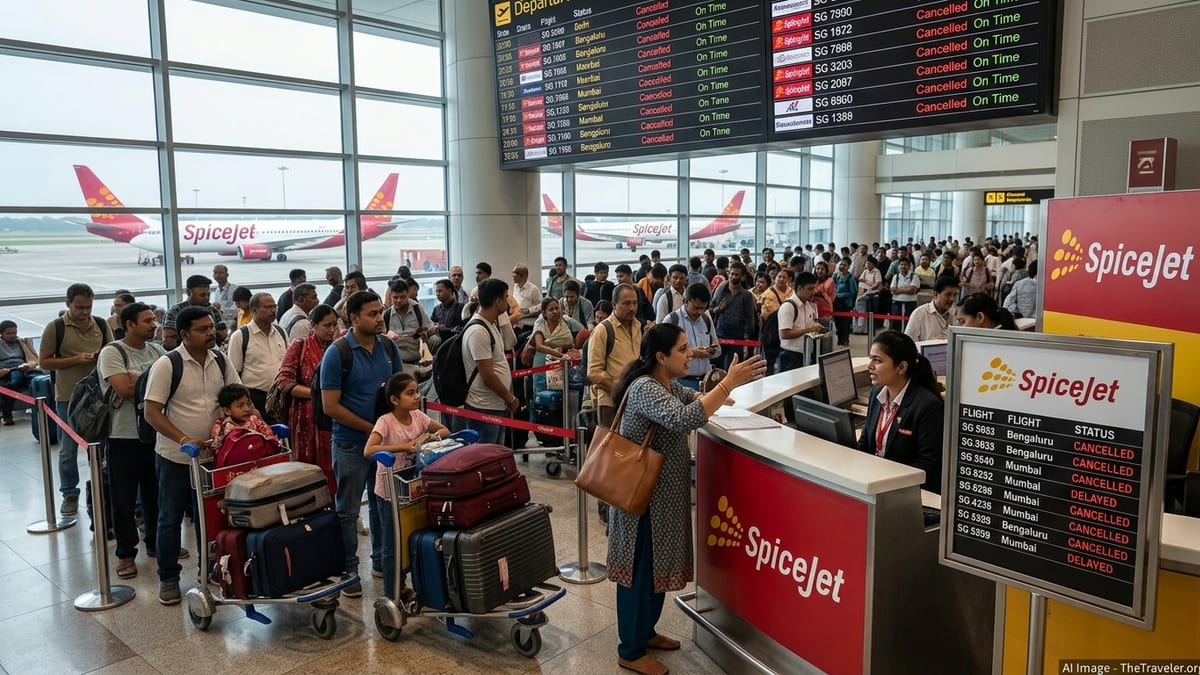
Operational data in the days that followed underline the scale of the disruption. According to figures cited by domestic media using airport movement logs, SpiceJet cancelled the majority of its planned departures at major hubs including Delhi, Mumbai and Bengaluru on November 19, operating only a fraction of its winter schedule that day. While exact numbers vary slightly by source, these reports consistently indicate that more than two-thirds of its scheduled flights from the three metros did not operate, forcing hundreds of passengers to rebook at short notice.
The show-cause notice gives SpiceJet seven days from November 17 to respond, meaning the regulator’s first detailed assessment of any corrective plan is expected before the end of November. Until that process concludes, the DGCA has not announced formal capacity curbs or a suspension, but officials have indicated that further regulatory action remains possible if SpiceJet cannot demonstrate that it has the financial and operational resources to support its published schedule.
Pilots’ body links finances to safety and urges tighter oversight
Alongside regulatory scrutiny, the Federation of Indian Pilots (FIP), a professional body representing pilots across several carriers, has written to Civil Aviation Minister K Ram Mohan Naidu warning that SpiceJet’s deteriorating finances should be treated as a potential safety issue rather than an isolated corporate matter. In a detailed letter dated November 22, 2026, the organisation calls for an immediate combined financial and safety assessment of the airline, arguing that prolonged liquidity stress can affect areas such as aircraft maintenance, crew training and adherence to duty-time rules long before it shows up in accident statistics.
The FIP has asked the ministry to direct the DGCA to restrict SpiceJet’s operating capacity if the airline fails to prove that it has adequate funds, crew and maintenance support to honour its approved winter schedule. The letter also calls for verification of the airline’s recently announced fundraising plans and for a closer review of cash flows, staff salary payments and working capital to ensure that operations are not being sustained by deferring payments to critical vendors.
Beyond the immediate case, the pilots’ body is pushing for structural changes to how India monitors the financial health of airlines. It has proposed a mandatory annual financial and safety risk assessment for all scheduled carriers, along with more frequent, quarterly reviews for any airline identified as being under financial stress. The group argues that closer oversight could help regulators identify early warning signs and avoid sudden collapses like those that ended operations at Kingfisher Airlines, Jet Airways and Go First in earlier years.
Market share collapses as flights are grounded and salaries lag
The pressure from regulators and pilots comes against the backdrop of a rapid loss of market position for SpiceJet. DGCA domestic traffic data compiled by several independent analysts show that the carrier’s share of India’s domestic passenger market fell to about 0.6 percent in September 2026, placing it behind regional carrier Star Air and far below its historical peak of more than 20 percent in the mid-2010s. More recent estimates for October, based on preliminary figures cited by the FIP, suggest that SpiceJet’s share remained below 1 percent despite a busy festival travel season.
The shrinking footprint reflects a much smaller active fleet than SpiceJet has on paper. Industry reports drawing on DGCA registrations and flight-tracking services indicate that although the airline technically has several dozen aircraft on its books, only a limited number have been operating scheduled services on any given day this month. Some of the grounded planes are linked to lease payment disputes with lessors, while others have been parked due to maintenance requirements or the cost of bringing them back into service.
At the same time, pilot and cabin crew unions have highlighted delays in salary payments. The FIP letter refers to overdue salaries for cockpit and cabin crew, as well as other employees, as a sign of the underlying cash-flow crunch. Staff concerns have been amplified on social media, where some self-identified SpiceJet employees have described months of partial or delayed pay. While these individual accounts cannot all be independently verified, they align with the broader picture of an airline operating with very limited financial flexibility.
Fundraising plan aims to stabilise operations but key details remain open
SpiceJet’s management has sought to reassure both regulators and passengers that it is working on a financial turnaround. On November 18, 2026, the airline’s board formally approved a plan to raise up to 5,500 crore rupees, or roughly 660 million US dollars at current exchange rates, through a mix of equity, debt or other permitted instruments. In a regulatory filing the same day, the carrier described the prospective funds as a way to strengthen its balance sheet, revive grounded aircraft and rebuild capacity.
The board’s approval, however, is only the first step in what is usually a multi-stage fundraising process. SpiceJet has not yet publicly announced a confirmed investor, pricing details or a firm timeline for when any funds could actually be received. Recent media reports, quoting unnamed sources, have mentioned a non-binding term sheet worth about 5,000 crore rupees, but these accounts remain unconfirmed by formal stock exchange disclosures. For now, the fundraising should be treated as a planned measure rather than a completed transaction.
Until new capital is secured and deployed, the airline remains dependent on its current cash flows and any short-term credit arrangements with vendors such as airports, fuel suppliers and maintenance providers. The FIP has warned that some of these counterparties appear to have already tightened terms, reportedly moving the airline to cash-and-carry arrangements in certain cases. If accurate, such changes can further squeeze liquidity and make it harder for SpiceJet to ramp operations back up quickly, even if demand from passengers remains strong.
Passenger disruption highlights human impact of operational uncertainty
For travellers, the most immediate effect of SpiceJet’s troubles has been a spike in short-notice cancellations and long delays, particularly on routes where the airline forms a substantial part of available capacity. In recent weeks, passengers have posted multiple videos and accounts from airports around India describing last-minute schedule changes, missing notifications and difficulties reaching the airline’s customer service channels to arrange rebooking or refunds.
One widely shared video this week featured a passenger in visible distress at a north Indian airport after reportedly missing his father’s last rites because repeated delays on his SpiceJet flight prevented him from reaching home in time. Local student leaders who shared the clip criticised both the airline and the lack of stronger regulatory safeguards for passengers travelling for urgent family events. While individual circumstances are difficult to verify from social media alone, the emotional response has captured growing public frustration with operational instability at the carrier.
Similar complaints have surfaced around international services, particularly on certain Dubai routes, where some travellers say they received little advance warning of cancellations and struggled to obtain timely refunds. Online discussions among India-based flyers this month have increasingly advised caution when booking SpiceJet, especially for time-sensitive trips, with several contributors recommending alternative airlines or flexible, refundable tickets where possible. These accounts do not replace official statistics, but they provide a snapshot of how confidence in the brand has eroded among frequent travellers.
What travellers should check if they are booked on SpiceJet
With the DGCA’s show-cause process still underway and the outcome of SpiceJet’s fundraising yet to be clarified, near-term uncertainty around the airline’s schedule is likely to continue. Travellers who already hold bookings on SpiceJet in late November or December should closely monitor their flight status on multiple channels, including the airline’s own website and their departure airport’s live arrivals and departures board, particularly in the 24 to 48 hours before travel.
India’s Civil Aviation Requirements set out specific obligations for carriers when flights are cancelled or heavily delayed, including options for refunds, rebooking and, in some cases, compensation. In practice, passengers often need to proactively request these remedies, especially if tickets were purchased through online travel agencies or third-party platforms. Keeping all booking confirmations, payment receipts and any written communication from the airline can help if a dispute arises later.
For trips where timing is critical, such as medical appointments, job-related commitments or family ceremonies, travellers may want to consider contingency plans. These can include booking fully refundable fares with another airline as a backup, avoiding tight connections to separate tickets on other carriers, and allowing extra buffer time when planning onward ground transport or international connections. While such steps add cost and complexity, they can reduce the risk of severe disruption if SpiceJet’s operations remain volatile while regulators and shareholders decide the carrier’s longer-term future.