


Standing at Skaftafell on Iceland’s South Coast, many travelers face the same question: is the free Skaftafellsjökull viewpoint walk enough glacier experience, or is it worth booking a guided hike onto the ice itself from Skaftafell? The answer depends less on which option is "better" and more on your time, budget, fitness and appetite for cold, heights and exposure.
Get the latest updates straight to your inbox!
Two Very Different Experiences Behind Similar Names
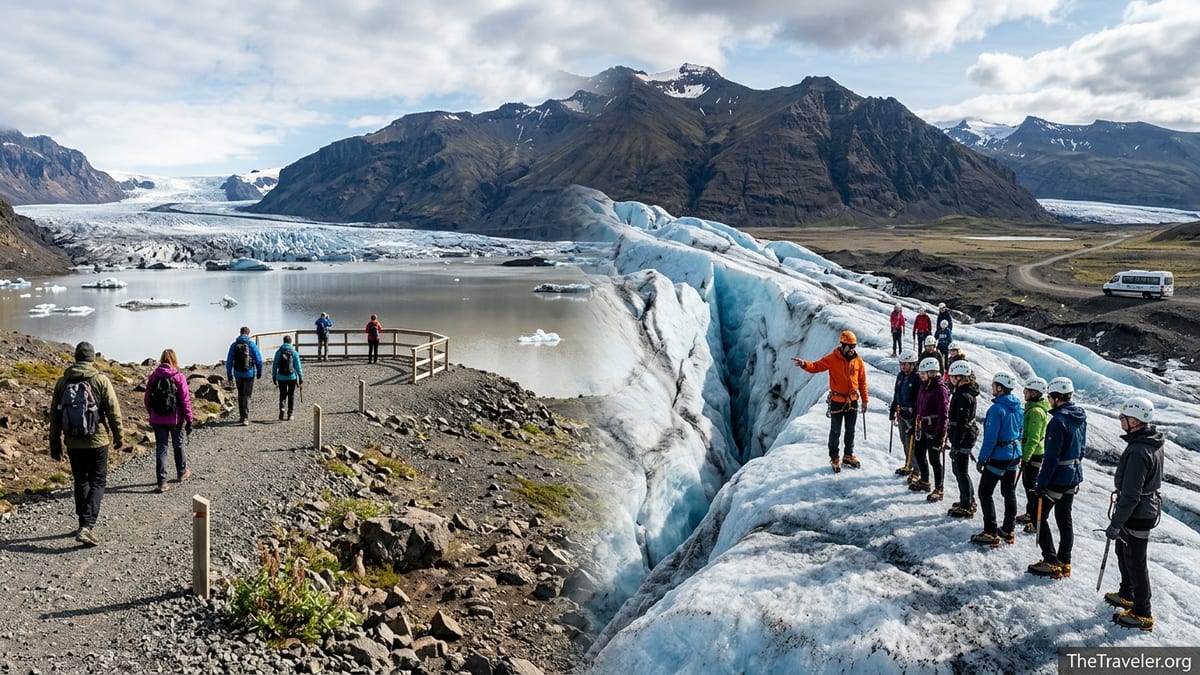
The first and most important distinction is that the Skaftafellsjökull S1 walk and the paid “Skaftafell glacier hikes” sold by tour companies are not the same thing. The S1 route is a self-guided walking trail from the Skaftafell visitor area to a viewpoint overlooking the tongue of Skaftafellsjökull and its small proglacial lagoon. You stay on marked paths over gravel, low vegetation and moraine, and you do not walk on the glacier ice itself.
In contrast, commercial glacier hikes from Skaftafell almost always take place on a different outlet glacier, most commonly Falljökull, a steep and heavily crevassed tongue flowing down from Öræfajökull within Vatnajökull National Park. Operators such as Arctic Adventures state clearly that their Skaftafell glacier and ice cave tours use a short bus transfer from the Skaftafell base to Falljökull, where guests are equipped with crampons, helmets, harnesses and ice axes before stepping onto the ice. Other providers based at Skaftafell similarly note that their hikes operate on Falljökull or neighboring outlets rather than on Skaftafellsjökull itself.
Complicating matters, marketing language often refers to “Skaftafell glacier hike” or even simply “Skaftafell glacier” without naming Falljökull. It is helpful to read the detailed description to see mention of a transfer from Skaftafell to Falljökull, or of hiking on Falljökull or Virkisjökull, so you understand that these tours involve travel onto the ice of a nearby outlet, not the viewpoint trail in front of Skaftafellsjökull.
This distinction matters when planning. The Skaftafellsjökull walk is short, flexible and inexpensive, while the guided glacier hikes are structured excursions with safety equipment, fixed departure times and significantly higher cost. Knowing which experience you are actually choosing will help you avoid disappointment and set realistic expectations for both time and budget.
What to Expect on the Skaftafellsjökull S1 Viewpoint Walk
Vatnajökull National Park lists the Skaftafellsjökull route, marked S1, as an easy circular trail of about 4 to 4.5 kilometres, typically taking around 1 to 1.5 hours at a relaxed pace from the Skaftafell visitor centre. The path leaves the main service area and follows a gently undulating route across old glacial outwash and low moraine. Underfoot you can expect mostly compacted gravel, occasional rocky sections and short slopes that most people with average mobility can manage without special equipment in summer conditions.
As you approach the end of the trail, the path climbs slightly onto a low ridge and then descends toward the official viewing area near the lagoon. Park authorities may fence off sections close to the waterline or unstable slopes depending on current conditions, but in good weather you can usually get to a point a few hundred metres from the ice front. You will not be able to touch the glacier safely, yet the feeling of standing so near the crevassed tongue and hearing cracking or splashing from the lagoon can be impressive.
For photography, the Skaftafellsjökull viewpoint offers broad, landscape-scale views. You look along the length of the glacier tongue, framed by dark volcanic peaks and streaked with ash layers in the ice. Telephoto lenses help pick out detail in crevasses and seracs, while a wider lens captures the full sweep of the valley and lagoon. In the right conditions, reflections of the ice front appear on the milky grey or blue surface of the water, and small icebergs sometimes float near the shore.
The S1 route also provides a visible record of glacier retreat. Information signs from the park and independent guides describe how Skaftafellsjökull has shrunk over recent decades, and you can often see older moraines, vegetation lines and dated posts that mark former ice margins. Without specialist knowledge you gain a clear sense of how fast the glacier has pulled back, which many visitors find sobering. All of this is accessible in as little as an hour or two, with no guide fees beyond the standard parking or facility charges for Skaftafell.
Inside the Guided Glacier Hike Experience from Skaftafell
Guided glacier hikes from Skaftafell follow a more structured pattern. You meet at a designated base in the Skaftafell car park area, check in, are fitted with technical gear such as crampons, helmets and harnesses, and then transfer by minibus along a rough track to the foot of Falljökull or a similar outlet. The drive generally takes about 15 to 20 minutes each way, followed by a short approach hike of roughly 20 to 30 minutes from the vehicle to the glacier edge.
Once on the ice, the guide leads the group in a line, picking a safe route among crevasses and undulations. Entry-level hikes typically spend around 1 to 1.5 hours actually walking on the ice, while longer “adventure” or “explorer” style tours increase this to about 2.5 to 3 hours of time on the glacier surface. Including check in, briefings, gear fitting, transfers and the walk back, total door to door duration usually ranges from around 3 hours for shorter options up to 5 or more hours for extended hikes.
What you see on the ice differs significantly from the viewpoint trail. You may peer into crevasses, see moulins where meltwater disappears into the glacier, and walk past pillars and waves of blue ice where snow has compressed over centuries. In winter, some tours combine a glacier walk with access to a natural ice cave, entering shimmering blue chambers formed within or beneath the glacier body. Guides also interpret the landscape, explaining how glaciers shape the valleys, how ash layers record volcanic eruptions and how climate trends influence the stability and flow of the ice.
This is a more immersive and physically engaged experience. You feel the crunch of crampons under your boots, notice the cooler temperatures and wind on the glacier surface, and need to focus on foot placement. For many travelers, it fulfills a long held wish to stand on a glacier and understand it from within the ice, not just from across a lagoon.
Types of Glacier Tours Available from Skaftafell
While each operator brands its products differently, guided glacier hikes from Skaftafell generally fall into a few common categories. The most accessible are short, family friendly walks that run for about 2.5 to 3 hours in total, often with roughly one hour on the glacier itself. These are designed for first timers and moderate fitness levels, and many accept children from around 8 years and up, though exact minimum ages can vary by company and season.
Standard half day glacier hikes make up the core offering from Skaftafell. These typically advertise around 3 to 4 hours of total trip time, including 1.5 to 2.5 hours on the ice. In practice that means a morning or afternoon commitment from the Skaftafell base, leaving the other half of the day free for activities like the Skaftafellsjökull walk or the popular Svartifoss waterfall trail. Minimum ages for these tours often sit around 10 to 12 years, again depending on operator and conditions.
In the colder months, combined glacier hike and natural ice cave tours are widely available from Skaftafell. These involve a similar transfer to Falljökull, time on the surface with crampons and guided instruction, plus an excursion into one or more ice caves if conditions allow. Total durations often stretch to 4 to 5 hours, and time actually inside caves is typically limited to tens of minutes to manage group flow and safety. Prices for these combination products are usually higher than basic glacier walks, reflecting the extra guiding complexity and seasonal demand.
At the most demanding end are full day or technical options, sometimes including steeper ascents, more remote sections of the glacier or introductory ice climbing elements. These tours can involve 6 hours or more of activity including longer periods on crampons. They generally require stronger fitness, good balance and a high tolerance for exposure and cold, and minimum ages are correspondingly higher. These are not as common as shorter offerings but are an important choice for experienced hikers who want a deeper immersion and are comfortable with a full day in glacier terrain.
Costs, Ages and Practicalities: What You Are Likely to Pay
The Skaftafellsjökull S1 trail itself is effectively free to walk. There is no trail fee, though you should budget for parking charges at Skaftafell and any refreshments or maps you choose to buy at the visitor centre. For travelers on tight budgets or those passing quickly through the South Coast, the ability to see a significant glacier from a marked path without additional tour costs is a major advantage.
By contrast, guided glacier hikes from Skaftafell are a premium activity. Based on recent price ranges from several major operators, short family oriented glacier walks tend to fall in the high tens to low hundreds of euros equivalent per adult, with discounted rates for children where they are accepted. Standard half day hikes and combined glacier plus ice cave tours usually cost in the low to mid hundreds of euros or equivalent for adults, depending on exact duration and inclusions. Technical or full day products can climb higher into the mid hundreds per person.
These prices normally include specialist equipment such as crampons, helmets and harnesses. Some operators also include mountaineering boots and waterproof outer layers in the base price or as low cost add ons, which can be valuable if you are traveling light. Transport from the Skaftafell base to the glacier edge and back is part of the tour. You are typically expected to bring warm layers, gloves, hats, a small backpack, snacks and water, plus adequate travel insurance for adventure activities.
Age restrictions are an important practical factor. Families with younger children may find that only the shortest and least technical tours will accept participants under about 12 years, and very young children are often not permitted on glacier walks at all. If traveling with teenagers, it is still worth checking specific minimum age, weight and equipment fit details before booking. Those with existing knee, hip or balance issues should also consider how well they manage uneven, icy terrain, even on the easier categories of tour.
Safety, Risk and Weather Considerations
Glaciers are dynamic and inherently hazardous environments. Crevasses can be partially hidden by snow bridges, ice can collapse without warning, and meltwater channels shift rapidly with temperature and rainfall. As a result, walking on glacier ice should be done only with qualified guides who hold appropriate certifications and operate under safety plans approved for the outlet glaciers they use. Licensed tour companies monitor conditions, choose routes suited to the group and carry safety equipment such as ropes and rescue kits.
Guided glacier hikes therefore carry more objective risk than a valley walk, but that risk is managed through training, route choice and equipment. Even so, participants need to follow instructions closely, use crampons correctly, keep appropriate spacing on the rope if one is used and be prepared for sudden changes in weather. Strong winds, rain or rapidly warming temperatures can lead operators to adjust itineraries, shorten tours or in some cases cancel outings entirely for safety reasons.
The Skaftafellsjökull S1 viewpoint trail is much lower in technical risk, yet it is not risk free. The route crosses uneven ground, can be slippery in wet or icy conditions and runs close to steep banks, water and unstable moraine in places. Weather in South East Iceland can change quickly, bringing strong gusts, heavy rain or poor visibility. Visitors should check current trail and weather information from the park, wear sturdy footwear and turn back if conditions deteriorate.
It is also important to note that some outlet glaciers once popular for tours have had access restricted in recent years because of geological or landslide hazards in the surrounding mountains. For example, operators previously active on Svínafellsjökull moved many tours to Falljökull and other outlets after concerns about slope stability above the glacier. When booking, favor companies operating on outlets that the park currently supports with permits and guidance, such as Falljökull, rather than attempting to access potentially unstable areas on your own.
Matching Time, Fitness and Comfort Level to the Right Option
Time is often the simplest deciding factor. If your schedule on the South Coast allows only one to two hours at Skaftafell, the Skaftafellsjökull viewpoint walk is usually the best fit. You can arrive, stretch your legs on the S1 loop, absorb the scale of the glacier and lagoon, and then continue toward destinations such as Jökulsárlón or Vík the same day. Those who have a half day or more can consider combining the viewpoint walk with an organized glacier hike before or after, provided departure times align.
Fitness and mobility also play a central role. The S1 trail suits most people with moderate fitness who are comfortable walking several kilometres on a good path with small hills. There is flexibility to turn back early, pause frequently or adjust your pace, since you are not tied to a group. A guided glacier hike, by contrast, requires sustained focus, ability to walk on uneven, sometimes steep ice while wearing crampons, and readiness to be outdoors in colder, windier conditions for multiple hours without the option to leave early except in an emergency.
Comfort with heights, exposure and slippery surfaces should not be underestimated. Some sections on Falljökull and similar outlets traverse sloping ice above visible crevasses or small drop offs. Guides choose conservative routes, but individuals who are very uncomfortable with exposure or who struggle with balance may find even an entry level glacier hike stressful rather than enjoyable. For those travelers, the Skaftafellsjökull walk or other land based trails in Skaftafell offer glacier views without the same intensity.
Tolerance for cold and wet is another practical point. Temperatures on the glacier surface are often a few degrees lower than at the Skaftafell car park, and wind chill can be marked. Standing still while groups are briefed or while other participants take photos can feel colder than the advertised air temperature suggests. Travelers who get chilled easily should bring extra layers and consider whether several hours on the ice will be comfortable, especially outside the peak summer months.
Recent Access and Outlet Glacier Choices
Skaftafell sits within a complex glacial landscape where conditions evolve from year to year. Park authorities and tour operators monitor crevasse patterns, ice stability, snowfall and hazards in the surrounding mountains when deciding which outlets to use for commercial glacier hiking. In the current period, Falljökull stands out as the primary glacier for guided walks from Skaftafell, with multiple companies basing their itineraries there. This reflects a balance between access, scenic value and manageable risk compared with some neighboring outlets.
By contrast, Svínafellsjökull, once heavily used for glacier tourism from Skaftafell, has seen reduced commercial activity due to concerns about potential landslides from the steep slopes above the glacier. Travelers may still see this glacier from viewpoints along the road, but organized tours have in many cases shifted away from operating directly on its ice. Other outlets east and west of Skaftafell host specialized tours, but these typically require longer driving times and are marketed separately rather than as Skaftafell based walks.
For visitors, the practical implication is clear. When you see “Skaftafell glacier hike” in a tour name today, you should expect to be driven a short distance to Falljökull or a similar approved outlet, not to Skaftafellsjökull itself. This is not a disadvantage. Falljökull offers dramatic broken ice, good access to crevasse fields and an impressive sense of descending icefalls that many guides rate highly for both safety and spectacle.
Before traveling, it is wise to check the latest notes from Vatnajökull National Park about trail conditions at Skaftafell and any general advisories related to glacier margins or access tracks. Once in the area, local information desks and your chosen tour operator can provide day to day updates on how current weather and ice conditions might influence your options.
Who Should Choose What: A Practical Decision Guide
For budget conscious travelers, the Skaftafellsjökull S1 viewpoint trail is the clear winner. It offers close views of a significant glacier tongue, a tangible sense of climate driven retreat and rewarding photography in exchange for only the costs of reaching Skaftafell and paying for parking. Those who are unsure about their fitness, anxious on ice or traveling with family members who are not up for a longer, colder outing often find that this walk delivers enough glacier atmosphere for their needs.
Families with young children, older relatives or people with limited mobility will often be better served by the viewpoint walk and other short trails around Skaftafell. Strollers are not ideal on the S1 route, but flexible pacing and the ability to turn around at any point make it easier to adapt to changing energy levels and weather. For families with older children or teenagers who are comfortable hiking and excited about adventure, a shorter family focused glacier hike can be an unforgettable highlight, provided age limits and equipment fit are checked in advance.
Photographers and travelers who have long dreamed of setting foot on a glacier will likely find that a guided hike justifies the extra time and expense. Being on the ice allows for intimate compositions of crevasses, blue walls and textures that are impossible to capture from the Skaftafellsjökull viewpoint alone. In winter, combining a glacier walk with an ice cave visit can yield unique images and memories, especially if you are prepared to accept variable cave conditions and the need to share the space with other groups.
For visitors with one or two nights in the area, a combination approach often works best. Use one half day for a guided glacier hike from Skaftafell and the other half for self guided exploring, including the Skaftafellsjökull S1 loop and perhaps the Svartifoss waterfall trail. This strategy balances cost, variety and rest time, giving you both the sweeping perspective of glaciers from a distance and the visceral experience of walking on living ice before you continue your journey along Iceland’s South Coast.