


Landing at Athens International Airport and wondering how to reach the city centre or Piraeus port quickly and affordably? Metro Line 3, the blue line, gives you a direct rail link from the airport to central Athens and all the way to Piraeus, with predictable journey times and simple ticketing. This guide walks you through exactly how to use it, what it costs, how long it takes, and the most common mistakes first-time visitors make.
Get the latest updates straight to your inbox!
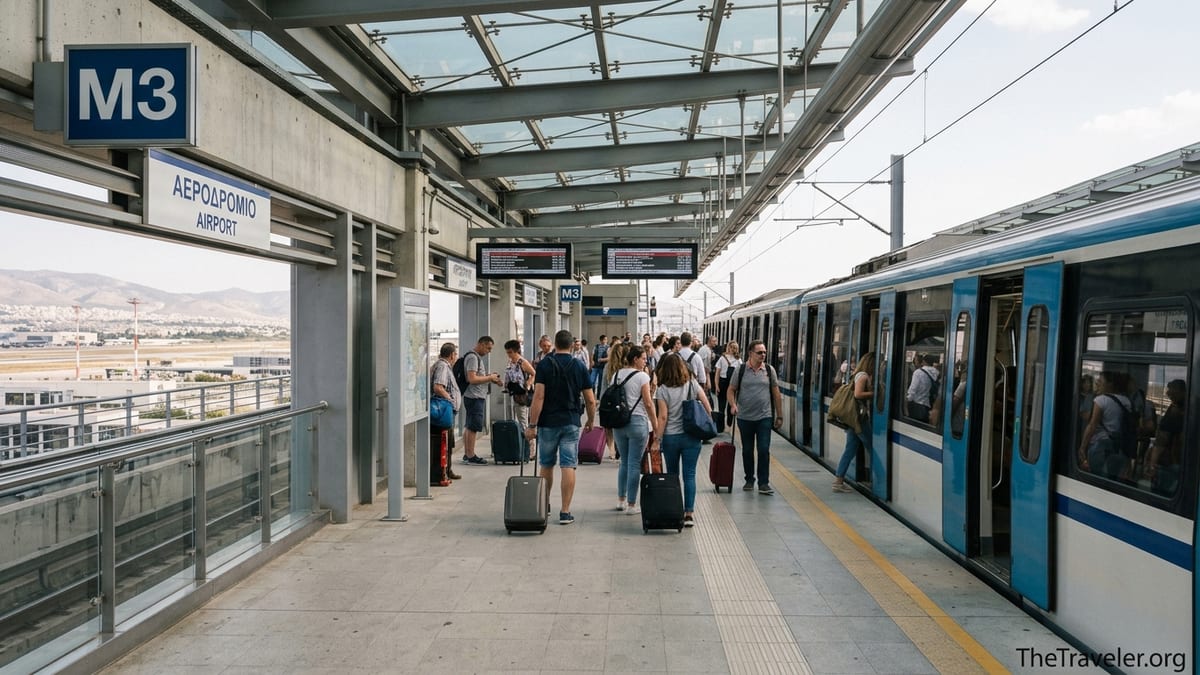
How Metro Line 3 Connects the Airport, City Centre and Piraeus
Metro Line 3 is Athens’ blue line, running from the western terminus at Dimotiko Theatro in Piraeus to Athens International Airport “Eleftherios Venizelos” in the east. For visitors, this single line covers three core needs on one route: reaching the historic centre around Syntagma and Monastiraki, connecting with other metro and suburban rail lines, and continuing all the way to the cruise and ferry port at Piraeus.
From the airport, trains follow the same tracks as the suburban railway for part of the journey, then continue underground through the northeastern suburbs before reaching central Athens. Key central stations on this line include Syntagma, Monastiraki and Kerameikos; beyond the centre the line continues through working neighbourhoods such as Egaleo, Nikaia and Maniatika before terminating at Dimotiko Theatro in Piraeus. In practice, this means that a passenger landing at Athens Airport can ride the same train all the way to the port, without changing lines, when boarding one of the direct airport services.
Travel time from the airport to Syntagma is typically about 40 minutes, depending on intermediate stops and dwell times. Continuing from the airport to Piraeus via Syntagma generally takes just under an hour end to end, which is competitive with taxi or bus journeys in peak traffic. The advantage is reliability: the metro runs on a fixed timetable that is largely unaffected by congestion on the Attiki Odos ring road or in the narrow streets near the port.
For many visitors, Line 3 becomes the backbone of their stay. A common pattern is to take the metro from the airport to Syntagma or Monastiraki, stay in a hotel within walking distance of those stations, then use the same line again a few days later to reach Piraeus for a ferry to the Cyclades or Saronic islands. Understanding how this line works will make both arrival and departure far smoother.
Tickets and Fares: What a Trip from the Airport Really Costs
Tickets for the airport section of Metro Line 3 are priced differently from ordinary city tickets. As of mid-2026, a standard adult single ticket from or to Athens Airport on the metro costs around 9 euros. This ticket is valid for 90 minutes on most public transport in Athens, including metro lines 1, 2 and 3 and urban buses and trams, except for the dedicated airport express buses. In practice, that means you can ride from the airport to Syntagma and, within the same 90-minute window, transfer to another metro or tram line to reach your hotel without buying a second ticket.
If you are staying several days, consider the 3-day Tourist Ticket sold at the airport metro station and major central stations such as Syntagma and Piraeus. This product costs around 20 euros and includes unlimited travel for 72 hours on buses, trams and metro within the urban network, plus one round trip on the metro or express bus between the airport and the city. For example, a couple staying three nights in Athens could use this ticket for both their arrival and departure airport trips plus all inner-city travel, usually saving money compared with buying separate airport tickets and daily passes.
There are also reduced tickets for eligible groups such as students of Greek institutions, seniors over a certain age and children, with airport metro fares typically about half the standard price. Children under six travel free with an adult. You will usually need supporting ID, such as an EU student card or passport, if you want to claim a reduced fare at a ticket counter. Ticket inspectors are active on Line 3, especially on the airport section, so it is important to validate your ticket at the gates even if they are already open.
Many visitors compare the metro fare with other options. The airport express bus X95 from the airport to Syntagma costs roughly 5.50 to 6 euros per person, while a flat-rate taxi from the airport to central Athens is around 40 to 45 euros in the daytime for the whole vehicle. For solo travellers or couples arriving during metro operating hours, Line 3 often provides the best balance of price and speed. For a family of four with luggage arriving late at night after the last metro, a taxi may be better value and more convenient door to door.
Finding and Using the Airport Metro Station
The metro station at Athens International Airport is connected to the main terminal building via a signposted elevated walkway. After clearing customs and baggage reclaim, follow the overhead signs for “Trains” and “Metro”. These lead you past the arrivals hall exit, across a short plaza and up an escalator or elevator to a glass-covered bridge that crosses the road system. At the far end, you will see the combined station serving both the metro and the suburban railway.
Inside the station concourse, ticket machines and staffed ticket counters are clearly visible near the entrances to the platforms. The self-service machines have an English-language option and accept cash and cards. To buy a single airport ticket, select the airport option on the screen; for a 3-day tourist pass, look for the tourist ticket icon or ask at the staffed counter if the machine options seem confusing. Your ticket will typically be loaded onto a rechargeable blue-and-white paper smart card that you tap on the gate readers.
Before heading to the platforms, check the electronic screens to confirm the next departure to your destination. Not every Line 3 train in the station is an airport train; some suburban services use the same tracks. Trains to central Athens and Piraeus are labelled with the blue metro symbol and the destination “Dimotiko Theatro” or “Piraeus,” while suburban services show different branding and may be heading to destinations such as Kiato or Acharnes. If you are unsure, ask a staff member or fellow passenger by pointing at the destination on the screen.
On the platform, clear door markings show where to stand. During busy daytime periods, airport trains can be crowded near the doors with people carrying suitcases. If you have large luggage, consider walking a little further along the platform to board at a less busy door, making it easier to stow your bags away from the entrance. A common real-world scenario: a morning arrival from London or Paris fills the middle cars quickly, while the first or last car still has seating and space for suitcases.
Timetables, Frequency and Travel Time on Line 3
Metro Line 3 operates from early morning until around midnight. On the airport branch, the first train from the airport towards central Athens typically departs just after 6:30 in the morning, and the last service leaves shortly after 11:00 at night. In the opposite direction, the last direct train from central Athens to the airport usually departs before 11:30 in the evening. Operating hours can be adjusted on specific days or during public holidays, so if you are arriving on a late flight it is wise to check the timetable close to your travel date.
Frequency on the airport section is lower than on the inner-city part of Line 3. Trains between Dimotiko Theatro and Doukissis Plakentias, the inner segment, can run every 4 to 6 minutes at peak times. However, only a subset of those services continue to the airport beyond Doukissis Plakentias, so airport trains are more typically every 30 minutes. In practical terms, if you just miss a train at the airport, you can usually expect to wait around half an hour for the next one, while in central Athens you will rarely wait more than a few minutes for any Line 3 train.
The journey time from Athens Airport to Syntagma is around 40 minutes, with intermediate stops at stations such as Pallini, Halandri and Holargos. To Monastiraki in the heart of the old town it takes only a couple of minutes longer. From the airport all the way to Piraeus via Syntagma, typical journey time on a direct service is just under 60 minutes. Compare that with a taxi in rush hour, which can easily take over an hour from the airport to the port, and Line 3 is often the more predictable option for passengers heading to an early morning ferry.
One practical example: a traveller booked on a 9:30 morning ferry to Santorini from Piraeus, staying near Syntagma, could comfortably catch a 6:30 or 7:00 airport metro, change accommodation in central Athens, sleep, and then on departure day take a Line 3 train from Syntagma around 7:45. That would have them at Piraeus Dimotiko Theatro station before 8:15, leaving time to walk or transfer to the appropriate ferry gate. Working backwards from fixed times like ferry or flight departures is the safest way to plan your use of Line 3.
Key City Centre Stops: Syntagma, Monastiraki and Beyond
For most visitors, Syntagma is the main gateway from Metro Line 3 into central Athens. The station sits directly beneath Syntagma Square, opposite the Greek Parliament. From here it is a straightforward walk to major hotels on Vasilissis Amalias Avenue, the shopping streets of Ermou, and the leafy National Garden. Syntagma is also an interchange with Line 2, the red line, which runs south to Acropoli station for the Acropolis Museum and north to key neighbourhoods such as Omonia.
One stop beyond Syntagma in the direction of Piraeus is Monastiraki, another critical hub for visitors. Here Line 3 intersects with Line 1, the green line, which runs to Piraeus, Kifissia and the northern suburbs. Monastiraki station opens directly onto Monastiraki Square, with easy walking access to the Plaka district, the flea market, and the lower slopes of the Acropolis. Many budget hotels and guesthouses are clustered within a ten-minute walk of this station, making it a popular choice for travellers who want a lively atmosphere and direct airport access.
Further along Line 3 toward Piraeus, Kerameikos serves the modern entertainment district of Gazi, with its restaurants, bars and the Technopolis cultural centre. Stations such as Egaleo, Nikaia and Maniatika are primarily local residential stops, but they are useful if you have booked accommodation outside the immediate tourist centre or are visiting friends or family. Dimotiko Theatro, the final stop, delivers you to the heart of Piraeus, close to the Municipal Theatre and within walking distance or a short local bus ride of most ferry departure gates.
Access between platforms and the street is generally step-free at the newer stations, including Syntagma, Monastiraki and Piraeus, which is convenient for travellers with luggage or reduced mobility. Elevators can be busy at peak times, so if you rely on them, allow extra time. Inside the stations you will also find practical services such as ATMs, small kiosks and in some larger stations exhibition areas or archaeological displays, which can be an unexpected introduction to Athens’ rich history while you transfer between trains.
From Central Athens to Piraeus: Making the Most of the New Connection
Before the extension of Line 3 to Piraeus was completed, travellers usually reached the port by changing to Line 1 at Monastiraki or using the X96 airport bus. Now, with the blue line running directly to Piraeus Dimotiko Theatro, it is possible to travel from the airport to the port, or from Syntagma to the port, without any line changes if you catch a through train. This has made a noticeable difference for visitors with heavy luggage heading to cruise ships or early ferries.
In practical terms, a visitor staying near Syntagma who needs to catch a ferry can simply walk to Syntagma station, take Line 3 in the direction of Dimotiko Theatro and remain on the train until the final stop. From Dimotiko Theatro, it is roughly a 10 to 20 minute walk to many ferry gates, depending on which island you are sailing to, or a short hop on local buses that circle the port. Port signage is improving but can still feel confusing, so many travellers use well-known landmarks such as the Piraeus Municipal Theatre and large ferry company buildings to orient themselves as they exit the station.
For cruise passengers, Line 3 is also useful, although some large cruise ships dock a little further from Dimotiko Theatro. In that case, there may be a complimentary shuttle or a short taxi ride between the terminal and the station. Some hotels in Piraeus advertise themselves as being “five minutes from the metro” meaning they are within walking distance of either Dimotiko Theatro, Piraeus or Maniatika stations, which is worth checking on a map before you book if you are prioritising easy access to Line 3.
One common real-world scenario involves travellers flying into Athens in the morning and continuing directly to an afternoon ferry. A pair of backpackers arriving on a 10:30 flight, for example, might clear the airport by 11:15, take the 11:30 metro, arrive at Dimotiko Theatro just after 12:30, walk to their ferry gate and still have time for a quick gyro near the port before boarding. This through connection reduces the need to haul luggage across busy roads or change lines in crowded central stations, and is one of the main reasons Line 3 has become the preferred route for many budget-conscious travellers.
How to Buy and Validate Tickets Correctly
Buying the right ticket and validating it properly is essential on Athens Metro Line 3. Most visitors will first encounter the ticket system at the airport station, but the process is similar at Syntagma, Monastiraki and Piraeus. Machines display clear icons for airport tickets, urban tickets and multi-day passes, and there is an English language option available on the home screen. If you prefer human assistance, staffed counters at the airport and major hubs can sell airport singles and tourist tickets and answer basic questions about validity.
Once you have purchased your ticket or pass, you will receive a contactless smart card roughly the size of a credit card, although made of coated paper. To enter the system, tap the card on the round blue reader at the gates; when the reader lights green and beeps, the gates open. You must also tap out at your destination station in the same way. The 90-minute validity starts from the first tap in. For example, if you tap in at the airport at 14:05, your ticket should remain valid for transfers within the system until approximately 15:35, which comfortably covers the ride to Syntagma and a short continuation on another metro line or tram.
Ticket inspection on Line 3 often happens aboard trains or on station platforms, especially at the airport and busy central stops. Inspectors carry handheld readers and may ask to see not only your ticket but also ID if you are using a reduced fare product. Travellers who have accidentally bought a regular city ticket instead of an airport ticket, or who failed to validate their card, can face on-the-spot fines that are several times the price of a proper airport ticket. For this reason, always double-check that the product shown on the machine matches “Airport” and that you see the green light and hear the validation beep at the gate.
If you are staying longer in Athens, you can top up the same card with additional tickets. For instance, a visitor might buy a 3-day tourist ticket first, use it for three days including arrival and daily travel, then reload a standard 90-minute urban ticket for extra local trips on day four. Machines allow you to choose between several stored products, but they will normally prioritise using the active period pass before deducting individual trips, which is usually to your advantage.
Common Tourist Mistakes on the Athens Airport Metro
Despite the relative simplicity of Line 3, there are several recurring mistakes that tourists make. One of the most frequent is arriving too late for the metro after an evening flight, assuming that it runs all night. While metro lines 2 and 3 sometimes offer extended late-night service on Friday and Saturday nights within the city, the airport branch is excluded from 24-hour operation. Travellers landing after about 23:00 may find that the last train has already departed by the time they clear immigration and collect bags, leaving them unexpectedly reliant on the night buses or taxis.
Another common error is buying the wrong ticket type. Visitors occasionally purchase a standard urban ticket instead of the airport ticket, either because they are rushing at the machine or do not notice the separate airport category. This becomes a problem if they are checked by inspectors en route. To avoid this, take a moment at the machine to read the options carefully, and if in doubt, ask at the staffed counter. Similarly, some travellers assume that the 3-day tourist ticket automatically covers their stay regardless of how late they activate it. In reality, it is valid for 72 hours from first validation; activating it at 23:00 on arrival means it will expire at 23:00 three days later, not at the end of that calendar day.
Luggage handling can also lead to awkward situations. Trains on Line 3 are not equipped with dedicated luggage racks like those on some airport express services in other cities. Suitcases are usually placed near the doors or at the ends of carriages, which can block passengers during busy times. A frequent real-world scene is a family with three large suitcases occupying the entire doorway area at Syntagma, forcing other passengers to squeeze past. A better strategy is to move your luggage into the open area immediately inside the doors, against the side wall, leaving one door space clear, or to stand near the articulated sections between carriage halves where there is often more room.
Finally, some visitors underestimate how easy it is to get off at the wrong central station. For example, travellers heading to a hotel near Syntagma sometimes disembark at Monastiraki because it appears on more tourist maps, then face an uphill walk with bags. Checking the hotel’s exact address and which metro station is closest before you travel can save a lot of effort. Many accommodation listings now include clear directions such as “Two minutes from Syntagma station, Line 3 exit to Amalias Avenue,” which are worth following rather than improvising after a long flight.
The Takeaway
Metro Line 3 is one of the most useful tools in a visitor’s toolkit for Athens. It connects the airport, the historic city centre and the port of Piraeus in a single continuous route, with fares that are transparent and generally good value. Using it effectively can turn a potentially stressful arrival or port transfer into a straightforward, predictable journey.
With a little preparation, you can avoid the most common pitfalls: check the timetable if you arrive late at night, choose the correct airport ticket or tourist pass, plan your stop based on your hotel’s location, and allow sensible transfer time if you are catching a ferry or onward flight. In return, you gain a fast link beneath the city’s traffic, a chance to glimpse local life as Athenians commute, and a simple, eco-friendly way to move between airport, Acropolis and Aegean in a single line on the map.
FAQ
Q1. How much does the metro from Athens Airport to the city centre cost?
The standard adult one-way ticket on Metro Line 3 from Athens Airport to the city centre costs around 9 euros, with reduced fares for eligible passengers and free travel for young children.
Q2. How long does the metro take from Athens Airport to Syntagma?
The journey from Athens Airport to Syntagma station usually takes about 40 minutes, depending on dwell times at intermediate stations.
Q3. How often do trains run from the airport into Athens?
Airport trains on Line 3 typically run every 30 minutes for most of the day, while services on the central section of the line between Piraeus and Doukissis Plakentias are more frequent.
Q4. Does the metro from the airport run all night?
No. The airport branch of Line 3 stops running around midnight, with the last train usually leaving the airport a little after 23:00, so late-night arrivals must use buses or taxis.
Q5. Is the 3-day Tourist Ticket good value?
For visitors staying up to 72 hours who plan to use public transport regularly, the 3-day Tourist Ticket is usually good value because it includes one round trip to or from the airport plus unlimited inner-city travel.
Q6. Can I go directly from the airport to Piraeus by metro?
Yes. Direct Line 3 services connect Athens Airport with Piraeus Dimotiko Theatro station in under an hour, though not every train runs through, so check the destination before boarding.
Q7. Which station is best for visiting the Acropolis?
The closest station to the Acropolis Museum is Acropoli on Line 2, one stop from Syntagma. From the airport, you can take Line 3 to Syntagma and change to Line 2 for a short ride to Acropoli.
Q8. Are there lifts and escalators for luggage at central stations?
Yes. Major stations on Line 3 such as the Airport, Syntagma, Monastiraki and Piraeus have lifts and escalators, though they may be busy during peak hours.
Q9. Do I need to validate my ticket if the gates are open?
Yes. You must always tap your smart card on the gate readers to validate it when entering and exiting, even if the gates are propped open, to avoid fines during inspections.
Q10. Is taking the metro safe for solo travellers at night?
Line 3 is generally considered safe, especially between the airport and central stations, though as in any big city it is sensible to keep an eye on your belongings and avoid displaying valuables.