


Boston Logan International Airport can feel confusing the first time you see the loop of terminals, overpasses and shuttle buses circling Boston Harbor. The good news is that Logan’s four passenger terminals – A, B, C and E – follow a fairly logical pattern once you know which airlines use which buildings, how domestic and international flights are split, and the best way to move between them. This guide breaks down each terminal with practical, real-world examples so you know exactly what to expect before you arrive.
Get the latest updates straight to your inbox!
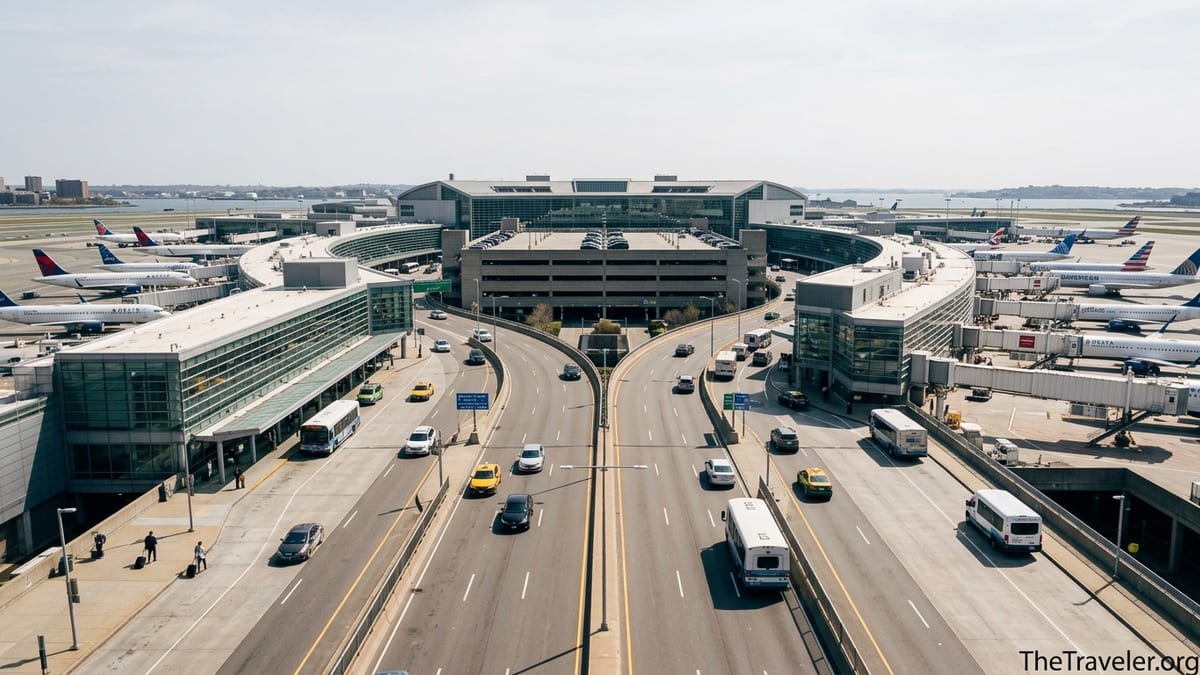
Logan’s Overall Layout: The Basics
Logan Airport is set up in a horseshoe shape around a central parking garage, with Terminals A, B, C and E connected by roadways, walkways and shuttle buses. Most domestic flights use Terminals A, B and C, while Terminal E is the main international terminal that handles the majority of overseas arrivals and departures. In practice, many travelers simply follow their airline: for example, a Delta passenger heading to Atlanta will almost always start in Terminal A, while a JetBlue passenger flying to Orlando will use Terminal C.
All terminals have their own ticketing, security checkpoints and baggage claim areas. Once you are through security, Terminals B, C and E are linked by post-security walkways, allowing some airside connections without exiting and re-screening. Terminal A sits slightly apart and is connected to the others on the public side by shuttle buses and curbside walkways. This split matters most for tight connections or when deciding where to eat, shop or visit a lounge between flights.
Road access and ride-share pickups are organized lane by lane. If you arrive at Logan in an Uber or Lyft from downtown Boston, the driver will typically ask which terminal and airline you need. Saying “Terminal B, American” or “Terminal C, JetBlue” is usually enough for them to follow the clear overhead signage and drop you at the correct door for check-in.
Public transportation feeds into the loop as well. The free Massport shuttle buses connect all terminals to the MBTA Blue Line’s Airport Station, the Rental Car Center and the water transportation dock. These shuttles run frequently and are the default option if you are transferring between terminals with luggage on the public side or arriving from the T.
Terminal A: Delta Stronghold with Some Partners
Terminal A sits on the southeastern side of the airport and is best known as Delta’s home at Logan. If you are flying Delta to common domestic destinations like Detroit, Atlanta, Minneapolis or Raleigh–Durham, you will almost certainly check in here. Delta also uses nearby Terminal E for many of its international departures and arrivals, but check-in for a typical domestic Delta flight remains in Terminal A, with clear signage on the departure boards.
Inside, Terminal A has a main building and a satellite concourse connected by an underground walkway. You will find the usual check-in counters along the front windows, followed by security, then a mix of fast-casual food outlets, coffee chains and newsstands past security. For example, a business traveler on a Monday morning Delta shuttle to New York may grab coffee near the gates in the main concourse before walking to the satellite concourse for boarding.
Terminal A also hosts a small group of other carriers from time to time, such as WestJet for some Canada flights, but most passengers here are Delta customers. Baggage claim for arriving flights is on the ground level directly beneath the ticketing hall. If you land from a late-evening Delta flight from Chicago, you will follow the “Baggage Claim / Ground Transportation” signs down the escalator, pick up your suitcase at one of the carousels and then walk outside to the designated ride-share or taxi zones.
Connecting from Terminal A to other terminals is easiest on the public side. For example, if you arrive on Delta in Terminal A and then connect to an international partner flight in Terminal E on separate tickets, you will collect your bags, exit to the curb and take a Massport shuttle marked for “All Terminals / Airport Station.” Ride times between terminals vary with traffic, but a typical A to E transfer is roughly 10 to 15 minutes curb to curb, so plan at least 60 to 90 minutes between separately booked flights.
Terminal B: American, United and a Mix of Domestic & Transborder
Terminal B is the most centrally located terminal at Logan and handles a wide mix of domestic and nearby international routes. It is subdivided into two main piers, historically known as the American side and the United side. Today, American Airlines remains one of the main tenants with frequent flights to hubs like Charlotte, Dallas–Fort Worth, Miami and Phoenix. United flies from the other side of Terminal B to its main hubs such as Newark, Chicago O’Hare, Denver and San Francisco.
Other airlines using Terminal B include Air Canada for many of its Canada routes, Spirit’s former operations that have now been replaced by other carriers, and Boutique Air on some regional services. A traveler flying from Boston to Toronto on Air Canada will check in at Terminal B, clear security there, and then board from one of the northern gates. On return, they will arrive back into the same terminal and use the baggage claim on the lower level, making it easy to meet car services or friends at the curb.
Check-in counters in Terminal B are organized by airline, so it is worth reading overhead signs carefully as you enter. For example, a family flying American to Orlando might be dropped at Door B on the American side, where multiple rows of kiosks and agent counters allow them to check bags and print boarding passes. Once through security, this side of Terminal B offers sit-down restaurants, bars and grab-and-go options. On the United side, a frequent business traveler might head straight for the United Club lounge before an evening flight to Houston.
On the airside, Terminal B connects to Terminal C and then onward to Terminal E via secure walkways. That means that if you arrive on an American flight from Chicago in Terminal B and need to connect to a JetBlue flight in Terminal C on the same itinerary with checked bags, you can often follow “Walkway to Terminal C / E” signs without exiting and re-screening. This connection can take 10 to 20 minutes of walking, so comfortable shoes are helpful, but it is straightforward and clearly marked.
Terminal C: JetBlue Hub and Select Regional Carriers
Terminal C is the main base for JetBlue at Logan and one of the airport’s busiest terminals. Most JetBlue flights, whether short hops to Washington National and New York JFK or long-haul services to the West Coast and Caribbean, operate from here. When a Boston resident books a JetBlue flight to Los Angeles, odds are high that their boarding pass will show a C gate number and that they will check in directly at Terminal C’s large JetBlue area.
In addition to JetBlue, Terminal C hosts several other carriers. Alaska Airlines uses Terminal C for its flights to Seattle and other West Coast destinations, giving travelers a West Coast–focused alternative to JetBlue and the legacy carriers in Terminal B. Cape Air also operates out of Terminal C, making it convenient for passengers connecting from JetBlue to regional destinations like Nantucket or Hyannis on the Cape. The ability to walk a short distance between a JetBlue gate and a Cape Air gate without leaving security is a key benefit for travelers heading to smaller New England communities.
Terminal C is known among Boston-based travelers for relatively efficient security during off-peak times, though early morning departures can see long lines. For instance, on a busy Saturday around 4:30 a.m., passengers flying JetBlue to Florida might encounter queues that loop through the main hall, so arriving a full two hours early is wise if you have checked baggage. Once past security, the terminal offers a mix of local and national food brands, from seafood counters to coffee chains, along with multiple seating zones and charging stations.
For baggage claim, arriving passengers follow signs down one level to several large carousels, which are usually grouped by airline. A visitor arriving on a JetBlue flight from San Juan will collect their checked bag here, then move directly outside to ride-share or taxis. If they are connecting onward to an international flight in Terminal E on a separate ticket, they will likely need to re-check bags with their international carrier, which means exiting to the curb and either walking or taking a shuttle around the loop.
Terminal E: Logan’s International Gateway
Terminal E, located at the north end of the airport, is Logan’s primary international terminal. It handles most long-haul flights to Europe, the Middle East, Latin America and parts of Asia. Major foreign carriers like British Airways, Lufthansa, Air France, Emirates, Qatar Airways, and others typically depart from here, alongside U.S. airlines operating international routes. For example, a nonstop flight from Boston to London on British Airways or from Boston to Doha on Qatar Airways will almost always leave from an E gate.
Terminal E also manages nearly all non-preclearance international arrivals. When you land from an overnight flight from Paris, your aircraft will park at an E gate, and you will proceed through federal inspection: passport control, customs and any secondary screening. After clearing, you retrieve your checked luggage in the international arrivals hall on the lower level, which has multiple carousels, customs exits and meeting points where friends, family and private car drivers often wait.
Some domestic flights, especially those tied to international operations or aircraft repositioning, also use Terminal E. Delta, for instance, may operate certain domestic segments from Terminal E because its long-haul aircraft are based there at specific times of day. It is not unusual to see a Delta flight from Boston to New York or Atlanta departing E rather than A, especially during busy transatlantic seasons. Always check your booking and the airport monitors on the day of travel to confirm the correct terminal.
Within the secure area, Terminal E connects via walkways to Terminal C and, from there, to Terminal B, forming a continuous post-security path. This is valuable for connecting travelers on single itineraries. A typical example is a passenger arriving on Lufthansa from Munich in Terminal E, clearing U.S. immigration and customs, re-checking their bag with United in the same hall, then proceeding upstairs through security and walking toward Terminal B for a domestic connection to Chicago without needing to take a shuttle bus.
Domestic vs International Flights by Terminal
At Logan, the split between domestic and international flights is not absolute, but patterns are clear. Terminals A, B and C are heavily domestic with some near-international service to Canada, Bermuda and the Caribbean. Terminal E is primarily international, especially for non-stop flights to Europe, the Middle East and beyond. For example, an American Airlines flight from Boston to Philadelphia operates from Terminal B and is fully domestic, while an American flight to London usually uses Terminal E in coordination with its transatlantic partners.
Canada flights are a special case. Air Canada, for instance, uses Terminal B at Logan for most departures and arrivals to cities such as Toronto and Montreal. These are technically international flights, but passengers follow a pattern much like a domestic departure: check in on the main level, clear TSA security, then clear Canadian border formalities on arrival in Canada. On the return, they clear U.S. formalities at Logan in Terminal B’s immigration area if preclearance is not available on the Canada side for that specific routing.
Many U.S. airlines also split their operations between terminals depending on whether a flight is domestic or international. Delta is the clearest example, largely using Terminal A for domestic departures and arrivals and Terminal E for its long-haul international flights, even though you may sometimes check in at A and be bussed or walked to an E gate. JetBlue, by contrast, often operates both domestic and some international Caribbean flights from Terminal C, keeping its network largely under one roof for easier connections.
For travelers booking separate tickets, understanding these patterns helps with planning safe connection times. Someone flying into Boston from a small New England airport on Cape Air into Terminal C and then connecting to a long-haul flight to Europe from Terminal E should budget at least two and a half to three hours. This allows time to collect bags, change terminals if needed, re-check with the international airline, clear security in Terminal E and still reach the gate comfortably before boarding.
Check-in, Baggage Claim and Security: What to Expect
Across Terminals A, B, C and E, the flow is similar: curbside drop-off, airline check-in counters and kiosks, security checkpoints, then concourses and gates. Most major airlines at Logan support online and mobile check-in, but if you have checked luggage or need to show documents for an international trip, you will still visit the counter. For example, a family flying JetBlue from Terminal C to Cancun might check in online but will line up at the JetBlue counters to check bags and have passports verified before heading to TSA.
Baggage claim is always on the arrivals level directly beneath or behind the main check-in halls. Carousels are grouped by airline and flight number displayed on overhead screens. A typical scenario: you land at Terminal B on a United flight from Denver, follow the crowd down the escalators to baggage claim, see your flight number on an electronic sign above Carousel 4 and wait nearby. Ground transportation signage from each baggage hall points to ride-share pick-up areas, taxi queues, hotel courtesy shuttles, rental car buses and the free Massport shuttles.
Security at Logan is handled by TSA, with dedicated checkpoints in each terminal. Wait times fluctuate significantly by time of day. Early morning departures between 5 and 9 a.m. are often the busiest, particularly in Terminals B and C, where airlines schedule banks of flights to hub cities. Travelers report that arriving 2 hours before a domestic flight and 3 hours before an international departure is generally safe, particularly if you need to check baggage. Programs like TSA PreCheck, CLEAR (where available) and airline priority lanes can shorten the wait, but lines can still stretch well beyond the roped areas during holiday periods.
Security re-check is a key factor for connecting passengers. If your entire trip is on a single ticket and both flights use Terminals B, C and E, you often remain in the secure zone, walking between terminals without passing through TSA again. However, if you land internationally in Terminal E, clear customs and exit into the public arrivals hall, or if you have separate tickets that require re-checking baggage, you will need to go back through security at your departing terminal. Planning buffer time for this extra screening step is crucial, especially in peak seasons like summer and school vacations.
Moving Between Terminals: Shuttles, Walkways and Realistic Timing
Logan offers two main ways to move between terminals: airside walkways (once you are through security) and landside shuttle buses and sidewalks (before security). The best option depends on your ticket type, whether your bags are checked through, and how much time you have. For many same-ticket connections, the airside route is easiest, while for separate tickets or after baggage claim, you will generally rely on shuttles.
Airside, Terminals B, C and E are connected in a continuous path. For example, if you arrive on a morning JetBlue flight into Terminal C and have a same-ticket connection on American in Terminal B, you can follow signs that lead through the C concourse and into the connecting corridor. This passage includes moving walkways and clear overhead directions like “To Terminal B gates.” Expect the walk from central Terminal C to the American side of Terminal B to take about 10 to 15 minutes at a normal pace, a bit longer if you are pushing a stroller or carrying heavy bags.
From Terminal C, another connector leads to Terminal E, used often by passengers connecting from domestic flights to international departures. A traveler landing from Chicago on United in Terminal B might walk through the B to C connector and then onward to E for a Lufthansa flight to Frankfurt. This full walk can stretch close to a mile depending on your exact gates, so giving yourself at least 60 to 90 minutes between flights is sensible, even if you do not need to clear security again.
On the public side, free Massport shuttle buses run around the terminal loop approximately every few minutes during peak hours. These buses stop at all terminals, the Rental Car Center and Airport Station on the Blue Line. If you arrive at Terminal A on Delta and have a separately booked JetBlue flight from Terminal C later in the day, you will exit to the curb, follow signs to the “All Terminals” shuttle stop, board the bus and ride a short distance to Terminal C. Total time, including waiting, is typically 15 to 25 minutes, but it can be longer during rush-hour traffic or winter weather. Walking between adjacent terminals on the sidewalks is possible for light-pack travelers, though the road network and parking structures can make this less intuitive than simply waiting for a shuttle.
The Takeaway
Boston Logan’s four terminals each have a clear role: Terminal A as Delta’s main base for domestic flights, Terminal B as a hub for American, United and several others, Terminal C as JetBlue’s stronghold with key partners like Alaska and Cape Air, and Terminal E as the international gateway. Understanding which airlines use which buildings, and how domestic and international flights are split, makes it far easier to plan your trip and avoid last-minute stress at the curb.
For most travelers, the most important habits are simple: check your terminal and gate on the day of departure, arrive early enough to handle check-in and security at busy times, and build realistic connection buffers, especially when changing terminals or traveling on separate tickets. Use the secure walkways between Terminals B, C and E when you can, and rely on the free shuttle buses when you cannot. With that basic mental map in place, Logan becomes a manageable, even familiar airport rather than a confusing maze.
Whether you are catching a quick shuttle to New York, starting a long-haul journey to Europe or meeting family flying in from across the country, knowing how Terminals A, B, C and E work will help you move confidently from curb to gate and back again.
FAQ
Q1. Which airlines use Terminal A at Boston Logan?
Terminal A is dominated by Delta Air Lines for most domestic flights, with occasional service from partner carriers such as WestJet on select routes.
Q2. What airlines are in Terminal B at Logan?
Terminal B primarily hosts American Airlines and United Airlines, along with carriers like Air Canada and some regional and low-cost operators on selected routes.
Q3. Is JetBlue always in Terminal C?
JetBlue’s main base at Logan is Terminal C, and the vast majority of its flights, both domestic and many Caribbean routes, operate from C gates unless otherwise noted on your booking.
Q4. Which terminal handles most international flights?
Terminal E is Logan’s main international terminal and handles most long-haul routes to Europe, the Middle East, Latin America and other overseas destinations.
Q5. Can I walk between Logan terminals after security?
Yes. Terminals B, C and E are connected airside by secure walkways, allowing you to move between many gates without exiting and re-clearing security.
Q6. How do I get from Terminal A to the others?
Terminal A is not connected airside to B, C or E, so you generally use the free Massport shuttle buses or walk the sidewalks on the public side between terminals.
Q7. How early should I arrive at Logan for my flight?
Plan about 2 hours before a domestic departure and 3 hours before an international flight, especially during peak morning and evening periods or school holidays.
Q8. Where do I claim baggage at Logan?
Each terminal has its own baggage claim area on the arrivals level. You follow “Baggage Claim” signs from your gate to the carousels labeled with your flight number.
Q9. Do I need to go through security again when connecting?
If your flights are on one ticket and you remain within the B–C–E secure area, you often avoid re-screening. If you change terminals on the public side or arrive from overseas, you must clear security again.
Q10. What is the best way to transfer between flights on separate tickets?
Allow extra time, at least 2.5 to 3 hours, because you may need to collect bags, change terminals via shuttle and re-check with your next airline before going through security again.