


Boston Logan International Airport sits unusually close to downtown, and that is good news if you are comfortable with public transit. Between the free airport shuttle buses, the MBTA Blue Line subway, and easy downtown transfers, you can get from your terminal to central Boston in around 25 to 35 minutes without spending more than a standard subway fare. This guide explains exactly how to use the free shuttle to Airport Station, how the Blue Line works, what tickets to buy, how it compares with the Silver Line, and when each option makes the most sense in the real world.
Get the latest updates straight to your inbox!
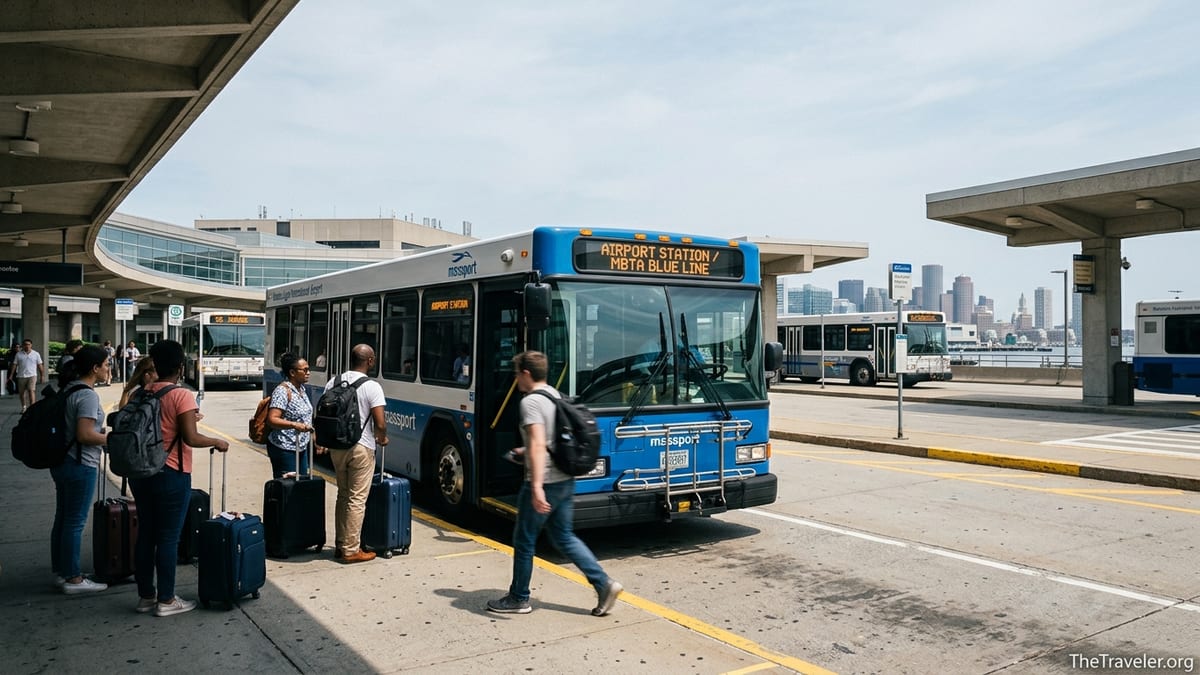
How the Free Logan Airport Shuttle to the Blue Line Works
Logan does not have a subway platform under the terminals. Instead, Massport runs a fleet of free Massport Shuttle buses that connect every terminal with Airport Station on the MBTA Blue Line, as well as the Rental Car Center and the water transportation dock. These blue and white buses loop through the airport roads all day and night, and you can ride them without a ticket or transit card.
At the terminals, follow the signs in the arrivals area for "Buses" or "MBTA Blue Line" and walk outside to the curb. You will see clearly marked stops for the Massport shuttles. Look for digital signs on the buses themselves showing numbers such as 22, 33, or 55, which are the common routes connecting terminals to Airport Station and the Rental Car Center. Service typically runs every few minutes during the day and somewhat less frequently late at night, but you rarely wait longer than 10 to 15 minutes in normal conditions.
Board through any open door; there is no farebox on these airport shuttles. With luggage, it is easiest to stand in the open low-floor area near the center of the bus and keep your bags close at hand. The ride from most terminals to Airport Station is short, usually 5 to 10 minutes depending on traffic around the terminals. The driver will announce Airport Station, and the stop is signed in large letters, so it is difficult to miss.
When you get off at Airport Station, you will be in a covered busway with signs pointing you toward the MBTA entrance. From there, you enter the station through fare gates just like any other Boston subway stop. The shuttle ride is free, but the Blue Line itself uses regular subway fares, so you will need to pay when you go through the gates into the station.
Blue Line Basics: Route, Frequency, and Typical Travel Times
The Blue Line is one of Boston’s four main subway lines and runs between Bowdoin in downtown and Wonderland in the coastal city of Revere. Airport Station sits between Maverick and Wood Island in East Boston, only a few stops from downtown. Trains run underground through the harbor tunnel to reach the city center, with State and Government Center being the key transfer points for other lines.
On a typical weekday, Blue Line trains generally run every 5 to 7 minutes during peak commuter times and roughly every 8 to 12 minutes during evenings and weekends. Early morning and late-night service can stretch to about every 15 minutes. The ride from Airport Station to State Street in downtown usually takes about 10 minutes once you are on the train, making the total airport-to-downtown time about 25 to 35 minutes when you include the shuttle and transfer walking.
For many travelers, the most useful downtown stops are State (for connections to the Orange Line and a short walk to Financial District hotels), Government Center (for transfers to the Green Line and City Hall area), and Bowdoin (a small terminal station near the Massachusetts General Hospital area, when open). If you are headed to the North End or Faneuil Hall, getting off at Aquarium or State is usually the fastest option. Compared with the often traffic-prone airport tunnels used by taxis and ride-hailing, the Blue Line offers a generally predictable travel time, especially during rush hour.
One practical example: if your hotel is near Boston City Hall or in the Government Center area, you can take the shuttle from your terminal to Airport Station, ride the Blue Line four stops to Government Center, and walk a few minutes to your hotel. In normal midday conditions, that entire trip often takes about 30 minutes and costs only a single subway fare, which is hard to beat in a major U.S. city.
Tickets, Fares, and How to Pay on the Blue Line
The MBTA uses the same fare structure on the Blue Line as on other subway lines. As of mid-2026, a standard one-way subway fare is around 2.40 dollars when paid with a CharlieCard, CharlieTicket, or contactless bank card such as a tap-enabled credit card or smartphone wallet. You pass through fare gates at Airport Station by tapping your chosen card or feeding in a paper ticket, and the system automatically deducts the fare.
First-time visitors often find it easiest to use contactless payment. If your credit card or phone supports tap to pay, hold it against the reader on the gate until the light turns green, then walk through. You pay the same base subway fare this way and do not need to buy a separate transit card. If you prefer a reusable card, a CharlieCard can be obtained from many station vending machines and MBTA staff. You can load stored value or passes onto the card and tap it at gates on subsequent rides.
For travelers planning more intensive use of the system, a monthly or weekly LinkPass may make sense. For example, if you are staying in Boston for a month and commuting daily from East Boston or Revere on the Blue Line into downtown, a monthly pass costs much more than a single ride but becomes cheaper per ride if you use the subway and buses multiple times per day. Occasional visitors, such as someone in town for a three-day conference near the Financial District, typically save money by just paying individual fares with a contactless card or loading a small amount of cash value onto a CharlieCard.
It is worth noting that while the shuttle from the terminals to Airport Station is free, the Blue Line itself is not. This differs from the Silver Line route SL1, which is currently free in the inbound direction from Logan to South Station thanks to a Massport subsidy. Travelers sometimes assume that all transit from the airport is free; in reality, you pay a standard subway fare when you board the Blue Line at Airport Station, so be prepared with a payment method before you reach the gates.
Downtown Transfers: Reaching Popular Neighborhoods and Hubs
One of the biggest advantages of the Blue Line is how neatly it connects into the rest of Boston’s subway grid. At State, you can transfer to the Orange Line, which continues to Back Bay, North Station, and Jamaica Plain. At Government Center, you can switch to the Green Line, which serves Boston Common, Back Bay, Fenway, and Allston. Both of these transfer points are inside the fare-paid area, so you do not have to tap again if you are just changing lines within a short time window.
As a concrete itinerary, imagine you have booked an Airbnb just off Downtown Crossing near the intersection of Washington Street and Winter Street. From Logan, you can take the shuttle to Airport Station, ride the Blue Line inbound to State, transfer to the Orange Line toward Forest Hills, and ride one stop to Downtown Crossing. The walk from the station to many central hotels and short-term rentals is only a few minutes. In total, you have paid a single subway fare and avoided the possibility of sitting in the Sumner Tunnel in a traffic jam after a late-afternoon arrival.
For travelers heading to the Seaport District, the picture is different. The Blue Line does not directly reach the Seaport. In that case, many people prefer the Silver Line SL1 bus, which is free inbound and runs directly from the terminals to World Trade Center and Courthouse stations in the Seaport before continuing to South Station. However, you can still use the Blue Line if necessary, such as during Silver Line disruptions, by connecting to the Red Line at Park Street or Downtown Crossing and continuing via other bus or walk options.
If you need to reach South Station itself, the Blue Line is usually not the most convenient choice, but it is doable. One option is to ride the Blue Line from Airport to State, walk underground to Downtown Crossing on the Orange Line corridor, then ride the Red Line one stop to South Station. In practice, that involves at least one extra transfer compared with simply taking the Silver Line SL1 directly from your terminal, which is why most travelers heading specifically to South Station or the Red Line favor the Silver Line.
Blue Line vs Silver Line: When Each Option Is Better
Boston offers two main transit options from Logan into the city: the Blue Line via the free airport shuttle and the Silver Line SL1 bus that runs directly from every terminal to South Station. Choosing between them depends on exactly where you are going and how much luggage you have. The Silver Line from the airport to South Station is currently free, which is a strong argument if your hotel or final destination is near South Station, the Seaport District, or any Red Line station such as Kendall, Harvard, or Porter.
The Blue Line often wins when your destination is closer to its downtown stops, particularly State, Government Center, or Aquarium. For example, if your hotel is in the Financial District around Atlantic Avenue or near Faneuil Hall, you can ride the shuttle to Airport Station and then take the Blue Line inbound to Aquarium or State, both of which are only a short walk away. In this case, using the Silver Line would require either backtracking from South Station or negotiating a longer walk with your luggage, even though the bus itself is free inbound.
Travel time is the other key factor. The Silver Line is a bus rapid transit route but still shares some roadway traffic, especially leaving the airport and approaching downtown. In smooth conditions, it can reach South Station in as little as 20 minutes, but at peak times it can stretch to 30 minutes or more. The Blue Line, by contrast, is usually more time-consistent once you are on the train. For an evening arrival when tunnels are prone to congestion but the subway is still running frequently, many locals prefer the shuttle plus Blue Line combination to reach downtown more predictably.
There are also reliability and disruption considerations. The MBTA has been conducting several rounds of maintenance and periodic shutdowns on different lines. If there is a temporary suspension on the Blue Line between Airport and Government Center, the Silver Line provides an alternative route between Logan and downtown. Conversely, if Silver Line service is delayed or crowded, the Blue Line may feel calmer and more comfortable. Checking transit alerts on arrival and being flexible about using either option can save you time and frustration.
Real-World Scenarios: Which Route Should You Take?
Consider a business traveler landing at Logan around 8:30 a.m. on a weekday with only a carry-on, heading to an office near State Street. During the morning rush, the airport tunnels and downtown streets are busy, and taxis may sit in traffic. In this situation, the most reliable option is typically the free shuttle to Airport Station followed by the Blue Line to State. Even with a short wait for the train, that rider is often walking into their office in about 30 minutes and has spent no more than a single subway fare.
Now imagine a family of four arriving on a Sunday afternoon with two large suitcases each, heading to a hotel next to South Station before catching an Amtrak train the following morning. For them, the Silver Line SL1 has clear advantages. They can board the bus right outside their terminal, ride for free to South Station with luggage racks available, and roll directly into the station concourse without making any transfers or carrying bags up and down multiple sets of stairs between lines.
A third scenario involves a budget-conscious traveler staying in East Boston or Revere, perhaps at an Airbnb near Wood Island or a hotel near Wonderland. In that case, the Blue Line is almost always the smarter route. The traveler can take the free shuttle to Airport Station, pay one subway fare to ride outbound, and reach their neighborhood station in only a few stops. Using the Silver Line would unnecessarily send them to South Station first, forcing them to backtrack on the subway and pay an extra fare or spend extra time.
Finally, consider someone arriving late at night around 11:45 p.m., when train frequencies are lower and some connections are less predictable. Both the Blue Line and Silver Line typically still operate, but service intervals can be longer. If this traveler is going to a hotel in the Seaport, catching the Silver Line directly from the terminal avoids an extra wait at Airport Station. If they are heading to a hotel near Government Center, however, the shuttle plus Blue Line might still be preferable, provided the last trains of the night are still running on a reasonable schedule.
Practical Tips for Using the Blue Line with Luggage
Although the Blue Line is popular with commuters, it is practical for travelers with bags if you plan ahead. Airport Station is equipped with elevators as well as escalators, which makes it possible to move roll-aboard suitcases from the shuttle level down to the platforms without tackling long flights of stairs. Most downtown stations such as State and Government Center also have elevators, though they may require a bit of wayfinding from street level to locate.
On board the train, try to avoid blocking the doors with large suitcases, especially during peak hours. Stand in the wider vestibule areas near the doors and keep your bag to one side. Locals are used to sharing space with airport travelers, and the atmosphere on the Blue Line is usually casual, with commuters, students, and visitors all sharing the same cars. If you are traveling with a stroller or multiple large bags, aim for off-peak times when the trains are less crowded whenever possible.
Noise and motion on the Blue Line can feel more intense than on some newer metro systems. The tunnel section under the harbor is a bit loud, and the trains can sway slightly. If you are prone to motion sickness, it can help to stand facing the direction of travel and keep a hand on the rail. The ride from Airport to downtown is short, though, so any discomfort is usually brief.
When planning your return to the airport, remember to budget time for both the subway ride and the shuttle back to your terminal. From central Boston, many travelers aim to board the Blue Line about 60 to 75 minutes before they want to be at their check-in counter, adding more time for international departures or peak security periods. This allows for a modest wait for a train, the 10-minute ride to Airport Station, the shuttle ride to the terminal, and a cushion for any minor delays.
The Takeaway
Boston Logan’s proximity to downtown, combined with the free Massport shuttle and the Blue Line, gives travelers a low-cost, fairly straightforward way to reach the city center. The key steps are simple: follow signs to the airport shuttle, ride free to Airport Station, pay a standard subway fare, and ride the Blue Line into downtown where you can walk or transfer to other lines.
In practice, your best option depends on your exact destination. The shuttle plus Blue Line shines for the Financial District, Government Center, Aquarium, East Boston, and Revere, as well as when you want predictable travel times during rush hour. The Silver Line is usually better for South Station, the Seaport, and anywhere along the Red Line, particularly if you appreciate a free inbound ride and fewer transfers with heavy luggage.
By understanding how these pieces fit together, you can treat Logan not as an isolated outpost, but as a well-connected gateway into Boston’s neighborhoods. A little advance planning, a contactless card or phone ready to tap, and a quick check of transit alerts on arrival will help you choose the right combination of shuttle, Blue Line, and transfers for a smooth start or finish to your trip.
FAQ
Q1. Is the shuttle from Logan terminals to the Blue Line really free?
The Massport shuttle buses that run between Logan terminals and Airport Station on the Blue Line are free to ride; you only pay once you enter the MBTA subway at Airport Station.
Q2. How much does the Blue Line cost from Airport Station to downtown?
A standard one-way subway fare is around 2.40 dollars as of mid-2026 when paid with a CharlieCard, CharlieTicket, or contactless bank card tapped at the fare gates.
Q3. How long does it take to get from Logan to downtown Boston on the Blue Line?
Allow about 25 to 35 minutes total in typical conditions, including 5 to 10 minutes on the free shuttle to Airport Station and roughly 10 minutes on the train to central stops like State or Government Center.
Q4. Is the Silver Line from Logan to South Station free?
Yes, the Silver Line SL1 bus is currently free in the inbound direction from Logan to South Station, although normal subway fares apply if you board the Silver Line within the subway system at South Station.
Q5. When is the Blue Line better than taking the Silver Line?
The Blue Line is usually better if you are heading to the Financial District, Government Center, Aquarium, East Boston, or Revere, or if you want more predictable travel times during rush hour.
Q6. Can I pay for the Blue Line with my contactless credit card or phone?
Yes, you can tap a contactless bank card or mobile wallet directly on the fare gate reader at Airport Station and pay the standard subway fare without buying a separate transit card.
Q7. How do I reach South Station using the Blue Line if I need to?
You can ride the Blue Line from Airport to State, transfer to the Orange or walk underground to Downtown Crossing, then take the Red Line one stop to South Station, although most people heading there use the Silver Line instead.
Q8. Is it easy to transfer from the Blue Line to other subway lines downtown?
Yes, State offers a connection to the Orange Line and Government Center connects to the Green Line, both within the fare-paid area so you usually do not pay an additional fare to transfer.
Q9. Is using the Blue Line with luggage practical?
It is manageable for most travelers; Airport Station and many downtown stations have elevators, and trains have level boarding, though you should avoid blocking doors and may want to travel outside peak commuting hours if you have large bags.
Q10. What if there is a service disruption on the Blue Line when I arrive?
If the Blue Line is partially suspended for maintenance, you can usually use the Silver Line SL1 between Logan and South Station or, in some cases, supplemental shuttle buses or ferry services that the MBTA and Massport put in place as alternatives.