


More news on this day
Delta Air Lines suffered a significant disruption to its operations on Sunday, November 22, 2026, after an outage in the automated system used to calculate aircraft weight and balance forced engineers and crews to switch to manual procedures, triggering widespread delays centered on its Atlanta hub during the peak Thanksgiving travel period.
Get the latest news straight to your inbox!
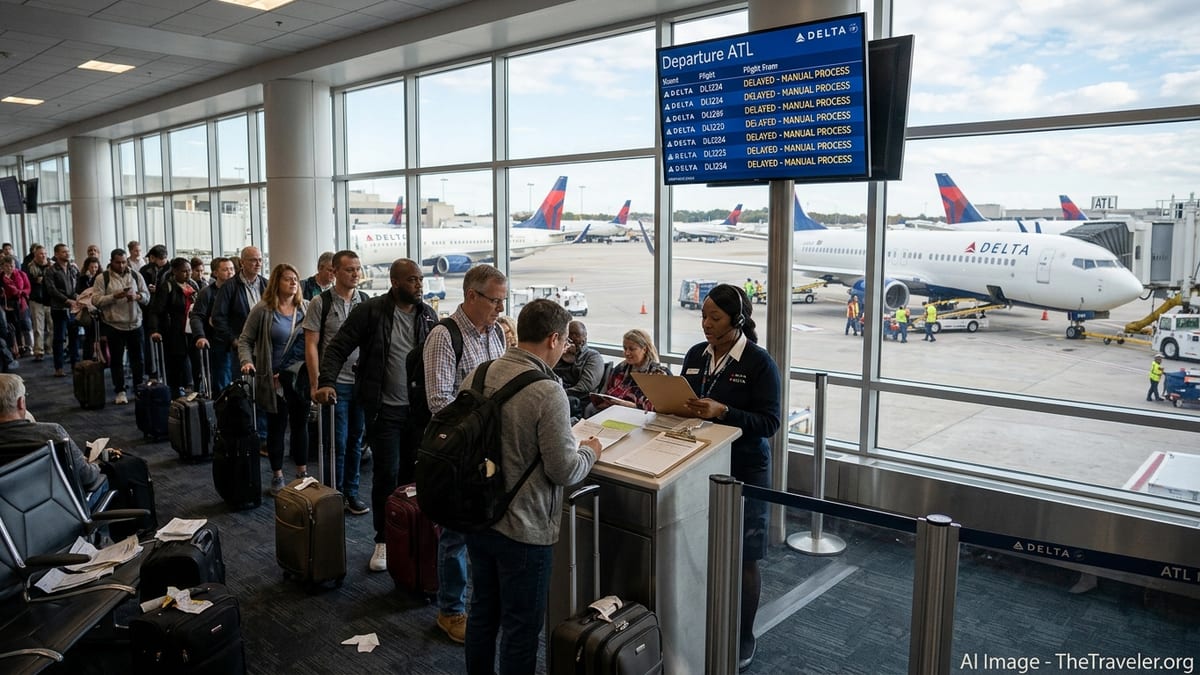
What happened to Delta’s automation system in Atlanta
Delta said the disruption began on Sunday morning, November 22, when the automated system that generates weight-and-balance data for departures became unavailable. The tool normally compiles key information such as passenger counts, checked baggage, fuel load and cargo to produce the numbers pilots need to safely distribute weight on board and calculate performance figures before takeoff. With the system down, Delta engineers and airport teams had to produce those calculations manually for each flight, a slower process that reduced the rate at which aircraft could depart from Hartsfield-Jackson Atlanta International Airport.
The airline did not report any impact on safety, but the slowdown quickly created bottlenecks at the world’s busiest passenger hub. According to Delta and federal officials, the Federal Aviation Administration responded by putting ground delays in place for Delta flights headed to Atlanta, meaning many flights were held at their origin airports to avoid gridlock on arrival. Average holds of around an hour were reported on some flights into the hub while the automation issue was being resolved.
By late Sunday, Delta said the root technical problem with the automation tool had been fixed and the system restored. However, after several hours of constrained operations, the airline was left with a large backlog of delayed flights, crews and aircraft displaced from their planned rotations, and thousands of passengers out of position, issues that typically take additional time to unwind even after a system returns to normal.
Scale of delays and where they were felt
Public flight-tracking data indicated that more than 1,000 Delta-operated flights were delayed on Sunday, representing well over half of the airline’s schedule that day, with a substantial portion touching Atlanta. Delta said that roughly 70 percent of the delays and cancellations recorded for the carrier during the incident were directly linked to the automation outage, while the remainder stemmed from separate weather-related disruptions on its network. That breakdown underscores how a single technical system that feeds core operational processes can ripple across the network when it fails.
The disruption was most acute on services to, from and through Atlanta, but passengers across the United States reported knock-on impacts as aircraft scheduled to pass through the hub arrived late to their next destinations. Some Delta flights from other hubs, including Detroit, Minneapolis–St. Paul and New York-area airports, departed behind schedule as crews waited for updated weight-and-balance figures or for arriving aircraft that had been held heading into Atlanta. International flights appeared to be less affected than short-haul domestic sectors, partly because of longer scheduled turn times and the ability to prioritize widebody departures once the system was restored.
Despite the scale of the disruption, Delta did not declare a full ground stop of its network tied solely to the automation failure. Instead, flights continued to depart using manual workarounds where necessary, albeit at a reduced pace. This approach limited outright cancellations but contributed to lengthy delays for many passengers, particularly those on multi-leg itineraries connecting through Atlanta, where a late first segment could easily cause a missed onward connection once the hub’s tightly timed bank structure was disrupted.
Timing alongside a strained U.S. aviation system
The weight-and-balance outage came at a sensitive moment for U.S. aviation. Just days earlier, the Federal Aviation Administration had ordered a rare nationwide ground stop after an unrelated network malfunction, temporarily halting domestic departures and disrupting schedules across all major carriers. Shortly after that, United Airlines experienced its own separate technology outage that affected departures. The cumulative effect left airlines, airports and passengers already dealing with a wave of rebookings and residual delays heading into the Thanksgiving travel period.
For Delta, the Sunday outage coincided with one of the busiest days of the holiday travel rush. Passenger volumes through Atlanta were forecast to reach several million over the broader Thanksgiving period, putting additional pressure on terminal facilities, ramp space and air traffic capacity even before the automation system failed. With many flights heavily booked, finding alternative seats for disrupted customers was more difficult than it might be during a quieter travel window, and options such as same-day standby or simple retiming to later services were more constrained.
The incident also revived scrutiny of airline dependence on complex technology stacks for core operational functions. While weight-and-balance automation has been standard across large carriers for years and is generally reliable, the Delta outage followed a series of high-profile technology problems across the industry in 2024, including a separate global IT incident in July that had a particularly severe impact on Delta’s operation. Regulators have opened investigations into how airlines plan for and manage such failures, and the latest disruption is likely to feed into ongoing policy and oversight debates around resilience and redundancy.
How Delta responded and what passengers were offered
During the outage, Delta said it implemented manual workarounds at affected stations, bringing in additional staff to support dispatch and ramp operations where possible. The airline prioritized restoring the automation system, but also focused on critical flights, including those carrying large numbers of connecting passengers or operating on long-haul routes where knock-on effects could be harder to recover. Crews were instructed to work with operations control to manage departure times while ensuring safety protocols around weight calculations remained fully in place.
As delays accumulated, Delta directed affected customers to its app and website for rebooking options and notified travelers of schedule changes through electronic channels. Although details of any dedicated travel waiver specific to the weight-and-balance outage had not been fully published at the time of writing, the airline has, in similar recent disruptions, offered fee-free one-time changes within specified date and route windows and, in some cases, refunds for canceled flights when passengers chose not to travel. U.S. Department of Transportation rules also entitle passengers to a cash refund, rather than a credit, if a flight is canceled by the airline and the customer decides not to be rebooked.
For passengers who were significantly delayed, Delta has in other disruptions provided hotel and meal vouchers where the cause was within the airline’s control, subject to availability and eligibility criteria. In this case, the airline indicated that the majority of delays linked to the automation issue were operational in nature rather than caused by weather or air traffic control, factors that typically limit carriers’ obligations. However, precise compensation and voucher policies can vary by itinerary, ticket type and location, and affected travelers are being advised to review their individual notifications and, if necessary, contact Delta customer service after travel to request reimbursements for reasonable out-of-pocket expenses where policies allow.
What travelers should do next and how to plan upcoming trips
By Monday, November 23, Delta reported that its operation had stabilized after the automation outage, with the weight-and-balance system functioning normally and the airline working through remaining residual delays. Travelers scheduled to fly early in the week can expect a more typical level of reliability, although some routes may still see minor timing adjustments as aircraft and crews are repositioned. Passengers with itineraries involving tight connections, particularly through Atlanta, may want to pay close attention to updated schedules and consider accepting voluntary rebookings to flights with longer layovers if offered.
For those whose travel was affected on Sunday, the most practical immediate step is to review the final status of their flights in Delta’s app or through their booking confirmation, then compare that with the airline’s current disruption and customer-service policies. If a flight was canceled and the traveler did not ultimately fly, a refund request can usually be initiated online. If a passenger reached their destination but incurred hotel, meal or ground-transportation costs because of an extensive delay linked to the outage, it may be worth submitting receipts with a reimbursement request, particularly if Delta later confirms that the disruption falls into the category of events within its control.
Looking ahead, the incident illustrates how even a single point of failure in an airline’s automation systems can have network-wide consequences, especially during peak travel seasons. Travelers planning trips through large hubs like Atlanta during busy periods may find it helpful to build in additional buffer time for connections, keep essential items in carry-on baggage in case of missed connections or overnight delays, and monitor both airline communications and third-party flight-tracking tools on the day of travel. While there is no indication that the specific weight-and-balance issue at Delta is ongoing, the broader pattern of recent technology disruptions across the U.S. aviation system means that maintaining flexible plans and up-to-date contact details with airlines remains a prudent strategy for minimizing the impact of any future outages.