


Denver’s A Line commuter rail, often called the “train to the plane,” is one of the easiest ways to travel between Denver International Airport (DEN) and downtown. Running between the airport’s on-site rail station and historic Union Station in LoDo, it offers predictable travel times, a flat airport fare and frequent departures most of the day. This guide walks you through exactly how it works, from buying tickets and boarding with luggage to avoiding the timing and fare mistakes that trip up first-time visitors.
Get the latest updates straight to your inbox!
Overview: How the A Line Works
The University of Colorado A Line is a commuter rail service operated by Denver’s Regional Transportation District (RTD). It runs about 23 miles between Denver Union Station and Denver Airport Station, with six intermediate stops through Denver and Aurora. Trains operate roughly from early morning until after midnight, making it a practical option for most flights arriving and departing during the day.
From end to end, the ride takes about 37 minutes in normal conditions between Union Station and the airport, making it more predictable than freeway traffic on Interstate 70, which can slow dramatically during rush hour or winter storms. For example, a trip that might take 30 minutes by car at 10 a.m. can easily stretch to more than an hour in bad traffic, while the train tends to stay close to its published schedule.
The A Line is designed for airport travelers as well as commuters. Wide doors, level boarding and open interiors make it easier to board with rolling suitcases, backpacks and even skis in winter. On board you will see a mix of airline crew, local commuters heading to jobs at the airport, downtown office workers and visitors heading into the city for conferences or vacations.
For most visitors, the biggest advantages of the A Line are price and reliability. A standard one-way airport ticket costs about 10 dollars for adults and covers unlimited RTD rides for the rest of the day, including buses and rail within the service area. That compares with ride-hail trips that often range between roughly 45 and 80 dollars to downtown, depending on traffic and surge pricing.
From Denver International Airport to the Train
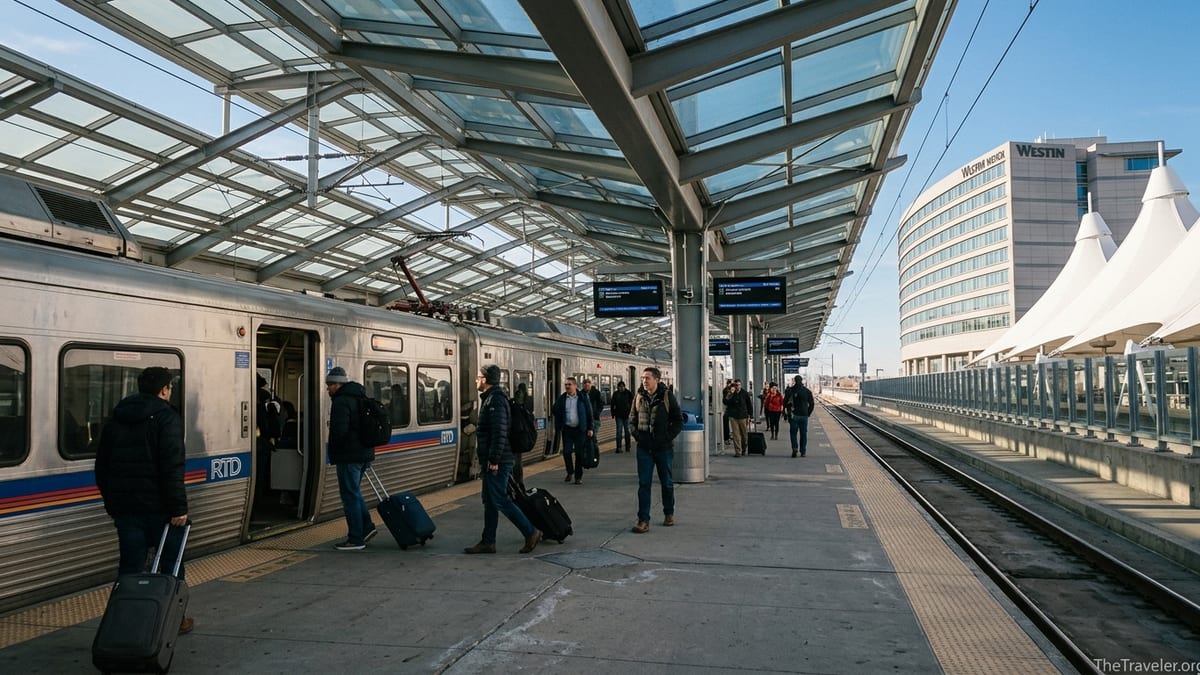
Denver Airport Station sits directly beneath the Westin Denver International Airport hotel at the south end of the main Jeppesen Terminal. After landing and collecting your bags, follow signs in the terminal for “Transit Center,” “A Line” or “Trains to City.” The key thing to remember is that the station is on Level 1, well below the check-in and baggage claim levels, next to the plaza in front of the Westin.
If you arrive on a domestic flight, you will exit onto Level 5 for baggage claim. From there, use the escalators or elevators down to Level 1, then walk toward the open-air plaza beneath the hotel. You will pass food and retail options and then reach the RTD ticket machines just before the station entrance. International arrivals follow signs from the customs hall to baggage claim and then onward to the same Level 1 transit center.
At the station entrance you will find multiple ticket vending machines, MyRide card readers for tap-on payments, and digital signs showing the next departure times. Gates are open; you simply walk out to the platform after purchasing a valid ticket or tapping your payment method. Conductors check tickets on board rather than at turnstiles, so it is easy to overlook buying a ticket if you are distracted. Fare checks are common, and traveling without a valid ticket can result in a steep fine, so take a moment to purchase or validate before boarding.
A real-world example: if your flight from Chicago lands at 2:10 p.m. and you have only carry-on luggage, most travelers can be at the train platform by around 2:35 p.m. It is usually safe to plan for 20 to 30 minutes between landing and reaching the station, longer if you are checking bags, arriving from an international flight or traveling with children.
Union Station: Downtown Hub and Final Stop
On the city side, the A Line terminates at Denver Union Station, the historic Beaux-Arts terminal in Lower Downtown (LoDo). The A Line platforms are located in the open-air train hall just northwest of the main station building. When you arrive from the airport, you step off onto a covered platform with clear signage pointing toward the station interior, light rail, bus concourse and local streets.
Union Station is more than just a rail terminal. Inside the restored Great Hall you will find a hotel, coffee bars, cocktail lounges and several restaurants, as well as seating areas popular with locals working on laptops. Immediately outside the station is the free 16th Street MallRide shuttle, which runs along the 16th Street pedestrian corridor through downtown. This makes it easy to connect between the A Line and many downtown hotels, offices and tourist spots without needing a taxi.
For instance, if you are staying at a hotel near the Colorado Convention Center, you can arrive at Union Station, walk out to 16th Street, board the free MallRide heading toward Civic Center, and get off near California or Stout Street a few minutes later. Travelers heading to neighborhoods like RiNo or Cap Hill often use ride-hail services or city buses from Union Station as a final leg.
Transit connections are straightforward once you know the layout. Beneath Union Station is a large underground bus concourse where regional and local buses arrive and depart. The light rail platforms, used for lines serving areas like the Tech Center, are a short walk south of the main station building. Wayfinding signs are clear, but it is worth allowing a few extra minutes the first time you navigate the hub.
Fares, Tickets and Payment Options
The A Line uses RTD’s standard fare system with a special airport fare. As of mid-2026, the adult airport fare is about 10 dollars for a single day. This fare covers your trip to or from Denver Airport Station plus unlimited rides on all local and regional RTD services for the rest of that service day. In practice, that means your airport ticket can also be used to ride buses, light rail and commuter rail lines during the same day without paying again.
Tickets can be purchased in several ways. The most common for visitors is the ticket vending machines at Denver Airport Station and Union Station, which accept cash and major cards. RTD also offers a reloadable smart card, branded as MyRide, and mobile ticketing through its official app. With MyRide or the mobile app, you can purchase an airport fare electronically and simply tap or show your screen when requested by fare inspectors.
Children, seniors and riders with disabilities may be eligible for reduced fares. For example, youth in certain age ranges pay a lower price for an airport trip, and some local residents use monthly or annual passes that already include airport travel. If you are a conference attendee, check with your event organizer; some large conventions in Denver provide pre-loaded transit passes that cover the A Line, which can save you the cost of individual tickets.
A common mistake is buying a standard local ticket instead of the airport fare when traveling all the way to Denver Airport Station. Local fares are cheaper and valid for many trips around Denver, but they do not cover the airport zone. Inspectors are trained to verify you purchased the correct type. If in doubt, choose the option clearly labeled “Airport” on the machine and confirm that the printed ticket mentions airport fare or zones that include the airport.
Schedule, Frequency and Travel Time Planning
The A Line operates seven days a week, with trains running roughly every 15 minutes during much of the day and every 30 minutes early in the morning and late at night. First departures from Union Station typically leave before 4 a.m., and the last departures from the airport are often just before 1 a.m., though exact times vary by day and season. Schedules are adjusted periodically, so it is wise to check the current timetable or trip planner shortly before you travel.
Under normal operations, the scheduled travel time between Denver Airport Station and Union Station is about 37 minutes. Intermediate stations like 61st & Peña, Central Park and 38th & Blake have shorter travel times, which can be useful if your hotel or accommodation is in those neighborhoods. For example, a rider staying near Central Park Boulevard might reach the airport in about 25 minutes by train instead of traveling into downtown first.
To plan an airport departure, work backward from your flight time. Airlines at DEN typically recommend arriving at least two hours before domestic flights and three hours before international flights, especially during busy periods like school holidays or ski season. Suppose you have a 9 a.m. domestic flight to Los Angeles. Aim to be at the airport by 7 a.m., which means boarding an A Line train at Union Station around 6:15 a.m. to allow the 37-minute ride plus a buffer for walking from the station up to security.
For late-night arrivals, pay close attention to the last train times. A traveler landing on a 12:05 a.m. flight might clear the gate and baggage claim by 12:35 a.m. If the last A Line departure toward downtown is around 12:45 a.m., you have a comfortable but limited window. If your flight is delayed past that, you may need to rely on taxis or ride-hail instead. During winter storms or special events, RTD sometimes operates bus bridges or adjusted schedules, so checking real-time information on the day of travel is especially important.
Luggage, Accessibility and Onboard Experience
The A Line trains are designed to handle airport-style luggage. Each car offers open floor areas near doors, allowing travelers to stand with rolling suitcases and larger bags. Overhead racks are modest in size, suitable for backpacks or small carry-ons. For larger checked bags, most travelers keep them upright near their seat or stand with them in the multi-purpose area by the doors. There are no dedicated checked-luggage services on the train itself, so plan to manage your own bags at all times.
Boarding is level with the platform, making it easier for passengers using wheelchairs, strollers or heavy suitcases. Doors are wide and stay open long enough for most travelers to board without rushing, but during busy times the aisles can feel crowded near the doors. If you are traveling with multiple large bags, it helps to enter through a less crowded door and move slightly inward to avoid blocking others.
Accessibility features include priority seating near doors, audio and visual stop announcements, and elevators at both Denver Airport Station and Union Station. For example, a traveler using a mobility device can take an elevator from baggage claim to Level 1 at the airport, roll directly to the platform, and board the train without needing assistance. Service animals are allowed, and non-service pets must typically be in carriers or follow RTD’s posted pet policies.
On board, the experience is closer to a modern commuter train than a subway. Seats are generally arranged in two-by-two rows with a combination of forward, backward and some facing seats. Wi-fi is not guaranteed, but cellular data service is fairly consistent along the route. Security staff and transit police patrol the line regularly, and many local flyers consider the A Line a safe option, especially during daytime and early evening hours. As with any urban transit, keeping your bag within sight and avoiding leaving items unattended is common sense.
Common Mistakes and How to Avoid Them
One of the most frequent mistakes first-time riders make is cutting timing too close for departing flights. Travelers used to small airports sometimes arrive at Union Station an hour before their departure and assume they will still make their flight. Between the 37-minute train ride, the walk from the station through the terminal and security screening times, that can be unrealistic. Building in at least a one-train cushion, especially during peak periods, greatly reduces stress.
Another common pitfall is boarding the wrong train at Union Station. The A Line departs from specific tracks in the open-air train hall, but other commuter lines like the B or N can be nearby. Visitors sometimes hop on the first train that pulls in, only to realize it is not heading to the airport. Always confirm the digital sign on the platform and the destination sign on the train itself. The train you want will clearly say it is bound for Denver Airport Station.
Fare selection can also cause confusion. At ticket machines, riders sometimes purchase a cheaper local fare that does not include the airport zone, either by mistake or because the interface is unfamiliar. Inspectors regularly check tickets and can issue fines for not having the correct fare, even if you bought some type of ticket. When in doubt, choose the airport fare option or ask an RTD staff member or fellow traveler before boarding.
Finally, some visitors underestimate walking distances inside Denver International Airport. The A Line drops you at the south end of the main terminal, but many gates require additional time to reach via security checkpoints and underground trains to concourses A, B or C. A traveler connecting to a regional flight at the far end of Concourse C, for instance, might need 20 to 30 minutes after clearing security to reach the gate. Treat the A Line as one part of your total journey time rather than the only leg you need to plan.
Practical Itineraries and When the Train Makes Sense
For many trips, the A Line is the best balance of cost and convenience. A solo traveler staying at a LoDo hotel near Union Station, for example, can easily roll a suitcase for a five- to ten-minute walk from the station, avoiding downtown traffic and expensive parking. Business travelers attending meetings near the 16th Street corridor often combine the A Line with the free MallRide shuttle and short walks to cover the last stretch.
Families and small groups can weigh the savings against the logistics of moving multiple pieces of luggage. A family of four with several large suitcases might find that a ride-hail or pre-booked shuttle becomes cost-competitive with four individual train fares, especially late at night. On the other hand, during busy times when curbside pick-up areas are congested, the predictability of walking straight to the train can be worth more than the modest price difference.
Travelers staying near intermediate stations can use the A Line creatively. For instance, someone renting an apartment near the 38th & Blake station in the RiNo district can ride a short distance from the airport to that stop, bypassing downtown entirely. From there, many restaurants, breweries and art spaces are within walking distance or a quick local bus trip. Similarly, employees at the airport or nearby business parks often commute from central Denver neighborhoods using the A Line as their daily backbone route.
There are situations where the A Line may be less ideal. Very early flights, such as departures before 5 a.m., can be difficult if you are staying far from Union Station and would need another bus or rideshare before catching the train. During severe weather events, RTD sometimes operates reduced frequencies or bus bridges, which can add uncertainty. In those cases, checking conditions on the morning of travel and having a backup plan, such as a taxi number saved in your phone, is wise.
The Takeaway
The A Line has become a defining feature of travel to and from Denver, offering a straightforward “train to the plane” experience that many cities still lack. With a simple fare structure, frequent service and a direct connection between a major international airport and a lively downtown station, it is an option most visitors should at least consider.
If you remember a few key points, you will likely find the journey smooth: allow enough time before flights, buy the correct airport fare, double-check train destinations at Union Station and factor in walking time inside the airport terminal. Whether you are a first-time visitor heading to a hotel near Union Station or a frequent flyer connecting through Denver for ski season, mastering the A Line can turn what might have been a stressful transfer into a predictable, even pleasant, part of your trip.
FAQ
Q1. How much does the A Line train from Denver Airport to Union Station cost?
The standard adult airport fare is about 10 dollars for a single day, covering your A Line trip plus unlimited RTD bus and rail rides for the rest of that day.
Q2. How long does the A Line take between Denver Airport and Union Station?
Under normal conditions, the scheduled travel time between Denver Airport Station and Denver Union Station is about 37 minutes from end to end.
Q3. How often does the A Line run?
Trains typically run every 15 minutes during most daytime and early evening hours, and every 30 minutes early in the morning and late at night, though exact times vary.
Q4. Where do I catch the train at Denver International Airport?
The A Line departs from Denver Airport Station on Level 1 of the main terminal, directly beneath the Westin Denver International Airport hotel at the south end of the terminal.
Q5. Do I need a special ticket to go all the way to the airport?
Yes. Trips that begin or end at Denver Airport Station require an airport fare rather than a standard local-only ticket. Choose the airport option on ticket machines or in the app.
Q6. Can I use the same airport ticket on buses and other trains in Denver?
Yes. The airport day ticket is valid for unlimited rides on RTD buses, light rail and commuter rail services for the rest of that service day, within the RTD system.
Q7. Is the A Line suitable if I have a lot of luggage?
Generally yes. Trains have wide doors, level boarding and open areas near the doors where travelers routinely stand with large suitcases, skis or other bulky items.
Q8. How early should I leave downtown to catch my flight?
A good rule is to board a train at least two hours and 45 minutes before a domestic flight and about three hours and 45 minutes before an international flight, allowing for the 37-minute ride and security.
Q9. Is the A Line safe to ride at night?
Many locals regularly ride the A Line in the evening. Trains and stations are patrolled, but you should follow normal urban safety habits, such as staying aware of belongings and choosing well-lit areas.
Q10. What happens if there is a service disruption on the A Line?
RTD may operate bus bridges or adjusted schedules during major disruptions or maintenance. Check RTD’s real-time updates or trip planner on the day you travel and allow extra time if conditions look uncertain.