


Anaga Rural Park feels wonderfully remote, but you do not need to drive to experience its laurel forests, ridge walks and fishing villages. From Santa Cruz de Tenerife and San Cristóbal de La Laguna the green TITSA buses put key trailheads and hamlets within reach, and a growing range of guided tours bundle transport with hiking. The trade off is time and planning. Services into the heart of Anaga are infrequent, weekend schedules are especially thin, and visitors staying in Puerto de la Cruz or the southern resorts must expect early starts and long days. A successful no car visit depends on building your plans around current timetables rather than assuming turn up and go frequencies.
Get the latest updates straight to your inbox!
Understanding Anaga’s Geography and What “Reachable” Really Means
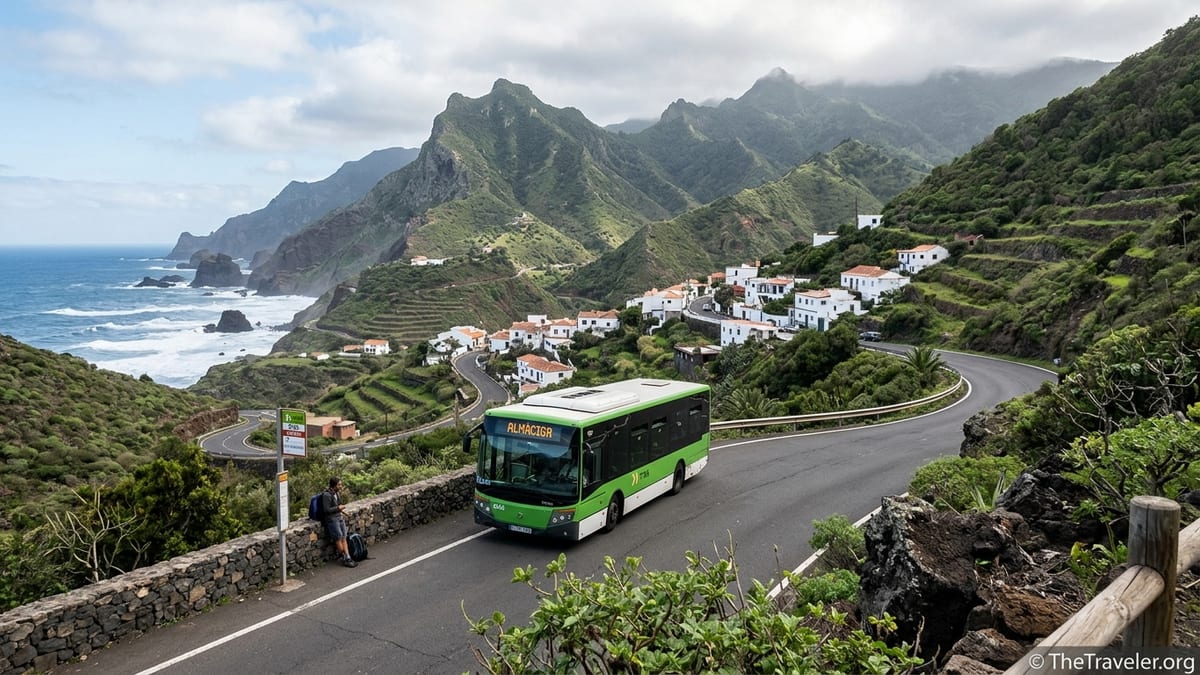
Anaga Rural Park occupies the rugged peninsula that rises immediately northeast of Santa Cruz and La Laguna, with steep ravines, cloud forest and isolated coastal settlements. The main road spine climbs from the coastal village of San Andrés up to the El Bailadero crossroads and on to the laurel forest around Cruz del Carmen before dropping to Taganana, Roque de las Bodegas and Almáciga. Smaller roads branch to hamlets such as Afur, Taborno and Chamorga, but public transport to these outposts is sparse and aimed primarily at residents rather than day trippers.
For visitors without a car, the most realistic bus accessible areas are the Cruz del Carmen and Las Mercedes forest zone, the villages around Taganana and Almáciga on Anaga’s north coast, and a handful of mid mountain hamlets reached from La Laguna. Santa Cruz and La Laguna function as gateways, each with a major bus interchange where TITSA routes into Anaga begin. From these hubs, journey times of roughly 30 to 80 minutes bring you into the park, but the buses often run only a few times per day and follow narrow, winding roads that slow progress.
If you are staying in Puerto de la Cruz or the southern beach resorts, Anaga is still feasible without a car but requires more effort. You will usually need one bus to Santa Cruz or La Laguna and a second into the park, which means that a missed connection can derail a day. It is essential to look up current timetables shortly before travel and to build in generous margins, particularly in the late afternoon when the last buses out of Anaga may be busy with local commuters returning home.
Seasonal changes, roadworks and occasional rockfalls can affect access, so conditions on the ground evolve. Before finalising plans, check recent notices from Tenerife authorities or local news for any closures on the roads that serve Taganana, Almáciga, Chamorga or Afur, and pay attention to weather warnings that might disrupt mountain routes. Travel in Anaga rewards preparation as much as spontaneity.
Key Bus Routes into Anaga and How to Use Them
Tenerife’s interurban buses, known locally as guaguas, are operated by TITSA and provide the backbone of no car travel into Anaga. From Santa Cruz, the most important lines for visitors are those that climb from the central Intercambiador bus station and the nearby Avenida de Anaga stops through San Andrés to the El Bailadero ridge and on to the northern villages. Current mapping and timetable information shows line 946 running from the Santa Cruz Intercambiador via San Andrés and Taganana to Almáciga, taking about one hour to cross the massif. Other routes such as 947 continue from Santa Cruz through San Andrés and El Bailadero towards Chamorga at the eastern tip of Anaga, again on a roughly 80 minute run, though with very limited departures each day.
La Laguna’s Intercambiador is the other main gateway. Several lines climb from here into the forest belt and outlying hamlets. Representative examples include line 275, which links La Laguna with Las Mercedes, Cruz del Carmen, the junction for Las Carboneras and Taborno, with journey times of around an hour up to the higher stops according to recent schedules. Local information in Spanish also highlights lines such as 076 and 273 that run from La Laguna towards Afur and to Cruz del Carmen via Las Canteras. All of these lines tend to offer a small cluster of morning departures, some quieter midday trips and a limited evening service, with fewer buses at weekends and on public holidays.
Because TITSA adjusts timetables periodically, you should never rely on printed brochures or second hand reports. Instead, consult the official journey planner or terminal departure boards a day or two before your excursion. Use them to identify an early bus up into Anaga and at least one, ideally two, realistic options for getting back. For line 946 to Almáciga, for example, recent weekday timetables show several morning and afternoon departures from Santa Cruz but only a handful on Saturdays, Sundays and holidays. Treat those as examples to understand the pattern rather than fixed promises and always reconfirm immediately before your travel date.
From the south coast, typical practice is to take an express bus such as the intercity lines linking Costa Adeje, Playa de las Américas or Los Cristianos with Santa Cruz or La Laguna, then change to an Anaga route. This usually makes for a journey of 2 to 3 hours each way once transfer times are included, so a full day is required and early starts are unavoidable. When planning this type of trip, avoid last possible connections back to the south; instead, build in at least one earlier backup service in case of delays or full buses leaving Anaga villages.
Structuring a Day in Anaga Using Only Buses
The simplest no car day from Santa Cruz or La Laguna focuses on the laurel forest around Cruz del Carmen. From La Laguna, take an early bus via Las Mercedes or Las Canteras that stops at Cruz del Carmen. On arrival you can walk short signed circuits through damp, mossy woodland and visit the viewpoints overlooking the north coast. After a leisurely loop and lunch, catch a mid afternoon bus back to La Laguna, leaving a spare later departure in reserve. This pattern works particularly well outside high season and on weekdays, when services are slightly more frequent.
A more ambitious option is a full day trip to Taganana and the north coast beaches. From Santa Cruz, catch a morning 946 to Taganana or all the way to Almáciga. Spend time wandering through the village, then walk or ride the short coastal stretch between Roque de las Bodegas and Almáciga, where Atlantic surf crashes onto dark volcanic sand. Swimming conditions vary and can be rough, so treat the beaches as scenic picnic and walking spots first and check local flags before considering a dip. In the afternoon, position yourself at the stop for your chosen return service well before the scheduled time; in small villages drivers may not wait and seats can fill quickly on the last buses.
More experienced hikers can use buses to create linear walks between villages or from forest viewpoints down to the sea. For example, some travellers hike from the Cruz del Carmen area down to Chinamada and then on towards Punta del Hidalgo, or use morning buses towards Afur or Taborno and walk back towards a later bus stop. These routes involve significant elevation change and occasionally exposed paths, so they should only be attempted with detailed trail information, appropriate footwear and a weather check. Always leave a margin of at least one earlier bus back than you strictly need, in case a descent takes longer than expected.
Whatever itinerary you choose, plan to be back at your bus stop in Anaga at least 15 to 20 minutes before departure and treat the last service of the day as a safety net rather than your main plan. Mobile coverage drops out in some ravines and along the coast, so do not rely on real time updates or ride hailing to rescue a tight schedule. Carry printed or saved timetables, a physical map or downloaded offline mapping, water, snacks and a layer for the cool, damp forest even if the coast feels warm when you set out.
Tickets, Payment and Practicalities on Tenerife’s Buses
TITSA operates an integrated fare system across Tenerife, anchored by the island’s Tenmas smart card and compatible mobile apps. Official information indicates that contactless bank cards are now widely accepted on TITSA buses, including international Visa and Mastercard cards stored in phone wallets, allowing occasional visitors to tap in without a separate transport card. However, cash payment on board has been progressively restricted and may not be available on all routes, so you should not assume that you can simply hand over coins when boarding in Santa Cruz or a remote village.
For travellers making multiple journeys, the rechargeable Tenmas card or app based equivalents can reduce per trip costs compared with paying individual cash or contactless fares. The card is typically sold at airport machines, main bus stations and selected kiosks, and can be loaded with stored value or specific passes. In recent years, Tenerife has offered day or multi day travelcards that cap spending across buses and, in some cases, the tram network around Santa Cruz and La Laguna. Names, prices and validity conditions for these products change from time to time, so before recommending a specific option the writer should verify current tariffs directly with TITSA and the island transport authority.
Visitors who prefer not to manage a physical card may find that a simple pay as you go contactless bank card offers enough flexibility for one off excursions into Anaga, especially if they are otherwise using a rental car or staying mostly within one town. For heavier public transport use, such as a week based in Santa Cruz with daily bus trips into the park and along the north coast, a travelcard or stored value product is more likely to be economical. When describing these choices, the article should highlight any minimum top up amounts, whether refunds of unused balances are possible and any rules that might affect couples or families, such as one card per passenger.
Whichever payment method is chosen, remind readers to always tap or validate correctly when boarding, and to keep their card or phone available for occasional inspections. Failure to pay or validate properly can result in on the spot fines. As with timetables, fare levels and discounts are periodically updated, so the author should check the latest official sources shortly before publication and, where helpful, include representative fare examples along with the verification month and year.
Guided Tours and When They Make Sense
Organised tours provide an attractive alternative for visitors who want to experience Anaga’s scenery without juggling bus timetables or negotiating mountain roads. Current offerings typically fall into three broad types. Small group hiking tours focus on specific routes through the laurel forest or along coastal paths, usually lasting between three and eight hours of walking and targeting reasonably fit participants. Scenic drive and short walk excursions combine several viewpoints, brief forest strolls and a coastal stop, with more time spent in the vehicle and on commentary. Private guides or tailor made outings cater to travellers with particular interests or mobility needs and can adjust pace and route more flexibly.
Recent price checks on established operators show that guided hiking in Anaga can start at roughly the mid tens of euros for half day walks without transport from the north of the island and can rise into the low hundreds of euros per person for full day excursions that include pickup from the southern resorts, transport across the island, guiding and sometimes lunch. One popular model is a full day Anaga mountains and enchanted forest hike with pickup from the south coast, marketed around a seven hour duration and priced in the low hundreds of euros per person as of late 2026, while shorter guided walks starting in the north can cost a few tens of euros, with optional add on transfers from Santa Cruz or La Laguna.
Most group tours are offered in several languages, commonly Spanish, English and German, and limit group size to maintain a more personal experience. Pickup points tend to cluster in the main southern resorts, in Puerto de la Cruz and in central Santa Cruz or La Laguna, with transport in minibuses or small coaches that can navigate Anaga’s tight curves. Inclusions vary: some packages provide picnic lunches or restaurant stops, others focus purely on walking with passengers bringing their own food and water. Permits are currently required for certain sensitive areas of Anaga’s laurel forest, and established operators usually take care of obtaining these as part of the package.
Because the tour market shifts with seasons and demand, the writer should periodically survey several major booking platforms and local agencies to identify common patterns in duration, start times, language options and what is included. They should quote representative price ranges only after confirming them close to publication and state the verification month and year, while noting clearly that fares can change seasonally and that early booking is advisable in peak months. It is important not to overpromise the availability of specific tours on particular days, especially in shoulder seasons when operators may consolidate departures or run only with a minimum number of bookings.
Using Taxis Strategically with Buses
Taxis can usefully complement bus travel in Anaga, particularly where early starts, tight cruise ship calls or sparsely served hamlets are involved. Official fare information from Tenerife Norte airport and municipal authorities indicates that taxis work on regulated metre rates with minimum charges and per kilometre tariffs that vary between day and night or weekend schedules. The precise figures are updated through regional decrees, so instead of quoting fixed numbers far in advance, it is safer to advise readers that meter based fares from Santa Cruz or La Laguna to high points in Anaga will often amount to a moderate sum for a small group, roughly comparable to the cost of several guided tour places, and that they should ask for an estimated price before committing.
One common strategy is to take a taxi early in the morning from Santa Cruz, La Laguna or even a cruise ship berth up to a trailhead such as Cruz del Carmen, El Bailadero or Taborno while traffic is light, then rely on buses for the return once you have more flexibility about timing. This approach avoids waiting for a first bus that might not align with ship schedules or connecting services from the south. It also lets hikers start popular forest routes before mid morning crowds arrive and before cloud builds in the higher, cooler zones.
Another use case is securing a taxi back from remote villages late in the day when the last bus has already left or is too crowded to be a comfortable option. This is particularly relevant in small settlements at the ends of lines, where a missed service may mean a long delay. In practice, arranging such pickups can be challenging because mobile coverage is patchy and taxis are not based in every hamlet. The writer should therefore research current official taxi ranks in Santa Cruz, La Laguna and key coastal villages, along with any dispatcher numbers that service Anaga, and explain how visitors can pre book a return ride, for example by asking a restaurant or bar to call a cab well before they plan to leave.
Some taxi cooperatives and independent drivers also advertise fixed price excursions from Santa Cruz or La Laguna into Anaga, sometimes including short guided walks or photo stops. These can bridge the gap between pure public transport and larger organised tours, especially for small groups who value flexibility but are nervous about self driving. Before recommending any particular option, the author should confirm current per kilometre rates, any published excursion prices and the legal status of the service, favouring official licensed taxis and registered guides.
Safety, Comfort and Accessibility Considerations
Travel into Anaga involves narrow, steep and twisting roads that can cause motion sickness even for those who are usually comfortable on buses. Visitors prone to nausea should sit near the front of the guagua where movement is less dramatic, avoid heavy meals just before travel and carry any recommended medication. Drivers are generally skilled at handling the gradients and tight curves, but sudden braking for goats, cyclists or fallen rocks is not unknown, so remaining seated and holding on when standing is important for safety.
Buses serving Anaga can be busy at commuter times, on sunny weekends and during local holidays when residents head to the coast. Standing for part of the journey is common, and boarding may be denied once legal capacity is reached, which is another reason to avoid relying on the final departure of the day. Some stops in the villages consist merely of a signpost beside the road with no shelter, so sun, wind or drizzle can be a factor while waiting. Travellers with limited mobility should be aware that not all rural stops have level access, and that paths from the bus to viewpoints or bars may involve steep steps.
Mobile phone coverage is generally good along the main ridge roads and around Cruz del Carmen but can drop to weak or no signal in deep ravines and at certain coastal sections. Offline maps and pre downloaded bus timetables help to bridge these gaps. Before each outing, visitors should check for any travel advisories that could affect their route, such as temporary road closures after heavy rain, maintenance works, or restrictions on access to particularly sensitive hiking areas. Weather is highly variable, with cool, misty conditions in the laurel forest even when Santa Cruz is warm and sunny, so layered clothing, a light waterproof and sturdy footwear are essential.
Cruise ship passengers need to be especially cautious. Local guidance suggests that independent visits to Anaga using regular buses only make sense on port calls of at least eight hours, and even then only for travellers who are comfortable managing tight schedules in an unfamiliar system. For shorter stops, or for anyone anxious about missing the last boarding time, a taxi from the port area or a ship organised excursion will be safer and less stressful. In all cases, allow substantial buffer time between your planned return from Anaga and any onward flights or cruise departures.
Sample No Car Itineraries from Different Bases
For travellers staying in Santa Cruz or La Laguna, a one day no car itinerary can focus on the forest heart of Anaga. From La Laguna, take an early morning bus via Las Mercedes to Cruz del Carmen, walk a signed circular trail through the laurel forest, enjoy views towards the north coast on clear days and have a simple lunch at the mirador complex or a picnic. In mid afternoon, catch a bus back to La Laguna, leaving one later departure in reserve. This outing suits moderately active visitors, couples and families with older children who are comfortable on uneven but well marked forest paths.
From Puerto de la Cruz, a realistic two day plan might dedicate the first day to reaching Santa Cruz, exploring the capital on foot and getting acquainted with the bus system, then visiting Anaga on day two. On the Anaga day, an early express bus from Puerto de la Cruz to Santa Cruz followed by line 946 to Taganana or Almáciga allows enough time for a leisurely village wander, lunch at a local bar and an hour or two on the beaches before returning, provided you pay close attention to the return timetable. This kind of itinerary is best for independent travellers who are used to public transport and are happy with long, sometimes tiring days.
Southern resort visitors who are comfortable with early starts can attempt a single very full day combining the south to Santa Cruz express bus and a connecting service into Anaga, but many will find a guided tour more efficient. A typical tour will pick up in the main beach towns, cross the island by motorway and then follow mountain roads into Anaga, with a mix of guided walks and scenic stops, before delivering you back to your hotel in the late afternoon or early evening. For those unfamiliar with mountain driving or with limited time, the extra cost is often justified by the ease of door to door transport and the elimination of timetable worries.
Overall, visiting Anaga without a car is entirely realistic for patient and organised travellers, especially those based in Santa Cruz or La Laguna. The combination of well run but infrequent buses, a growing menu of guided outings and the option of strategic taxi use provides several ways to reach trailheads and coastal hamlets. However, anyone with tight schedules, mobility constraints, small children or a strong dislike of winding roads may be better served by hiring a car for a day or booking a reputable guided tour. Choosing the right approach will ensure that Anaga’s forests and cliffs are remembered for their beauty rather than for missed buses or rushed returns.