


More news on this day
JR East has announced that Suica will be introduced at 19 additional stations in Nagano Prefecture from autumn 2027 or later, extending IC card access across four rural and regional lines and simplifying local transfers for visitors heading to Nagano, the Saku area, Iiyama and resort gateways along the Ōito Line.
Get the latest news straight to your inbox!
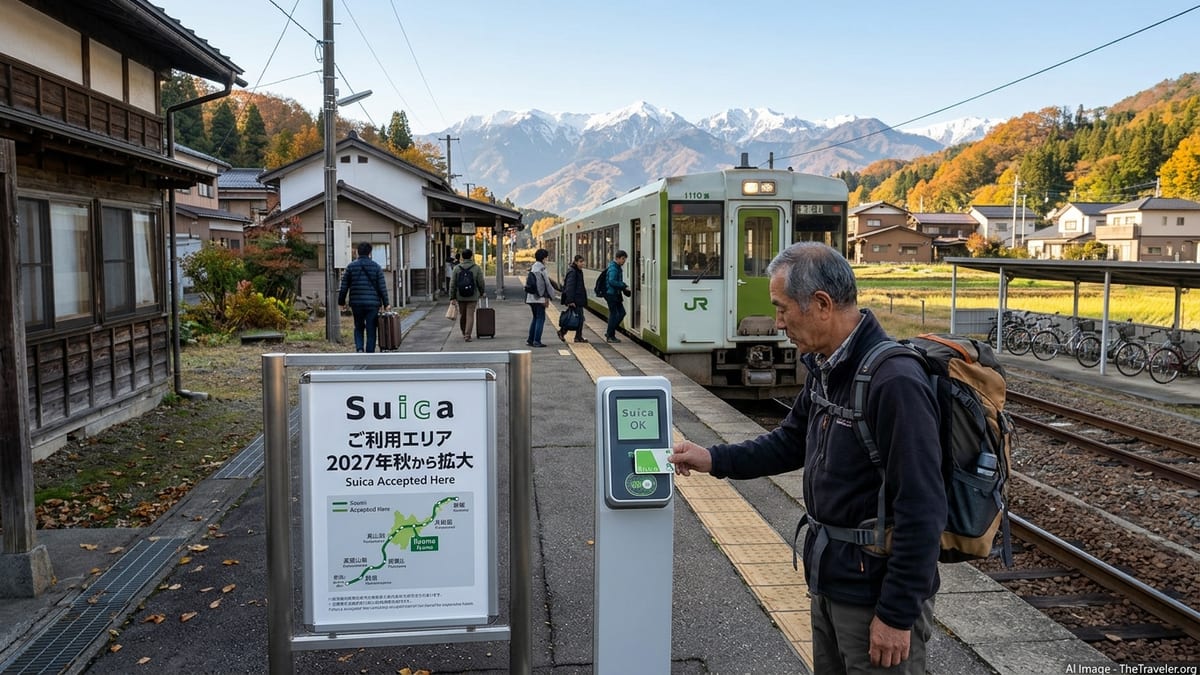
What JR East Has Announced for Nagano
In a 19 November 2026 press release, JR East’s Nagano division confirmed that Suica will become usable at 19 more stations in the prefecture, with service planned to start sometime from autumn 2027 onward. All of the new locations will be equipped with simple Suica gates, allowing passengers to tap in and out rather than buying paper tickets on site.
The expansion covers one station on the Chūō Main Line (Tatsuno), eleven on the Koumi Line (Otome, Mioka, Misato, Sakudaira, Iwamurada, Kita-Nakagomi, Nakagomi, Tatsuokajō, Usuda, Kaise and Koumi), four on the Ōito Line (Ariake, Azumi-Oiwake, Shinano-Matsukawa and Shinano-Tokiwa) and three on the Iiyama Line (Kami-Imai, Iiyama and Kita-Iiyama). JR East describes this as part of a broader program to expand Suica use across its regional network.
The company has not yet set an exact launch date and stresses that detailed information on start timing, valid sections and how to use Suica at these stations will be announced closer to the beginning of service. Until that formal start date, Suica cannot be used at the newly listed 19 stations for regular gate entry or exit.
How This Differs From the 2025 Suica Rollout
The newly announced plan follows an earlier Suica expansion in Nagano that took effect on 15 March 2025. On that date, Suica gate use began at 23 stations on the Shinonoi Line, Shin’etsu Main Line and Ōito Line, bringing the total number of Suica-enabled JR stations in the prefecture to 43 at that time.
The 2025 rollout mainly focused on corridors linking Nagano with nearby urban centers and key interchange points, while the 2027 phase pushes Suica deeper into rural and regional sections such as the mid sections of the Koumi and Iiyama lines and additional Ōito Line stops between Matsumoto and the northern resort areas. Travelers should note that the 2025 stations are already active for Suica, whereas the newly announced group will not be usable until the start date set for autumn 2027 or later.
Because the 2027 phase is a separate project, information and maps that reference the 2025 expansion alone will not yet show the 19 additional stations. When checking Suica coverage for trips in or after late 2027, travelers should look for updated JR East diagrams that explicitly include Tatsuno, the newly added Koumi Line stations, the four additional Ōito stops and the three Iiyama Line stations.
What the New Coverage Means for Travelers
For domestic travelers, Suica access at these 19 stations will reduce the need to buy individual paper tickets when moving around local areas of Nagano Prefecture. Once service begins, it should become easier to combine long-distance Shinkansen or limited express journeys with short regional hops using the same IC card at small intermediate stations.
International visitors who already use Suica or Welcome Suica in major cities will be able, after the 2027 start, to tap through stations that serve as gateways to smaller destinations. The expanded coverage will be particularly useful for stays around the Saku area on the Koumi Line, trips into and around Iiyama, and transfers along the Ōito Line toward resort areas used as gateways for destinations such as the Hakuba region via connecting services.
At the same time, the Suica expansion applies only to the named JR East stations on the four listed lines. It does not mean that Suica automatically works at every station in Nagano Prefecture or on non-JR operators such as Shinano Railway, nor does it change the rules for separate “regional IC” cards issued for buses or private rail. Travelers planning to rely on IC cards for a whole itinerary in the region should still confirm, line by line, where Suica will be accepted.
Unresolved Details and What to Check Before You Travel
JR East has not yet published the fare tables, exact Suica-valid sections, or the detailed interoperability rules for the 2027 Nagano expansion. It also has not specified how the new Suica coverage will interact with existing discount tickets or reservation products on the same lines. These points are expected to be clarified when the company issues a follow-up notice with the confirmed start date.
Before planning travel that relies on tapping in or out at these 19 stations, passengers should wait for JR East to announce the specific launch day, confirm that their origin and destination both fall inside the updated Suica area, and check any English-language guidance released through JR East’s official channels or Nagano-focused tourism information sites. Until those details are available, paper tickets remain the default for these stations.
Because the 2027 timeline is an announced plan rather than an in-service reality, travelers visiting Nagano from mid 2027 onward should recheck the latest information shortly before departure. Once JR East confirms the go-live date and publishes section maps in Japanese and English, it will become clearer how seamlessly Suica can be used for itineraries that combine Nagano city, the Saku area, Iiyama and the resort gateways along the Ōito Line.