


More news on this day
Regional flight data for 23 November 2026 show 323 cancellations and 3,186 delays across Asia and the Middle East, as ongoing security concerns and conflict-zone advisories over Saudi airspace continue to generate day-to-day disruption for travelers using hubs such as Jeddah’s King Abdulaziz International Airport, even though the airport itself remains open and operating.
Get the latest news straight to your inbox!
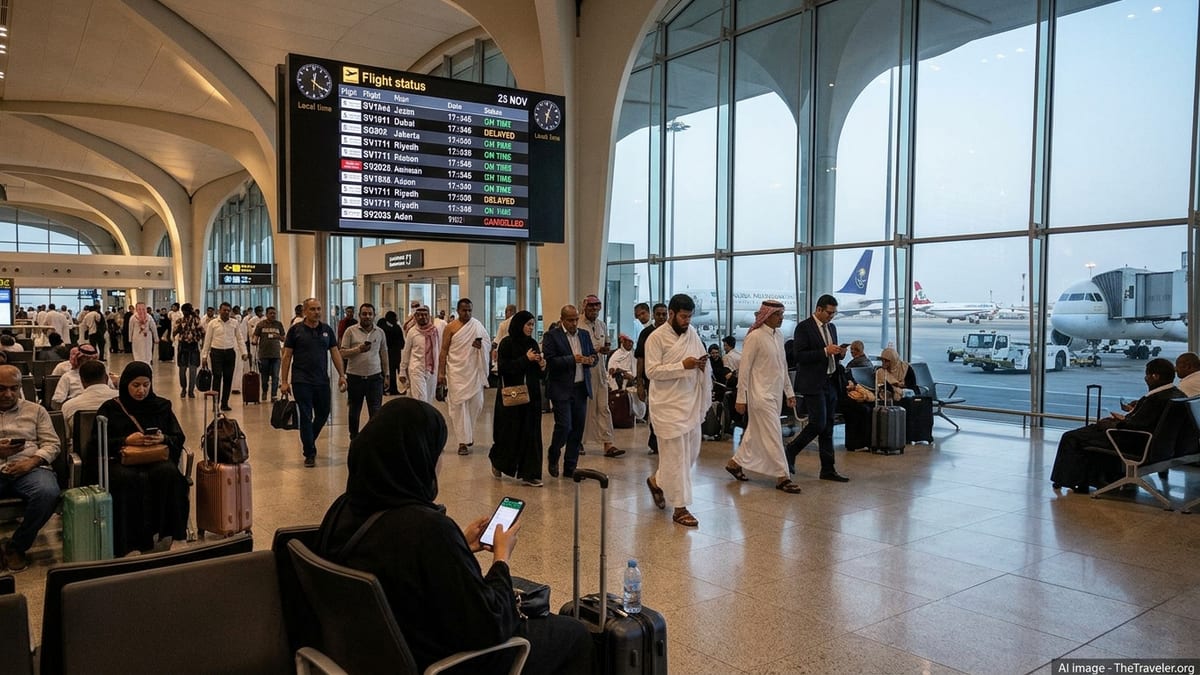
Jeddah Stays Open Amid Elevated but Manageable Disruption
Live airport boards on 23 November confirm that King Abdulaziz International Airport in Jeddah is operating, with more than 150 departures on the schedule and only a small number of same-day cancellations. One tracker logged two cancellations involving Jeddah for the day, while another showed the majority of listed flights running, some early and some late, rather than a full-scale shutdown. This indicates that Jeddah is functioning as a major regional hub despite elevated operational stress.
Delay patterns at Jeddah on Monday skew toward modest hold-ups rather than extreme disruptions. Real-time status boards through the evening local time show most services departing and arriving within typical ranges for a busy Middle Eastern hub, although individual flights to and from regional cities such as Jazan and Aden have experienced cancellations or significant delays. For passengers, the impact is more likely to involve missed connections and extended layovers than wholesale route closures at Jeddah itself.
The wider numbers, including the 323 cancellations and 3,186 delays recorded across Asia and the Middle East for 23 November, underline that Jeddah is part of a broader pattern. These figures cover multiple airports and routings, including services that only overfly Saudi airspace, rather than reflecting conditions at Jeddah alone. Travelers connecting between South and Southeast Asia, the Gulf and Europe are among those most exposed to knock-on schedule changes.
Conflict-Zone Bulletins and Airspace Warnings Over Saudi Arabia
Saudi airspace remains under close scrutiny from regulators and airlines following a series of missile and drone incidents in and around the kingdom in recent months. The European Union Aviation Safety Agency currently has an active Conflict Zone Information Bulletin covering the area formerly known as the Jeddah Flight Information Region, advising operators to avoid specified portions of Saudi airspace or to conduct enhanced risk assessments on routes that pass through those segments. The bulletin, updated in mid November, stresses that the operating environment can deteriorate rapidly and urges contingency planning for reroutes and diversions.
Saudi aeronautical information circulars issued this month confirm administrative changes that consolidate the country’s controlled airspace into a single Saudi FIR managed from Jeddah and Riyadh control centers, but these documents also make clear that airspace users must remain alert to security notices and tactical flow-control measures. Together with international bulletins, these official publications form the regulatory backdrop for the reroutings and schedule reductions that are now visible in day-to-day operations across the region.
Foreign-office travel advisories add another layer of caution. The United Kingdom’s Foreign, Commonwealth & Development Office, for example, continues to warn against travel to specific parts of Saudi Arabia and explicitly tells air travelers to check flight status and booking confirmations before heading to the airport, highlighting the possibility of short-notice disruption. Similar warnings from other governments do not tell travelers to avoid Jeddah or Riyadh airports altogether but do acknowledge an elevated level of security-related risk and operational uncertainty.
Airline Schedule Cuts, Suspensions and Rebooking Options
Airlines serving Saudi Arabia have responded with a mix of temporary suspensions, reduced frequencies and aircraft swaps on affected routes. Industry updates compiled in mid November show that some carriers have paused services to secondary Saudi cities such as Abha and Taif, while low-cost and regional operators have diverted certain flights to alternative airports like Qassim or Dammam, sometimes combining them with bus transfers to Riyadh. These adjustments reduce the volume of traffic crossing more sensitive parts of Saudi airspace but lengthen journeys for many passengers.
Capacity constraints are most visible out of Riyadh’s King Khalid International Airport, which was fully closed for a period in October following attacks and has since reopened under restrictions, with departures reported as cut sharply during the affected weeks. A recent earnings release from Saudi carrier flynas notes that operations from Riyadh only began to resume gradually after 25 October and that the airline’s outlook remains highly uncertain as schedule rebuilding continues. While Jeddah has not experienced similar closures, the strain on the national network means that flights through Jeddah can be affected by aircraft and crew imbalances created elsewhere.
Major international carriers have also adjusted their Saudi plans. Singapore Airlines, for example, has postponed the launch of its planned Riyadh service from late 2026 to March 2027, explicitly deferring new capacity into the market. Other airlines have filed schedule changes that trim frequencies to Saudi gateways over the northern winter while maintaining options for rebooking and refunds on cancelled services. Travelers holding tickets on affected routes are generally being offered no-fee date changes, re-routing via alternative Gulf hubs such as Doha, Dubai or Abu Dhabi, or refunds where flights are cancelled outright, though the exact terms vary by airline and fare class.
Impact on Pilgrims and Asia-Bound Transit Passengers
For many travelers, the most immediate effects of the current airspace and security environment are being felt in the form of longer, less predictable trips rather than outright inability to travel. Jeddah and Medina are primary gateways for Umrah pilgrims heading to Mecca year-round, and both rely heavily on feeder traffic from South Asia and Southeast Asia. When airlines reschedule or cancel flights into Saudi Arabia, these itineraries can involve multiple changes, with some passengers being reprotected via alternative routings that add hours and additional connections.
Live booking engines on 23 November still show one-stop options from major Asian cities such as Jakarta, Kuala Lumpur and Dhaka into Jeddah for travel over the next several weeks, but in some cases at higher fares or with tighter minimum connection times than earlier in the year. Travel-advisory services report instances where passengers originally booked on Riyadh or Abha flights have been shifted to fly into Dammam or Jeddah with ground transfers to their final destinations inside Saudi Arabia, particularly during peak demand periods around school holidays and religious observances.
Asia-bound travelers using Jeddah as a transit point also need to keep a close eye on changes. Because airlines are tweaking schedules in response to shifting security assessments and airspace bulletins, connection windows that looked comfortable at booking may shrink, and same-day reaccommodation options can be limited on busy days. Monitoring airline notifications, confirming visas for any alternative transit points and allowing additional buffer time for onward connections are prudent steps for anyone planning to route through Saudi Arabia in the coming weeks.
What Travelers Should Check Before Flying Through Jeddah
Prospective passengers should treat Jeddah and other Saudi gateways as operational but high-alert hubs. Before travel, it is advisable to confirm flight status with both the airline and a reputable flight-tracking or airport-board service on the day of departure, paying particular attention to any last-minute cancellations or retimed services on regional feeders. Travelers connecting from or to secondary Saudi cities should double-check whether their flights have been moved to alternative airports or substituted with coach transfers.
Given the active conflict-zone advisories, travelers should review the latest government travel advice for Saudi Arabia issued by their home country, especially if they plan to spend time outside the main urban centers. Travel insurance policies may contain exclusions where official advice warns against travel to particular regions, so confirming coverage in advance is important. Pilgrims and group travelers may benefit from booking through operators that provide dedicated disruption support, such as coordinated rebooking and ground-transport arrangements, rather than relying solely on individual tickets stitched together across multiple airlines.
Looking ahead, regulators and airlines are likely to keep adjusting risk assessments and schedules as the security situation evolves. No firm timeline has been set for a return to pre-disruption levels of airspace confidence, and further tweaks to frequencies and routings into Saudi Arabia are possible through the northern winter season. For now, travelers can still reach Jeddah and connect onward across Asia, but should build extra flexibility into their plans and be prepared for changes up to the day of departure.