


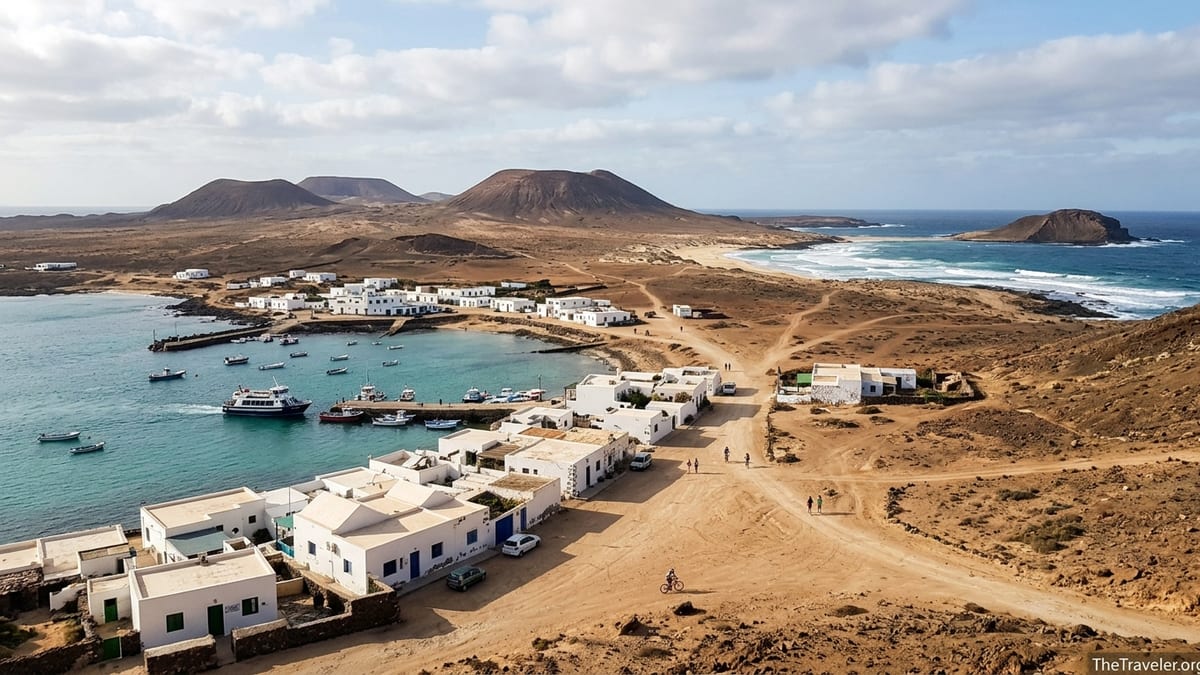
Just across the narrow Strait of El Río from Lanzarote, La Graciosa feels like another world. Sandy streets instead of asphalt, white cottages facing a turquoise sea and long empty beaches make this small island an appealing escape from the Canary Islands’ better known resorts. Using Lanzarote as a base, it is easy to visit for a day or stay longer to slow down to its quieter rhythm.
Get the latest updates straight to your inbox!
Quick facts and why La Graciosa is worth your time
La Graciosa is a small volcanic island in the Chinijo Archipelago, around 2 kilometres north of Lanzarote across the Strait of El Río. Officially recognised as the eighth inhabited Canary Island, it has a land area of roughly 29 square kilometres and a population of around 700 to 800 people, mostly in the main village of Caleta de Sebo. There is no airport and no conventional road network. Access is by passenger ferry only and the island remains largely car free apart from a limited number of authorised vehicles.
The island forms part of the Chinijo Archipelago Natural Park and the surrounding waters are protected as the La Graciosa and Islets of the North of Lanzarote Marine Reserve. This brings strict rules on driving, camping and environmental behaviour. Visitors are expected to stay on marked tracks, avoid lighting fires, respect dunes and vegetation and be especially careful not to disturb nesting birds or marine life. Free camping is not allowed and the only place where tents are permitted is the authorised campsite area at Bahía del Salado on El Salado beach, with advance permits required.
La Graciosa suits independent travellers who value space, silence and nature over facilities. Hikers, photographers, snorkellers and birdwatchers come for its wild beaches and low volcanic cones. Families with children often appreciate the calm, shallow waters of some bays close to Caleta de Sebo. Couples looking for simple apartments and low key evenings in a waterfront bar rather than full resort infrastructure will feel at home. Those who seek nightlife, shopping streets, big hotel pools or an extensive choice of restaurants are likely to be disappointed.
Despite its small size, La Graciosa can feel surprisingly busy in summer and on certain weekends, but it remains a place where it is still possible to walk for an hour and see almost nobody once you leave the village. The contrast with Lanzarote’s resort areas makes it an attractive addition to a broader Canary Islands trip, either as a long day excursion or as a two or three night nature retreat.
When to visit and how long to stay
La Graciosa shares the generally mild, dry and sunny climate of Lanzarote. Temperatures tend to be pleasant throughout the year, often ranging from the high teens to mid twenties Celsius, with relatively low rainfall. Trade winds can be strong though, especially in summer, and swell and currents on open beaches are often powerful. These conditions are part of the island’s character and an important reason why it is popular with experienced swimmers and water sports enthusiasts, but they also mean visitors should be cautious when entering the sea, especially on north and west facing beaches.
Passenger statistics and regional tourism reports indicate that visitor numbers peak from roughly June to early September, with another busy period around Easter and some long weekends. During these months ferries run a fuller timetable and same day trips from Lanzarote are simple to arrange, but popular apartments and the small campsite may book out far in advance. Spring and autumn are excellent seasons for hikers and cyclists, when temperatures are a little softer and the light can be beautiful, while winter months are quieter but still generally comfortable for walking, with cooler evenings.
Events can have a noticeable impact on accommodation availability. The classic open water swim known as “El Río” between Lanzarote and La Graciosa and the “Eighth Island” triathlon attract athletes and support crews, and official tourism advice has long noted that beds can sell out around these dates. Calendars for these events can shift from year to year, so it is wise to check the current year’s sporting schedule before fixing dates if your trip is flexible. Even if you are not competing, visiting during an event weekend can change the character of the island, with a livelier atmosphere and busier ferries.
For timing your stay, a well planned day trip is enough to get a first taste. You can explore Caleta de Sebo, walk or take a licensed 4×4 taxi or bicycle to one or two nearby beaches, and be back on Lanzarote by evening. To slow down and see more than a single bay, one or two nights are ideal. A stay of two to three days allows for a sunset at Playa de las Conchas, a half day hike to Montaña Amarilla or across the interior tracks, some unhurried snorkelling and time simply to enjoy village life without looking at the ferry timetable.
How to get from Lanzarote to La Graciosa
There is no airport on La Graciosa and no direct sea links from mainland Spain for foot passengers, so almost all visitors arrive via Lanzarote. Lanzarote’s César Manrique Airport lies on the east coast of the island. From there, you must travel overland to Órzola, the small harbour village at Lanzarote’s northern tip, and then continue by ferry to Caleta de Sebo on La Graciosa. The crossing typically takes around 25 minutes in normal sea conditions.
From the airport and main resorts such as Puerto del Carmen, Costa Teguise and Playa Blanca, the most flexible way to reach Órzola is by rental car. Driving times are roughly 35 to 45 minutes from the airport or Puerto del Carmen, a little less from Costa Teguise and close to an hour from Playa Blanca, depending on traffic. Paid parking is available close to the harbour, and many visitors leave their hire car in Órzola for the day or for the duration of their stay on La Graciosa, since conventional tourists are not allowed to bring vehicles across.
Public buses connect Lanzarote airport and resort areas with Arrecife and onward with the north of the island. Depending on schedule and day of the week, you may be able to ride a bus from Arrecife towards Órzola, usually with a change in a town such as Costa Teguise. Timetables can change and evening services are limited, so travellers relying on buses should consult the latest schedules from the island’s transport authority and allow generous connection time before their chosen ferry.
Taxi and organised shuttle services are the other main options. A taxi from the airport or Puerto del Carmen to Órzola is likely to cost on the order of several tens of euros one way, with higher fares from Playa Blanca. Some ferry operators and excursion agencies advertise hotel pick up packages from major resort areas, using coaches to bring day trippers to Órzola in time for a mid morning ferry and back on a late afternoon return. Prices and pick up zones vary, so it is worth comparing offers when you book your ferry ticket if you prefer not to rent a car.
Ferry operators, schedules and tickets
Two main companies currently operate regular ferries between Órzola and Caleta de Sebo. Their departures are interleaved to offer a combined timetable with multiple sailings through the day in both directions. Information compiled from operator websites and independent timetable summaries in late 2026 indicates that in summer there are usually first departures from Órzola in the mid morning, with some days offering an early sailing, and last returns from La Graciosa in the early evening. In winter, frequencies are somewhat reduced and the first and last crossings may fall inside a slightly narrower window of daylight hours.
Crossings typically take between 20 and 30 minutes depending on sea state. Most boats are open upper deck catamarans with indoor seating below. They are designed for foot passengers, although some services may allow bicycles on board if space permits. Tickets can be bought in person from the small ticket offices on the harbour at Órzola and at Caleta de Sebo or reserved online through company sites and booking platforms. At the time of writing, adult fares quoted by multiple sources are in the region of 29 euros for a standard return ticket, with single tickets priced in the mid teens. Canary Islands residents benefit from discounts regulated by regional and national rules, and these reductions are generally applied when collecting boarding passes at the port on presentation of valid documentation.
Families, groups and those combining ferry travel with additional excursions sometimes find package offers that include transport from Lanzarote resorts, a return ferry ticket and a simple guided walk or beach transfer on La Graciosa. While these can be convenient, independent travellers with some Spanish and a flexible schedule may prefer to buy ferry tickets directly and arrange their own time on the island. Regardless of how you book, checking departure times for both companies for your intended travel date ensures you have a realistic idea of the last safe return connection.
Weather and sea conditions can affect sailings. Strong north easterly winds and swell occasionally lead to delays or cancellations, especially in winter or during adverse forecasts. It is sensible to monitor marine weather updates a day or two before your trip and to avoid booking tight onward connections such as same day evening flights after a planned return from La Graciosa. For overnight stays, consider booking a morning or midday return crossing so that you have fallback options in case the first boat of the day does not run.
Getting around: sand tracks, bikes and evolving rules on vehicles
There are no paved roads on La Graciosa. The few tracks that cross the island and link Caleta de Sebo with outlying beaches and Pedro Barba are compacted sand and dirt. This lack of asphalt is one of the island’s defining images. It also means that movement is naturally slower and that most visitors travel either on foot, by bicycle or in one of a small number of licensed 4×4 taxis, which provide a service comparable to shared jeeps on request.
Walking is straightforward for anyone with basic fitness, but distances are longer than they may first appear. The popular route from Caleta de Sebo to Playa Francesa and round to Montaña Amarilla follows the coast for several kilometres each way, while the trail to Playa de las Conchas at the opposite end of the island involves a hotter and more exposed crossing of the interior. Official route brochures stress the importance of carrying sufficient water, sun protection and some food, and of respecting signposted paths to reduce erosion and disturbance in the protected natural park.
Bicycle rental is widely available in Caleta de Sebo, usually in the form of simple mountain bikes with or without child seats. Surfaces are sandy and in places quite soft, so riding can be tiring and is not suitable for narrow road bike tyres. For families with children or those not confident cycling in sand, walking or a combination of walking and using a 4×4 taxi for the furthest legs may be more comfortable. Helmets and locks are typically provided when you rent.
The presence and number of motorised excursions is the subject of active debate. Local authorities in Teguise municipality and the Cabildo of Lanzarote and La Graciosa began steps in 2026 to regularise transport on the island, provisionally limiting the number of authorised vehicles providing visitor services and considering further rules on where and how they may operate. Environmental organisations have called for the elimination of tourist excursions by motor, arguing that transport for visitors should prioritise guided walks and cycling. Because regulations are changing, anyone planning to rely on 4×4 tours should check the latest guidance close to their travel date and be prepared to adapt to a system that may increasingly favour non motorised access.
Main areas and beaches
Caleta de Sebo is the heart of La Graciosa. The small harbour is lined with low white houses, modest apartments, a few bars and restaurants, a church and basic services including small grocery shops and the island’s school. Sandy lanes radiate inland between one and two storey buildings. It is a pleasant place to wander for an hour, watching fishing boats, children playing in the streets and the views back across the water to Lanzarote’s Famara cliffs. The main village beach is convenient for a quick swim but most visitors head further afield for the island’s headline stretches of sand.
To the south of Caleta de Sebo lies El Salado, a low key beach backed by dunes and scrub, and the location of the authorised camping area at Bahía del Salado. Walking there from the village takes around ten minutes along the coast. Continuing along the shore and around a headland brings you to Playa Francesa, one of the most photographed bays on the island. Here turquoise water laps a wide arc of sand with views to Montaña Amarilla rising at the southern tip of La Graciosa. At low tide the sea is usually calm and suitable for swimming and snorkelling close inshore, though currents can still be strong further out.
On the northwest coast, Playa de las Conchas is a long, wild beach framed by the small island of Montaña Clara offshore and by volcanic cones inland. The sand is beautiful, but swimming is often dangerous or inadvisable due to strong breakers and powerful undertows. Official and destination information strongly emphasises caution and recommends enjoying the scenery from the shore. Reaching Las Conchas involves an exposed journey of several kilometres from Caleta de Sebo, either on foot, by bicycle or using a licensed 4×4 taxi to the closest drop off point.
Between these headline beaches and the northern settlement of Pedro Barba lie other smaller coves and stretches of sand, many with no services at all. In fact, none of La Graciosa’s main beaches have built facilities such as toilets, lifeguard stations, kiosks or rental stands on the sand. Visitors must bring everything they need, including water, snacks or picnic food, sun hats and high factor sunscreen, and their own snorkel gear if they wish to explore the shallows. Taking all rubbish back to the village for proper disposal is essential to protect the fragile coastal environment.
Things to do: hiking, snorkelling and slow days by the sea
Hiking is one of the easiest and most rewarding activities on La Graciosa. Several marked routes cross the island, climbing low volcanic hills or contouring around bays. Popular options include the walk from Caleta de Sebo to Playa Francesa and Montaña Amarilla, the track north to Playa de las Conchas and the loop incorporating parts of the interior. None of these paths are alpine in difficulty, but there is little shade and surfaces are rough and sandy, so sturdy footwear, a hat and plenty of water are important. Starting early in the day helps avoid walking in the strongest midday sun.
The protected marine reserve around La Graciosa offers good snorkelling close to shore in calm conditions, with clear water and a variety of fish species and underwater rock formations. There are no large snorkel rental operations on the beaches themselves, so bringing your own mask and fins from Lanzarote or renting in Caleta de Sebo is recommended if you intend to spend time in the water. Organised boat trips from Lanzarote and from La Graciosa sometimes combine ferry transport with swimming stops and simple lunches on board, but availability fluctuates with season and current regulations on marine excursions.
Cycling can turn beach hopping into a full day of exploration. Confident riders can pedal from Caleta de Sebo to Las Conchas or to Pedro Barba, stopping at viewpoints and less visited coves along the way. The mix of sand and hard pack means progress can be slow, so allowing extra time and being realistic about distances is wise, especially with children. Wind can be a significant factor, turning one direction into an easy roll and the return into a grind.
For many travellers, the greatest appeal of La Graciosa lies in doing very little. Reading on a terrace, strolling the harbour at sunset, watching the light change over Lanzarote’s cliffs and lingering over simple seafood dinners can be just as memorable as longer excursions. The absence of big attractions, shopping centres or nightlife shifts the focus towards quiet connection with place and landscape. Bringing a book, a sketchpad or a camera may be as important as packing hiking shoes.
Accommodation basics and village life
Accommodation on La Graciosa is limited and low key. There are no large purpose built resorts or tower hotels. Instead, most visitors stay in small apartment blocks and guesthouses in Caleta de Sebo, with a smaller number of holiday homes and seasonal residences in Pedro Barba on the north coast. Properties are usually simple but comfortable, often with kitchenettes, terraces or small balconies and decor that ranges from basic to pleasantly coastal. Because the island’s water and energy resources are finite, travellers should not expect the same range of services as in Lanzarote’s big resorts.
Prices vary with season, property size and level of finish. In general, nightly rates are noticeably higher in July and August, during Easter and around major sporting events. Well ahead booking for these peaks is advisable, especially for families or groups who need more than one bedroom. Outside the main summer period, there is usually more flexibility, although weekends can still be busy. When researching options, it is best to use accommodation platforms and local agency sites to get an up to date sense of what is available and typical price bands, then book once you are sure of your ferry timings.
Village services cover basic needs but are limited in scale. Caleta de Sebo has small supermarkets for groceries, a bakery and a handful of bars and restaurants, many of which serve fresh fish, tapas and simple Canarian dishes. Opening hours can feel irregular compared with urban areas and some places close outside peak season or on certain days of the week. Card payments are widely accepted in better established businesses but carrying some cash is sensible for smaller shops, bike rentals or informal cafes. There is no petrol station on La Graciosa and no large medical facility, only basic local healthcare services, so serious conditions require transfer back to Lanzarote.
The official campsite area at El Salado is very simple, consisting mainly of pitches and basic sanitary facilities. Advance permission is required through the relevant national parks booking system, and numbers are capped. There are no on site shops, so campers must walk back to the village for supplies and abide by strict rules on fires, waste and noise. Outside this designated zone, overnight camping with tents, campervans or similar is not permitted anywhere on the island, reflecting its status as a protected natural space.
Costs, practical tips and how La Graciosa fits your itinerary
Overall daily costs on La Graciosa can be comparable to or slightly higher than on Lanzarote, largely because nearly everything has to be transported from the larger island and visitor numbers are limited. The main predictable expenses are the ferry tickets, your chosen style of accommodation, one or two meals a day in local restaurants if you do not self cater, and any extras such as bicycle rental or a 4×4 taxi to distant beaches. Packing refillable water bottles, sun protection and simple picnic gear from Lanzarote can reduce small purchases and help minimise waste.
In practical terms, the most important preparation is checking weather, sea and wind forecasts before you travel. Strong winds can make beach days uncomfortable and may lead to rough crossings. If you are especially sensitive to motion sickness, carrying appropriate medication and choosing a seat on the lower deck and towards the stern of the ferry can help. On land, light clothing, a hat, sunglasses and footwear that copes with sand and rough track surfaces are essential, as is respecting signage that restricts vehicles from certain areas.
La Graciosa can slot into a Canary Islands trip in several ways. As a day trip from Lanzarote, it provides a refreshing change of pace, ideal for travellers who want a glimpse of wilder Atlantic landscapes without changing their base. As an overnight or two or three night add on, it becomes a gentle retreat for walkers, photographers and couples looking to disconnect from busier resort rhythms. For some, it is even attractive as a primary base for a week focused on hiking, snorkelling and reading, with only occasional forays back to Lanzarote for supplies or onward travel.
Ultimately, deciding whether and when to include La Graciosa depends on your priorities. If you enjoy independent exploration, are comfortable with simple infrastructure and value natural quiet, the island rewards the effort of reaching it. If you prefer all inclusive arrangements, evening entertainment and a wide choice of restaurants on your doorstep, you may be happier visiting as a short excursion rather than committing several nights. Used thoughtfully within an itinerary, La Graciosa can become a highlight, encapsulating a slower, more elemental side of the Canary Islands.