


Landing at Manila’s Ninoy Aquino International Airport and heading straight to Pasay or the Mall of Asia area is one of the easiest short transfers in Metro Manila, but only if you know how the local taxis, Grab cars, traffic and hotel zones work. This guide walks you through the real options, what they cost, where to find them, and how to avoid common airport hassles while managing luggage after a long flight.
Get the latest updates straight to your inbox!
Understanding the Route: NAIA to Pasay and Mall of Asia
Ninoy Aquino International Airport (NAIA) sits right next to Pasay and Parañaque, which makes journeys to Pasay hotels and the SM Mall of Asia (MOA) area among the shortest airport runs in Metro Manila. Depending on your terminal and traffic, the drive is typically 15 to 35 minutes for the roughly 5 to 8 kilometer trip to the MOA complex or nearby bayfront hotels.
Most transfers follow a similar pattern: you leave NAIA via the airport access roads, join either Roxas Boulevard, Macapagal Boulevard or the NAIA Expressway, then drop into the Bay City and MOA area. If you are staying in a hotel along Roxas Boulevard or in inner Pasay, you may exit earlier, but the difference in driving time is rarely more than 10 to 15 minutes outside peak hours.
What surprises many first-time visitors is not the distance, but how traffic patterns can change the feel of the journey. On a late evening arrival, a GrabCar or yellow taxi can cover NAIA Terminal 3 to Mall of Asia in as little as 15 minutes. Yet the same route around 5:30 pm can stretch to 40 minutes or more, especially near the MOA complex and convention centers where office workers, shoppers and event crowds converge.
The good news is that, unlike longer transfers into Makati or Quezon City, you very rarely need to worry about complicated combinations of trains or buses. For most travelers, especially with luggage, the best options are straightforward: airport taxis, Grab ride hailing, or prebooked private pickup, all of which are easy to use from any NAIA terminal.
Airport Taxis: Yellow and Coupon Cabs Explained
NAIA officially supports two main types of airport taxis that you will see immediately on arrival: yellow metered taxis and white coupon taxis. Both operate from signed taxi lanes just outside the arrivals halls and are regulated by the Manila International Airport Authority, making them significantly safer than accepting offers from freelance drivers or touts near the doors.
Yellow taxis are metered airport cabs, easy to spot by their bright yellow color and official markings. They carry an airport surcharge on top of the regular meter, so the starting flag-down rate is higher than a standard city taxi. In practice, a ride from NAIA to the Mall of Asia area usually comes out somewhere around 250 to 400 pesos in normal traffic, including the airport surcharge and any short toll segment if the driver uses the expressway. In light traffic late at night, the fare can be closer to the lower end of that range.
Coupon taxis are white airport-authorized cars that operate on a fixed-rate system. Inside the terminal at the coupon taxi counter, you state your destination, and the staff prints a coupon with a set price for that zone. For a Pasay or MOA drop-off, the fare will typically be higher than a yellow taxi covering the same distance, but the certainty appeals to travelers who want a guaranteed price before they get in. For example, a couple arriving for a weekend at a MOA bayfront hotel may see a coupon fare in the 400 to 600 pesos range, depending on the current zone tables, which can be worth it after a long-haul flight.
Both taxi types are generally reliable, though experiences can vary, and there are occasional complaints about drivers trying to negotiate flat rates instead of using the meter. As a rule, if you choose a yellow taxi, make sure the meter is turned on as soon as you depart, and if you take a coupon taxi, keep your coupon slip until you reach your hotel. In either case, ignore anyone who approaches you inside the terminal and leads you away from the signed taxi lines, as these are usually unregulated operators offering inflated prices.
Using Grab: App-Based Rides from the Airport
Grab is the dominant ride-hailing app in Manila and the most popular choice for many locals traveling between NAIA and Pasay or the MOA complex. If you already use ride-hailing in other countries, the experience is familiar: you open the app, pin your pickup terminal, set your destination (for example, “SM Mall of Asia” or “Conrad Manila”), and see an upfront price estimate before you confirm.
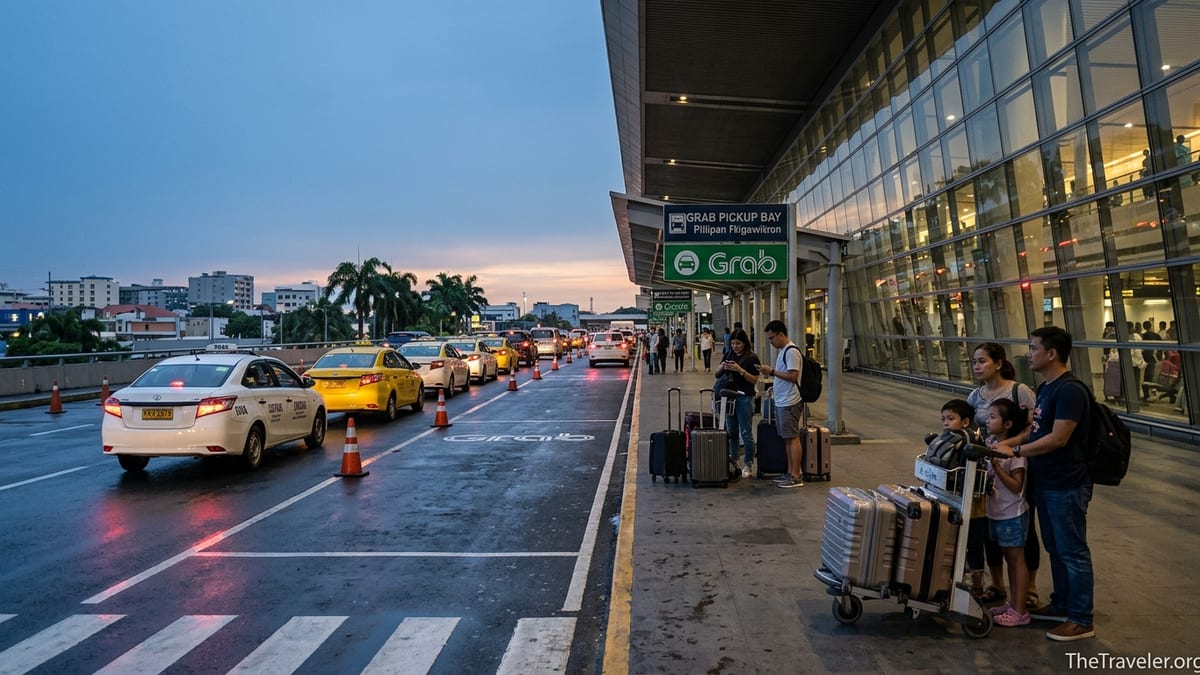
Each NAIA terminal has designated Grab pickup points or booths, shown on signage in the arrivals area. At Terminal 3, for instance, you follow signs to the transport bays outside arrivals, where a Grab kiosk can assist with bookings if you do not have mobile data yet. Staff can help you request a GrabCar using a booking code, then match you with the arriving driver at a marked bay. This avoids wandering across busy lanes searching for your car.
For a standard GrabCar from NAIA to MOA, typical base prices are often in the 250 to 400 peso range in light to moderate traffic, broadly similar to a yellow taxi. During rush hour or heavy rain, surge pricing can lift that to the 400 to 600 peso bracket. A late-night arrival at Terminal 1, going to a Pasay hotel behind Mall of Asia, might cost around 300 pesos and take 20 minutes, while a mid-afternoon departure from MOA back to Terminal 3 on a busy Saturday could be closer to 450 pesos and 35 minutes.
Grab offers larger vehicle types such as GrabCar 6-seater, which is useful if you are a family or small group with several suitcases. For example, four travelers landing with five checked bags might choose a 6-seater at a fare perhaps 30 to 50 percent higher than the base car type. Payment methods include local bank cards, some international cards, and popular e-wallets. If you do not wish to link a card, many visitors simply set cash as the payment method and pay the driver directly in pesos.
Private Pickups, Hotel Transfers and Chauffeur Cars
For travelers who want to walk out of the terminal and go straight to a waiting driver holding a signboard, private airport transfers remain a strong option. Numerous Manila car services and tour operators offer prebooked transfers to Pasay or the Mall of Asia area, using sedans, vans or SUVs depending on your group size. Prices are higher than taxis but predictable and fixed in advance, and vehicles are often newer.
As a reference point, a prebooked sedan transfer from NAIA to a hotel beside SM Mall of Asia might cost in the region of 900 to 1,500 pesos per car, depending on vehicle type and provider. A van for five or six passengers with luggage could be around 1,500 to 2,000 pesos. This means a solo traveler will pay more than taking a taxi, but a family of four with large suitcases may find the per-person cost reasonable for the convenience.
Many mid-range and upscale hotels in Pasay and the Bay City corridor offer their own airport transfer services, either via private sedans or shared shuttles. For instance, a bayfront hotel beside the SMX Convention Center may quote around 1,500 pesos one-way for a hotel car pickup, billed to your room. Some more budget-friendly apartments slightly inland from MOA area partner with third-party van services that can be arranged via reception. These options are particularly useful for late-night arrivals, conference travelers heading directly to SMX, or visitors carrying bulky items who want guaranteed vehicle space.
Chauffeur cars can be booked not only as one-way transfers but also as hourly rentals, which appeals to business travelers who need to move between NAIA, MOA, and office zones in Makati or Bonifacio Global City on the same day. An hourly car might cost the equivalent of several taxi rides, but it simplifies logistics when you are in town for a short event at the MOA Arena or an expo at SMX and cannot risk struggling for a car in heavy rain.
Traffic Patterns, Timings and Expressway Choices
Although Pasay and the MOA complex are geographically close to NAIA, Manila’s traffic still matters. Travel time can range from a fast 15 minutes late at night to more than 45 minutes at peak times. Knowing when congestion peaks and how drivers choose between local roads and the NAIA Expressway can help you set realistic expectations.
Morning rush hour typically builds from around 7:00 am to 9:00 am on weekdays, affecting access roads around NAIA and the main arterials leading into Makati and Manila. For a simple NAIA to MOA trip, this may add 10 to 20 minutes as you approach Pasay and the Bay City area. Evening rush hour, from roughly 4:30 pm to 7:30 pm, can be more intense, especially on Fridays and on days when large concerts or sports events take place at the MOA Arena. In those cases, the final kilometer or two near the mall and convention centers can crawl.
Many taxis and Grab drivers use the NAIA Expressway (NAIAX) to link the airport to the roads that feed into the MOA district. The tolls are modest, usually less than the cost of a coffee, but they are not always automatically included in quoted ride-hailing prices or taxi estimates. With Grab, tolls may appear as a separate line item on your receipt, or the driver might ask you to reimburse the amount in cash at the end of the ride if it was not integrated into the fare.
Realistically, first-time visitors should plan on around 30 to 45 minutes from landing to clearing immigration and baggage, then 20 to 30 minutes in the car to reach most Pasay or MOA hotels when arriving in daytime. On a midnight arrival with minimal queues and clear roads, that door-to-door time can shrink considerably. On the other hand, during a rainy Friday evening with an event at the arena, it is wise to allow a full hour from airport curbside to hotel check-in.
If you are heading directly to a timed activity, such as a conference session at SMX or a show at the MOA Arena, avoid counting on the fastest possible transfer. Instead, give yourself at least an extra 30 minutes as a buffer, especially in the late afternoon and early evening.
Where to Stay: Key Hotel Zones in Pasay and MOA
Choosing a hotel close to your onward activities can make the short airport transfer even simpler. The broader Pasay and Mall of Asia area can be loosely divided into three practical zones for arriving passengers: inner Pasay near major roads like EDSA and Taft Avenue, the Bay City and MOA complex itself, and the Roxas Boulevard waterfront strip that curves north toward Manila.
Inner Pasay includes numerous budget to mid-range hotels and guesthouses along EDSA and side streets, often popular with overnight transit passengers or travelers catching early domestic flights. From NAIA, standard taxis and Grab cars can reach these areas in 20 to 30 minutes, and fares are usually slightly below those for the MOA waterfront, since the distance is a little shorter. These neighborhoods can be busy and less polished, but they are practical if cost is a priority.
The MOA and Bay City zone, built around SM Mall of Asia, SMX Convention Center and the MOA Arena, caters heavily to events, shopping and family trips. Here you will find large hotels attached to or within walking distance of the mall, plus serviced apartments tucked on quieter side streets behind the complexes. For visitors attending trade shows at SMX or concerts at the arena, being able to walk instead of battling traffic at peak times more than compensates for slightly higher room rates.
Further along the waterfront, the Roxas Boulevard area offers a mix of resort-style properties and older city hotels, many facing Manila Bay. From NAIA, the ride to the southern end of Roxas Boulevard near Pasay is only slightly longer than to MOA. This makes it feasible to stay in a bayfront resort with a pool and still reach the airport in under 30 minutes door to door during off-peak periods, an appealing combination for travelers who want one or two days of rest at the beginning or end of their trip.
Managing Luggage and Group Size on Short Transfers
The amount of luggage you are carrying and how many people are in your group can shape the best transfer choice from NAIA to Pasay or MOA. A solo traveler or couple with one suitcase each can comfortably use any of the available options, including yellow taxis, GrabCar sedans or even city buses if they are packing very light and are familiar with the area.
For families or groups of three to five people, especially with multiple checked bags, a larger vehicle can remove a great deal of stress. Booking a GrabCar 6-seater, a private van transfer, or a hotel-arranged minivan ensures you have enough space for both passengers and luggage without needing to stack bags on laps. This is particularly relevant for trips involving children, long-haul flights, or bulky equipment for events at SMX or the MOA Arena.
If you opt for a regular taxi with several suitcases, keep in mind that Manila’s sedans are often compact. Two large suitcases and two carry-ons usually fit in the trunk and footwells of a typical yellow taxi, but adding a third large bag can become awkward. When in doubt, split the group into two taxis, especially if fares are low for the short distance. For example, two yellow taxis at around 250 to 300 pesos each can still be good value for a group of four compared with squeezing everyone and everything into a single overloaded car.
Inside NAIA terminals, luggage trolleys are generally available up to the curb, and porters can help if you are handling several bags. When using app-based rides or private pickups, confirm in the booking notes how many passengers and pieces of luggage you have. This helps drivers arrive in an appropriately sized vehicle, avoiding last-minute reshuffling at the curbside.
Is It Easy After Landing? Step-by-Step Arrival Experience
For most travelers, getting from NAIA to Pasay or the Mall of Asia is one of the simplest arrival experiences in the Philippines, provided you ignore touts and follow signs. After landing, you pass through immigration and baggage claim, and then customs. Immediately beyond the customs exit in each terminal, you will find ATMs, currency exchange counters, local SIM card sellers, and then doors leading out to the public arrival area and transport bays.
Once you exit, look for overhead signs indicating “Taxi,” “Grab,” or “Transport” rather than following individuals who approach you to offer rides. At Terminal 3, for example, there is a well-marked taxi lane outside arrivals where yellow metered taxis queue in an organized line. Nearby, you will see the coupon taxi counter and the Grab booth. Staff in these areas typically wear airport or company uniforms and can answer destination questions such as “Pasay hotel near Mall of Asia.”
All you need to tell them is your hotel name or “SM Mall of Asia” if you are going to the mall complex. If you choose a yellow taxi, an attendant will usually assign you to the next cab in line. If you prefer a coupon taxi, you pay at the counter and receive your coupon slip before boarding. For Grab, you either use your own app or ask the booth staff to help create a booking and direct you to the correct pickup bay, where the driver’s license plate is displayed in the app.
Overall, the process is straightforward even for first-time visitors who arrive late at night. The most common mistakes are accepting rides from unmarked vehicles, not confirming that the taxi meter is running, or leaving the terminal area with someone posing as an “assistant.” As long as you stay within the official transport zones and ask airport staff if in doubt, reaching Pasay or MOA is usually smooth and takes significantly less time and complexity than many other Asian megacity airports.
The Takeaway
Travelers flying into Manila and heading to Pasay or the Mall of Asia area benefit from one of the city’s shortest and most convenient airport transfers. With only a few kilometers separating NAIA from the Bay City and Roxas Boulevard zones, you have multiple easy options that balance cost, comfort and predictability.
Yellow metered taxis and GrabCar rides are often the best value for most visitors, delivering door-to-door service to MOA hotels and Pasay streets for a moderate fare, even when airport surcharges and expressway tolls are included. Coupon taxis and hotel-arranged cars add price certainty and meet-and-greet service, which can be worth the premium if you are arriving late, unfamiliar with the city, or carrying a lot of luggage.
Traffic and event schedules around MOA are the main variables, so building in an extra cushion of time, especially in late afternoon and on weekends, is wise. Once you understand how to find official taxi lines, Grab pickup points and private drivers inside the terminal, the short hop from NAIA to Pasay or MOA is generally easy, allowing you to start your Manila stay with minimal stress.
FAQ
Q1. How long does it usually take to get from NAIA to Mall of Asia?
In light to moderate traffic, the drive from any NAIA terminal to the Mall of Asia area typically takes around 20 to 30 minutes, though it can be as quick as 15 minutes late at night or up to 45 minutes during rush hour or big events.
Q2. How much should I expect to pay for a taxi from NAIA to Pasay or MOA?
For yellow metered taxis or GrabCar, expect a fare generally in the range of about 250 to 400 pesos, depending on traffic and route. Coupon taxis and hotel cars may cost more, often around 400 to 600 pesos or higher for premium services.
Q3. Is Grab cheaper than airport taxis for this route?
GrabCar fares for NAIA to MOA or Pasay are usually similar to or slightly cheaper than yellow airport taxis in normal conditions, but prices can surge during peak demand. Coupon taxis and hotel transfers usually cost more than either option in exchange for fixed pricing and added convenience.
Q4. Are the taxis at Manila airport safe to use?
Official yellow airport taxis and white coupon taxis operating from the signed taxi lanes are generally considered safe and regulated. To reduce the risk of overcharging, avoid unmarked cars, insist on using the meter in yellow taxis, and keep your coupon slip if you choose a fixed-rate taxi.
Q5. Should I book a private transfer in advance?
Prebooked private transfers are a good idea if you arrive late at night, are traveling with a large group or many bags, or simply prefer a driver meeting you at arrivals. For solo travelers arriving at typical hours, taxis and Grab are usually sufficient and easier on the budget.
Q6. Is it easy to find the Grab pickup point at NAIA?
Yes. Each terminal has signs directing you to the Grab pickup area or booth in the arrivals transport zone. If you are unsure, you can ask uniformed airport staff to point you toward the Grab bay instead of following unofficial touts.
Q7. Can I use public transport from NAIA to Mall of Asia?
There are buses and jeepneys that locals use between the airport area and Pasay, but they can be crowded and awkward with luggage. For most visitors heading to MOA or nearby hotels, taxis, Grab or private cars are simpler and still relatively affordable.
Q8. What is the best option if I have a lot of luggage or bulky items?
If you have several large suitcases or bulky equipment, choose a larger vehicle such as a GrabCar 6-seater, private van transfer or hotel-arranged minivan. This ensures enough space without forcing passengers to hold bags on their laps.
Q9. Do I need cash, or can I pay by card for the transfer?
Airport taxis usually require cash in pesos, while Grab supports card and e-wallet payments as well as cash, depending on your account settings. Private transfers and hotel cars often accept cards, but it is wise to confirm payment options when booking.
Q10. How early should I leave MOA or Pasay for a return flight from NAIA?
For international flights, plan to leave MOA or Pasay about two and a half to three hours before departure, adding extra time during rush hour or bad weather. For domestic flights, leaving roughly two hours before departure is usually sufficient, with a small buffer for traffic.