


Landing in Manila can feel overwhelming, especially after a long-haul flight. The humidity hits you, the arrivals hall is busy, and a dozen people seem eager to “help” with your ride into the city. At Ninoy Aquino International Airport (NAIA), choosing the right taxi can mean the difference between a smooth 30-minute trip to Makati and an expensive, stressful start to your stay. This practical guide explains the main taxi options at NAIA, what you should roughly pay, red flags to watch for, and when a regular taxi is actually better than booking Grab.
Get the latest updates straight to your inbox!
Understanding NAIA’s Terminals and Where Taxis Wait
NAIA has four terminals that sit a few kilometers apart: Terminal 1 and 3 handle most international flights, Terminal 2 is heavily used by Philippine Airlines and some regional carriers, and Terminal 4 is a small domestic terminal. All have taxi options directly outside arrivals, but the layout and crowd level differ. Terminal 3 is the largest and usually has the longest, most organised taxi lines, while Terminal 4 can feel more chaotic and cramped.
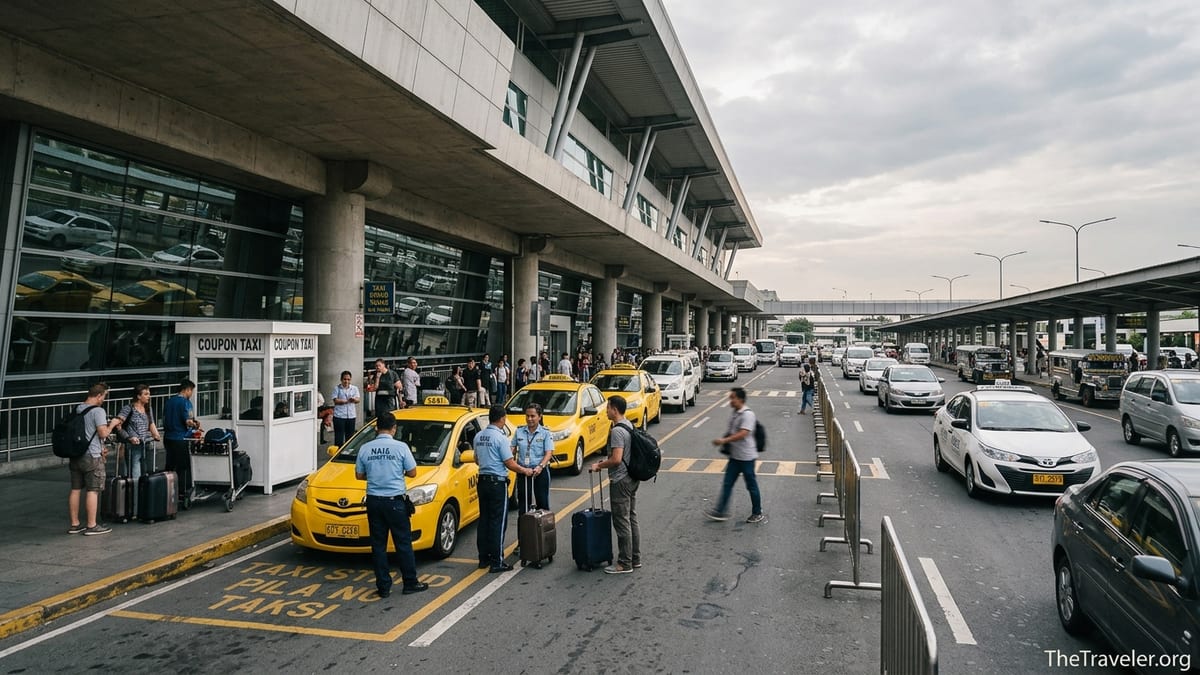
Once you exit customs and baggage claim, you will typically pass a small row of counters and currency exchange booths before pushing through sliding doors to the arrivals curbside. Here, you usually find three main taxi options: fixed-fare coupon taxis at a small booth, yellow airport metered taxis at a signed bay, and regular white metered taxis a little farther along or on a separate lane. Official signs overhead mark “Airport Taxi,” “Coupon Taxi,” and sometimes “Metered Taxi,” although the exact wording and bay numbers can change over time.
For example, at Terminal 3, arriving passengers step out to a broad, covered curbside where yellow taxis usually queue in a clearly marked lane with airport security visible nearby. Coupon taxi counters tend to be just outside the exit doors, staffed by uniformed personnel issuing printed coupons. Regular white metered taxis may line up in a separate area or be directed by guards further down the curb. Understanding this basic geography before you land makes it easier to walk purposefully past unsolicited touts and go straight to the option you want.
Inter-terminal transfers at NAIA are possible by free shuttle, but some travellers still end up using taxis even for short hops like Terminal 3 to Terminal 4. In these cases, a legitimate metered taxi should charge only a small amount, often under 200 pesos, depending on traffic. If you are quoted 1,000 pesos or more for a simple terminal transfer, that is a clear sign to walk away.
Coupon Taxis: Fixed Fares and When They Make Sense
Coupon taxis at NAIA operate on fixed, published rates based on your destination area. You go to the coupon counter, tell the staff where you are going, and they print or write a coupon that shows the total fare. You pay the driver at the end of the ride, but in most cases no additional charges should be added beyond the small official airport surcharge already baked into the rate. Vehicles are usually older vans or larger sedans, often with Department of Transportation markings on the side.
As of 2026, typical coupon fares from NAIA to central Metro Manila tend to be higher than what a metered taxi would cost in light traffic, but not outrageously so when the system is working properly. For example, travellers regularly report coupon quotes in the rough range of 800 to 1,200 pesos to Makati or Bonifacio Global City, depending on vehicle size and exact drop-off. By comparison, a regular metered taxi under good conditions might land closer to 300 to 500 pesos for the same trip, while heavy rush-hour traffic or toll roads can push metered fares higher.
The big advantage of coupon taxis is predictability. If you have just landed with family, multiple suitcases and perhaps young children, knowing the exact price and not worrying about the meter or small detours can be worth the premium. Many travellers arriving late at night choose coupon taxis from Terminal 1 or 3 because the counter is easy to find, the fare is fixed, and there is little risk of being pressured into “special deals.” A common real-world scenario is a couple landing at midnight from Europe who accept a coupon taxi at around 1,000 pesos to Makati, reasoning that a 10 to 15 USD equivalent for a stress-free ride at that hour is acceptable.
However, coupon taxis have also been involved in overpricing incidents when bogus or unaccredited operators mimic the official setup. One common pattern involves a laminated “rate card” listing absurdly high prices, sometimes several thousand pesos even for short city rides. If a staff member or driver tries to rush you into accepting such a card without going through a clearly signed booth that issues an actual coupon, treat it as a red flag and step away. Always insist on getting an official coupon from a proper desk, not from someone approaching you in the crowd.
Yellow Airport Metered Taxis: Official but Pricier Meter
Yellow taxis are NAIA’s official airport taxi fleet and run on a regulated but higher meter tariff than regular city cabs. The idea is that these taxis are licensed specifically for airport work, monitored more closely, and allowed to queue inside the airport compound. Recent official guidance places their flagdown at about 70 pesos, with the meter increasing in small increments of a few pesos for every few hundred meters or minutes in traffic, so a typical 10 to 15 kilometer ride into the city may cost in the region of 400 to 700 pesos, depending on traffic and tolls.
In practice, a solo traveller landing at Terminal 3 around midday and heading to Makati or Pasay often finds that a yellow taxi ride takes 25 to 45 minutes and costs somewhere around 450 to 650 pesos. The driver should switch on the meter the moment you depart the curb. There may be small extras like tolls if you agree to use the elevated expressway to bypass gridlock, but these are modest and you can ask to see the toll receipt.
Yellow taxis are usually easier to spot and regulate than regular cabs, with clear airport branding and numbers painted on the doors. For first-time visitors, they often strike a good balance between safety and cost, especially when you are tired and do not want to spend time comparing Grab prices vs taxi meters. Most scams involving yellow taxis are subtler, such as taking a slightly longer route or quietly not returning small change, rather than the extreme fixed “package” prices that unlicensed operators sometimes quote.
There have been occasional reports of yellow taxi drivers attempting to negotiate a fixed, off-meter price, especially at busy times or on late-night arrivals. If a yellow taxi driver refuses to use the meter and instead offers something like “1,500 pesos to Makati, no meter,” you should politely decline and step out. You can then join the official line again or choose a different option. Legitimate yellow taxis should always agree to run on the meter.
Regular White Metered Taxis: Cheapest but Higher Scam Risk
Regular white metered taxis are the same city cabs you will see all over Metro Manila. At NAIA they often wait in a separate line from the yellow cabs and usually run on the standard urban tariff, which starts around 40 pesos on the meter with smaller per-kilometer increments than the yellow taxis. When used honestly, these taxis are usually the cheapest way to get from NAIA to most city destinations, particularly outside peak hours.
For example, a daytime ride from Terminal 3 to Makati with light traffic might cost around 250 to 350 pesos on a regular metered taxi. A trip to Quezon City or Ortigas in moderate traffic might be in the 350 to 600 peso range. These are ballpark figures, not guarantees, and can rise significantly with severe congestion, but they give you a sense of what a reasonable fare looks like. If a driver at the taxi line quotes you something like 1,500 pesos flat to Makati before you even get in, that is wildly above usual metered expectations and you should walk away.
The trade-off is that scams are more frequently reported with regular white taxis at NAIA. A familiar pattern involves a driver insisting that the meter is “broken,” or claiming there is a special “airport rate” that justifies three or four times the normal fare. There have also been cases where a driver uses the meter for part of the trip, then switches it off and demands an inflated lump sum at your hotel, banking on you being too tired to argue. Another tactic is to take unnecessarily long routes through side streets instead of the straightforward expressway, quietly inflating the metered fare.
To protect yourself, always insist that the meter is used from the start. If the driver resists or says the meter is broken, calmly say you will take another taxi and step out. Keep an eye on the meter during the ride; if the numbers jump unusually fast compared to traffic progress, it may have been tampered with. It is also wise to have a rough idea of the normal fare from checking Grab or asking your hotel beforehand. If you arrive at your destination and the driver suddenly asks for several thousand pesos for a typical city ride, pay only what is reasonable, take note of the plate number and company name, and ask hotel staff to assist if needed.
Many local residents still use regular metered taxis from NAIA without issues, particularly during the day, but they do so with clear expectations and a willingness to walk away from any driver behaving suspiciously. As a visitor, you can adopt the same mindset: if something feels off, you are not obliged to stay in that taxi.
Official Taxi Stands, Grab Zones and How to Spot Touts
Every terminal at NAIA has officially designated taxi stands and, increasingly, dedicated zones for ride-hailing services such as Grab. These stands usually have overhead signs, painted bays and sometimes uniformed marshals or airport security managing the queue. The clearer and more structured the setup looks, the more likely you are in the right place. If you find yourself standing behind a random car in the middle of the road with no signage and no queue, you have probably wandered into the territory of soliciting drivers rather than the official line.
Grab has specific pickup zones marked at the terminals, often with simple signage indicating the bay number where app bookings should meet their drivers. At Terminal 3, for instance, Grab pickup has been relocated and adjusted several times, but it remains a clearly defined zone away from the most congested part of the curb. Users report that staff with Grab placards sometimes assist passengers, particularly during campaigns or joint initiatives between Grab and airport authorities. When in doubt, you can ask airport information counters where the current Grab pickup point is for your terminal.
Touts are most active just outside the arrivals doors and near parking areas. They typically approach arriving passengers with phrases like “Taxi? Where you go?” or “No Grab here, only airport taxi,” while flashing an ID badge or a laminated rate card. Some appear to be wearing legitimate airport IDs or vests, which can confuse newcomers. A common real-world complaint in recent years involves staff-like individuals at Terminal 1 telling families waiting at the bay that Grab is not allowed to pick up there, then steering them toward a “special taxi” quoting several thousand pesos for short rides, such as 4,500 pesos to nearby Cavite.
The simplest rule is to never accept a ride arranged entirely through a stranger who approaches you. Walk to the clearly marked taxi bay or Grab zone yourself. If someone insists that Grab is not allowed, open the app, check the pickup instructions for your terminal, and verify for yourself. If they claim the official taxi stand is “full” or “closed,” look for signage or ask at an airport information desk instead of following them.
What You Should Roughly Pay: Realistic Fare Expectations
Taxi fares in Manila depend heavily on traffic, route and whether toll roads are used, so no one can quote an exact figure ahead of time. However, having realistic ranges in mind helps you quickly recognise when a driver is trying to overcharge. For context, the airport is only about 7 kilometers from central Manila, though congestion can turn that short distance into a slow crawl.
As of mid 2026, a typical daytime ride from NAIA to Makati using a yellow airport taxi and moderate traffic might cost in the neighbourhood of 450 to 650 pesos on the meter, including some waiting time at lights. The same trip in a regular white metered taxi might fall closer to 300 to 500 pesos. To Bonifacio Global City or Ortigas, expect a bit more, say 400 to 700 pesos in a regular taxi, and 600 to perhaps 900 pesos in a yellow taxi in heavier traffic. Coupon taxi quotes for these same routes often sit in the 800 to 1,200 peso band, depending on vehicle size and recent rate changes.
For shorter hops, such as NAIA to Pasay or to hotels clustered near the Mall of Asia complex, a fair metered taxi fare might be 200 to 400 pesos in ordinary traffic. Rides to farther suburbs such as Alabang, Quezon City or parts of northern Metro Manila can legitimately run above 700 pesos, especially at rush hour. When Grab is available, the app’s fare estimate gives you a good benchmark. For instance, if Grab quotes 380 to 450 pesos to Makati at a given time and a taxi driver is asking for 2,000 pesos cash, that is a clear sign of overcharging.
Always treat extremely high fixed quotes as warning signs. Reports of 1,500 pesos for a simple terminal-to-terminal transfer, or laminated cards showing 10,000 pesos or more for ordinary city destinations, point to outright scams. Unless you are booking a legitimate out-of-town private transfer to a distant province, you should rarely see fares above a couple of thousand pesos for journeys originating at NAIA within Metro Manila.
Common Taxi Scams at NAIA and How to Avoid Them
Despite greater scrutiny from authorities in recent years, taxi scams still crop up around NAIA. Some are small annoyances; others can leave a serious dent in your budget. Knowing the common patterns helps you shut them down quickly and confidently.
One widely reported scam involves “fixed rates” masquerading as official prices. A driver or handler shows you a laminated card with printed fares that are several times the realistic cost, such as multiple thousands of pesos to downtown Manila. They may hint that these are airport-approved prices or that heavy traffic justifies the amount. In reality, genuine coupon taxis have counters, printed coupons and clear signage, not random laminated sheets carried by individual drivers. If someone hands you a card at the curb and pressures you to agree on the spot, decline, step back and head for a clearly signed stand.
Another frequent issue is meter manipulation. Some drivers claim the meter is broken, then quote an inflated flat fee once you are already inside the car. Others keep the meter on but take longer, unnecessary routes to drive up the fare. If a driver refuses to turn on the meter, you are under no obligation to stay. Politely say you want a metered ride, and if they still resist, step out and join the official line again. During the ride, feel free to politely suggest the more direct route or ask whether they plan to use the expressway; visible toll receipts can reassure you that any extra tolls are legitimate.
Subtler scams involve small amounts that add up, such as drivers refusing to provide change, adding imaginary extras like “luggage fees,” or rounding up the fare significantly. For example, a metered fare of 320 pesos might lead the driver to ask for 400 pesos “because of airport fee,” without any receipt. In reality, the airport surcharge should already be incorporated or be a modest printed amount. Having smaller bills and coins helps you avoid many of these situations by paying the metered fare almost exactly.
If you do encounter serious overcharging or threatening behavior, try to note the taxi company, plate number and time of day. Many hotels and large condominiums are used to assisting guests with complaints and can help you reach the relevant authorities. While involving police or airport authorities can feel intimidating, visible enforcement in some high-profile cases has made it clear that officials are willing to suspend or even revoke licences over egregious abuse, which in turn deters some would-be scammers.
Taxi vs Grab: When the Meter Beats the App
In Manila, Grab is often the most comfortable option: you see the estimated fare in advance, can pay cash or card, and the driver is rated by other passengers. At NAIA, however, the balance between Grab and taxis shifts depending on time of day, demand and your tolerance for waiting. There are times when a good old-fashioned taxi line is actually the faster and even cheaper choice.
During peak arrivals, especially evenings and late nights at Terminal 1 and 3, Grab prices can surge due to heavy demand and limited nearby drivers. Travellers regularly report situations where Grab quotes 800 to 1,200 pesos to Makati with a 15 to 25 minute wait, while the yellow taxi line moves steadily and ends up costing around 500 to 700 pesos on the meter. In those conditions, the yellow taxi not only gets you to your hotel sooner but also undercuts the app fare by a noticeable margin.
On the other hand, during quieter periods in the late morning or early afternoon, Grab can sometimes beat or match taxi fares, especially for trips to nearby districts like Pasay or Makati. For example, if Grab is showing 320 to 380 pesos to your hotel with only a short wait, and the yellow taxi line is long, many passengers opt for Grab to avoid standing outside in the heat. The ability to track the route on the app and see the total fare in advance is also reassuring for travellers nervous about metered taxis.
Regular white metered taxis can be the cheapest option of all if used honestly, but their reliability varies more. Locals often check Grab’s fare estimate first, then mentally compare it to what a white taxi meter is likely to show in current traffic. If Grab is quoting 400 pesos and you know a fair metered fare would be roughly similar, you might choose the app for peace of mind. But if Grab is surging closer to 900 pesos and you are comfortable asserting yourself with taxi drivers, a metered taxi may be worth the effort, especially outside the busiest hours.
Ultimately, the best approach is flexible: look at Grab’s current estimate while you are still inside the terminal, glance at how long the taxi queues are, and weigh the trade-off between certainty, price and waiting time. Having all three options available lets you make a practical choice rather than feeling trapped by the first offer you hear.
The Takeaway
Arriving at Manila’s NAIA airport does not have to mean battling with aggressive touts or guessing blindly at fair taxi prices. Once you understand the three main options, your decision becomes much easier. Coupon taxis offer fixed, predictable fares that suit tired travellers, families and those arriving very late at night, especially from Terminals 1 and 3. Yellow airport taxis provide an official, metered service at a slightly higher tariff but with relatively straightforward access and reasonable fares for most central destinations.
Regular white metered taxis remain the cheapest choice on paper, particularly in lighter traffic and for shorter hops, but they carry a higher risk of scams and require you to be firm about using the meter and rejecting suspicious offers. Meanwhile, Grab sits alongside these choices as a flexible tool rather than a one-size-fits-all answer. Sometimes the app is cheaper and more convenient; other times the taxi line moves faster and costs less.
If you remember a handful of simple principles, you will start your Manila stay on the right foot: walk away from anyone offering a “special” taxi deal in the arrivals hall, join clearly marked taxi queues, insist on the meter unless you are using an official coupon taxi, check Grab’s estimate before you commit, and trust your instincts when a price seems excessive. With those habits, Manila’s reputation for tricky airport taxis becomes far less intimidating, and your first experience of the city can be focused on where you are going, not how you got there.
FAQ
Q1. Are taxis from NAIA safe for solo travellers at night?
Yes, many solo travellers use NAIA taxis safely at night, especially yellow airport taxis and official coupon taxis. Stick to clearly marked stands, avoid unsolicited offers, insist on the meter for metered cabs, and consider sending the plate number to a friend or hotel via message for extra peace of mind.
Q2. How do I know if I am using an official coupon taxi?
Official coupon taxis are booked at a designated counter or booth just outside arrivals, where uniformed staff issue a printed or written coupon showing your destination and fixed fare. If someone approaches you in the crowd with only a laminated card and no booth, or refuses to issue an actual coupon, treat it as suspicious and walk away.
Q3. What should I do if a taxi driver at NAIA refuses to use the meter?
If a driver will not turn on the meter or insists on an inflated fixed price, politely decline, step out of the taxi and return to the official queue or choose another option such as Grab. You are under no obligation to accept a ride on terms you did not agree to, and leaving early is much easier than arguing at your destination.
Q4. Is Grab allowed to pick up passengers at all NAIA terminals?
Yes, Grab is allowed at NAIA, with designated pickup zones at the terminals. The exact bay numbers and locations can change, so check the app’s instructions for your terminal and follow airport signage. If anyone claims Grab is “not allowed,” verify on the app or at an information desk rather than relying on strangers at the curb.
Q5. How much does a taxi from NAIA to Makati usually cost?
In normal daytime traffic, a regular white metered taxi from NAIA to Makati might cost roughly 300 to 500 pesos, while a yellow airport taxi could be around 450 to 650 pesos. Coupon taxi fixed fares are often higher, commonly somewhere in the 800 to 1,200 peso range depending on the latest rate table and exact drop-off point.
Q6. Are there luggage or “airport fees” I should expect to pay on top of the fare?
Legitimate extras are limited, typically small airport surcharges or toll road fees if you choose the expressway. These amounts are modest and sometimes already built into the rate. Be wary if a driver adds vague “luggage fees” or large, unexplained surcharges. Ask to see any toll receipts and keep smaller bills so you can pay close to the exact fare.
Q7. How can I avoid taxi scams if it is my first time in Manila?
Use clearly signed taxi stands and coupon counters, ignore unsolicited offers inside the terminal, insist on the meter for metered taxis, and check Grab’s fare estimate for a benchmark before you leave the airport. If a price sounds unreasonably high, do not be afraid to say no and walk away. Having your hotel’s name and area written down also reduces confusion that scammers can exploit.
Q8. Is it ever worth paying extra for a coupon taxi?
Yes, coupon taxis can be worth the premium when you value predictability over the lowest possible price. This is especially true for late-night arrivals, families with children, large groups with a lot of luggage, or travellers who feel anxious about negotiating. Knowing the fixed fare upfront and avoiding meter disputes can make your first hour in Manila more relaxed.
Q9. Can I use a taxi for short inter-terminal trips at NAIA?
Yes, you can, though NAIA also offers shuttle options. A legitimate metered taxi between terminals should cost well under 200 pesos in most conditions. If a driver quotes something in the thousands for a simple terminal transfer, decline and look for another option, as that price is far outside normal expectations.
Q10. What should I do if I feel I have been overcharged by a taxi from NAIA?
Note the taxi’s plate number, company name and the time of your trip, and ask hotel staff to help you assess whether the fare was reasonable. If the overcharge is clear and substantial, they can often assist you in contacting the appropriate airport or transport authorities. Even if you decide not to pursue a formal complaint, sharing the details with your accommodation or travel agent can help alert future travellers.