


More news on this day
Swedish state operator SJ and German private railway RDC Deutschland will relaunch a jointly operated Stockholm–Berlin night train on 13 December 2026, restoring the SJ EuroNight brand on a key overnight corridor that crosses Denmark and offering travelers a clearer, rail-based alternative to flying between Scandinavia and Germany.
Get the latest news straight to your inbox!
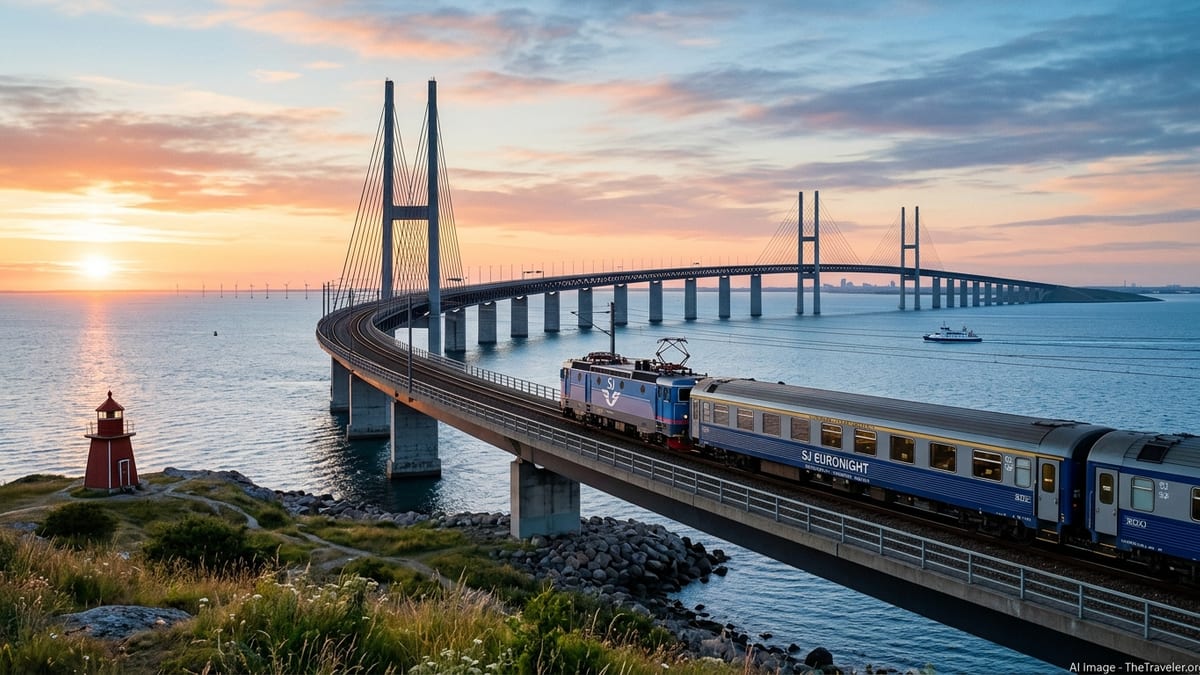
Joint SJ–RDC deal puts Denmark back at the center of the route
The new cooperation agreement, announced in mid November 2026, confirms that SJ and RDC will again run the EuroNight service together after a short interim in which RDC continued the train commercially under its own branding once Swedish state funding ended in summer 2026. Under the deal, the night train will again be marketed as SJ EuroNight when the 2027 timetable starts on 13 December 2026.
The route remains broadly the same as in previous years: Stockholm to Malmö, then across the Öresund Bridge to Copenhagen Airport, onward through Denmark and over the Great Belt and Little Belt links toward Germany, before continuing via Hamburg to Berlin. This alignment keeps Denmark as the physical spine of the connection between Sweden and central Europe, even though no long dwell time is scheduled in Copenhagen itself.
RDC’s press material confirms that the relaunched SJ EuroNight will link Stockholm with both Hamburg and Berlin, with the Danish section remaining an overnight transit corridor rather than a separate standalone service. For travelers, that means the familiar pattern of crossing Sweden in the evening, traversing Denmark in the small hours and waking up in northern Germany is set to continue.
Timetable, frequency and responsibilities from December 2026
From the timetable change on 13 December 2026, SJ EuroNight is scheduled to run three times per week in each direction. Current RDC documents indicate that, at least initially, one weekly round trip will extend to and from Berlin, with the remaining two built around Stockholm–Hamburg. The exact stopping pattern and any later adjustment of how many trips serve Berlin versus Hamburg may evolve as the partners refine the offer.
The night train will continue to stop at Copenhagen Airport station rather than Copenhagen Central, which is important for travelers planning long haul or European connecting flights. Earlier public timetables and draft schedules for the 2026/27 period have also suggested an additional stop at Copenhagen South, but travelers should verify final station lists and timings in SJ’s journey planner once the new timetable is fully loaded.
Operational responsibilities are split by geography. SJ is responsible for ticket sales and train operations in Sweden and across Denmark, while RDC provides the rolling stock and manages operations in Germany. That structure formalizes a division of labor which had already existed in practice during previous contract periods, but now without the Swedish state subsidy that originally underpinned the route.
What the relaunch changes for travelers
For passengers, the most immediate change is booking clarity. During the interim phase starting 1 September 2026, RDC sold tickets under its own EuroNight branding, which required travelers to use separate channels from SJ’s main site. With the SJ EuroNight name restored, bookings are again planned to be integrated into SJ’s regular sales system, simplifying reservations and making it easier to combine the night train with Swedish domestic or connecting services.
The service remains one of the few overnight rail options that directly link Sweden and Denmark with northern Germany, providing an alternative to short haul flights on city break routes such as Stockholm–Berlin or Malmö–Hamburg. It can also function as a rail bridge for longer trips, for example connecting Scandinavian journeys with day trains onward from Berlin or Hamburg toward central and southern Europe.
RDC has stated that it intends to develop the service step by step, and that berths and accommodation types continue to include sleeper and couchette options. Exact compartment configurations, onboard services and seasonal capacity may change over time, and fares are set dynamically. Travelers are advised to check current prices, availability and any pass surcharges directly in SJ’s or RDC’s booking engines, particularly for peak holiday periods.
Denmark’s growing role in cross-border night trains
The Stockholm–Berlin sleeper is not the only project to put Denmark at the heart of international night train planning. A proposed Basel–Malmö night service via Denmark was shelved after the Swiss parliament declined to provide funding, illustrating how such long cross-border overnight routes still depend heavily on public support and can be vulnerable to political decisions.
Looking ahead, private operator European Sleeper and other companies have outlined plans for future Brussels or Amsterdam to Copenhagen and Malmö services from around 2028, again routing through Denmark as the natural land bridge between mainland Europe and southern Sweden. These remain announced plans rather than confirmed services, and their final routings, timetables and start dates are not yet fixed.
Together, the active Stockholm–Berlin SJ EuroNight, the cancelled Basel–Malmö project and the various proposed Brussels or Amsterdam links underline that Denmark’s rail network is increasingly treated as a key node in north–south night train concepts. At the same time, the mixed record of such projects shows that funding, rolling stock and capacity constraints are still significant hurdles rather than solved problems.
What travelers should watch next
With the relaunch date approaching, the most important step for travelers is to re-check timetables and booking options as they are updated. Three weekly departures in each direction are confirmed in current operator information, but the balance between Hamburg-terminating and Berlin-terminating services, intermediate stops and the precise night-by-night timings could still be fine-tuned before or after 13 December 2026.
Prospective passengers should also confirm how rail passes are recognized and whether any reservation surcharges or quota limits apply for Interrail and Eurail users under the new joint operation. RDC has previously indicated that the train is part of the Interrail network, but concrete conditions can change from one timetable period to the next.
Finally, anyone planning to rely on the night train as part of a longer interlining journey through Copenhagen Airport, Hamburg or Berlin should build in buffer time and check for last minute alterations close to departure. While the SJ–RDC partnership is intended to stabilize the service, the train remains a long cross-border operation running across multiple networks, and real world performance will only become clear after the new timetable has bedded in.