


On the far north coast of Tenerife’s Anaga Rural Park, the small settlements of Taganana, Almáciga and Benijo cling to steep slopes where cultivated terraces meet the Atlantic. Linked by narrow, winding roads and a handful of bus services, they feel a world away from the island’s southern resorts. This pocket of Anaga offers wild black-sand beaches, dramatic views of the Roques de Anaga sea stacks and a slower, quieter pace, but also limited services and real ocean hazards that visitors need to understand before planning a day trip or an overnight stay.
Get the latest updates straight to your inbox!
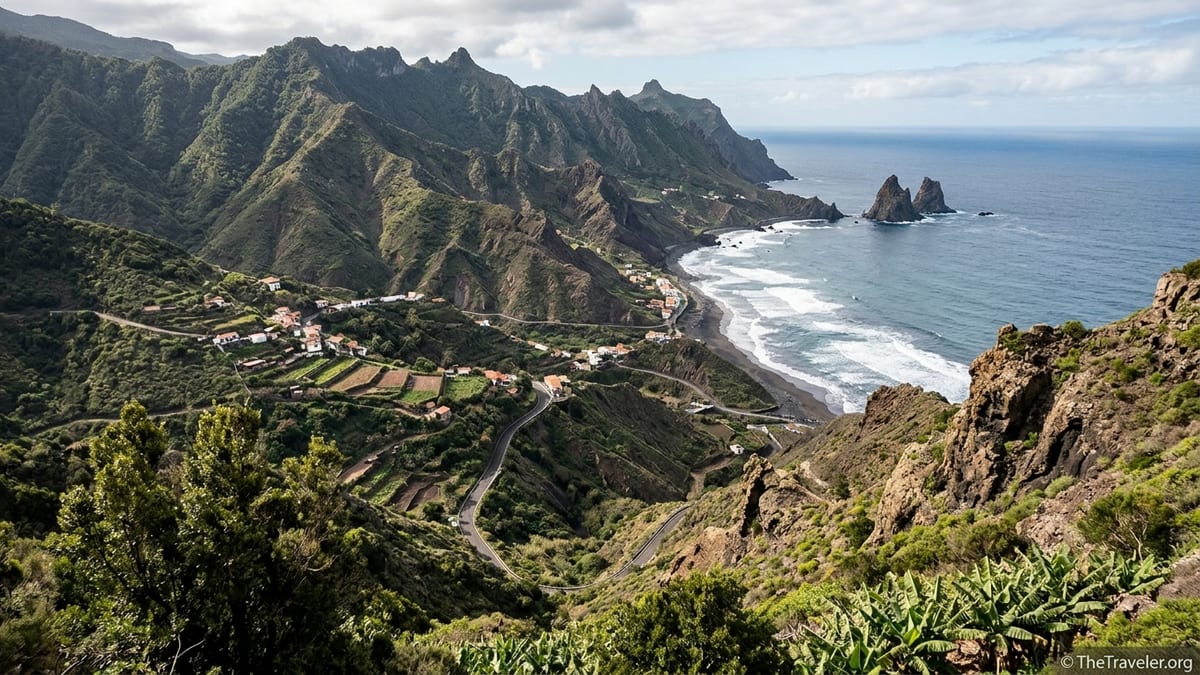
Setting: Villages at the End of the Road
Taganana, Almáciga and Benijo sit on the northern flank of Anaga Rural Park, a protected biosphere reserve of deep ravines, laurel forest and craggy ridges. The road from the crest drops through sharp bends into Taganana, then follows the coast past Roque de las Bodegas and Almáciga to end above the hamlet of Benijo. Houses are scattered along steep hillsides, often with terraced plots and banana groves below, and most practical services are concentrated in Taganana and beside the main coastal road.
The character here is resolutely rural. There are no large hotels, no seafront promenades and very few shops. Visitors come for the scenery, for hikes starting in the ravines and on the ridges above, and for the black-sand beaches where the Atlantic swell breaks almost constantly. The offshore Roques de Anaga, jagged rock stacks just offshore from Benijo and Almáciga, are a constant presence in the views but not a managed attraction in themselves.
It is important not to treat this coastline as a substitute for the island’s lifeguarded resort beaches. Winter swells can be heavy, rip currents can be powerful at any time of year, and both the roads and hiking paths are exposed to rockfall and landslides after heavy rain. Local authorities have closed Benijo beach itself to the public because of slope instability and there is no confirmed reopening date; visitors can still enjoy viewpoints and restaurants in the hamlet above, but must respect all barriers and closure signs.
Services are deliberately limited to preserve the area’s character. You will find a few small restaurants, rural guesthouses and holiday rentals, basic bus connections and simple beach facilities where access is currently permitted. There are no large supermarkets or nightlife venues. For many travelers this remoteness is part of the appeal; for others, it is a reason to base themselves in Santa Cruz, La Laguna or the south and visit the north coast on a focused day trip.
Getting There: Winding Roads and Sparse Buses
From Santa Cruz de Tenerife, the usual driving route follows the TF-11 along the shore towards San Andrés, then climbs on the TF-12 into the Anaga mountains before turning down towards Taganana on the TF-134. In normal conditions the journey from the Santa Cruz transport interchange to Taganana or Almáciga typically takes around 50 to 70 minutes, depending on traffic, weather and roadworks. The road is narrow and very twisty, with frequent tight bends, steep drop-offs and limited passing opportunities; drivers unused to mountain roads should allow extra time and avoid driving when tired.
From San Cristóbal de La Laguna, you usually join the TF-12 across the Anaga crest and then follow the same descent to the coast. Travel time from La Laguna is similar to or slightly longer than from Santa Cruz, again often around an hour in each direction in good conditions. Fog and low cloud are common on the ridge, particularly in the cooler months, which can reduce visibility and make the drive more stressful. Rockfalls and temporary closures are not rare after heavy rain, so checking current road conditions before setting out is advisable.
Parking in the villages and near the beaches is limited. In Taganana, most parking is on-street in narrow lanes and small pull-ins; in Almáciga and near Roque de las Bodegas it consists of informal bays beside the road and a few small gravel lots by the beach. Around Benijo, visitors usually park along the roadside near the viewpoint and restaurants at the end of the TF-134. On sunny weekends and local holidays, these spaces fill quickly from late morning and double-parking can cause blockages. Local authorities have discussed and piloted measures such as controlling access and expanding park-and-ride schemes from higher up in Anaga, and restrictions can change from year to year. Before driving, check current advice from Santa Cruz or the island council, obey all no-parking signs and be prepared to walk from whichever legal space you find.
For those who prefer not to drive, the main public transport link is bus line 946, operated by TITSA, which currently runs between the Santa Cruz transport interchange and Almáciga via San Andrés, El Bailadero and Taganana. Recent timetables show several departures per day in each direction on weekdays, with slightly fewer services on weekends and public holidays. Other Anaga services from La Laguna connect mainly to the ridge villages rather than directly to the north-coast hamlets, so most visitors planning to reach Taganana or Almáciga by bus should expect to travel via Santa Cruz and change if necessary.
Bus frequencies and even route detours can change temporarily, for example when bridge works in San Andrés affect through services. Therefore you should always check the official TITSA timetable or real-time information close to your travel date, and avoid planning your day around the last evening bus. In practice, that means aiming to return on an earlier service so that, if it is full or disrupted, you still have options. If you do miss the last bus, taxis can sometimes be called from Santa Cruz but availability is not guaranteed and costs will be significantly higher than the bus fare.
Beaches: Almáciga’s Surf and Benijo’s Viewpoint
Almáciga beach lies just beyond Roque de las Bodegas on the coastal road from Taganana. It is a broad curve of dark volcanic sand and pebbles, exposed directly to Atlantic swell and popular with experienced surfers. Access is usually straightforward: several small parking areas and roadside bays sit directly behind the sand, so you step down only a short way from the car or bus stop. The setting feels wild, surrounded by steep cliffs and cultivated terraces above, and even on busy days it has a raw, open-ocean atmosphere rather than a resort feel.
Swimming here is possible in suitable conditions, but it is never a classic calm-water beach. Waves and currents can be strong and changeable, especially in winter and during North Atlantic storms. There may be flag systems or warning signs in place, but lifeguard presence is not continuous year round. In some recent summers there have been limited seasonal lifeguard services on certain Anaga beaches during peak months, but these arrangements are subject to annual contracts and budget decisions and cannot be assumed. Visitors should check locally on arrival whether any lifeguards are on duty and treat yellow or red flags and any posted warnings very seriously.
Facilities at Almáciga are basic. There are usually no built-in promenade facilities, and any toilets, showers or beach bars depend on seasonal setups or on the small bars and restaurants in the nearby hamlets. Sand and rocks can be slippery, particularly where streams reach the sea or algae grow on the stones, so protective footwear is useful. Even standing near the shoreline, you need to watch for sudden larger sets of waves that can knock you off your feet. Families with small children are generally better off treating Almáciga as a place to walk, play at the upper edge of the sand and enjoy the scenery rather than as a shallow paddling beach.
Benijo, a few minutes farther along the road, currently offers its ocean views from above rather than from the sand. The hamlet stands on the slopes overlooking a narrow black-sand cove directly opposite the Roques de Anaga. In past years visitors would descend steep steps to the beach itself and some sections were informally used by nudists, but that access path has been officially closed due to the risk of rockfalls and slope instability and local authorities have confirmed that swimming there is prohibited until the area can be made safe. There is no confirmed reopening date, and visitors should not bypass any barriers or closure signs.
Even with the closure, Benijo remains a worthwhile stop for the view alone. Roadside viewpoints and the terraces of the small restaurants at the top look straight out over the sea stacks and the often spectacular sunset, particularly on days when cloud hangs on the Anaga peaks while the horizon stays relatively clear. There are no beach facilities now that access is closed: no lifeguards, no toilets or showers on the sand and no safe route down. Planning your day here means focusing on photography, a meal or drink with a view and perhaps including Benijo as one end of a coastal walk, rather than expecting a day of swimming.
Walking and Viewpoints: Short Trails With Changing Conditions
The combination of steep slopes and sea views makes the Taganana coast one of Anaga’s most rewarding areas for walking, but it also means that trails are vulnerable to erosion and landslides. After storms and heavy rains in recent years, several coastal and ravine paths around Benijo and Almáciga have faced temporary closures or diversions, and the official information from island and park authorities has stressed the need to respect closure notices. Before committing to any hike in this area, it is essential to cross-check your chosen route against a recent map and any official park updates.
One classic outing connects the Taganana area with Almáciga and Benijo, combining short road sections with footpaths that cut across the slopes. In its full form this coastal link can take several hours at a leisurely pace with photo stops, but it is easy to break into shorter segments. Paths are generally signposted at main junctions with standard Anaga waymarking, though smaller local tracks between houses and terraces can be confusing without a map. Terrain includes steep ascents and descents, uneven stone steps and narrow traverses above ravines, so it is best suited to reasonably fit walkers with proper footwear rather than casual flip-flop strolls.
Another popular idea is to link time on the coast with higher viewpoints. Trails from the Anaga ridge, such as routes descending from around Cruz del Carmen or El Bailadero, lead down towards Taganana through laurel forest and then more open slopes. These typically take several hours one way, with significant descent that becomes a punishing climb if you reverse the route. Many hikers prefer to descend from the ridge and then use bus line 946 or a pre-arranged pick-up to return to the starting point. Marking is usually good on the main regional trails, but mud, loose rock and occasional landslides can make conditions tougher than the map profile suggests.
For shorter, lower-level options, there are informal walks that string together viewpoints above Roque de las Bodegas, Almáciga and Benijo. These might involve walking stretches of the coastal road and detouring to signed miradores. Time investment can be as little as an hour or two, but even these short walks involve some steep sections and unpaved ground. Wherever you walk, bring water, sun protection and layers; the coastal strip can feel warm in the sun, while cloud and wind sweeping down from the ridge may make it noticeably cooler within the same outing.
Staying and Eating: Simple Comforts in Remote Hamlets
Accommodation around Taganana, Almáciga and Benijo is modest in scale. Instead of large hotels you will find small guesthouses, traditional rural cottages and a scattering of self-catering apartments and rooms in village houses. Typical options include a handful of rural tourism properties in or near Taganana and a small number of apartments or rooms in Almáciga and the Benijo area, many bookable through mainstream platforms. Prices fluctuate with season and demand, but as a rough guide, simple double rooms or small apartments in this area often cost less than resort hotels in the south, especially outside peak holidays, while offering far more limited services.
Availability can tighten considerably at weekends and around local holidays, when residents of Tenerife and other Canary Islands also head to Anaga for walking, eating out and cooler air. Last-minute options may be scarce on those dates, so anyone who definitely wants to stay overnight in these hamlets should book ahead. Properties usually suit hikers and nature lovers who value quiet and proximity to trails, and surfers who accept that conditions are rougher than on many other beaches. Couples seeking solitude often appreciate the seclusion, provided they are comfortable with narrow roads and do not mind the lack of nightlife, shopping and hotel-style amenities.
Eating revolves around a small but characterful set of local restaurants and bars. In Taganana and along the coastal strip between Roque de las Bodegas, Almáciga and Benijo you can expect simple dining rooms and terraces serving fresh fish, octopus, papas arrugadas with mojo sauces and other Canarian staples, often at moderate prices. Opening hours can vary seasonally and midweek evenings may be quiet, so it is wise to check ahead or have a fallback plan if a particular place is closed. There are no large supermarkets; you should bring any special items or snacks from Santa Cruz, La Laguna or another base.
For coffee and basic supplies, small village bars or shops may carry essentials, but not in the variety or volume of urban supermarkets. Vegetarian and vegan options exist but can be limited, especially away from the better-known restaurants. Many visitors staying in self-catering accommodation choose to shop in the city before driving out and then rely on local restaurants for one main meal a day, either lunch after a hike or an early dinner before driving back along the mountain road.
Weather, Seasons and Planning Your Itinerary
Compared with southern Tenerife’s resort coasts, Anaga’s north shore is cooler, cloudier and windier for much of the year. The trade winds often bank cloud against the mountains, making mornings grey and damp even when the south of the island is sunny. Temperatures are usually mild rather than hot, which many hikers appreciate, but evenings can feel chilly, especially in winter and at higher elevations. Rain is more frequent here than in the south, and when Atlantic fronts cross the island they can bring heavy downpours, swollen barrancos and an increased risk of landslides.
Sea conditions follow a similar pattern. Winter and early spring often bring stronger swells and more powerful rip currents, which is part of the appeal for experienced surfers but increases risk for swimmers and anyone near the shoreline. Even in summer, calm days are interspersed with rougher spells. Very occasionally, storms have led to temporary closures of access roads and trails in the Anaga area, including the coastal route beyond Roque de las Bodegas. Keeping an eye on local news and official advisories before and during your visit is prudent, particularly if your plans rely on specific trails or on driving in and out on the same day.
Many travelers find that the most satisfying way to experience this part of Anaga is to combine a forest walk on the ridge with an afternoon or evening on the coast. A common pattern in fine weather is to start with a short laurel-forest trail near the main Anaga viewpoints higher up, then drive down to Taganana or Almáciga for a late lunch and finish at a coastal viewpoint near Benijo for sunset. This approach spreads driving across the day, reduces midday parking pressure at the beaches and gives a fuller sense of Anaga’s contrasting environments.
If you plan to hike down from the ridge to the coast, building in margin for bus connections or pick-ups is essential. Walking times can lengthen considerably in wet or muddy conditions, and late afternoon cloud can make way-finding more difficult on higher sections. Always carry more water and clothing layers than you think you need, and remember that mobile phone coverage can be patchy in steep ravines. Treat the remoteness with respect, even though you are technically not far from two sizable cities.
Is It a Day Trip or an Overnight Base?
Choosing whether to treat Taganana, Almáciga and Benijo as a day trip or as a base for a night or two depends on your priorities and your tolerance for remoteness. If you enjoy winding roads, do not mind limited facilities and are more interested in scenery and hiking than in structured beach time, staying in a rural guesthouse in Taganana or Almáciga can be rewarding. You wake up among the mountains, can start walks straight from your door and have the coast almost to yourself outside peak lunchtime hours. Evenings tend to be quiet, focused on a simple meal and an early night rather than bars or entertainment.
On the other hand, if you prefer a choice of restaurants, easy supermarket access, nightlife or reliable public transport, basing yourself in Santa Cruz, La Laguna or the southern resorts and visiting Anaga’s north coast as a day trip is usually more practical. The roughly hour-long drive in each direction, the limited bus frequencies and the lack of fallback options if a restaurant, bus or trail plan does not work out all argue for keeping your commitments flexible. For many visitors, one full day that combines a ridge walk and coastal viewpoints provides a memorable taste of the area without the need to manage luggage and bookings in the small villages.
Driving confidence is a key factor. Anyone nervous about narrow mountain roads, hairpin bends and meeting buses or vans on single-width sections may find the journey stressful, particularly in poor visibility or heavy rain. In that case, travelling by bus and accepting the fixed timetable, or joining a small-group excursion that uses experienced local drivers, can make the experience more relaxing. Conversely, confident drivers who are comfortable with mountain conditions may appreciate the flexibility of having their own car, especially if they plan early starts or late returns outside peak bus hours.
Ultimately, these hamlets and their wild coastline reward visitors who value solitude, raw landscapes and the feel of a working rural community over polished resort comforts. Whether you come for an afternoon or for a few days, plan carefully, respect local safety notices and closures and arrive with realistic expectations of services. In return, Anaga’s north coast offers some of Tenerife’s most evocative scenery, where cultivated terraces, ravines and the Atlantic swell all meet at the island’s outer edge.