


El Hierro is the Canary Island for travelers who prefer cliff paths to cocktail bars. That low-key character extends to its accommodation. Instead of resort strips and tower hotels, you will find a patchwork of small villages, rural houses and a handful of modest hotels scattered across steep, volcanic landscapes. Choosing where to stay is less about chasing nightlife and more about matching your base to your priorities: hiking, diving, tranquillity, services or getting around without a car.
Get the latest updates straight to your inbox!
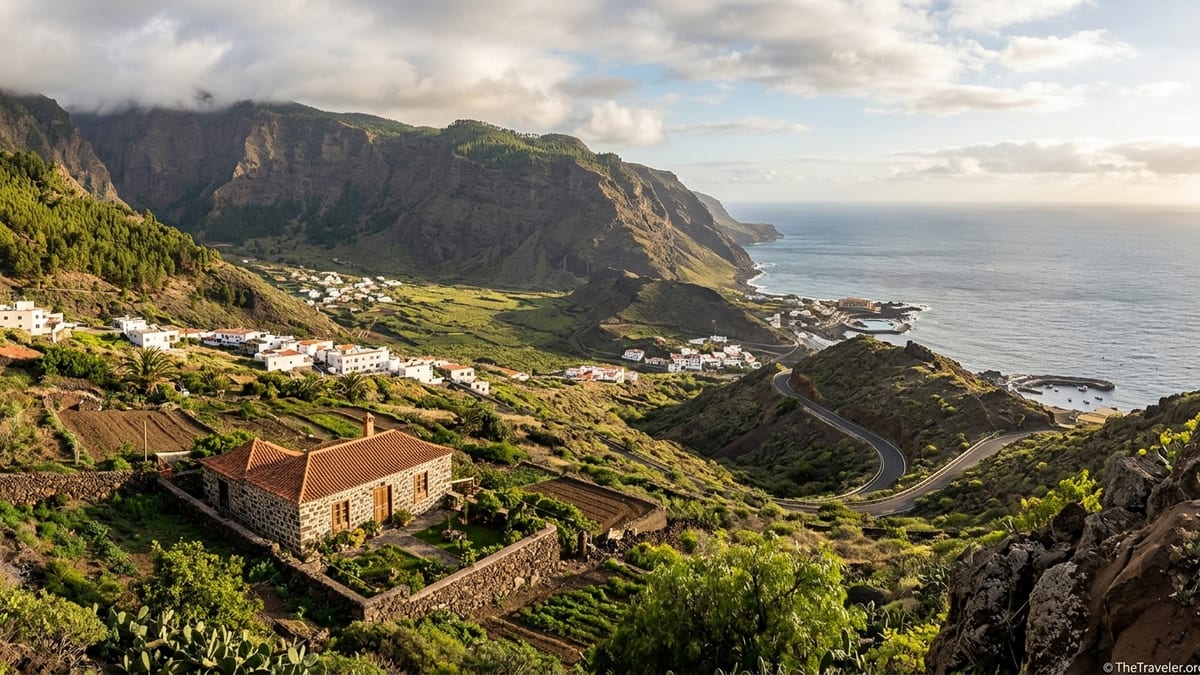
How El Hierro is Laid Out: Three Municipalities, Many Small Bases
El Hierro is divided into three municipalities: Valverde in the northeast, La Frontera in the west and El Pinar in the south. Valverde holds the small island capital, the ferry port at Puerto de la Estaca and El Hierro Airport, so most visitors pass through this corner first. La Frontera spreads across the fertile El Golfo valley below dramatic cliffs, while El Pinar occupies upland forests and slopes that fall to the tiny coastal village of La Restinga, Spain’s southernmost settlement.
Instead of one dominant resort strip, accommodation is dispersed. Official tourism information and recent booking data show that a large share of regulated beds are in casas rurales, holiday homes and small apartment complexes, with far fewer classic hotel rooms. Rural lodging is especially common inland, around hamlets and old agricultural areas, while apartments and small hotels cluster in La Frontera, La Restinga, Valverde and a few coastal outposts.
There are no large all-inclusive complexes on El Hierro. The most conventional hotel experiences are the Parador de El Hierro on the secluded Las Playas bay, the Balneario Pozo de la Salud on the northwestern coast and a short list of two and three-star hotels and guesthouses in places like Valverde, La Frontera and Las Puntas. Everywhere else, expect small-scale stays: self-catering apartments, restored stone houses and simple pensiones above village bars.
The island’s rugged relief means driving times are longer than the map suggests and weather can shift sharply between misty uplands and sunny coves. Understanding these microclimates and road links is crucial when deciding whether to base in cooler, greener heights, a warm valley floor or a remote cove by the ocean.
Valverde & North Coast: Practical Base Near Airport and Port
Valverde town sits on a cool, often misty hillside, a short drive from both the airport and the port. The surroundings are green by Canary Islands standards, with views across pastureland and old lava flows to the Atlantic. This is the administrative and service hub of the island, with the Cabildo offices, banks, pharmacies and several supermarkets and hardware shops that make it useful for longer stays.
In and around Valverde you will find small hotels such as simple in-town establishments, family-run guesthouses and straightforward apartments. Typical examples include basic hotels with private rooms and Wi-Fi close to the main square, and apartments such as VVs and studios with kitchenettes set in residential streets. North-coast villages like El Mocanal and Pozo de las Calcosas offer more rural guesthouses and apartments perched above dramatic cliffs, while the Parador de El Hierro occupies its own bay at Las Playas under huge basalt walls, with a pool, sea views, restaurant, parking and usual four-star comforts.
For meals, Valverde has a modest but reliable spread of cafés, bakeries and restaurants, usually open year-round and later than in some smaller villages. Supermarkets in and near town are well stocked for self-catering; the Parador and Balneario Pozo de la Salud have in-house dining. Attractions within easy reach include the viewpoints of Mirador de La Peña, coastal natural pools such as Pozo de las Calcosas and the sweeping amphitheatre of Las Playas.
Staying in or near Valverde makes sense if you will not rent a car. The island bus operator connects the airport, Puerto de la Estaca, Valverde and La Frontera several times a day, and there are routes to El Pinar and some villages, although frequencies can be limited and timetables often geared to local commuting. From Valverde you have the best chance of making onward bus connections, but you should still expect to plan around fixed schedules and possibly use taxis for evening returns, remote trailheads or luggage on arrival.
La Frontera & El Golfo Valley: Green Slopes, Natural Pools and Village Life
On the western side of the island, the municipality of La Frontera spreads across the El Golfo valley, a dramatic half-caldera fringed by steep cliffs draped in cloud and pine forest. Down on the valley floor, banana plantations, orchards and small villages like Tigaday, Las Puntas and Sabinosa enjoy a milder, often sunnier climate than the uplands, with easy access to natural pools along the rocky shore.
La Frontera is one of the most popular bases for first-time visitors because it combines scenery, services and relative convenience. In Tigaday and nearby streets you will find supermarkets, bakeries, petrol stations, several bars and restaurants and small shops, along with the island’s second-largest cluster of accommodation. Options range from apartment complexes with shared gardens or small pools to rural-style studios set in converted farm buildings. Properties such as Pensión Casa Trudo, Apartamentos Finca Wapa, El Sitio or various VV apartments show the typical pattern: self-contained units with kitchens, Wi-Fi, parking and terraces or balconies facing the valley or ocean.
Along the coast at Las Puntas, Hotel Puntagrande has become one of the island’s most distinctive oceanfront stays, with just a handful of rooms perched on a narrow lava pier amid the waves. Nearby, more modest apartments and small hotels look across to the old salt pans and basalt arches. Sabinosa and the northern cliff villages offer traditional houses and small-scale holiday homes, often with big views but fewer on-foot services.
From La Frontera you are well placed for hiking in the Frontera Rural Park, including routes up through laurel forest and pine to panoramic viewpoints on the rim, as well as for visiting natural pools like Charco Azul and La Maceta and wild beaches like Playa del Verodal further north. Bus connections link La Frontera with Valverde and, less frequently, with El Pinar, but schedules are not dense. A car gives you much more flexibility to reach trailheads, beaches and viewpoints early and to return after sunset.
El Pinar & La Restinga: Southern Forests and World-Class Diving
El Pinar occupies the island’s southern slopes, covered in Canary pine forest that gradually gives way to scrub and lava fields as you descend toward the sea. The inland villages of Taibique and Las Casas feel quiet and residential, with a few cafés and small shops. Accommodation here is mainly rural: stone houses and small cottages surrounded by fields and pines, usually with kitchens and terraces, often heated for cool nights at altitude.
At the bottom of a long, winding mountain road lies La Restinga, a compact fishing village wrapped around a sheltered harbor and small beach. Its low-rise white houses sit between old lava flows and the calm waters of the Marine Reserve of Mar de las Calmas, one of Spain’s premier diving areas, with dozens of well-known sites along the steep underwater slopes offshore. The atmosphere is relaxed and outdoorsy, revolving around the promenade, the harbor and the dive centers.
Accommodation in La Restinga centers on apartments and small hotels. Examples visible on current booking platforms include Aparthotel-style properties with studios and one-bedroom apartments around a small pool, simple apartment blocks directly above the harbor with balconies and Wi-Fi, and newly refurbished small hotels like Ablancas with modern rooms, sea views and close proximity to dive operators. Most units offer kitchens or kitchenettes, which matter because restaurant choice, while good for fresh fish, is limited and can be quiet in low season.
For divers, La Restinga is usually the most practical base, since boat departures are early and weather-dependent. For general sightseeing it is less central. The drive from Valverde or La Frontera to La Restinga can take 40 to 50 minutes along mountain roads, and while buses do connect the village to the rest of the island, frequencies are low and journey times long. Without a car, staying in La Restinga suits visitors whose main goal is diving or relaxing locally, rather than touring the whole island.
Scattered Rural Houses & Seaside Retreats: Off-Grid El Hierro
Between the three main municipal hubs lies a patchwork of tiny hamlets, terraced hillsides and isolated coves. Here you find one of El Hierro’s defining accommodation types: the rural house. Many are restored stone dwellings that once housed farming families, now converted into independent holiday homes with one to three bedrooms, living areas, kitchens, terraces and small gardens. Heating is common at higher elevations, and Wi-Fi is increasingly standard, though speeds can vary.
These casas rurales are spread across areas like Erese and Isora above the Las Playas bay, the villages between Valverde and El Mocanal, upland clearings near El Pinar and isolated pockets overlooking the El Golfo valley. Some are grouped in small complexes with shared courtyards or barbecue areas, others stand alone at the end of narrow lanes amid orchards or old fields. A few properties closer to the coast, particularly between La Frontera and Sabinosa or near Pozo de la Salud, mix a rural-house character with direct ocean views and, in some cases, small pools.
On the northwestern shore, the Balneario Pozo de la Salud combines a small hotel with a wellness focus, thermal-style facilities and oceanfront setting above a rocky shoreline. At Las Playas on the east coast, the Parador de El Hierro offers a more conventional hotel environment but in an isolated setting where the nearest village is a drive away. Both are good fits for travelers who want tranquility, coastal scenery and on-site dining, and who are comfortable relying on a car for excursions.
These scattered stays work best for visitors who prioritize space, privacy and landscape over on-foot access to shops and restaurants. You will almost certainly need a rental car, and in some cases you may drive several kilometres of narrow roads to reach supermarkets or fuel. In return, you gain dark skies, quiet nights and sunrise or sunset views that feel very far from the mass-market Canary experience.
Trip Styles: Matching Your Base to Your Priorities
Hikers and nature photographers usually benefit from staying in or near La Frontera, El Pinar or central rural areas rather than exclusively at the coast. From La Frontera you can reach the Frontera Rural Park trails quickly and still have supermarkets and restaurants nearby. From El Pinar and its upland surroundings, you are closer to pine forests, high viewpoints such as Cruz de los Reyes and the trail network that crosses the island. A split stay, for example several nights in La Frontera and a night or two at the Parador or rural house near the Las Playas or Pozo de la Salud areas, allows you to experience different microclimates and landscapes.
Scuba divers almost always base in La Restinga or within a short drive of it. Dive centers are concentrated around the harbor, and early-morning departures, kit storage and post-dive briefings make staying in the village very practical. Self-catering apartments with balconies to dry gear are particularly popular, as are small hotels within a few minutes’ walk of the pier. Non-divers in the same group should be aware that outside peak Spanish holiday periods, La Restinga is extremely quiet, with limited non-diving activities beyond coastal walks, swimming, reading and enjoying the seafood restaurants.
Digital nomads and long-stay visitors tend to look first at La Frontera or Valverde and its surroundings. Both offer better access to supermarkets, hardware stores, health services and cowork-friendly cafés than smaller villages. Many modern apartments and some rural houses advertise Wi-Fi, and recent visitor reports suggest that fiber or high-speed connections are increasingly common in built-up areas, though speeds can still lag behind mainland standards. A car remains helpful for errands and weekend hikes, but basing in a village centre means you can walk to most daily needs.
Low-mobility travelers should carefully check accessibility details before booking anywhere on El Hierro. Traditional rural houses often involve uneven paths, external staircases, steps between rooms and steep approaches. Even village apartments can sit on hillsides or up flights of stairs. For the smoothest experience, look at single-level apartments in the centre of La Frontera or Valverde, newer small hotels with lifts where available, or the Parador and Balneario Pozo de la Salud, which are designed more like conventional hotels. In all cases, confirm step-free access, lift presence, shower type and parking arrangements directly with the property before committing.
Prices, Availability and Booking Practicalities
El Hierro remains generally more affordable than the larger Canary Islands, but limited inventory means prices respond quickly to demand. Rural houses and self-catering apartments commonly price per unit rather than per person. Recent searches for shoulder-season dates show simple studios and one-bedroom apartments from roughly the lower double digits per night, mid-range rural houses and well-rated apartments in the mid-range figures, and distinctive oceanfront or design-focused properties and the Parador in the higher double or low triple digits per night for two adults. These are broad examples only. Actual rates vary significantly by season, length of stay, specific property and how early you book.
Peak periods on El Hierro are aligned more with Spanish holiday calendars than with classic beach seasons. School holidays, Christmas and New Year, Easter week and local festivals such as the Bajada de la Virgen de los Reyes every four years can see properties book out well in advance. During these times, expect higher prices, stricter minimum stays, especially in rural houses, and limited last-minute choice in La Frontera and La Restinga.
Many casas rurales and independent apartments operate with flexible but clear house rules. Minimum stays of two to four nights are common, and week-long bookings are often favoured in high demand periods. Cancellation policies vary from fully flexible to partially refundable or non-refundable. Unlike large hotels with 24-hour receptions, you may need to arrange your arrival time with the owner, collect keys at a meeting point or use a lockbox for self check-in. Check-in hours can be limited if hosts have other jobs.
Before publication, writers should verify up-to-date nightly examples for a specific upcoming month using major booking platforms and, when possible, the accommodation’s own reservation system. Pay attention to inclusions such as Wi-Fi, heating or air conditioning, parking and cleaning fees, which may differ by property. On an island with changeable weather and cool nights at altitude, heating can be more important than air conditioning in some rural houses.
Making the Choice: A Simple Summary
If convenience and bus connections matter most, start by looking at Valverde and its nearby villages. You will be closest to the airport, port and public transport, and you can pair a modest in-town hotel or apartment with easy access to basic services. Add a night or two at the Parador de El Hierro if you want a hotel-style retreat in a spectacular but isolated bay.
If you prioritise a blend of hiking, scenery and everyday services, La Frontera and the El Golfo valley are the first places to consider. Here you can combine trail access and road links across the island with supermarkets, petrol stations and a wide range of apartments, rural houses and small hotels, including some of the island’s most characterful oceanfront properties around Las Puntas.
If world-class diving and a quiet harbor atmosphere top your list, focus on La Restinga and, to a lesser extent, inland El Pinar. Apartments and small hotels here put you within walking distance of dive centers and seafood restaurants, though you accept longer drives, sparse buses and limited nightlife elsewhere on the island.
For deep tranquillity, dark skies and a sense of being embedded in the landscape, browse the many rural houses scattered between the main centres, or consider the coastal retreats at Pozo de la Salud and Las Playas. Wherever you stay, keep expectations aligned with El Hierro’s character: small-scale, nature-focused, with simple evenings and a pace set by winding roads, trade winds and the Atlantic swell rather than entertainment schedules.