


The Alaska Marine Highway System is Alaska’s state-run ferry network, linking more than 30 coastal communities over roughly 3,500 miles of routes from Bellingham, Washington to the Aleutian Islands. In Southeast Alaska, these blue-and-white ships are not just scenic vessels but essential transportation for towns without road connections. For independent travelers, they offer a flexible, slow-travel alternative to big-ship cruises, with the freedom to hop between communities, bring a vehicle, and spend more time ashore along the Inside Passage.
Get the latest updates straight to your inbox!
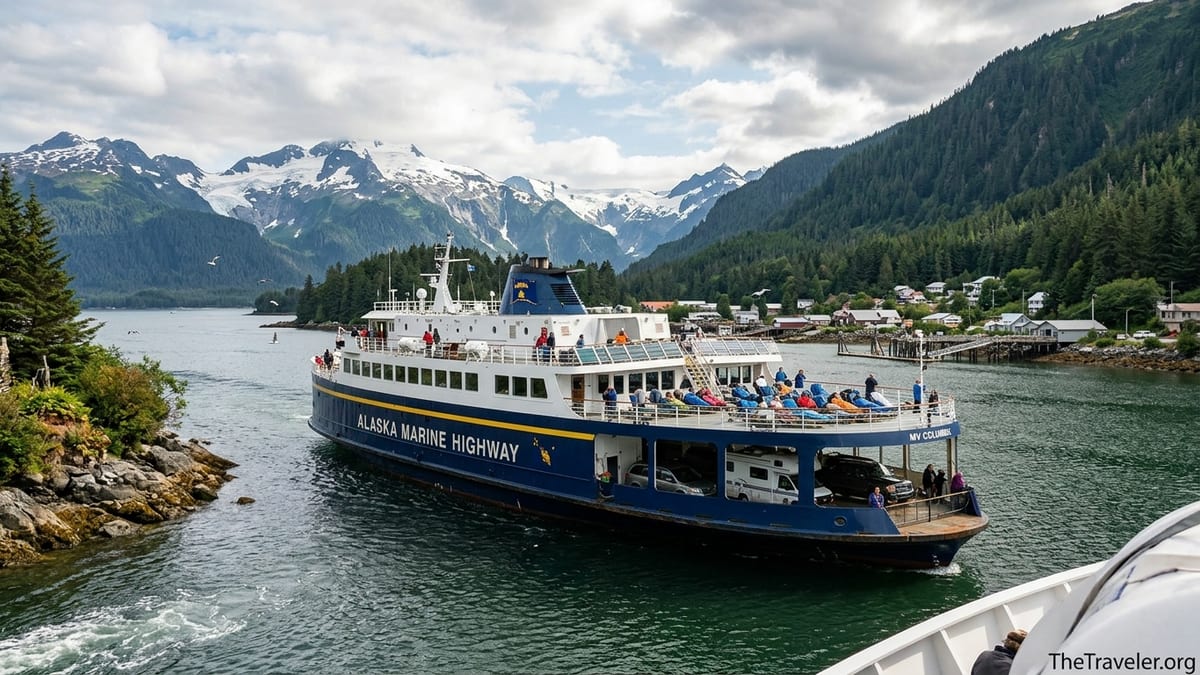
Understanding the Alaska Marine Highway in Southeast
In Southeast Alaska, the Alaska Marine Highway System, or AMHS, runs through the Inside Passage from Bellingham at the southern end up to hubs such as Ketchikan, Petersburg, Wrangell, Sitka, Juneau, Haines and Skagway. These mainline communities act as junctions for smaller towns like Kake, Angoon, Tenakee Springs, Gustavus and Hoonah. The ferries serve as a true highway for residents, carrying passengers, vehicles and freight where no roads exist.
For travelers, the appeal lies in point-to-point flexibility. Instead of seeing the Inside Passage only from a cruise ship balcony, you can disembark in multiple ports, stay several nights and re-board a later sailing. You can also travel as a walk-on passenger or bring a car, camper van or bicycle, which opens up road-accessible regions at the northern end in Haines and Skagway where the highway connects into Canada and the rest of Alaska.
Compared with conventional cruises, AMHS is usually more utilitarian than luxurious, but often more affordable for long-distance transport, especially for those combining several legs. Fares are typically charged per passenger and per vehicle, with cabins as an optional add-on. Travelers comfortable with simple accommodations and a slower pace often find that the ferries provide richer contact with Alaskans and more time in real communities.
Beyond Southeast, AMHS also operates routes across the Gulf of Alaska, in Prince William Sound and to Southwest Alaska. However, vessels, routes and seasonal coverage in those regions have seen frequent changes in recent years. For a first-time visitor focused on the Inside Passage, concentrating on the Southeast network is the most straightforward way to plan.
How the Southeast Routes and Hubs Fit Together
The Southeast system is structured around mainline sailings and shorter feeder routes. Mainline ferries typically run the longer stretches between Bellingham and key hubs such as Ketchikan, Juneau, Sitka, Haines and Skagway. Day-boat or shorter feeder routes then connect smaller communities to these hubs, often on schedules tailored to local needs rather than tourist convenience.
On a typical current pattern, a weekly mainline vessel sails from Bellingham to Ketchikan, then continues north through Wrangell, Petersburg and Juneau, often with branches or separate sailings reaching Sitka and then on to Haines and Skagway. While the exact route, intermediate stops and vessel assignment can shift by season and year, Juneau generally functions as the central hub for Southeast connections, with Haines and Skagway as the primary road links to the Yukon and Interior road network.
Smaller communities such as Angoon, Kake, Tenakee Springs and Hoonah may be served by dedicated day boats or by mainline vessels on selected days, sometimes only a few times per week or even less in winter. This means that building an itinerary around these ports requires close attention to the specific schedule for your travel year and a willingness to be flexible about travel days.
Because state funding levels, vessel maintenance and regulatory requirements influence the network, service patterns in one winter or summer should never be treated as permanent. For example, winter schedules have seen temporary pauses to Prince Rupert service and gaps in some corridors while ships rotate through shipyards. Travelers should always confirm the current route map and sailing options for their intended travel year rather than relying on older guidebooks.
Typical Travel Times and Choosing Your Route
To plan a realistic itinerary, it helps to understand typical crossing durations between key ports. According to current AMHS route information and recent schedule examples, the through sailing from Bellingham to the first Alaska stop at Ketchikan usually takes in the range of 36 to 40 hours, essentially an overnight plus a full day at sea. From Ketchikan to Juneau is commonly another long overnight run of roughly 20 to 24 hours, depending on the route and intermediate stops.
Within northern Southeast, crossings become shorter but still significant. Juneau to Haines is often listed at about four and a half hours on direct sailings, while Haines to Skagway is a quick hop of around one hour. Travel between Juneau and Sitka can range from roughly eight to ten hours on typical schedules, often run as an overnight or long day sailing. Actual times vary by vessel, routing and season, but these figures give a useful sense of scale.
When choosing where to start and end, independent travelers often pick one of three patterns. One is a full Inside Passage trip such as Bellingham to Skagway or the reverse, spending one to two weeks breaking up the voyage with stops in Ketchikan, Petersburg or Wrangell, Sitka and Juneau before continuing north. A second option is to fly into Juneau or Ketchikan and use ferries regionally. A third is to combine the ferry with an overland drive by starting or ending in Haines or Skagway and continuing by road into Canada and the rest of Alaska.
Since many mainline sailings through Southeast operate about once per week, while feeder legs between northern ports may run more frequently in summer, it is wise to sketch your preferred sequence of ports first, then check which direction and dates the schedule supports. In some cases it may be easier to sail a particular leg southbound rather than northbound, or to adjust your time in a town by a day or two to line up with the next available ferry.
Using AMHS Schedule Tools and Booking Strategically
AMHS provides several digital tools that are essential for planning. The sailing search lets you select an origin and destination and see available departures within a date range, including basic fare information and whether cabins and vehicle space are available. Colored schedule grids show all sailings in a region or on a specific vessel by month, which is useful for visualizing frequency and how ships move through the network. Many travelers start with the grids to choose rough travel dates, then use the sailing search to price specific options.
When making reservations, you can often book online for standard passengers and vehicles up to a certain length. Longer rigs and commercial-type vehicles usually need to be reserved through the call center or a ferry terminal. Online bookings typically close several hours before departure from staffed ports and earlier for smaller unstaffed ports, so last-minute walk-on travel is easier without a vehicle than with one.
Reservations for new summer and winter seasons are usually opened to the public once schedules are finalized, often several months to nearly a year in advance for some dates. Because there are a limited number of cabins and vehicle spaces on each sailing, popular summer departures and long-haul legs such as Bellingham to Ketchikan or Juneau can sell out, particularly for larger vehicles. Walk-on passenger space is more forgiving, but cabins may still book out well ahead of time on peak sailings.
AMHS uses fare classes and has specific rules for changes and cancellations that can include fees or fare differences depending on how close to departure you alter your plans. Policies can change as the system updates its terms, so travelers should always check the current conditions on the official booking site before purchasing. If you value flexibility, it may be worth paying close attention to refundability and change penalties, and avoiding over-tight connections that would be hard to rebook at short notice.
Cabins, Sleeping Arrangements and Onboard Life
Life onboard an AMHS ferry is more akin to a long-distance train or functional overnight boat than a cruise ship. Mainline vessels such as the MV Columbia and MV Kennicott generally offer vehicle decks, indoor observation lounges, a cafeteria-style restaurant, a solarium or covered outdoor deck area, small movie or quiet lounges and basic amenities like showers and coin-operated laundry. Newer day boats like the MV Hubbard focus on comfortable seating and observation areas for shorter runs between communities.
Cabins are optional but can greatly improve comfort on multi-night segments. On ships like the Columbia and Kennicott, cabins usually come in two- or four-berth configurations with private bathrooms, and some are specifically designed to be accessible for travelers using wheelchairs or with limited mobility. Cabins rarely include cruise-style extras; think of them as simple, private sleeping spaces with bunks, linens and a small desk or seating area.
Many budget-conscious travelers skip cabins and sleep in public areas. The heated, covered solarium on the top deck of mainline ships is a classic Alaska Marine Highway experience, where passengers roll out sleeping pads and bags on lounge chairs and watch the scenery through the night. Others claim a quiet corner of an indoor lounge. This is allowed within posted rules, but outlets, reclining chairs and prime spots can fill quickly on busy sailings, so arriving early helps.
Wi Fi offerings are evolving by vessel. AMHS has begun rolling out a public satellite internet network on some ships, including free or limited-access Wi Fi zones, but connections can still be slow or intermittent, especially in remote channels. Travelers should not count on streaming-quality service. Food options are typically limited to a cafeteria with hot meals and grab-and-go items; many locals bring a cooler with snacks, simple meals and drinks. All vessels publish specific accessibility details by vessel class, so passengers with mobility or medical needs should verify features when selecting sailings.
Costs, Sample Fares and Seasonal Considerations
AMHS fares are calculated mainly by passenger, vehicle and optional cabin. Passenger fares increase with distance, and vehicles are charged based on length, with higher rates for longer rigs and trailers. Cabins are priced per room rather than per person, and nightly rates vary by vessel, cabin type and route. This structure means solo walk-on travelers can move relatively cheaply between communities, while families with a large camper and private cabin on long routes will see costs add up.
Because fares change by season, demand and state decisions, it is best to use representative examples rather than fixed prices. On recent sample dates, a one-way walk-on passenger fare from Bellingham to Ketchikan is often several hundred dollars, with additional cost for a standard car and significantly more for a longer RV and a private cabin. Shorter regional hops, such as Juneau to Haines or Juneau to Sitka, usually cost noticeably less but can still be a significant budget item when multiplied by several legs.
Seasonality strongly affects both availability and reliability. Summer schedules typically offer more frequent sailings in Southeast, including near-daily service between Juneau, Haines and Skagway on some vessels. In fall and winter, the emphasis shifts to core community service, with reduced frequency and occasional service gaps while ships rotate through overhauls. Recent winter schedule announcements have highlighted week-long periods with no mainline ferry between Bellingham and Southeast as vessels transition seasons, which can strand travelers who assume daily or even weekly options.
Weather is another factor. Strong winds, heavy seas or icing can delay sailings or require route adjustments, particularly in shoulder and winter seasons. While outright cancellations are not the norm, experienced travelers build slack into their itineraries and avoid scheduling tight, same-day connections with flights or tours. Carrying essential medication, warm layers and a flexible mindset is prudent, especially outside midsummer.
Combining Ferries with Flights and Road Travel
For many visitors, the most practical way to experience the Alaska Marine Highway is to combine ferries with flights. Juneau and Ketchikan both serve as major regional air hubs, with frequent flights from Seattle and Anchorage. A common strategy is to fly into Juneau, spend several days exploring, then use the ferry as a scenic connector to Sitka, Haines or Skagway before continuing overland or flying onward.
Coordinating timetables is essential. Ferry arrival and departure times may be early morning, late at night or in the small hours, depending on the port slot and the long-distance nature of some routes. Because schedule changes and weather delays are possible, it is unwise to book tight same-day connections with flights, particularly on the outbound leg. Many travelers choose to overnight in their ferry port both when arriving and before flying out to buffer against disruption.
At the northern end of Southeast, Haines and Skagway connect directly to the highway system via Canada, making them natural endpoints for road trips. One popular pattern is to sail north from Bellingham or Juneau to Haines or Skagway, spend several days exploring the region, then drive through the Yukon and down to the Alaska road system or vice versa. If you plan to cross borders with a vehicle, ensure that your paperwork, insurance and identification are valid for Canada and that you understand customs rules.
Some travelers also mix ferries with regional flights between smaller communities that have limited ferry frequency. For example, if the ferry schedule between Sitka and Petersburg does not line up with your dates, you might fly one direction and sail the other. As always, planning around the current AMHS schedule and building flexibility into your days is the key to making mixed-mode travel work smoothly.
Example One to Two Week Inside Passage Itinerary
The following example shows how a traveler might structure a one to two week AMHS-based trip with several ferry legs. Exact sailings, times and availability will depend on your travel year and season, so treat the table as a planning framework rather than a fixed schedule.
Segment | Approximate duration | Day or overnight | Minimum recommended nights ashore
Bellingham to Ketchikan | About 36 to 40 hours | Overnight plus day at sea | 2 to 3 nights in Ketchikan
Ketchikan to Sitka (usually via another hub) | Often 16 to 20 hours total, depending on routing and stops | Frequently overnight | 2 to 3 nights in Sitka
Sitka to Juneau | Roughly 8 to 10 hours | Long day or overnight | 3 to 4 nights in Juneau
Juneau to Haines or Skagway | Around 4.5 hours to Haines plus 1 hour to Skagway on direct runs | Day sailing | 2 to 3 nights in Haines or Skagway
In this pattern, you would likely depart Bellingham on a weekly mainline sailing, arrive in Ketchikan two days later, then choose to spend two or three nights exploring totem sites, trails and nearby rainforest. Your onward trip to Sitka may be a direct sailing on certain dates or may require a change in another hub, so you would use the colored schedule grids and sailing search to find the cleanest connection.
From Sitka, continue to Juneau on a daytime or overnight ferry, then give yourself at least three nights to explore glaciers, trails and museums. Finally, sail north to Haines or Skagway for a combination of small-town life and access to road-trip options into the Yukon. This itinerary can be compressed closer to ten days by limiting each stop to two nights, or expanded to two full weeks by adding smaller communities like Petersburg or Wrangell if the schedule supports your dates.
Throughout, the critical planning steps are to confirm which legs operate on which days in your specific month, verify current crossing durations when choosing between day and overnight options, and reserve cabins and vehicle space early on longer or more popular segments. By planning the longest legs first and leaving shorter hops until after mainline bookings are confirmed, you reduce the risk of building an itinerary around a sailing that is not offered on your chosen dates.
Is the Alaska Marine Highway Right for You?
Traveling Southeast Alaska by ferry rewards a particular kind of traveler. If you enjoy slow journeys, do not mind basic public spaces instead of private balconies, and value time in real communities more than entertainment at sea, AMHS can be a perfect fit. It fosters encounters with locals, from students heading back to college to families visiting relatives in remote towns, and offers long hours watching whales, islands and mountains glide past the observation lounge windows.
On the other hand, the system can feel frustrating if you are on a rigid timetable or expecting cruise-style service. Sailings may operate only on certain days, ships can be taken out of service for maintenance, and weather can push back arrival and departure times. Amenities are functional rather than lavish, and cabins, while comfortable, are simple. Travelers who need guaranteed daily departures and elaborate onboard activities may be happier on a traditional cruise.
The Alaska Marine Highway works best when you approach it as public transportation with spectacular scenery. Build in buffer days, keep your plans flexible, and be prepared to adjust your route if the schedule shifts. By using the official AMHS schedule tools, reading current policies closely and reserving key legs early, you can craft a rewarding ferry-based journey through Southeast Alaska’s fjords and forested islands.
For independent travelers willing to embrace some uncertainty in exchange for authenticity, the ferries remain one of the most memorable ways to experience the Inside Passage and connect the dots between Alaska’s coastal communities.