


Landing at Nairobi’s Jomo Kenyatta International Airport with a few hours to spare and wondering if you can squeeze in a real safari before your next flight? Thanks to Nairobi National Park sitting just outside the city, many travelers do exactly that. With the right timing, planning, and expectations, a layover game drive can move from fantasy to a very achievable highlight of your trip.
Get the latest updates straight to your inbox!
How Close Is Nairobi National Park to JKIA and Is a Layover Safari Realistic?
Nairobi National Park is one of the closest wildlife reserves to any major international airport in the world. The park’s eastern side lies only a short drive from Jomo Kenyatta International Airport, with many local operators quoting about 5 to 10 kilometers from the airport area to the park’s nearest gate. In light traffic, airport transfer vehicles routinely cover this in 20 to 30 minutes, sometimes faster very early in the morning.
Because of this proximity, several Nairobi safari companies now market specific “JKIA layover safaris” or “airport layover tours” that include pickup and drop-off at the international terminal, a guided game drive in Nairobi National Park, and transfers back to the airport. Many of these itineraries are designed around a total duration of about 4 to 6 hours from pickup to drop-off, making them realistic for medium to long layovers that fall within park opening hours.
In practical terms, a layover safari is generally realistic if you have at least 6 to 7 hours between flights, are willing to move efficiently through immigration and security, and schedule your game drive at a time that fits the park’s daily gate times. Travelers with 8 to 10 hours or longer often find they can enjoy an unhurried 3 to 4 hour game drive, a snack or breakfast stop, and still be back at the airport in comfortable time for their connecting flight.
There are limits. If you arrive late at night and depart again before mid-morning, you may not have enough overlap with park hours to make it work. Likewise, if your layover is less than 5 hours or your connection involves re-checking bags, the margins become tight. The key is to consider not only the calendar hours between flights but also how much usable time you will truly have on the ground outside the terminal.
Understanding Park Hours, Best Wildlife Times, and Seasonal Factors
Nairobi National Park operates on fixed daily opening hours, with the main gates typically open from around 6:00 a.m. to 6:00 p.m. every day of the year. Game drives must begin and end within that window, and vehicles are not normally allowed to enter or remain in the park outside those times unless attached to a prearranged overnight stay at the park’s tented camp. That means any layover safari must fit fully inside this daylight envelope.
From a wildlife perspective, the first two or three hours after the park opens are often the most rewarding. Big cats and other predators are more active in the cool early light, and many layover tours specifically target a 6:00 or 6:30 a.m. gate entry for this reason. For example, operators offering “sunrise Nairobi National Park layover safaris” typically advertise pickup at JKIA around 5:15 to 5:45 a.m. for early-morning arrivals, entering the park soon after gates open and finishing the drive late morning before dropping guests back at the airport.
Midday drives are still possible and can deliver excellent sightings of giraffe, buffalo, zebra, rhino, and plains game, but animal activity may be lower in the hottest months. In January, February, and around September, heat and dust can build by late morning, so guides often focus on waterholes, rivers, and shaded valleys. In contrast, during the cooler wet seasons, the landscape turns green and temperatures moderate, but some park tracks may be muddy and slow.
Rain rarely cancels a drive outright, but heavy showers can delay departures and affect visibility. The upside is that dramatic cloudscapes and clean, post-rain light create striking views of the city skyline behind the park’s open plains. If your layover falls in the afternoon rainy season, it is wise to build in extra time for wet roads both to and from the park.
How Many Layover Hours Do You Really Need for a Safari?
Many operators suggest a minimum of 4 to 5 hours on the ground in Nairobi to attempt a very compressed safari, but a more realistic buffer for international travelers is at least 6 hours between scheduled arrival and departure. This allows time for immigration, possible visa or eTA checks, baggage handling, road transfers, the game drive itself, and airport security on your return.
As a working example, imagine you land at JKIA at 5:00 a.m. and depart again at 1:00 p.m. You might clear immigration and exit the arrivals hall around 6:00 a.m. An arranged driver meets you at the terminal and you reach the park gate by 6:30 a.m., entering just after it opens. You enjoy a 3-hour drive, leaving the park around 9:30 a.m., and return to the airport by roughly 10:15 or 10:30 a.m., leaving you well over two hours of margin for check-in, security, and boarding.
Now consider an 8-hour daytime layover, such as arriving at 8:00 a.m. and departing at 4:00 p.m. You might leave the airport near 9:00 a.m., have a 2.5 to 3-hour drive from 9:30 a.m. to 12:30 p.m., and then return to the airport by 1:15 or 1:30 p.m. This still leaves a cushion of about two and a half hours before your next flight. Travelers report that this timing feels relaxed enough to enjoy animal sightings, stop briefly at viewpoints, and not spend the entire time on edge about missing their connection.
Shorter layovers are possible, but the risk rises quickly. With only 5 hours between flights, a single delay at immigration or an unexpected traffic jam on Mombasa Road or the Southern Bypass can erase your margin. For that reason, many reputable operators hesitate to accept bookings when the layover falls below around 6 hours for an international-to-international connection, or they insist on very early or late drive times that allow extra flexibility.
Transport Options: Taxi, Private Driver, or Organized Layover Tour?
Once you decide that your layover is long enough, the next question is how to get from JKIA to the park and back. In theory, you could simply walk out of the terminal, hail a taxi or ride-hailing car, and ask the driver to take you to the nearest park gate, wait while you arrange your own entry and hire a park guide, and then drive you around the park tracks. In practice, that is rarely the smoothest choice for a short layover.
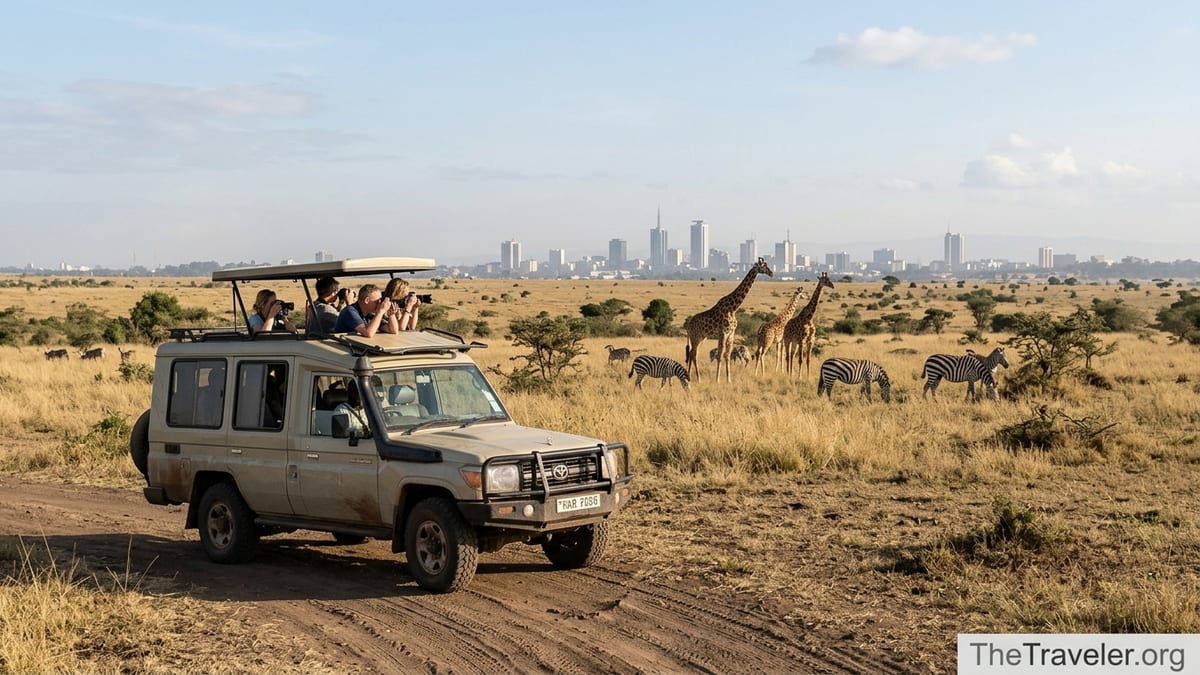
The most common and straightforward option is to book a dedicated Nairobi National Park layover tour with an established operator that provides airport pickup, park entry handling, and a professional safari guide in a proper game-viewing vehicle. Nairobi-based outfits such as Inside Nairobi Tours, Divine Travel Nest Safaris, AjKenyaSafaris and several others advertise JKIA layover packages that include a 4x4 or high-roof safari van with pop-up roof, driver-guide, bottled water, and hotel or airport transfers.
Prices vary by operator, vehicle class, and group size, but as of mid-2026 many half-day layover safaris around Nairobi National Park tend to fall in a ballpark of roughly 150 to 250 US dollars per person for a private trip for one or two guests, sometimes less if you join a small group. Some operators quote a flat vehicle rate, such as around 200 to 300 US dollars for up to four or six passengers, excluding park fees. Always check exactly what is included and whether Kenya Wildlife Service park entry fees are paid directly at the gate or through your guide.
Organized tours bring two big advantages. First, your guide is familiar with park rules, gate systems, and current traffic conditions between the airport and the park. Second, if your inbound flight is delayed, a responsive local company can often adjust the schedule, shorten the drive, or in some cases reschedule to a city tour or hotel transfer if the safari becomes impossible. With a random taxi, you shoulder all the risk if timings slip or if the driver is unfamiliar with park procedures.
Luggage, Visas, and Airport Formalities on a Safari Layover
Luggage is one of the most practical concerns for layover safaris. If your bags are checked through to your final destination on the same airline alliance, you can often leave them in transit and only carry your hand luggage out of the terminal. If you have to collect bags at JKIA and re-check them later, the extra handling time will eat into your margin and may make a short layover safari less advisable.
For those with bulky or valuable baggage, Jomo Kenyatta International Airport offers on-site luggage storage facilities. Official airport services detail short-term storage options in the terminal complex, allowing travelers to leave larger suitcases securely at the airport while they head out with just a small daypack and camera. Prices are charged per bag and per time period, so it is worth confirming current rates with the airport information desks on arrival.
Immigration and entry requirements also matter. Most travelers from outside East Africa require either a visa or an electronic travel authorization to enter Kenya, even if leaving the airport for only a few hours. Kenya has been moving toward an eTA system for many nationalities, and local safari operators advise applying online several days before travel. Without the correct authorization, you may be restricted to the international transit area and unable to exit for a park visit.
On your return from the park, you will re-enter normal airport security and, if changing airlines or checking bags, standard check-in counters. Arriving back 2.5 to 3 hours before an international departure is usually a comfortable cushion. That said, peak times at security and immigration can lengthen queues, especially in the evening departure wave, so it is safer to err on the side of an early return rather than squeezing in a final 20 minutes of game viewing.
Early Morning Arrivals, Airport Hotels, and Overnight Options
Early morning is often the sweet spot for layover safaris. International flights from Europe and the Middle East frequently land at JKIA between about 4:00 a.m. and 7:00 a.m. If you arrive in this window, clear formalities promptly, and have a midday or afternoon onward connection, you can often fit a full early-morning game drive into your stop. Several tour companies specifically market “5:00 a.m. arrival, 2:00 p.m. departure” sample itineraries that start their pickups as soon as you exit customs.
If you arrive in the late evening and have a long layover that includes an overnight, an airport hotel can bridge the gap. Properties such as the Four Points by Sheraton Nairobi Airport, Crowne Plaza Nairobi Airport, and budget-friendly options close to the terminal provide comfortable rooms, airport shuttles, and early breakfast. A common pattern is to arrive late at night, sleep a few hours at an airport hotel, then be collected at 5:30 or 6:00 a.m. for a sunrise safari in Nairobi National Park before being returned in time for a late-morning or afternoon onward flight.
Another overnight option is to stay in the wider Nairobi area and treat your “layover” like a very short city break. Hotels closer to the park or along the Southern Bypass can position you for a quick early-morning transfer into the park. For instance, some travelers choose lodges on the city’s southern fringe, combining a night’s rest with views toward the park plains or short transfers to nearby attractions like the Giraffe Centre and Karen Blixen Museum if their layover extends beyond a single day.
If your onward flight is late at night, you could even reverse the pattern: check into a day room at an airport hotel after your arrival, rest and shower, then head out for an afternoon safari, returning in the early evening to collect your luggage and check in for your overnight departure. It all comes down to matching hotel check-in and check-out times with park hours and your personal tolerance for sleep disruption.
Costs, Park Fees, and Managing Expectations on a Short Safari
Even on a layover, a visit to Nairobi National Park is a real safari, with real wildlife and corresponding costs. Kenya Wildlife Service maintains a tiered fee structure for park entry, with different rates for Kenyan citizens, residents, and international visitors. Foreign adult visitors pay a higher fee than local residents, and these charges are usually on a per-day basis. Exact rates change periodically, so reputable operators will quote current park fees separately or build them into an all-inclusive price.
On top of park fees, expect to pay for your vehicle, guide, and transfers. A typical private half-day game drive vehicle might cost the equivalent of a couple of hundred US dollars, which, when split among three or four people, becomes relatively affordable per person. If you prefer a fully private 4x4 with a rooftop viewing hatch rather than a shared minivan, the cost rises, but the comfort and sightlines often justify the premium, especially for keen photographers.
For many travelers, the question is whether a short layover safari will “feel worth it” compared with a longer multi-day trip later. Nairobi National Park has an impressive checklist of wildlife, including lion, black rhino, buffalo, giraffe, hippo, crocodile, and abundant plains game, and sightings of several of these are common on a well-timed 3-hour drive. However, there is never a guarantee you will see every iconic species. Cats can be elusive, and rhinos may remain in thickets. Going in with a sense of curiosity rather than a rigid checklist makes it easier to enjoy whatever the park offers on the day.
What almost every visitor does gain is the surreal experience of watching wild animals move across open savanna with Nairobi’s skyscrapers in the distance. For layover travelers who may not have another chance to visit a wildlife reserve in East Africa, that alone can justify the logistics and expense of leaving the airport for a few hours.
Common Pitfalls and How to Maximize Your Short Time
The most common mistake on a layover safari is underestimating how long airport formalities and city traffic can take. Immigration queues can fluctuate dramatically depending on how many long-haul flights land at once, while early-morning or late-afternoon traffic surges on major highways around the airport can add 20 to 40 minutes to an otherwise short drive. Booking with a local operator that tracks real-time traffic and is used to meeting flights at JKIA helps reduce these unknowns.
Communication with your tour company is critical. Always share your flight numbers, arrival and departure times, and whether your luggage is checked through or must be collected. Confirm in writing where exactly your driver will meet you. On the day, if your inbound flight is delayed, send a quick message via WhatsApp or another agreed channel as soon as you have airport Wi-Fi. Many companies will adjust the route, shorten the drive, or suggest an alternative Nairobi city tour if the park becomes impossible due to timing.
Another pitfall is packing poorly. Nairobi’s mornings can be cool, especially in July and August, while mid-morning sun can be strong. A light jacket, hat, sunscreen, and a simple camera or smartphone are usually sufficient. Most vehicles provide drinking water, but it is wise to confirm. Avoid bringing valuables you do not need. If you plan to use airport luggage storage, keep passports, onward boarding passes, and essentials in a small daypack that stays with you at all times.
Finally, be realistic about fatigue. If you have already flown overnight and are facing another long-haul segment, a 6:00 a.m. game drive immediately after landing may leave you exhausted. For some travelers, a quiet airport hotel room, shower, and a few hours of sleep will be more restorative than a dash to the park. For others, the chance to see a wild rhino or a pride of lions on the edge of a capital city is exactly the burst of excitement that makes a long travel day feel memorable.
The Takeaway
Thanks to the rare geography of Nairobi National Park hovering practically on the doorstep of Jomo Kenyatta International Airport, a layover safari here is not a marketing gimmick but a genuine possibility. With 6 to 10 hours between flights, a valid visa or eTA, and a bit of planning, you can leave the terminal, track lions and rhinos for a few hours, and still make your onward flight on time.
The key is to be honest about your timing, book with a reputable Nairobi operator that understands airport logistics, and communicate clearly around flight delays, luggage, and pickup points. A well-run layover tour will factor in park hours, traffic, and immigration formalities so you do not have to track every minute yourself.
Even if your schedule ends up too tight for a park visit, the same operators can often pivot to a shorter Nairobi city tour, a visit to a local restaurant, or simply a comfortable hotel transfer. Either way, treating your layover as potential bonus time rather than wasted hours in a terminal opens up experiences that most travelers never realize are possible.
For those who do make it to Nairobi National Park between flights, the memory tends to linger: the silhouette of the city skyline behind grazing giraffe, the rumble of planes overhead as zebras cross the track, and the quiet thrill of realizing that a routine connection turned into an authentic African safari.
FAQ
Q1. What is the minimum layover time needed to do a Nairobi National Park safari from JKIA?
Most travelers should aim for at least a 6 to 7 hour layover to allow time for immigration, transfers, a 2.5 to 3 hour game drive, and a safe return to the airport.
Q2. Can I do a layover safari if my bags are checked through to my final destination?
Yes. If your luggage is checked through, you can usually leave it in transit and exit with only your hand luggage, which makes a short safari much easier logistically.
Q3. Are there luggage storage services at Jomo Kenyatta International Airport?
Yes, JKIA offers short-term luggage storage facilities inside the terminal complex, allowing you to store suitcases securely and head to the park with only a small daypack.
Q4. Do I need a visa or electronic travel authorization for a layover safari in Nairobi?
In most cases, yes. Even if you leave the airport for only a few hours, you must comply with Kenya’s entry requirements, which for many nationalities now involve an electronic travel authorization obtained before travel.
Q5. Is it better to book a layover safari in advance or on arrival?
Advance booking is strongly recommended. It allows an operator to plan around your flight times, advise honestly on feasibility, and meet you promptly at arrivals with a vehicle and guide ready.
Q6. What time of day is best for a layover safari at Nairobi National Park?
Early morning, just after the park opens around 6:00 a.m., usually offers the most active wildlife and cooler temperatures. Many layover tours are designed around sunrise game drives.
Q7. How much does a typical Nairobi layover safari cost?
Prices vary, but many half-day private layover safaris fall in a broad range of about 150 to 250 US dollars per person, depending on group size, vehicle type, and whether park fees are included.
Q8. Can I use a regular city taxi or ride-hailing app instead of an organized tour?
It is possible but not ideal. Many city drivers are not licensed safari guides and may be unfamiliar with park rules or wildlife routes. A dedicated safari operator provides a proper game-viewing vehicle and experienced guide.
Q9. What wildlife can I realistically expect to see on a short layover safari?
Common sightings include giraffe, zebra, buffalo, various antelope, and often black or white rhino. Lions and other big cats are present but never guaranteed, especially on a brief visit.
Q10. What happens if my inbound flight is delayed and I miss the start of my safari?
If you booked with a flexible local operator, they will usually try to shorten or reschedule the tour or offer an alternative like a city drive. With a tight layover, a major delay may make a park visit impossible, so clear communication with your operator is essential.