


Korčula sits only about 75 nautical miles northwest of Dubrovnik, close enough to combine both in a single trip yet far enough to feel like a different world. With multiple summer catamarans, year-round ferries via the Pelješac Peninsula, and a growing number of private transfer options, getting from Dubrovnik to Korčula has never been easier. This guide walks you through the main routes, seasonal ferry schedules, realistic travel times, luggage rules, and whether Korčula truly works as a day trip from Dubrovnik.
Get the latest updates straight to your inbox!
Understanding the Dubrovnik to Korčula Route
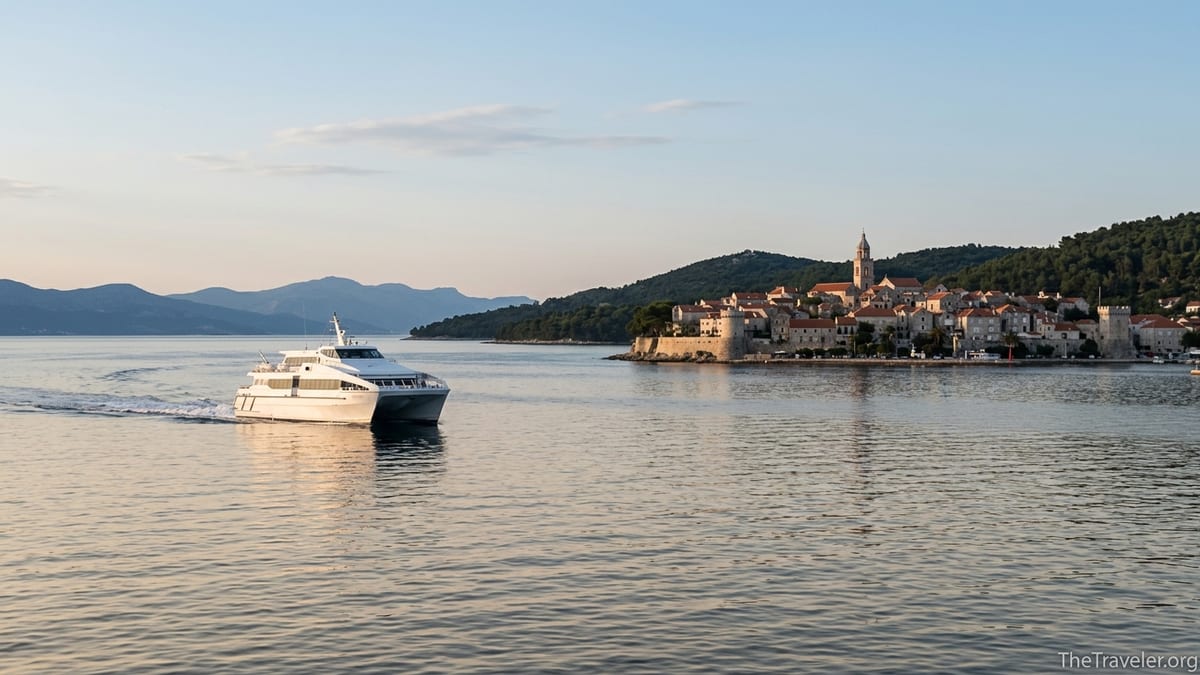
The straight-line distance from Dubrovnik to Korčula is relatively short, and fast passenger catamarans cover the route in roughly 1 hour 55 minutes to just over 2 hours. In practice, your total door-to-door time is longer once you factor in getting to Dubrovnik’s Gruž ferry port, boarding procedures, and walking or transferring on arrival in Korčula Town. Most travelers should assume around 3 hours door to door each way when using a direct catamaran.
There are two main ways to reach Korčula from Dubrovnik. The first is the direct foot-passenger catamarans that run between Dubrovnik (Gruž) and Korčula Town. The second is the combination route via Orebić on the Pelješac Peninsula, where you drive or take a bus from Dubrovnik to Orebić, then cross the narrow channel by car ferry or passenger boat to Korčula. Both options have pros and cons depending on season, budget, and whether you are traveling with a car.
In summer 2026, the direct Dubrovnik–Korčula route is served by several fast-ferry companies, including TP Line, Krilo (Kapetan Luka) and Krilo Shipping Company. These operators typically run multiple daily sailings between late spring and late autumn, with up to around 7 crossings on peak days in July and August and reduced frequencies in shoulder season. Outside of the high season, the number of direct boats drops substantially, and in winter you may rely on a once-daily ferry or the more flexible Orebić route.
Because schedules change each year and even within the same season, it is essential to confirm departure times and operating dates for your exact travel day. Catamaran operators publish 2026 timetables in advance, but they always note that sailing schedules are subject to change, especially in early and late season and during bad weather. Treat any written schedule as a strong guideline rather than an unbreakable guarantee, and build some flexibility into your plans.
Direct Catamarans from Dubrovnik to Korčula
For most foot passengers traveling between April and October, a direct fast catamaran is the simplest and most comfortable way to reach Korčula. Boats depart from Dubrovnik’s Gruž port, a short bus or taxi ride from the Old Town. On Korčula, they normally arrive at the main port by Korčula Town’s historic center, though depending on the operator and day they may occasionally use different quays on the east or west side of the harbor.
Typical journey times on direct ferries range from about 1 hour 55 minutes to just over 2 hours. A commonly seen pattern in high summer is a morning departure from Dubrovnik around 8:00 or 9:00, a late morning or early afternoon sailing, and a mid-afternoon boat around 14:00 to 15:30. For example, one recent schedule pattern showed three daily fast ferries leaving Dubrovnik between roughly 08:00 and 15:30, all arriving in Korčula within about 2 hours. Exact times and operating dates vary by company and month, so always check the current season’s timetable.
Prices for the direct route are competitive between operators. As a concrete reference, a 2026 Krilo Shipping Company fare for the Dubrovnik–Korčula segment is listed at around 30 euros one way for adults, with children aged 3 to 12 paying about half that and infants traveling free when seated on a parent’s lap. Other operators on the same route tend to be in a similar price band, typically in the high 20s to low 30s of euros for a one-way adult ticket during peak season.
On board, these catamarans operate like simple passenger ferries rather than cruise ships. Expect indoor seating in airplane-style rows, limited outdoor space, and basic facilities such as restrooms and a small bar counter or vending machines on some vessels. There is no business-class section on the Dubrovnik–Korčula fast ferries, and food options are minimal, so many travelers grab a coffee and snack in Gruž before boarding and bring water with them. Because these are foot-passenger catamarans, you cannot take a car on the direct ferries; anyone traveling with a vehicle must route via Orebić.
Seasonal Schedules and When to Book
Ferry service between Dubrovnik and Korčula is heavily seasonal. From roughly June through early September, there can be several direct catamarans daily operated by TP Line and the two Krilo companies, plus additional longer routes from Split or Lastovo that stop in Korčula on their way to or from Dubrovnik. In this period it is possible, for instance, to leave Dubrovnik mid-morning and arrive in Korčula just before lunchtime, then return to Dubrovnik in the late afternoon or early evening on a different operator’s boat.
In shoulder months such as April, May and October, frequencies drop. A typical pattern is one or two daily direct boats, often a morning departure from Dubrovnik and an afternoon return from Korčula. This still works well for one-way travel or for travelers changing bases, but it narrows your ability to treat Korčula as a straightforward day trip. In late autumn and winter, the route generally operates with a minimal once-daily service, or is replaced by different multi-stop lines. Winter sailings are more prone to weather cancellations and are best suited to travelers who can spend at least one night on the island.
Because high-season sailings are very popular with both tourists and locals, advance booking is strongly recommended. Many travelers in July and August report that popular midday sailings sell out several days ahead, especially on weekends and around Croatian public holidays. If, for example, you want to travel from Dubrovnik to Korčula on a Saturday in late July and catch a specific morning ferry in order to connect to an afternoon wine tour in Lumbarda, purchasing tickets as soon as your dates are fixed will avoid last-minute stress.
Shoulder season is more forgiving, but even then it is sensible to buy tickets at least a day or two before travel if your schedule is tight. Tickets can be purchased online through the ferry companies or via local ticket agents in Dubrovnik and Korčula. If you are flexible about departure times and do not mind waiting for the next available catamaran, same-day purchase at the port can still work, especially in May and October, but you should have a plan B in case your first-choice sailing is fully booked or cancelled due to weather.
Via Orebić: Buses, Car Ferries and Private Transfers
Traveling via Orebić on the Pelješac Peninsula is the most flexible route, especially for those with a rental car or those traveling outside peak summer schedules. The road distance from Dubrovnik to Orebić is around 120 kilometers, using the modern Pelješac Bridge to bypass the short stretch of Bosnian coastline, and the drive usually takes about 2.5 hours in normal traffic. From Orebić, car ferries and passenger boats cross the narrow Pelješac Channel to Korčula in approximately 15 to 20 minutes.
If you are driving yourself, the typical pattern is to leave Dubrovnik after breakfast, reach Orebić by late morning or midday, and take one of the frequent Jadrolinija car ferries to Dominče, the main car-ferry port a short drive from Korčula Town. In high season, this ferry runs many times per day, often with departures roughly every hour or so during busy periods. For example, an official 2026 fare overview for the Orebić–Dominče line shows standard car and passenger ticket prices and notes that the schedule is subject to change, but in practice locals treat it almost like a shuttle link.
Bus and ferry combinations also work well on this route. Daily buses run between Dubrovnik and Orebić, stopping at towns along the Pelješac Peninsula such as Ston. Travel time by bus is similar to driving yourself, often between 2.5 and 3 hours, depending on traffic and intermediate stops. From Orebić you can either walk or taxi to the nearest quay and board the passenger boat directly to Korčula Town or the car ferry if you have a vehicle. Many independent travelers use this combination when direct catamaran times do not suit them or when they want to explore Pelješac wineries en route.
Private transfers via Orebić are increasingly common, particularly for small groups or families with luggage. Many Dubrovnik-based transfer companies offer door-to-door service that includes a driver picking you up at your accommodation, driving to Orebić, then helping you board the ferry. Some companies coordinate with partners on Korčula who meet you on the other side and complete the transfer to your hotel or apartment. Prices vary considerably, but as a rough example, a private car transfer for two to three people from Dubrovnik to Orebić might fall in the range of 200 to 300 euros, not including the ferry ticket, with larger vans for families or groups costing more. For four or more travelers, this can be cost-effective compared with multiple catamaran tickets, especially when you value comfort and door-to-door service.
Luggage Rules, Onboard Comfort and Practical Tips
Luggage policies on the Dubrovnik–Korčula ferries are generally straightforward, but there are differences between operators. As a practical reference, one major operator on the route, Kapetan Luka–Krilo, allows passengers to bring up to about 23 kilograms of luggage included in the ticket, typically understood as one large suitcase plus a small cabin bag. Oversized or additional items may incur a small fee or be refused if there is no space. Other companies on the route have similar limits, and all emphasize that luggage is carried at the owner’s risk.
On fast catamarans, luggage is usually stored in designated racks near the entrance or in front of rows of seats. You carry your own bags on and off the boat, and there is no porter service as standard. For this reason, it is worth packing so you can comfortably manage your own suitcase on stairs, gangways and uneven quays. If you are traveling with heavy or bulky gear like diving equipment, a folding stroller or sports equipment, consider contacting the ferry company in advance to confirm what is allowed and if any extra charges apply.
Car ferries between Orebić and Korčula are more forgiving with luggage since most travelers leave their bags in the vehicle for the short crossing. Foot passengers using these ferries can bring standard suitcases and backpacks without issue, and the short 15 to 20 minute journey means you seldom need much more than a daypack on deck. The key difference is that, unlike on catamarans, you might spend time loading and unloading vehicles, and stairs between vehicle decks and passenger lounges can be steep.
A few simple habits will make the journey smoother. Arrive at the port at least 30 minutes before departure, as requested in many catamaran timetables, especially in July and August when queues are longer. Keep your ticket and ID handy for inspection on boarding. In Gruž, it is wise to arrive even earlier if you still need to buy tickets, as lines at ticket offices and kiosks can form when multiple ferries leave around the same time. In Korčula, note that some catamarans may use different sides of the harbor depending on the day, so check the screens or ask staff to confirm the exact boarding point.
Is Korčula Realistic as a Day Trip from Dubrovnik?
Whether Korčula works as a day trip from Dubrovnik depends heavily on the time of year and your expectations. In peak summer, when there are multiple fast ferries daily, it is technically possible to leave Dubrovnik in the morning, spend several hours in Korčula Town, and return in the evening. For example, a traveler might take an 8:00 or 9:00 catamaran from Gruž, arrive in Korčula just before 11:00, explore the medieval streets, have lunch overlooking the channel, perhaps fit in a quick swim at a nearby beach, and then catch a mid- to late-afternoon boat back, returning to Dubrovnik early evening.
This makes for a long but rewarding day, particularly if your goal is to get a taste of Korčula Town rather than to explore the entire island. It works best for those who are comfortable with early starts, do not mind scheduling their day tightly around fixed boat times, and understand that any delay or cancellation could disrupt the plan. Travelers who have used this approach often comment that the day feels full but feasible, and some combine it with a short taxi ride to Lumbarda’s sandy beaches or a local winery if ferry times align.
Outside peak season, however, Korčula is less practical as a same-day hit. If there is only one morning catamaran from Dubrovnik and a single afternoon return from Korčula, your time on the island shrinks and your options disappear if one of the sailings is cancelled due to wind or rough seas. In shoulder months like May or October, you may still manage a day trip, but it usually requires careful coordination of schedules and a willingness to adapt, perhaps returning via Orebić and bus instead of your original planned ferry if conditions change.
In winter, Korčula is best approached as an overnight or multi-night destination from Dubrovnik. Limited ferry frequencies, early nightfall and a higher risk of weather-related disruptions mean that a rushed day trip can feel more anxious than enjoyable. The island has enough to offer in terms of historic architecture, wine, and quiet coastal walks that most travelers who invest the effort to reach it prefer to spend at least one or two nights, even in summer. As a rule of thumb, treat Korčula as a day trip only if you are traveling in peak season, have checked the current year’s schedules carefully, and are happy to keep the day focused and simple.
Sample Itineraries and Real-World Scenarios
To visualize how these options play out, consider a couple visiting Dubrovnik in late July who want to experience Korčula but are short on time. They decide to use direct catamarans both ways. They book an 8:00 departure from Gruž with a journey time of about 2 hours, arriving in Korčula Town shortly after 10:00. After coffee on the seafront, they join a late-morning walking tour of the Old Town, visit St. Mark’s Cathedral, and enjoy lunch at a terrace restaurant facing the Pelješac Peninsula. In mid-afternoon they stroll to a nearby beach for a quick swim, then catch a 17:30 ferry back, arriving in Dubrovnik around 19:30. It is a long day, but with roughly seven hours on the island, they feel the trip was worthwhile.
Now imagine a family traveling in early May with a rental car and two children. Instead of relying on the reduced spring catamaran schedule, they choose the Orebić route. Leaving Dubrovnik around 9:00, they drive across the Pelješac Bridge and stop in Ston to climb a portion of the famous walls and buy oysters from a local stand. They reach Orebić just before noon, catch a midday Jadrolinija car ferry to Dominče, and arrive in Korčula with their vehicle, giving them flexibility to reach Lumbarda’s shallow beaches and inland villages. After two nights on the island, they return to Dubrovnik via the same route, timing their drive to enjoy a late lunch at a Pelješac winery on the way back.
For a small group of friends traveling in shoulder season, a private transfer may offer the right balance between comfort and efficiency. Four travelers share a prebooked van from Dubrovnik to Orebić for roughly the same cost as four high-season catamaran tickets. The driver picks them up at their apartment in Dubrovnik, handles luggage, and sets a relaxed pace with a coffee stop along the peninsula. In Orebić, the driver helps them load bags onto the ferry, then a partner driver meets them at Dominče to deliver them to a hillside villa near Korčula Town. While more expensive than public buses, the convenience and door-to-door timing make the overall journey less stressful, especially if they are carrying wine or olive oil purchases on the return.
These examples underline a key point: there is no single best route for everyone. Solo travelers and couples in peak season often favour direct fast ferries for simplicity, while families, those with cars, and off-season visitors may prefer the flexibility and scenic variety of the Orebić combination. Whichever option you choose, planning around current-year schedules and building in a margin for delays will make your journey from Dubrovnik to Korčula smoother and more enjoyable.
FAQ
Q1. How long does the ferry from Dubrovnik to Korčula take?
The direct fast ferries usually take around 1 hour 55 minutes to just over 2 hours between Dubrovnik’s Gruž port and Korčula Town. Including getting to and from the ports, most travelers should allow about 3 hours door to door each way.
Q2. How much does a Dubrovnik to Korčula ferry ticket cost?
In summer 2026, adult one-way tickets on the direct catamarans typically cost around 30 euros, with children paying about half that and infants often traveling free on a parent’s lap. Prices can vary slightly between operators and seasons.
Q3. Do the Dubrovnik–Korčula ferries run all year?
Yes, the route is active year-round, but frequencies change with the seasons. In summer there can be several daily fast ferries, while in winter you may find only a single daily sailing or need to rely more on the Orebić route.
Q4. Can I take a car on the direct Dubrovnik–Korčula ferry?
No. The direct ferries between Dubrovnik and Korčula Town are passenger-only catamarans. If you are traveling with a car, you must go via Orebić on the Pelješac Peninsula and use the Jadrolinija car ferry to Dominče near Korčula Town.
Q5. Is Korčula a good day trip from Dubrovnik?
Korčula can work as a day trip in peak summer when multiple fast ferries operate, giving you several hours on the island. Outside high season, limited sailings and higher risk of cancellations make it more practical as an overnight stay.
Q6. How early should I arrive at the port before my ferry?
Most operators advise arriving at least 30 minutes before departure, and in July and August it is wise to be there even earlier if you still need to buy tickets. For car ferries via Orebić, aim to join the vehicle queue well ahead of busy weekend or holiday sailings.
Q7. What are the luggage limits on Dubrovnik–Korčula catamarans?
Policies vary slightly, but a common rule is one piece of luggage up to around 23 kilograms plus a small cabin bag per passenger. Oversized or extra bags may incur a fee or be refused if space is limited, so pack so you can comfortably carry your own items on board.
Q8. Do I need to book Dubrovnik–Korčula ferries in advance?
Advance booking is strongly recommended in high season, especially for popular morning and afternoon sailings which can sell out days ahead. In shoulder season you may sometimes buy tickets on the day, but prebooking is still wise if your schedule is tight.
Q9. What happens if my ferry is cancelled due to bad weather?
If a sailing is cancelled, operators usually transfer you to the next available departure or refund your ticket. In peak summer there may be another boat the same day, but in shoulder or low season a cancellation could delay your travel until the following day or require rerouting via Orebić and bus.
Q10. Is it better to visit Korčula before or after Dubrovnik?
There is no single right order, but many itineraries flow northward from Dubrovnik to Korčula and onward toward Hvar and Split. Starting in Dubrovnik, then spending a few days on Korčula before continuing up the coast, fits well with most ferry routes and keeps backtracking to a minimum.