


More news on this day
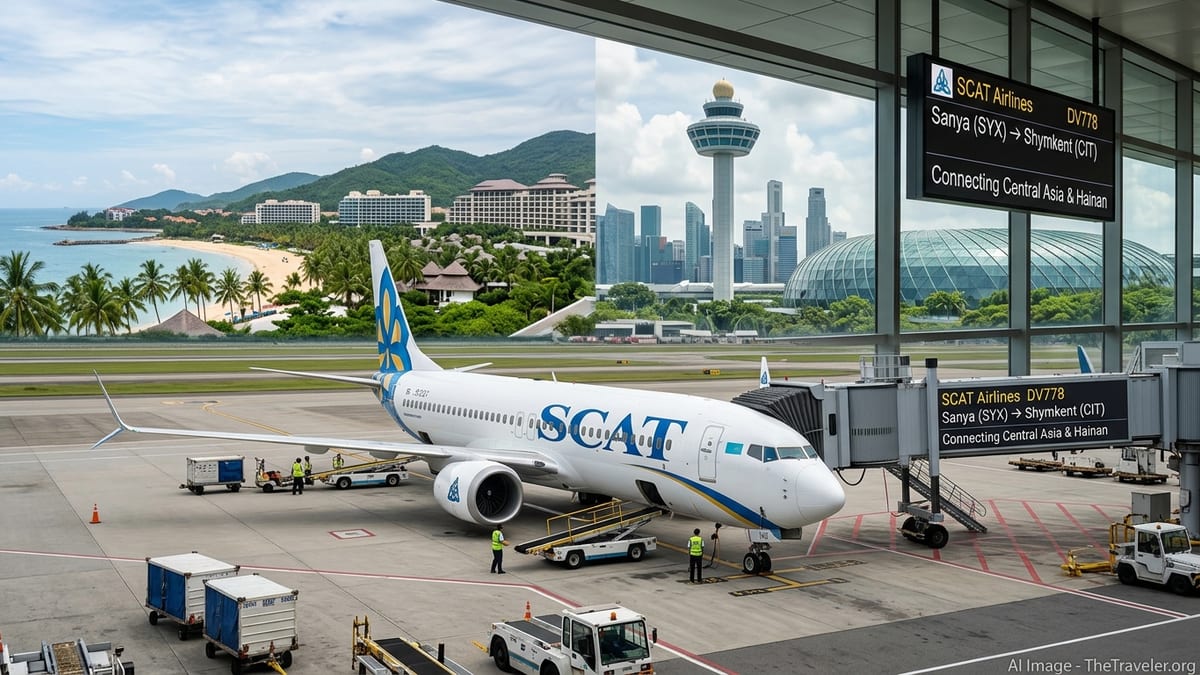
SCAT Airlines has begun operating a new fifth-freedom route linking Shymkent in southern Kazakhstan with China’s Sanya and Singapore Changi, offering twice-weekly Boeing 737-8 flights that connect Central Asia, Hainan and Southeast Asia on a single service.
Get the latest news straight to your inbox!
What the new route offers travelers
According to Kazakhstan’s Civil Aviation Committee, SCAT Airlines launched the Shymkent–Sanya–Singapore service on 20 October 2026, operating twice a week under fifth-freedom traffic rights via Sanya in Hainan province. The routing connects Shymkent (CIT), Sanya (SYX) and Singapore Changi (SIN) on one scheduled service, with tickets available for travel both between Kazakhstan and Singapore and between Sanya and Singapore.
Industry schedule data and SCAT’s own announcement confirm that the route is operated with Boeing 737-8/MAX 8 narrowbody aircraft throughout. In practice, this means a single aircraft and flight number across both sectors, giving passengers from Central Asia a one-carrier option to reach Singapore while also adding a new China–Singapore city pair operated by a Kazakh airline.
Changi Airport has highlighted the new link as its first direct connection to Central Asia since 2019, positioning Shymkent as a new entry point for Singapore-based travelers heading into the region. For passengers starting in Kazakhstan, the flight provides non-stop access to Sanya plus a same-aircraft continuation to Southeast Asia’s largest international hub.
Schedule, timings and aircraft details
Filed schedules for the northern winter 2026/27 season show flight DV777 operating CIT–SYX–SIN and return flight DV778 operating SIN–SYX–CIT twice weekly. Typical timings place the Shymkent–Sanya sector at roughly three hours of flying time, followed by a ground stop in Sanya of about 1.5 to 2 hours before the onward leg of around six and a half hours to Singapore. Exact departure and arrival times vary by operating day and should be checked at booking, as airlines may adjust timings within the season.
SCAT specifies Boeing 737 MAX 8 equipment on the route, consistent with multiple schedule providers that list the aircraft type for every CIT–SYX and SYX–SIN segment now in operation. The airline describes the service as using “modern Boeing 737 MAX 8 aircraft” but has not published full seating layouts or a detailed cabin description for this route; travelers can reasonably expect an all-economy or economy-led configuration typical of SCAT’s regional and medium-haul international network, though exact seat counts and amenities are not disclosed.
Public timetable data indicate that the flights currently operate twice weekly rather than daily, with services clustered on two days of the week in each direction. While aviation databases broadly agree on aircraft type and frequency, potential passengers should rely on SCAT’s booking engine or a travel agent using a global distribution system for the latest filed schedule, including any seasonal variations or additional dates beyond the northern winter period.
Transit via Sanya and new China–Singapore option
The new routing relies on fifth-freedom traffic rights granted via Sanya, which allow SCAT to sell tickets not only between Kazakhstan and Singapore but also on the Sanya–Singapore sector alone. Kazakhstan’s Civil Aviation Committee has underlined that this arrangement emerged from coordination between Kazakhstan’s Ministry of Transport, Chinese authorities and Singaporean regulators, reflecting a trilateral framework rather than a simple overflight or technical stop.
For through-passengers traveling between Shymkent and Singapore, trade publications and airport messaging describe Sanya as a brief technical and transit stop, generally around 90 minutes, during which travelers remain within the international transit area. These accounts note that passengers do not normally clear Chinese passport control when simply transiting to or from Singapore, but they do not provide a comprehensive statement on visa rules or the possibility of planned stopovers. Travelers who intend to enter Hainan rather than remain in transit should therefore check current Chinese entry and visa policies in advance.
On the local market, the same SCAT flight creates a new scheduled link between Sanya and Singapore, adding another option alongside Chinese and Singaporean carriers that already connect Hainan and Southeast Asia through a mix of direct and connecting services. Because SCAT’s operation is built on a Kazakhstan–China–Singapore pattern with a narrowbody aircraft, its capacity is modest compared with widebody operators, but it provides an additional choice for passengers seeking specific timings or through-tickets to Central Asia.
Impact on connectivity for Central Asia, Hainan and Singapore
For Kazakhstan, the Shymkent–Sanya–Singapore route represents a further step in positioning the country as a regional transit point. The Civil Aviation Committee has framed the service as supporting tourism flows, investment links and wider business ties with Singapore, while also strengthening air access to southern China. Shymkent’s role as the airline’s home base and a growing regional hub aligns with broader government efforts to expand international connectivity from cities beyond Astana and Almaty.
Singapore gains a renewed non-stop link, via a short transit, to Central Asia as well as a new point-to-point connection to Sanya operated by a foreign carrier. For travelers based in Singapore, the route adds an alternative gateway into Kazakhstan’s south, from which SCAT and other airlines offer domestic services onward to cities such as Almaty and Astana. This can shorten total journey times compared with itineraries that route via larger hubs in the Gulf or Europe, particularly for trips focused on southern Kazakhstan or nearby Silk Road destinations.
For Hainan, the service increases international visibility for Sanya Phoenix International Airport as a stop on longer regional routes. SCAT already uses Sanya as one of several international points in its network, and the new service embeds the resort city within a multi-country itinerary that may attract both leisure and niche business travel segments. At the same time, the scale remains limited to two weekly rotations, so the route should be viewed as a targeted addition rather than evidence of a broad surge in Kazakhstan–China–Singapore traffic.
What travelers should check next
With the route now in operation, the main variables for travelers are schedules, fares and any adjustments to operating days for the remainder of the winter 2026/27 season and beyond. SCAT’s announcement sets out a twice-weekly pattern, and current timetable data confirm Boeing 737-8/MAX 8 aircraft on the route, but airlines routinely fine-tune timetables in response to demand and operational considerations, so passengers should reconfirm departure and arrival times close to travel.
SCAT has published starting fares in Kazakhstani tenge and noted that tickets are on sale through its website and distribution partners, yet pricing appears to vary significantly by date and point of origin. Travelers are advised to compare one-way and return options originating in Singapore, Sanya and Shymkent, paying particular attention to fare conditions such as change penalties, baggage allowances and refund rules, which can differ across booking classes even on the same flight.
Given that details of onboard service, seat configuration and transit formalities in Sanya remain only partially described in official and trade sources, passengers with specific needs, such as families requiring extra assistance or travelers planning to enter China during the journey, should seek confirmation directly from the airline or relevant authorities. As the service beds in over its first full season, additional operational information is likely to emerge, and travelers booking further in advance should watch for any updates to aircraft type, frequency or routing before departure.