


More news on this day
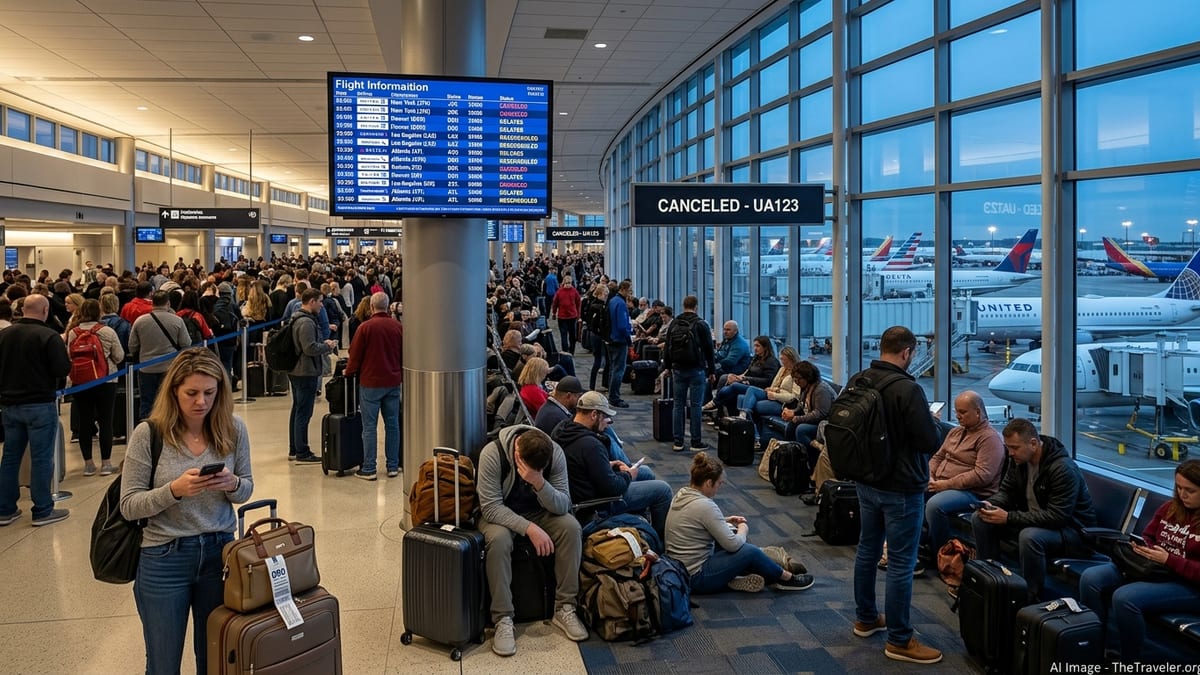
Millions of Americans heading to the skies for Thanksgiving this week are flying into an air travel system still recovering from a nationwide Federal Aviation Administration ground stop on November 13 and two separate technology outages at United Airlines and Delta Air Lines. While officials say the underlying problems have been contained, the incidents highlight how vulnerable holiday travel remains to both federal infrastructure failures and airline-specific glitches.
Get the latest news straight to your inbox!
What has gone wrong in the run-up to Thanksgiving
The most disruptive incident came on November 13, when a telecommunications failure affected key communications and radar systems used by air traffic control, prompting the FAA to order a rare nationwide ground stop. According to the agency’s post-incident summary, the stop began in the mid-afternoon and lasted nearly five hours while engineers stabilized the network and verified that traffic could resume safely. Thousands of flights were canceled or delayed over the following days as airlines worked through the backlog.
Federal officials have since explained that instability in legacy parts of the FAA’s network, triggered by excessive data traffic through routers that bridge older analog and newer digital equipment, led to the disruption. The FAA says it has restored services and is working on targeted upgrades, but it has not projected a date by which the vulnerable components will be fully replaced. Airlines including American, Delta, United and Southwest have all warned investors that the weekend’s disruption will have a measurable impact on their quarterly results, underscoring the scale of the event.
On November 16, United Airlines experienced a separate technology failure that affected systems needed to dispatch departing flights, including tools that provide pilots with final weight information and other predeparture data. United told regulators and media the problem lasted roughly 60 to 90 minutes and was limited to departing flights, with no indication of a cybersecurity issue. Flights already in the air and those operated by its United Express partners continued to operate. Even so, the outage caused significant delays at major hubs such as Chicago O’Hare and San Francisco as departing traffic briefly stacked up.
Then, on Sunday November 22, Delta Air Lines encountered problems with its automated system for calculating aircraft weight and balance, a critical safety step before departure. The FAA said the issue lay within Delta’s own automation, not federal systems, but confirmed that the malfunction caused system-wide delays at the carrier. Flight-tracking services reported more than 1,000 delayed Delta flights on Sunday, and the airline and regulators said manual workarounds were deployed while the automation was restored on November 23.
Government response and what it covers
In the wake of the November 13 ground stop, the White House and Transportation Department have moved to reassure travelers ahead of the holiday rush. The administration has convened a cross-agency group that includes the FAA, the Department of Transportation, the Department of Defense and members of the intelligence community to review federal air traffic control infrastructure. Officials say the group has been meeting daily to identify vulnerabilities in the network, prioritize hardware and software replacements and review contingency plans if another critical component fails.
The focus of that work is the government-controlled side of the system: the telecommunications, radar and data networks that support air traffic control. The recent failures at United and Delta are separate, residing in each airline’s own operational technology such as load planning, crew applications and flight-planning systems. Regulators have emphasized that the federal review does not extend to private airline IT, though they are sharing technical findings that may be relevant across the industry.
On the consumer side, the Department of Transportation has also highlighted its existing rules and tools for passengers dealing with disruptions. Federal regulations give passengers on U.S. carriers a right to a refund of the ticket price when a flight is canceled or significantly changed and they choose not to travel. The department defines a significant delay, for the purposes of refunds, as arriving at a destination at least three hours late on a domestic itinerary or six hours late on an international trip when the passenger decides to forego the rebooked flight.
DOT’s online airline cancellation and delay dashboard compares what each major carrier has committed to provide when delays and cancellations are within the airline’s control. These commitments range from meal vouchers after certain delays to hotel accommodations for overnight disruptions, as well as ground transportation to those hotels in some cases. Weather and air traffic control problems typically fall outside those voluntary promises, meaning airlines often are not obliged to offer hotels or meals when the cause is clearly external to their operation.
How to reduce your risk of serious disruption
With the infrastructure under strain and airlines still working through the knock-on effects of recent outages, travel advisers say Thanksgiving flyers should assume a higher-than-usual risk of disruption and plan accordingly. The most basic step is to monitor your flight closely before leaving for the airport. Installing your airline’s app, logging in with your booking details and enabling notifications allows you to receive schedule changes, gate shifts and delay notices as soon as they are recorded in the system.
Independent flight-tracking tools can provide a second layer of awareness. Services such as FlightAware and Flightradar24 allow travelers to see where the aircraft operating their flight is coming from and whether that inbound segment is already delayed. If the plane assigned to your evening departure is still on the ground in another city late in the afternoon, it may be a signal to adjust your plans, seek an earlier reroute or at least prepare for a late arrival.
Building extra time into your itinerary is another practical safeguard. For those with flexibility, choosing an earlier departure on the same day gives more options to be rebooked if something goes wrong. Travelers connecting to international flights, cruises or long-distance rail should consider longer layovers than they might accept at quieter times of year. Nonstop flights remove the risk of misconnecting entirely, which can be particularly valuable on peak travel days when later options are heavily booked.
Some consumer advocates recommend having a concrete Plan B, especially when a missed flight would mean losing an important family event or nonrefundable booking. That can include researching alternate routings, nearby airports and other airlines’ schedules before you travel, so that you know what to ask for if your flight is canceled. In some cases, travelers with the means to do so purchase a fully refundable ticket on another airline for the same day, canceling it if the original flight operates as planned. Anyone considering that approach should read the fare rules carefully and be prepared for the temporary cost of holding two tickets.
Your rights when flights are delayed or canceled
Understanding when airlines must compensate or assist passengers can help travelers make quicker decisions during a disruption. Under federal rules, the clearest protection is the right to a cash refund when a flight is canceled or significantly changed and the passenger opts not to travel. That applies even when the ticket was sold as nonrefundable. Passengers who accept a rebooked itinerary and complete their trip generally are not entitled to an additional refund of the original fare on top of the replacement transportation.
The situation is more nuanced when it comes to meals, hotel rooms and other out-of-pocket costs. For problems within an airline’s control, such as many types of mechanical failures, crew mispositioning or some IT outages, carriers have made public commitments about what they will cover. These commitments differ by airline but can include vouchers for meals after a set delay threshold, free hotel accommodation for overnight disruptions and transportation between the airport and hotel. Travelers can check the Transportation Department’s dashboard in advance to see how each carrier compares and decide whether the trade-offs matter for their holiday plans.
By contrast, when the root cause is weather or government-directed air traffic control restrictions, airlines typically classify the event as outside their control and do not promise hotel rooms or meals. The November 13 FAA ground stop sits partly in this gray area: although the problem arose in a federal system rather than within an airline, passengers experiencing cancellations on that day still had refund rights if they chose not to travel, but most carriers treated hotel and meal expenses as the traveler’s responsibility.
Because of these distinctions, it is essential to keep detailed records whenever your trip is disrupted. Saving screenshots of delay and cancellation messages, photographing airport information boards, noting the reason provided by gate agents and retaining receipts for meals, hotels and ground transportation all strengthen your position if you later request reimbursement from the airline or file a claim with a travel insurer or credit card issuer.
Avoiding scams and strengthening your backup protections
The scramble to rebook during a major outage has created an opening for scammers who pose as airline customer service agents. Consumer advocates and travel editors report cases where passengers, searching online for an airline’s number during a disruption, have reached impostor call centers that demand payment for nonexistent change fees or steal card details. To reduce the risk, travelers are advised to contact airlines directly through official apps, logged-in websites or the phone numbers printed on the carrier’s own site or boarding pass, rather than through third-party search results or unsolicited links.
Financial protections can also help cushion the impact of a disrupted Thanksgiving trip. Many midrange and premium credit cards include built-in coverage for qualifying delays, cancellations or trip interruptions when the ticket is purchased with that card. Typical benefits reimburse reasonable expenses for meals, lodging and essentials after a delay that meets a set threshold, provided the disruption falls under covered reasons listed in the policy. Travelers should review their card’s guide to benefits before departure so they understand the documentation required and the types of situations that qualify.
Standalone travel insurance may provide broader or more predictable coverage, especially for longer or more expensive itineraries, but policies vary significantly. Travelers considering insurance should pay close attention to how the contract defines covered events, exclusions, maximum payouts and timing requirements for purchase. Known problems, such as an already-announced strike or a disruption that has already begun, are generally excluded from new policies. Those relying on insurance also need to document expenses carefully and obtain written confirmation from the airline that the delay or cancellation occurred.
On a practical level, assuming you might spend longer than expected in an airport or face an unplanned overnight stay can make disruptions more manageable. Keeping essential medications, a phone charger, travel documents, valuables and at least one change of clothes in your carry-on bag reduces the impact if checked luggage becomes temporarily inaccessible. Parents traveling with children may also want to pack extra snacks, entertainment and any comfort items that could ease a long wait during a busy and stressful travel period.
What Thanksgiving travelers should watch for next
Looking ahead through the Thanksgiving period, the key variables for air travelers are weather and the stability of both federal and airline technology systems. Forecasts suggest storms could affect parts of the country during the peak travel window, which would likely lead to additional delays and cancellations unrelated to the recent IT problems. Airlines have not announced any further system outages since Delta restored its automated weight and balance tools on November 23, but they have not provided detailed public timelines for longer-term fixes to the affected systems.
The FAA’s review of its telecommunications and radar infrastructure will continue beyond the holiday period, and any major hardware or software replacements are expected to take months rather than days. For passengers, the most immediate impact of that work is likely to come in the form of procedural changes behind the scenes, such as revised contingency plans or traffic management initiatives, rather than visible changes at airports. Officials say there is no evidence linking the recent series of technology incidents across different industries, but they acknowledge that the clustering of outages has highlighted how dependent modern air travel is on complex digital networks.
For those flying over Thanksgiving and into the December holidays, the most practical step is to stay informed and be ready to act quickly if conditions change. That includes confirming flight status before leaving for the airport, checking whether your airline has modified schedules or added waivers for itinerary changes in response to weather forecasts, and making sure you understand your refund and rebooking options ahead of time. By combining up-to-date information with realistic backup plans and careful documentation, travelers can better navigate a season shaped both by high demand and by the lingering ripple effects of November’s disruptions.