


More news on this day
Back-to-back technology outages at Delta Air Lines and United Airlines in mid-November 2026, coming just days after a rare nationwide U.S. ground stop, are intensifying pressure on carriers and regulators to prove that disruption playbooks, passenger notifications and compensation policies are keeping pace with increasingly fragile digital operations and record holiday travel demand.
Get the latest news straight to your inbox!
New automation failures hit Delta and United on eve of peak travel
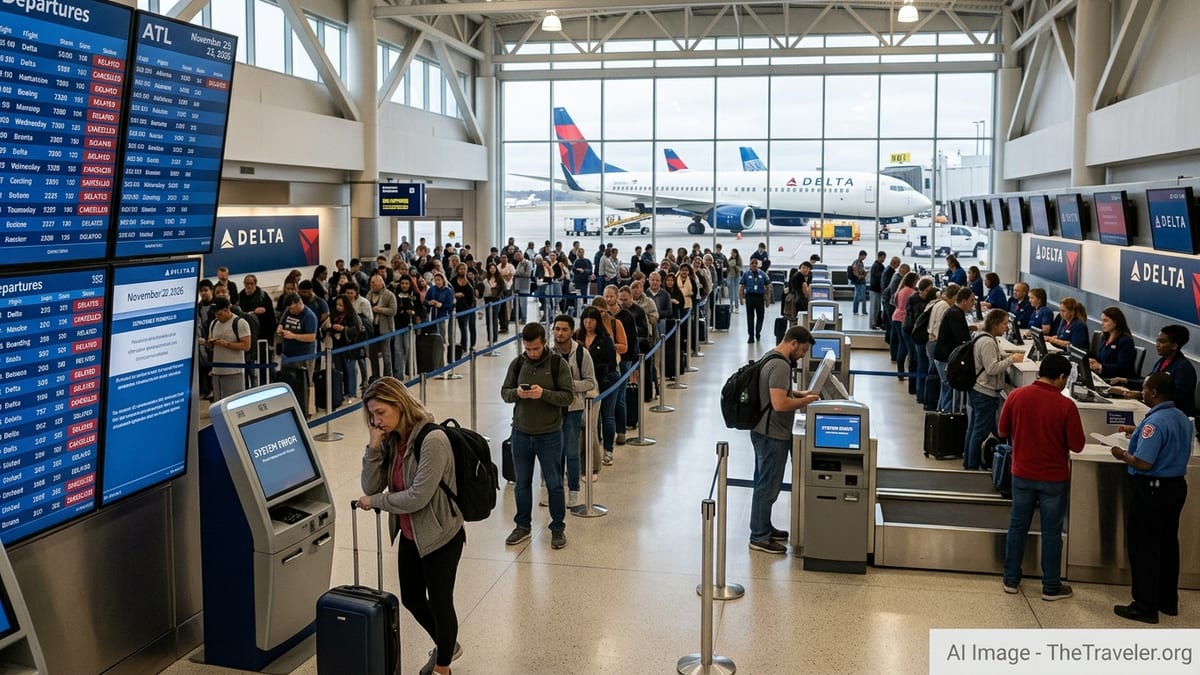
On Sunday 22 November 2026, Delta Air Lines suffered a malfunction in the automated system that calculates aircraft weight and balance, a mandatory safety check before every departure. The glitch triggered nationwide delays affecting more than 1,000 Delta flights, according to flight-tracking and airline statements, with operations gradually stabilizing later that day as the database issue was resolved.
The problem coincided with one of the busiest travel weeks of the year in the United States, pushing delays across Delta’s network and creating bottlenecks at Hartsfield–Jackson Atlanta International Airport, the carrier’s largest hub. The Federal Aviation Administration briefly halted some flights bound for Atlanta while the airline worked to restore its systems, before normal departure flows resumed as the automation tool came back online.
Delta has not reported any safety compromise related to the incident, and described the disruption as primarily operational. The carrier said most delays were traceable to the technology failure, with the remainder linked to poor weather. By Monday 23 November its public statements indicated that the system was again functioning and that rebooking and customer-care options were being offered under its existing policies.
The Delta outage followed a separate technology failure at United Airlines on Monday 16 November 2026. United reported a “widespread system outage” that prevented some aircraft from receiving necessary takeoff data, including final weight information required for safe departure. Departures were delayed across multiple hubs for roughly 90 minutes while United and its technology teams worked to restore affected systems.
Union communications and pilot reports linked United’s problem to the airline’s internal tools for calculating aircraft weight and balance and handling certain crew applications. Once the systems were restored, the airline lifted its self-imposed hold on departures and said there was no indication of a cybersecurity issue. The disruption nonetheless stranded customers on aircraft and in terminals as departure banks were pushed back during the outage window.
These two carrier-specific incidents came just three days after a malfunction in Federal Aviation Administration systems triggered a nationwide ground stop on Friday 13 November, halting most U.S. departures for several hours. Together, the events have highlighted how reliant air travel has become on complex software, and how quickly a single failure point can cascade into hundreds of delays at a time when November and December flight volumes are near or above pre-pandemic records.
Data shows delays rising while passenger expectations harden
Federal statistics for the 2025 holiday season, newly analyzed by independent outlets in 2026, show that nearly one in four scheduled domestic flights in November and December 2025 arrived at least 15 minutes late. That metric, commonly used in aviation to define a delayed arrival, confirms that punctuality was under sustained strain through last year’s Thanksgiving and year-end peaks.
Those figures are broadly consistent with wider Department of Transportation data indicating that system delays have grown faster than scheduled seat capacity since travel demand rebounded after the pandemic. Analysts at oversight bodies such as the U.S. Government Accountability Office have previously calculated that poor on-time performance and cancellations translate into billions of dollars in lost time and productivity for airlines and passengers when aggregated over multiple years, even before counting additional costs such as hotel stays and missed connections.
In the immediate term, the new FAA ground stop and the mid-November technology failures at Delta and United have raised doubts for many travelers about how smoothly the 2026 holiday period will run. At large hubs such as Atlanta, Newark and San Francisco, travelers interviewed by local and national media in recent days described long queues, difficulty getting clear answers about departure times and uncertainty over when replacement flights or lodging would be confirmed during the glitches.
Survey data collected before the latest outages suggests those anecdotal experiences are part of a broader confidence gap. A 2024 Eurobarometer survey commissioned by the European Commission found around 30 percent of EU air travelers had experienced a significant disruption such as a long delay or cancellation in the preceding 12 months. Yet only about one in three EU citizens said they were aware of their air passenger rights, a mismatch that implies many affected travelers may not know what assistance or compensation to request when things go wrong.
In Canada, research published in 2024 for the Canadian Transportation Agency and federal transport authorities reported that fewer than half of surveyed passengers were confident airlines would deliver a satisfactory solution if they encountered a serious flight problem. Only about a third of respondents said they understood that the regulator could assist with complaints. Those findings came as Canada’s Air Passenger Protection Regulations faced pressure from a growing backlog of complaints and legal tests of how far airline obligations extend when events are outside their control.
Private sector surveys tell a similar story about knowledge gaps. A 2025 study by claims-management firm AirHelp, focusing largely on European and UK travelers, found that a large majority of respondents believed they understood their rights, but most could not correctly answer practical questions about eligibility for compensation or care during delays and cancellations. While such surveys are not official statistics and may over-represent travelers who have recently faced problems, they underscore the disconnect between traveler expectations shaped by marketing messages and what the law or airline contracts actually promise.
Regulators emphasize transparency over new payouts
Regulators on both sides of the Atlantic have been working to tighten transparency on passenger rights, with a focus on making existing commitments easier to find and compare rather than immediately expanding cash compensation for delays. In the United States, the Department of Transportation launched its Airline Cancellation and Delay Dashboard in 2022 and has continued to update it. The dashboard consolidates what each major U.S. carrier publicly commits to provide when flights are delayed or cancelled for reasons within the airline’s control, such as meal vouchers, hotel accommodation or rebooking on the same or partner airlines.
Congress has since written that dashboard model into federal law. Under provisions now codified in Title 49 of the U.S. Code, each large, medium and small hub airport with scheduled passenger service must prominently display posters that summarize key federal passenger rights, including those relating to cancellations and long tarmac delays, and direct travelers toward DOT dashboards and resources. The statutory language requires that the posters clearly and concisely outline rights and explain that additional details are available online.
Despite the heightened focus on transparency, U.S. law still does not require airlines to pay cash compensation for domestic delays or cancellations that fall within an airline’s control. The Department of Transportation reiterates that passengers are entitled to refunds when a flight is cancelled or significantly changed and the traveler decides not to travel, a position it strengthened in refund rules finalized in 2024. Those rules also specify circumstances in which refunds must be automatic, but they do not transform domestic delays into a compensation regime similar to Europe’s Regulation 261.
In the European Union, Regulation (EC) No 261/2004 continues to underpin a more expansive set of passenger entitlements. The regulation can grant fixed cash compensation and care in defined cases of cancellations, long delays and denied boarding, provided that the disruption is not attributable to extraordinary circumstances. On 22 July 2024 the European Commission issued updated interpretative guidelines on air passenger rights, aiming to clarify recurring grey areas such as missed connections on separate tickets, passenger rerouting options and responsibilities in multimodal journeys.
Alongside those guidelines, the Commission released a fresh Eurobarometer survey on passenger awareness and reiterated earlier legislative proposals. The proposed reforms include measures to strengthen enforcement across member states and adapt rules to trips that combine different modes of transport, such as rail segments linked to a flight. However, these proposals remain under negotiation among EU legislators and had not been adopted as binding law by late 2026.
Elsewhere, regulators in markets including Canada and the United Kingdom are reviewing or refining their frameworks in response to post-pandemic disruption patterns and mounting complaint volumes. Several authorities have signalled interest in closer alignment or at least clearer interaction between aviation rules and consumer-protection laws, but timelines and eventual outcomes vary by jurisdiction and are still subject to political debate.
Airlines step up tech investment but resilience gaps remain
Airlines have been investing heavily in new technology aimed at preventing and managing disruptions, yet the recent outages show that resilience remains uneven. A 2024 airline technology investment survey published by Amadeus reported that roughly one third of participating carriers believed they already had end-to-end disruption-management tools capable of simultaneously rebuilding schedules, re-accommodating passengers and managing flights in near real time during irregular operations. Nearly two thirds of respondents said they aimed to reach that level of capability by 2030, citing improved passenger experience and operational stability as major drivers.
These integrated platforms are designed to go beyond basic rebooking after flights are cancelled. In theory, they can ingest weather forecasts, airspace restrictions and airport congestion metrics, anticipate which flights and connections are at greatest risk, and automatically propose alternate routings, issue vouchers or push tailored notifications to travelers through apps and messaging channels. Some systems are being developed to coordinate with partner airlines, airports and even rail operators to provide cross-modal alternatives when an entire region is affected.
However, the Delta and United incidents in November 2026 show that vulnerabilities persist even at airlines that have invested heavily in automation. In both cases, critical safety-related functions that generate aircraft weight and balance data became chokepoints. Once those tools stopped delivering reliable numbers to cockpits and operations centers, departures could not proceed until manual workarounds or technical fixes were in place. The resulting operational pauses rippled through banked schedules, quickly congesting key hubs despite relatively short outage windows.
Industry specialists note that such failures highlight a structural tension in modern airline operations: tight schedules and high aircraft utilization improve revenue potential, but they reduce the slack available when systems fail. When multiple carriers are disrupted simultaneously, as happened around the November FAA ground stop, even an airline with strong internal tools may struggle to secure spare seats, hotel rooms or crew assignments, limiting the practical impact of its digital investments.
The new outages also form part of a wider pattern of high-profile technology incidents across different sectors in November 2026, including disruptions affecting email platforms, payment systems and government networks. While current reporting has not established a common cause for these events, the clustering has renewed public debate about whether increasingly interconnected and automated systems are outpacing organizations’ ability to monitor and maintain them without periodic large-scale failures.
What travelers can verify and do before the next disruption
For passengers planning trips during the remainder of 2026 and into 2027, the recent disruptions reinforce the value of preparation and independent verification of rights. In the United States, travelers can review the Department of Transportation’s Airline Cancellation and Delay Dashboard before booking or flying to see, in a single place, what each major carrier commits to provide when flights are delayed or cancelled for reasons within the airline’s control. Those commitments, which sit alongside each airline’s customer service plan and contract of carriage, spell out whether a carrier promises meal vouchers, overnight hotel accommodation or complimentary rebooking on its own or partner services.
At airports, new federally mandated passenger-rights posters should now be visible at large, medium and small hubs with scheduled service. These notices are required to summarize core federal protections related to cancellations, long delays on the tarmac and disability assistance, and to direct travelers to further information. While the posters do not create new rights, they can help passengers quickly identify when a situation may entitle them to a refund or other remedies and when they remain dependent on goodwill policies.
In Europe, passengers whose flights depart from an EU airport, or who are flying into the bloc on an EU carrier, can consult official summaries of Regulation 261 and national enforcement body guidance to assess entitlement to fixed cash compensation and assistance such as meals and accommodation. Because eligibility depends heavily on the cause of the disruption and the itinerary, travelers on complex journeys or separate tickets may need to pay close attention to whether flights are on a single booking and which carrier is operating each leg.
Across regions, regulators advise that passengers should first try to resolve problems directly with the airline, using official channels such as app chat, website forms and staffed counters, while keeping records of delay notifications, boarding passes, receipts and any written communication. If those efforts fail, travelers in many jurisdictions can escalate complaints to national enforcement bodies or transport agencies, which track patterns and can in some cases order remedies or penalties.
Looking ahead, proposed legislative changes in the European Union, ongoing reviews of compensation and complaint rules in Canada and the United Kingdom, and the continued roll-out of new automation tools within airlines suggest that the framework around disruptions will keep evolving through the rest of the decade. For now, however, the mid-November technology failures at Delta and United, combined with the recent FAA ground stop, indicate that irregular operations are likely to remain a recurring feature of air travel. Ahead of busy periods such as the late-November and year-end holidays, travelers may wish to check airline-specific disruption policies, build additional buffer time into itineraries and ensure they understand how to document and pursue any claims if schedules unravel unexpectedly.