


More news on this day
Thanksgiving 2026 is shaping up as one of the most expensive and operationally fragile holiday travel periods in years, with domestic airfares at decade highs, tens of millions of Americans on the move and fresh concerns about delays from coastal storms and recent technology failures in the U.S. aviation system.
Get the latest news straight to your inbox!
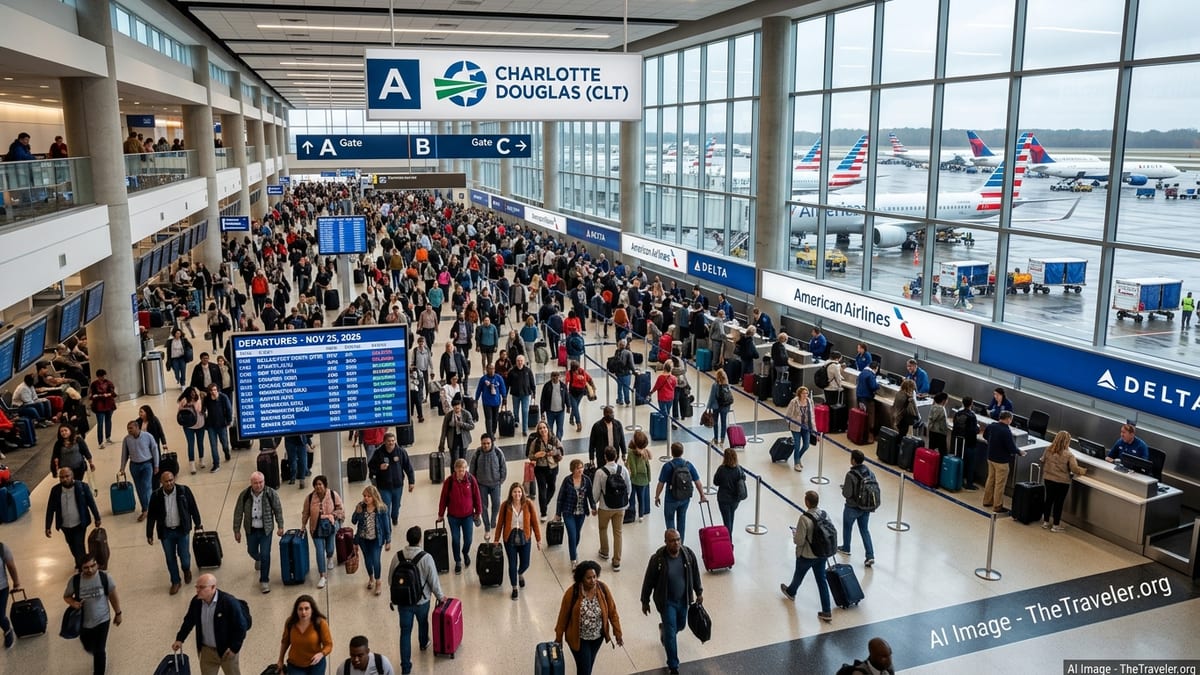
Near‑record crowds despite first dip in Thanksgiving travel since 2020
AAA now projects that 81.5 million people in the United States will travel at least 50 miles from home between Tuesday November 24 and Monday November 30, 2026. That is a marginal 0.1% decline compared with 2025, ending a three year streak of record Thanksgiving travel that began in 2023. Road trips will again dominate, but more than 7% of travelers are expected to fly, a similar share to last year, while about 2.6 million people are forecast to travel by bus, train or cruise, 4.1% more than in 2025.
At major hubs, those national forecasts translate into sustained pressure on airport infrastructure across the week. Charlotte Douglas International expects around 1.9 million passengers to pass through between Thursday November 19 and Tuesday December 1, with its busiest days falling after the holiday as travelers return home. Dallas Fort Worth anticipates more than 120,000 travelers per day on Wednesday, Saturday and Sunday, its three peak days for departures and arrivals. Similar patterns are expected at other connecting hubs including Atlanta, Chicago and Denver, where airline schedules concentrate flights into narrow banks and delays or weather issues in any one region can ripple nationwide.
Recent federal statistics highlight how vulnerable the U.S. system can be during these peak periods even when overall operations are considered successful. An analysis of more than one million Bureau of Transportation Statistics flight records for November and December 2025 found that nearly one in four flights arrived at least 15 minutes late during last year’s Thanksgiving and Christmas seasons, with late arriving aircraft accounting for about 40% of total delay time, airline related issues for roughly one third and weather for a smaller but still significant share. Those patterns suggest that bottlenecks away from a traveler’s origin or destination airport can still produce long waits at the gate during the holiday rush.
Domestic airfares at decade highs as airlines trim capacity
For those who have not yet booked, the cost of flying for Thanksgiving 2026 is markedly higher than in recent years. Hopper’s 2026 Holiday Travel Index and supporting analyses place the average domestic round trip Thanksgiving airfare at approximately 402 dollars, up around 31% or 95 dollars compared with 2025 and the highest level in at least a decade. Separate reporting based on the same dataset notes that Thanksgiving and Christmas airfares have both reached ten year highs, with Christmas round trip fares averaging about 452 dollars, roughly 23% above last year.
Industry capacity decisions and fuel costs are key factors in this year’s pricing. Since early August, U.S. airlines have quietly removed about 3% of domestic seats scheduled to operate between November 25 and December 31, according to aviation analytics firm Cirium. Several carriers, including Southwest, have confirmed that they scaled back earlier capacity growth plans for late 2026 as jet fuel prices remained elevated and demand patterns shifted. When an airline reduces future flights it takes seats out of the market, leaving fewer options to absorb peak holiday demand and making it easier for remaining flights to sell out at higher fares.
The result is a compressed booking window and fewer last minute deals than travelers may remember from pre pandemic years. Data shared by Hopper and summarized by financial planning sites such as NerdWallet indicate that fares for the busiest return days, particularly Sunday November 29, are among the most expensive of the entire year, with some domestic itineraries on that date averaging more than 600 dollars. While prices fluctuate by route and load factor, several consumer and airline sources stress that those still searching for tickets in the days immediately before Thanksgiving are unlikely to see broad based fare drops, and that flexible dates, alternative airports and connecting itineraries are now the main avenues for savings.
Recent tech glitches and stormy forecasts heighten delay concerns
Operational risk rather than sheer traveler volume is emerging as the defining concern for Thanksgiving 2026, following two high profile aviation technology incidents earlier in November. Last week a rare nationwide ground stop, the longest such system wide halt since the September 11 attacks according to the Associated Press, disrupted flights across the U.S. after an issue involving air travel infrastructure. Days later, a separate automated weight and balance system failure at Hartsfield Jackson Atlanta International Airport led the Federal Aviation Administration to temporarily halt all flights bound for Delta Air Lines’ largest hub before operations were restored. Both incidents were resolved, but they highlighted the dependence of the current system on complex, interlinked software and the potential for localized glitches to cascade across the network.
Those tech scares are coinciding with a weather pattern that forecasters say could produce regional travel disruptions on some of the busiest days. The National Weather Service and independent outlets including AccuWeather expect a series of storms to affect both the East and West Coasts in the run up to and just after Thanksgiving. A developing low pressure system off the Southeast coast, which federal meteorologists have said could acquire subtropical or tropical characteristics, is projected to move northward with landfall in the Carolinas around the weekend before Thanksgiving, bringing heavy rain and strong winds to parts of the Mid Atlantic and Northeast. On the West Coast, forecasters are watching Pacific systems likely to deliver rain to coastal California and Oregon and snow at higher elevations.
For air travelers, the most immediate implications are at large coastal and hub airports where strong crosswinds, low visibility or thunderstorms can force ground stops or slow departure rates. Storms in one region frequently delay aircraft and crews needed elsewhere hours later, which was a key takeaway from last year’s federal delay data. Even where local conditions remain dry on the day of travel, impacts from earlier weather or tech issues can still lead to rolling cancellations or long lines for rebooking. Meteorologists currently emphasize that no single coast to coast storm is expected to paralyze travel through Thanksgiving Day itself, but the timing and track of these regional systems will determine whether particular departure peaks, such as Wednesday outbound and Sunday return waves, experience more significant disruptions.
How 2026 compares with previous Thanksgiving travel seasons
While total traveler numbers are expected to fall just short of last year’s record, several features make 2026 distinct within the past decade of Thanksgiving travel. The first is the combination of near record volume with substantially higher prices. AAA’s 81.5 million traveler forecast keeps overall activity close to its pandemic era peak, but the typical domestic air traveler is paying around one third more than in 2025, and considerably more than in 2019, once inflation in ticket prices is accounted for. That stands in contrast to the 2021 and 2022 recoveries, when deep discounting and promotional fares were more common as airlines rebuilt schedules and encouraged passengers to return.
The second difference is in mode choice and schedule design. AAA data show that the share of travelers choosing buses, trains and cruises is rising faster than car or air travel in percentage terms, with a projected 4.1% increase this year over 2025. At the same time, airline schedule cuts since late summer suggest that carriers are placing a higher priority on yield and reliability than on absolute seat counts. The experience of November and December 2025, when roughly a quarter of flights arrived late but massive nationwide meltdowns were largely avoided, appears to be informing those choices. Airlines are entering the 2026 holiday season with somewhat leaner schedules intended to be more resilient, but that also leaves less slack for recovering after major storms or systems failures.
Finally, the backdrop of elevated fuel prices linked to geopolitical tensions, including conflict in Iran, differentiates 2026 from earlier years in which fuel represented a smaller share of airline operating costs. Travel booking platforms and national media analyses note that these fuel dynamics are an important contributor to the ten year high in holiday airfares. For travelers, this means that even if demand eases slightly or economic conditions weaken, there is no guarantee that Thanksgiving 2027 will immediately revert to pre 2020 price patterns, particularly if capacity remains constrained and infrastructure upgrades proceed slowly.
What travelers can realistically expect and how to prepare
Looking ahead through the rest of Thanksgiving week, travelers should expect crowded airports, full flights and limited flexibility on peak days rather than a repeat of the sweeping shutdowns that defined early pandemic or extreme weather events. Current forecasts suggest unsettled conditions on both coasts and largely dry weather across much of the country’s interior on many key travel days, but that outlook can change and regional storms are likely to affect some hubs. The experience of 2025 also shows that delays can accumulate even in largely benign weather if earlier flights run behind schedule, and the recent nationwide ground stop and Atlanta technology outage demonstrate that non weather events remain a live risk.
In practical terms, the combination of high prices, tight capacity and elevated disruption risk means travelers have fewer margins for error. Those who still need to book should be prepared for above average fares, especially for departures on Tuesday and Wednesday and returns on Sunday. Flexible travelers who can leave on Monday or Thanksgiving morning and return on Friday or the following Tuesday are more likely to find lower prices and less crowded flights, a pattern that is consistent across most booking and pricing analyses for this year. Choosing nonstop flights where possible can reduce the number of potential failure points, although these itineraries are often the first to sell out or carry the highest fares.
Once tickets are booked, industry data and recent disruptions point to a few concrete steps that can help mitigate problems without eliminating them. Monitoring weather forecasts not only at origin and destination airports but also at major hubs served by the chosen airline or alliance can provide early warning of likely disruptions. Keeping airline apps updated and opting into notifications allows travelers to receive real time rebooking options if their flight is delayed or canceled, a process some carriers now automate when they expect substantial schedule changes. Finally, arriving at the airport earlier than usual for check in and security, particularly on the mornings of Wednesday November 25 and Sunday November 29, remains a simple way to create personal buffer time in a system that is operating near capacity.