


More news on this day
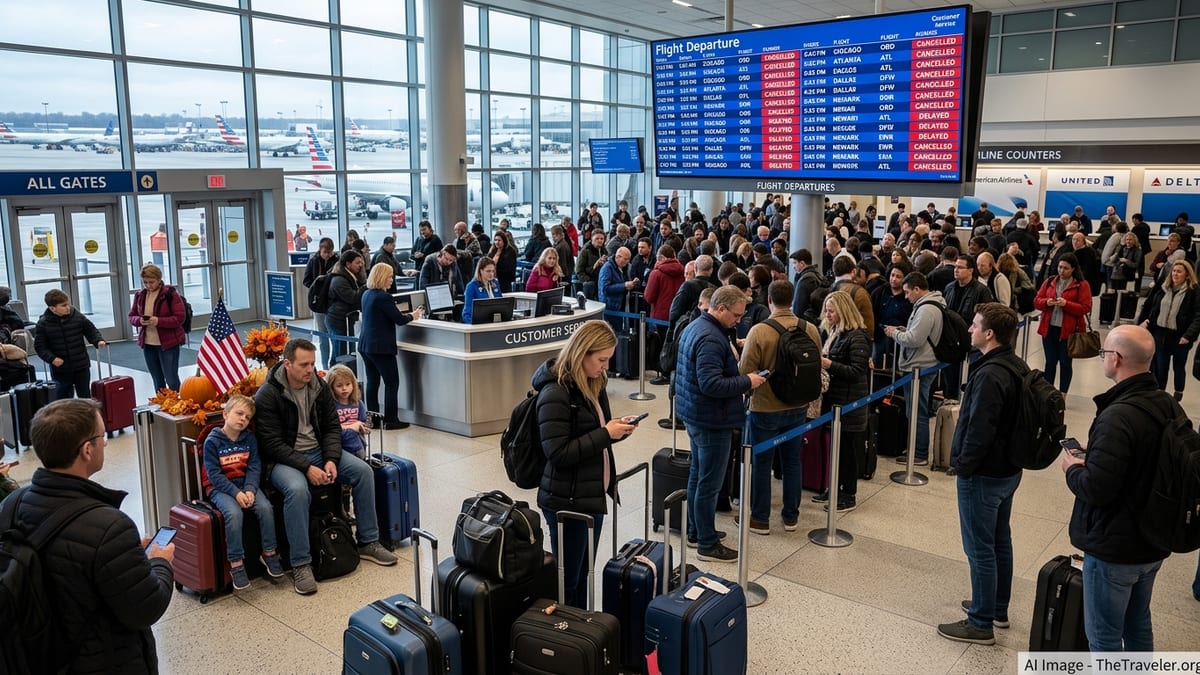
Millions of Americans are heading to the skies for Thanksgiving just days after a nationwide Federal Aviation Administration ground stop and separate technology outages at United Airlines and Delta Air Lines disrupted thousands of flights, raising the risk of knock-on delays during one of the busiest travel weeks of the year.
Get the latest news straight to your inbox!
What has gone wrong in the run-up to Thanksgiving
The most disruptive incident came on Friday, November 13, when the FAA ordered a nationwide ground stop after its telecommunications network became unstable. According to the agency’s own post-incident explanation, a problem linked to new routers being installed by network contractor L3Harris caused data to flood parts of the air traffic control network, forcing officials to halt most departures for about four hours and 45 minutes while they stabilized the system. The FAA later said more than 12,000 flights were canceled between November 13 and 16 as a result, including more than 9,000 cancellations by major U.S. airlines.
Airspace gradually reopened on the evening of November 13, but recovery took much longer. Airports and airlines reported rolling cancellations and missed connections into the weekend as aircraft and crews were repositioned. American Airlines, for example, told customers on November 14 that it was still working through the backlog created by the FAA ground stop, even as flights were once again able to depart.
On Monday, November 16, United Airlines then experienced its own technology problem unrelated to the FAA network. The carrier said a “technology-related issue” affecting systems used for departing flights forced it to hold departures for more than 90 minutes while engineers worked on the problem. United and the FAA both stated there was no indication of a cybersecurity incident. Flights already in the air were able to continue, but the departure freeze created queues and connection problems across United’s network for the rest of the day.
The turbulence continued into the final weekend before Thanksgiving. On Sunday, November 22, Delta Air Lines was hit by an outage in its automated system used to calculate aircraft weight and balance before departure. The airline confirmed that the malfunction required some checks to be conducted manually and acknowledged that more than 1,000 flights were delayed while it restored normal operations. Delta said it aimed to have all delayed flights airborne by Sunday night, but the disruption occurred just as holiday traffic was building.
Separately, on Monday, November 23, the FAA briefly halted some flights bound for Chicago O’Hare International Airport because of air traffic controller staffing constraints in the region. The pause was lifted after the agency adjusted traffic flows, but it added another localized layer of uncertainty for travelers connecting through one of the country’s busiest hubs.
How authorities and airlines are responding
The series of disruptions has triggered an unusually rapid federal response. The White House has said it convened a group of officials from the FAA, the Department of Transportation, the Department of Defense and the intelligence community to examine the nationwide ground stop and identify vulnerabilities in the air traffic control communications network. According to public briefings, this team has been meeting daily since the incident to review technical findings and recommend measures to improve reliability. Officials have stressed that, based on current information, they have found no evidence that the FAA outage was caused by a cyberattack.
Within the FAA, the focus is on the legacy communications equipment involved in the failure and the upgrade program that was underway when the routers malfunctioned. Agency statements and congressional briefings indicate that two facilities, in Amarillo, Texas, and El Dorado, Arkansas, were key to the instability and that engineers are still testing why the new routers behaved differently from similar devices installed elsewhere. The FAA has signaled it will seek additional funding from Congress to accelerate modernization of its network, while also tightening procedures around equipment changes that can affect multiple control centers at once.
Airlines, for their part, have been dealing with two different categories of failure. The FAA outage affected all carriers that rely on federal air traffic control systems, but the subsequent United and Delta disruptions were tied to the airlines’ own technology. United has said its November 16 problem was a technology-related issue limited to its systems for handling departing flights, and it was resolved in roughly an hour and a half. Delta has stated that its November 22 delays were caused by the automated weight and balance system used to generate critical performance data before takeoff and that the underlying fault has been corrected.
Despite those assurances, there is still potential for knock-on effects. Disruptions that occur in the days before a peak travel period can leave aircraft and crews out of position even after the immediate issue is fixed. For travelers, that means some of the strain caused by the mid-November outages could still be visible as tight holiday schedules collide with limited spare capacity in airline fleets and at major hubs.
What current data says about delays and your rights
The Department of Transportation’s latest Air Travel Consumer Report, released on November 19, provides context for reliability heading into this holiday period. Using data from January through September 2026, the report shows that American Airlines and its regional affiliates recorded the highest cancellation rate among the four largest U.S. airline networks, at 2.99 percent of scheduled flights. Delta followed at 2.25 percent, United at 1.75 percent and Southwest at 0.96 percent. Among eight large airline networks tracked in the same comparison, JetBlue had the highest cancellation rate, at 4.08 percent.
On-time arrival performance in the report also varied. For the first nine months of 2026, Southwest recorded the lowest on-time arrival rate among the big four carriers, with 73.1 percent of flights arriving on schedule. American reported an on-time rate of 73.3 percent, United 76.2 percent and Delta 78.3 percent. Across all reporting U.S. airlines, the combined on-time arrival rate for the period was just under 75 percent, slightly lower than the same stretch of 2025. The data predates the mid-November FAA, United and Delta incidents, so it does not yet reflect those specific problems, but it highlights that delays and cancellations were already a significant issue before the latest round of outages.
For passengers affected by future disruptions, federal rules and airline commitments determine what assistance is available. Under existing Department of Transportation policy, U.S. airlines are required to provide a cash refund if a flight is canceled and the passenger chooses not to travel, or if there is a significant schedule change or delay and the traveler declines any rebooking options. For domestic itineraries, a significant delay is generally defined as arriving at least three hours later than originally scheduled. For international trips, the threshold is typically six hours.
Passengers who accept a replacement flight and complete their journey are usually not entitled to a refund of the original ticket price, even if the trip was heavily delayed. In those cases, what travelers can claim depends on whether the disruption is within the airline’s control. When delays are caused by airline-specific issues, such as certain crew or maintenance problems or a malfunction in the carrier’s own IT systems, many major airlines commit to providing meal vouchers, hotel accommodation if an overnight stay is required, and ground transportation between the airport and hotel. When irregular operations are caused primarily by weather, air traffic control restrictions or other factors outside the airline’s control, carriers typically do not provide hotels or meals, even if they rebook affected passengers.
To help travelers compare commitments, the Department of Transportation maintains an online dashboard that summarizes what each U.S. airline has promised to provide in the event of controllable cancellations or significant delays. The chart details whether a carrier offers complimentary rebooking, meal vouchers after a specified delay, hotel rooms when a stay is required and arrangements to rebook on another airline when necessary. These policies do not replace legal rights to refunds when flights are canceled or significantly changed, but they do influence the practical experience when something goes wrong.
Practical steps to reduce your risk of disruption
Given the recent failures, aviation and consumer advocates are recommending that Thanksgiving travelers take extra steps to monitor their flights and build flexibility into their plans. One basic measure is to download the mobile app for the airline operating each segment of your trip and enable notifications. Airlines increasingly push gate changes, estimated departure and arrival times, and rebooking options to their apps before they appear on terminal displays, and travelers who see these updates quickly may have more options to adjust their plans.
Independent flight-tracking tools can also help. Services that allow you to see where the aircraft assigned to your flight is coming from may provide an early warning of potential problems, especially during busy periods when a late arriving inbound aircraft often cascades into a delayed departure. Checking the status of that inbound flight on the airline’s site or app a few hours before departure can provide a more realistic picture than the initial schedule alone.
For travelers who can afford the added cost and complexity, some advocates suggest arranging a backup option on a different airline for particularly critical trips. This usually involves booking a fully refundable ticket on an alternative flight and canceling it once it is clear that your primary itinerary is operating more or less on time. Anyone considering this strategy should read fare rules carefully to confirm refund conditions and cancellation deadlines and be prepared for the temporary impact of holding two reservations on their available credit.
Schedule choices can also reduce exposure to disruption. Where possible, booking nonstop flights removes the risk of misconnecting at a hub if the first leg is delayed. When a connection is unavoidable, leaving a larger buffer between the first and second flights, particularly in the late afternoon and evening when delays tend to accumulate, may cut the risk of an unplanned overnight stay. Travelers with flexibility may wish to choose an earlier departure on their travel day to leave more room for recovery if something does go wrong.
Regardless of itinerary, experts recommend that essential items such as prescription medications, critical documents, a phone charger and at least one change of clothes travel in carry-on luggage rather than in checked bags. This can be particularly important if a disruption forces an unexpected overnight stay away from home or leaves checked bags temporarily separated from passengers.
Protecting yourself financially and avoiding scams
Financial protection and documentation are also key considerations when disruptions are more likely. Many mid-range and premium credit cards include built-in travel protections for eligible trips purchased with the card, such as coverage for certain expenses after a qualifying delay, missed connection or trip interruption. These benefits vary widely by issuer and card type and often exclude some weather-related events, so travelers need to review their card’s specific terms and conditions in advance to understand what is covered and what documentation is required.
Standalone travel insurance can provide additional coverage for delays, cancellations and missed connections, but policies are highly specific about what events are included. Importantly, most insurers will not cover problems that were reasonably foreseeable at the time of purchase. That means coverage generally must be arranged before a particular storm, strike or widely reported system outage becomes public knowledge. Travelers should review policy documents carefully to check coverage limits, exclusions and claim procedures and keep in mind that some protections, such as “cancel for any reason” upgrades, add significant cost.
Whatever form of protection you rely on, keeping records is essential. Passengers are advised to save screenshots of delay or cancellation notifications from airlines, record revised departure and arrival times, and keep all receipts for out-of-pocket expenses such as meals, hotels, ground transportation and incidentals purchased as a direct result of a disruption. These records may be necessary when requesting reimbursement from an airline or making a claim with a credit card issuer or insurer.
Another growing concern is fraud targeting stranded travelers. Officials and consumer advocates report that scammers sometimes create fake airline customer service numbers or social media profiles, then collect payment details from passengers who believe they are speaking to the carrier. To limit this risk, travelers should use only contact details provided directly on the airline’s official website or mobile app and be cautious of phone numbers that appear solely in search engine results or on unofficial third-party sites. Genuine airline representatives do not request payment solely to discuss existing reservations or to process standard rebookings after an airline-controlled delay.
What Thanksgiving travelers should check in the days ahead
With the FAA, United and Delta outages now resolved, there is no indication of an ongoing nationwide system failure, but the underlying issues are still under investigation and schedules are tight. Weather forecasts for the Thanksgiving period will be a major unknown, and any new storm systems affecting major hubs could interact with already stretched operations. Travelers departing between now and Sunday, November 29, should monitor their flights closely starting at least 24 hours before departure and again on the morning of travel.
Before leaving for the airport, it is worth confirming three details: whether your flight is still scheduled and on time, whether there have been any last-minute terminal or gate changes and whether any alerts have been issued for your origin or destination airport. Checking these details directly in the operating airline’s app or on its website reduces the risk of acting on outdated information from third-party services. If a delay appears likely, contacting the airline through its official channels as soon as possible can provide a wider range of rebooking options than waiting to speak with an agent at a crowded gate.
Finally, passengers should keep in mind that performance statistics and recent outages are indicators, not guarantees. Airlines with relatively strong on-time records can still suffer major disruptions from a single system failure, and carriers that have struggled with delays at certain airports may operate smoothly on any given day. In the current environment, preparation and flexibility are more reliable tools than predictions. Building extra time into connections, carrying essentials in hand luggage and knowing your refund and compensation rights in advance can make a significant difference to how manageable any holiday disruption becomes.