


More news on this day
After a rare nationwide Federal Aviation Administration ground stop and separate technology outages at United and Delta in mid‑November, millions of Americans heading to airports for Thanksgiving are being warned to expect potential delays and to prepare concrete backup plans, documentation and protections before they travel.
Get the latest news straight to your inbox!
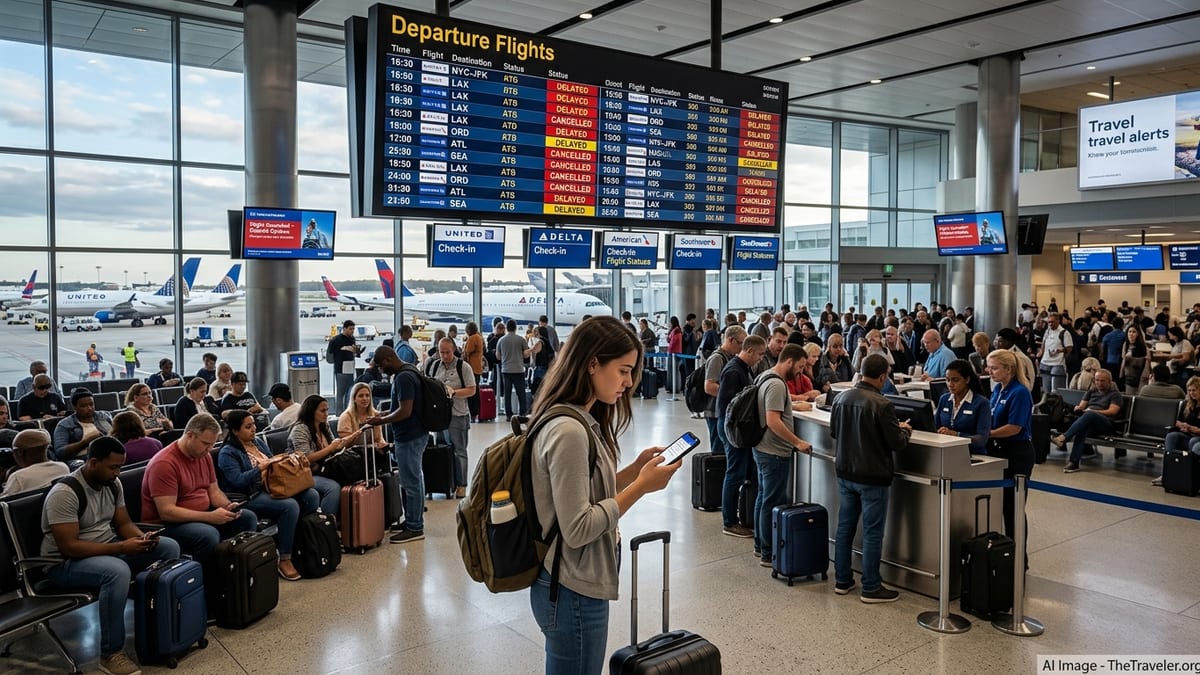
What has gone wrong in the skies ahead of Thanksgiving
The current concern about air travel reliability stems from a sequence of confirmed technology failures that hit the U.S. aviation system between November 13 and November 22, 2026, just as Thanksgiving travel ramps up. On Friday, November 13, the FAA ordered a nationwide ground stop after a failure in its telecommunications network left controllers with an unstable flow of data across the air traffic control system. According to the agency and subsequent congressional research, the order halted most departures for about 4 hours and 45 minutes while engineers worked to restore stable communications.
FAA figures indicate that roughly 12,000 flights were canceled between November 13 and November 16 as the system recovered, with major U.S. carriers accounting for the bulk of those cancellations. The agency says the instability was triggered when legacy equipment could not handle a surge of connection attempts, leading to cascading problems on the network that required shutting down departures nationwide until safety could be assured. The FAA has stressed that it treated the stop as a last resort and that there is no indication of a cybersecurity breach.
On Monday, November 16, United Airlines experienced its own outage unrelated to the FAA incident, temporarily preventing the carrier from providing final weight information for many departing flights. United and federal officials described the disruption as a technology issue affecting systems that support departure operations rather than a security event. The problem lasted for about 90 minutes, during which time many United departures were held at gates. The airline later said there was no sign of a cyberattack and that flights already in the air were unaffected.
Less than a week later, on Sunday, November 22, Delta Air Lines reported a failure in its automated weight and balance system, which calculates how passengers, cargo and fuel are distributed on each aircraft. That outage led to more than 1,000 delayed Delta flights on a single day, according to publicly available flight tracking data, with additional knock-on disruptions into Monday. Delta has said that the automated system was restored and that operations are stabilizing, although some flights are still facing manual processing and residual delays at busy hubs.
How authorities and airlines are responding before the holiday rush
The series of incidents has prompted a fast response from federal transportation officials, who are trying to reassure travelers that the underlying systems are stable while acknowledging the vulnerabilities exposed ahead of one of the busiest travel weeks of the year. The U.S. Department of Transportation has convened a group that includes senior FAA staff and representatives from the Defense Department and intelligence community to review the November 13 ground stop and to identify any remaining weak points in the national air traffic control communications network.
According to the FAA and DOT, that team has been meeting regularly since the ground stop to evaluate how legacy routers and other equipment responded to the burst of network traffic that triggered the outage. Officials say their early focus is on strengthening redundancy in the communications backbone and accelerating longer term modernization projects that are already in progress. The FAA has also signaled to Congress that it will seek additional funding to replace aging systems more quickly, citing the ground stop as evidence that portions of the network remain vulnerable if upgrades are delayed.
At the airline level, carriers involved in the most recent outages say their systems are back online and that they have taken steps to reduce the risk of repeat failures. United has said it identified and corrected the fault that stopped its departure systems from providing final weight figures on November 16 and has emphasized that the incident did not affect flight safety. Delta has reported that its automated weight and balance platform is again functioning and that it is working through remaining backlogs at airports where flights were delayed or canceled over the weekend. None of the major carriers has reported evidence that the November technology problems were linked or caused by outside interference.
Local airport operators have meanwhile been focused on recovery. Several major hubs that saw severe disruption after the FAA ground stop, including Dallas Fort Worth, Chicago O’Hare and Detroit Metro, report that operations have returned to normal scheduling, although some carriers are still repositioning aircraft and crew. Airports are advising Thanksgiving travelers to monitor their flight status frequently and arrive earlier than usual, particularly for early morning departures that may follow overnight equipment checks or schedule adjustments.
What travelers can do now to reduce disruption risk
With federal investigators still analyzing the root causes of the November 13 FAA outage and airlines fine-tuning their own systems, the most practical steps for Thanksgiving travelers involve building flexibility into their plans and ensuring they can react quickly if a schedule changes. Travel advisers strongly recommend that passengers download their airline’s official mobile app, enable push notifications and log in before leaving home. These apps are typically the fastest way for airlines to push new departure times, gate changes and rebooking options when a disruption occurs.
Independent flight tracking sites can add another layer of information. Services that allow passengers to see where the aircraft assigned to their flight is coming from can offer early warning if an inbound leg is significantly delayed. Watching the status of that inbound flight throughout the day helps travelers make more informed decisions about when to leave for the airport or whether to explore backup options if a long delay looks likely.
Choosing flights strategically can also cut the chance of severe disruption. For travelers who have flexibility, booking a nonstop itinerary removes the risk of missing a connection if one segment is delayed. Early morning departures are often less vulnerable to knock-on disruptions because aircraft and crews are already in place from overnight, giving airlines more options to keep schedules intact. On peak travel days, selecting flights that arrive earlier in the day can also provide more rebooking possibilities if something does go wrong, because later flights may still have empty seats.
Some consumer advocates suggest that passengers who are particularly concerned about technology failures consider structured backup plans. One approach involves purchasing a fully refundable ticket on an alternative carrier for the same travel window, then canceling that second ticket if the original flight operates on time. Travelers considering this strategy need to confirm the refund rules, cancellation deadlines and any service fees on the backup fare and be prepared to carry the temporary cost of two tickets until the first trip is completed or canceled.
Understanding your rights and available protections
U.S. Department of Transportation rules give passengers certain baseline rights when flights are canceled or significantly delayed, although the exact remedies can differ depending on the cause of the disruption and the airline involved. Under DOT policy, if a flight is canceled and a passenger chooses not to travel, they are generally entitled to a refund of the unused portion of the ticket, even on nonrefundable fares. That principle also applies when an airline significantly changes the schedule or route and the passenger declines the alternative.
DOT guidance has clarified that a “significant” delay includes arriving at a final destination at least three hours late on a domestic itinerary or at least six hours late on an international route, although carriers retain some discretion and may handle borderline cases differently. Travelers who accept a rebooking and complete their trip typically cannot also demand a refund of the original fare, but they can still ask the airline for additional consideration such as meal vouchers or frequent flyer miles, which are offered at the carrier’s discretion.
What airlines owe beyond a fare refund depends heavily on whether the problem is within the carrier’s control. Issues such as certain mechanical problems, crew scheduling errors or internal technology failures may fall into that category, in which case many airlines commit in their customer service plans to provide meals, hotel accommodations or ground transportation if passengers are stranded overnight. By contrast, delays or cancellations caused primarily by weather, air traffic control restrictions or airport closures are generally considered outside a carrier’s control, and in those cases the airline may not offer hotel rooms or meal vouchers, even though it will still attempt to rebook customers on the next available flight.
Travelers can check the current commitments of individual airlines on the DOT’s public cancellation and delay dashboard, which summarizes what each major U.S. carrier has pledged to do in various disruption scenarios. Because these policies can change, especially after high profile incidents like the November ground stop or significant IT outages, passengers should review the latest version shortly before their trip. It is also important to keep all documentation: screenshots of cancellation notices, records of new itineraries and receipts for hotels, meals and ground transportation can be crucial if a traveler later seeks reimbursement from an airline, files a credit card claim or uses a separate travel insurance policy.
Some credit cards offer built-in trip delay or trip interruption coverage when tickets are purchased with that card, potentially reimbursing reasonable expenses such as lodging and food after qualifying delays that meet a specified minimum number of hours. Standalone travel insurance can provide additional protection, but policies vary widely in what they consider a covered reason, how they define weather or mechanical issues and whether problems related to known events, like an already publicized outage, are excluded. Coverage almost always must be purchased before the specific problem arises, so travelers who want this layer of protection need to arrange it in advance of the holiday period.
Which airlines are canceling the most flights this year
For travelers deciding which carrier to book over Thanksgiving, federal performance data offers a snapshot of how the largest airlines were operating in 2026 before the recent outages. The U.S. Department of Transportation’s November 2026 Air Travel Consumer Report, which compiles results for January through September, shows notable differences in cancellation rates among major airlines and their regional partners. In that period, American Airlines and its affiliated regional network recorded the highest cancellation rate among the four largest U.S. carriers, with just under 3 percent of scheduled flights canceled.
Delta Air Lines posted a cancellation rate a little above 2 percent over the same months, while United Airlines and its partners were below that level. Southwest Airlines, which operates a different point to point network and does not rely on regional affiliates in the same way as the other three, reported a lower cancellation rate for the period. Among a broader group of eight networks that DOT compares, JetBlue had the highest share of canceled flights through September, reflecting ongoing challenges that have persisted into recent years.
On-time performance tells a slightly different story. The same federal data set indicates that Delta had the highest on-time arrival rate among the big four U.S. airlines through September 2026, followed by United, with American and Southwest a few percentage points behind. “On time” in this context means arriving within 15 minutes of the scheduled arrival time, the standard metric used across the industry. Travelers weighing options for Thanksgiving week can treat those historical figures as a rough guide, but they do not incorporate the late November IT failures at United and Delta or any disruptions that may be caused by forecasted holiday weather systems.
It is also important to recognize the limitations of these statistics. The DOT report aggregates performance over nine months, obscuring day to day variation and the impact of specific events such as storms, air traffic control staffing challenges or individual airline outages. A carrier with relatively strong year to date performance can still suffer significant delays during a concentrated period, as United and Delta passengers experienced in mid November. For that reason, travelers should combine long term data with near real time information from airline apps and flight status tools when making final decisions about routes and departure times.
What to watch in the days ahead
Looking ahead to the peak departure days around Thanksgiving, travelers will be dealing with two overlapping sources of potential disruption: the normal risks associated with winter weather and crowded airports, and the lingering effects of November’s network and airline specific outages. Forecasts suggest that storms in parts of the country could add pressure to the system, particularly at large hubs where any ground delay program can quickly ripple through airline schedules. Even when the technology issues that caused earlier disruptions have been resolved, those weather patterns and high passenger volumes can expose any remaining weak points in contingency planning.
Federal officials say the FAA’s telecommunications network is currently stable and that they do not expect a repeat of the November 13 nationwide ground stop. Nevertheless, the agency is urging passengers to stay informed about their flights and to heed any guidance from airlines or airports, especially if bad weather coincides with peak holiday departure windows. Congressional committees are expected to continue reviewing the November 13 incident in the coming weeks, and the FAA has indicated it will publish additional technical details about what happened and how it plans to reduce the risk of similar failures in the future.
For individual travelers, the most practical steps in the days ahead are to reconfirm itineraries 24 hours before departure, monitor flights on the day of travel, keep essential items such as medications, documents, chargers and a change of clothes in carry on bags, and have a clear plan if a long delay or cancellation occurs. That may mean identifying alternative flights in advance, understanding how to contact the airline quickly through its app or messaging channels, or confirming what protections are available through credit cards or travel insurance. With those preparations in place, passengers will be better positioned to navigate any remaining turbulence in the system as the Thanksgiving travel period reaches its peak.