


More news on this day
A nationwide rail strike in Italy from 21:00 on Friday 20 November to 20:00 on Saturday 21 November 2026 caused widespread disruption to both high-speed and regional services on Trenitalia, Trenitalia Tper, Trenord and Italo routes, but the stoppage has now ended and no rail strike is in effect today, Monday 23 November.
Get the latest news straight to your inbox!
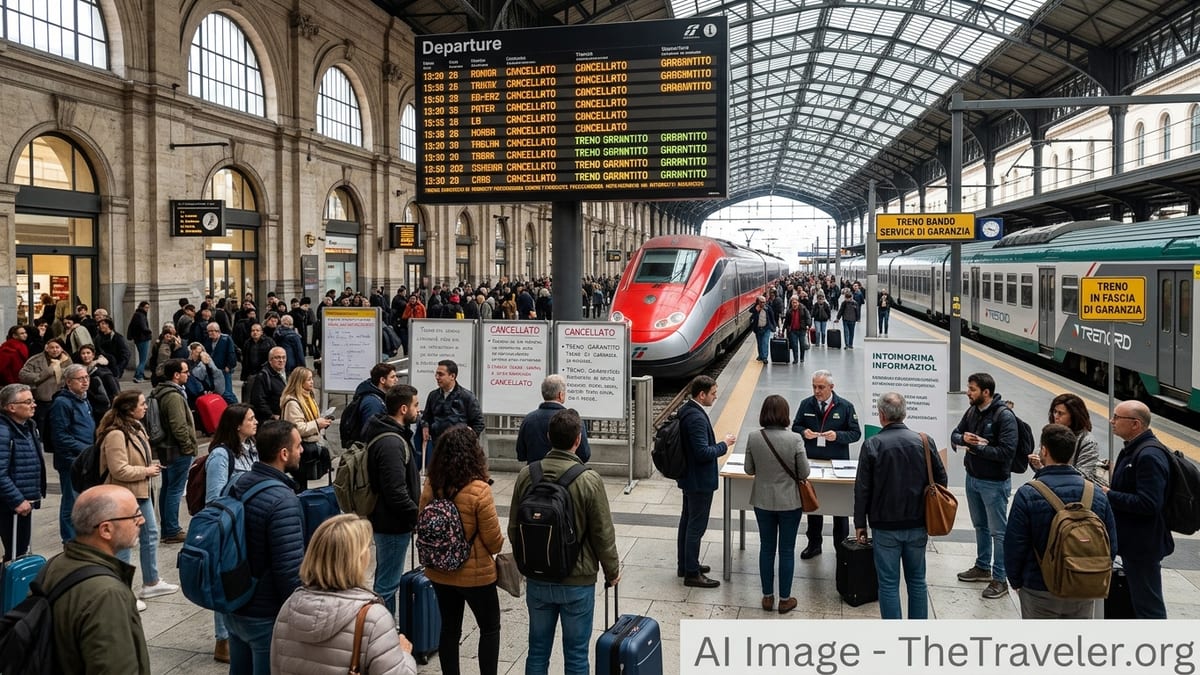
What the 20–21 November rail strike involved
The 23-hour strike was called by autonomous unions CUB Trasporti, CAT and SGB and covered staff of the FS Group, including Trenitalia and Trenitalia Tper, as well as Trenord and private high-speed operator Italo. Official notices from operators and regional transport authorities confirmed that the action ran from 21:00 on Friday 20 November until 20:00 on Saturday 21 November 2026, within the legal framework that requires a minimum level of passenger service.
FS Group and Trenitalia advisories warned in advance that both long-distance and regional trains could be cancelled or altered during the strike window, while stressing that “servizi minimi garantiti” would operate. Similar alerts from regional bodies, such as the Province of Trento and the Province of Bolzano, underlined that passengers should expect cancellations and delays but that key commuter bands on regional routes would still see some trains.
The strike coincided with a broader wave of industrial action in the Italian transport sector in November, but rail stoppages for 20–21 November were organised as a distinct nationwide agitation on the rail network. National media and local outlets reported crowded concourses, reduced timetables and altered train formations on Saturday 21 November in particular, especially on regional lines where staff participation was high.
How “guaranteed trains” worked in practice
In the days before the strike, Trenitalia, Trenitalia Tper and Trenord each published strike notices and detailed lists of “treni garantiti,” while Italo issued its own PDF tables for 20 and 21 November. For Trenord, the list of guaranteed services covered regional, suburban, airport and some longer-distance trains operating in two protected time bands on Saturday 21 November, reflecting the national minimum service rules.
On regional routes, operators highlighted “fasce di garanzia,” typically from 06:00 to 09:00 and from 18:00 to 21:00 on the strike day. Within those bands a core set of commuter and essential services had to run. Outside those windows, many regional trains were either cancelled outright or operated only in part. Traveller reports and regional bulletins on 21 November pointed to heavily thinned service outside the protected bands, with passengers urged to consult live departure boards and operator apps before travelling.
For long-distance and high-speed services, including Frecce and Intercity trains as well as Italo’s NTV services, the approach relied less on time bands and more on specific train numbers. FS Group’s information channels referred customers to national tables of guaranteed long-distance trains, while Italo’s strike notice listed individual departures on 20 and 21 November that would run in any case. Trains not appearing in those lists were not necessarily pre-cancelled but were at higher risk of suppression or delay during the strike.
What travellers experienced on high-speed and regional routes
Early indications from union communiqués and media coverage suggest that many non-guaranteed regional trains were cancelled on Saturday 21 November, especially in the middle of the day outside the 06:00–09:00 and 18:00–21:00 protection bands. In some regions, authorities warned in advance that service on local lines could be limited to the guaranteed trains only, which meant significantly longer waits and more crowded carriages for travellers who did travel.
On the high-speed network, where both Trenitalia and Italo had issued explicit lists of guaranteed trains, a skeleton but structured service pattern was maintained. Selected Frecciarossa and other long-distance trains that appeared in the national “treni garantiti” tables continued to run, and Italo’s published list showed specific trains operating in full or partially along their routes. Nonetheless, cancellation of non-guaranteed trains led to gaps in the timetable and knock-on delays where rolling stock and crews were out of position.
Passengers were repeatedly advised to check real-time updates through official apps, websites and station boards, and many operators offered the option to travel on earlier or later trains where space allowed. Importantly, the strike did not shut down the Italian rail network completely. Minimum services, focused on commuter peaks and selected long-distance links, remained in operation, even though overall capacity was significantly reduced.
Refunds, rebooking and what to do for future strikes
In their strike advisories, Trenitalia and Italo set out specific rules for refund and rebooking when trains were cancelled or delayed because of the 20–21 November action. Trenitalia directed passengers to existing strike policies, which typically allow a full refund without fees or the possibility to rebook for a different date when a train is cancelled or delayed by at least a set threshold due to a strike, though precise options depend on the ticket type and service used.
Italo’s notices stated that for services affected by the strike passengers could request a refund or change their booking, again according to the fare conditions tied to their ticket. In practice, this meant that some travelers were able to shift journeys to non-strike days at no extra cost, while others opted for refunds and alternative transport. Because policies are updated over time and can vary, passengers should always check the latest conditions directly with their specific operator before making changes.
Looking ahead, Italy’s Ministry of Infrastructure and Transport strike calendar and consumer strike-tracking sites indicate that the next nationwide rail stoppage is currently scheduled for early December 2026, with plans at the time of writing pointing to a 3–4 December window. These December dates, and the precise hours and scope, are still subject to confirmation or modification, so travellers planning early-December rail journeys should reconfirm the official calendar and operator advisories close to departure.
Practical tips for travelling during upcoming strikes
For any future rail strike, the most important step for travellers is to consult the official “treni garantiti” lists published by the relevant operator. On Trenitalia, Trenitalia Tper and Trenord, these are available through their strike or information pages and usually distinguish between long-distance and regional services. Italo typically publishes a dedicated PDF showing exactly which train numbers are guaranteed and whether any partial reductions apply.
Understanding the protected time bands is crucial on regional routes. If you must travel on a strike day, try to book or plan journeys that fall within the 06:00–09:00 and 18:00–21:00 “fasce di garanzia,” when at least a minimum regional service should be operating. Outside those windows, especially in the middle of the day, assume that many trains may be cancelled and factor in longer waits or consider postponing your trip.
Travellers who prefer to avoid uncertainty altogether can look at shifting journeys to non-strike days when possible, or consider alternatives such as long-distance coach services, domestic flights on routes with good air links, or short-term car rentals for specific segments. For Monday 23 November 2026 there is no rail strike in effect, and trains are operating under normal timetables, but with further industrial action scheduled for early December, monitoring official channels in the days before travel will remain essential.